
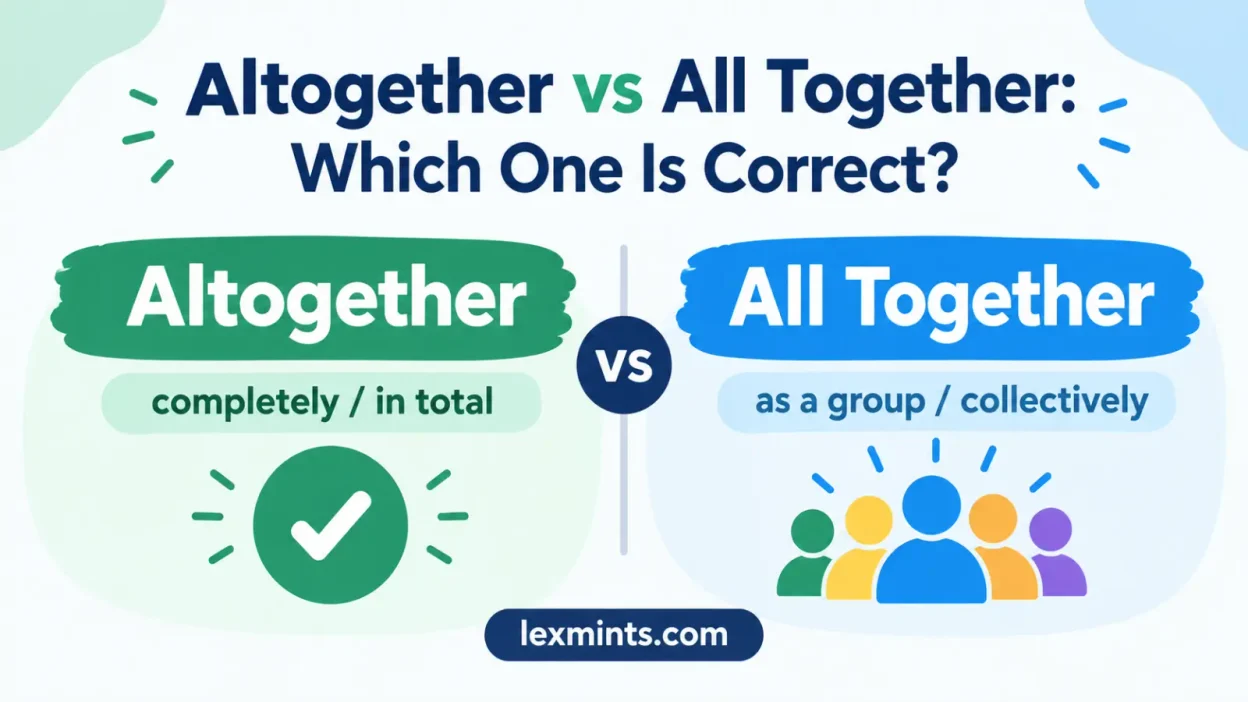
Altogether and all together look almost identical, but they do not mean exactly the same thing. The difference is small in appearance but important in meaning and grammar.
The easiest way to remember the distinction is this:
- Altogether is usually an adverb meaning completely, entirely, or in total.
- All together is a phrase meaning everyone or everything together, often referring to people or things being in the same place or doing something at the same time.
For example:
The plan was altogether unsuccessful.
Here, altogether means “completely.”
Now consider:
The children stood all together for the photograph.
Here, all together means that the children were together as a group.
Understanding this difference can help you choose the correct form in writing, emails, school assignments, professional communication, and everyday American English.
Altogether vs All Together: The Quick Answer
If you need a quick rule, use altogether when you mean completely, entirely, or in total.
Use all together when you mean everyone or everything together.
Examples of “altogether”
- The project was altogether different from what we expected.
- She stopped eating sugar altogether.
- There were ten dollars altogether.
- The situation was altogether confusing.
Examples of “all together”
- The family sat all together at the dinner table.
- Put the books all together on this shelf.
- We sang the song all together.
- The students entered the classroom all together.
A useful test is to ask what you mean. If completely, entirely, or in total fits the sentence, altogether is usually correct. If you mean everyone or everything in one group, all together is usually the right choice.
What Does “Altogether” Mean?
Altogether is one word. It is primarily used as an adverb and has several closely related meanings.
The most common meaning is completely or entirely.
For example:
I decided to quit the project altogether.
In this sentence, the speaker is not saying that several people quit as a group. Instead, the speaker means they quit completely.
Another common meaning of altogether is in total.
For example:
There were 25 guests altogether.
Here, altogether refers to the total number of guests.
It can also mean on the whole or considering everything in certain contexts.
For example:
Altogether, it was a successful trip.
In this sentence, the word introduces an overall assessment of the experience.
Because altogether has more than one related meaning, context is important. However, its meanings are different from the group-oriented meaning of all together.
What Does “All Together” Mean?
All together consists of two separate words: all and together.
It generally means everyone or everything in the same place, at the same time, or as one group.
For example:
The students walked all together to the auditorium.
The phrase describes the students moving as a group.
Another example is:
Let’s say the answer all together.
This means everyone should say the answer at the same time.
The phrase can also describe objects that are gathered or placed in one location.
For example:
Keep all the documents all together in one folder.
In this case, the documents are being kept as a group.
The two-word phrase is especially useful when all modifies a group and together describes the way that group is arranged or acts.
Altogether vs All Together: The Main Difference
The key difference is meaning.
Altogether usually describes the idea of completeness, totality, or an overall amount.
All together describes people or things being together as a group.
Compare these sentences:
I stopped drinking soda altogether.
This means I stopped completely.
We drank soda all together at the party.
This means we drank it together as a group.
The first sentence focuses on completeness. The second focuses on group activity.
Another comparison makes the difference even clearer:
The repairs cost $500 altogether.
This means the total cost was $500.
The workers stood all together near the entrance.
This means the workers stood together in one group.
The spelling difference reflects a genuine difference in usage. Altogether is a single adverb, while all together is a phrase.
When to Use “Altogether”
Use altogether when you mean completely or entirely.
For example:
The new policy changed the process altogether.
The meaning is that the process changed completely.
You can also use it when something is done or removed completely:
She abandoned the idea altogether.
This means she abandoned the idea completely.
Another common use is when talking about a total:
We spent $150 altogether.
Here, altogether means “in total.”
You can also use altogether to introduce an overall conclusion:
Altogether, the event went smoothly.
In this use, the word is similar to “overall” or “all things considered.”
Common “Altogether” Patterns
Several sentence patterns are especially common:
1. Verb + altogether
He stopped smoking altogether.
2. Number or amount + altogether
There were 40 people altogether.
3. Altogether + adjective
The situation was altogether unexpected.
4. Altogether + sentence
Altogether, the results were encouraging.
Learning these patterns makes it easier to recognize when the one-word form is appropriate.
When to Use “All Together”
Use all together when you are talking about people or things being together as a group.
For example:
The entire team gathered all together after the game.
The phrase emphasizes that the team members were gathered in one group.
It can also describe simultaneous action:
Everyone shouted all together.
Here, everyone shouted at the same time.
Another example:
The children counted all together.
The phrase indicates that the children performed the action together.
Common “All Together” Patterns
You may see all together in sentences involving groups, locations, or simultaneous actions.
1. People + all together
The guests stood all together.
2. Objects + all together
Put the pieces all together in the box.
3. Group action + all together
Let’s read the sentence all together.
4. All + noun + together
They packed all the supplies together.
The important idea is that all together has a physical, group, or simultaneous sense.
A Simple Trick to Remember the Difference
One of the easiest ways to remember altogether vs all together is to replace the expression with another phrase.
Try replacing altogether with:
- completely
- entirely
- in total
- overall
If the sentence still makes sense, altogether may be correct.
For example:
She rejected the proposal altogether.
Replace it:
She rejected the proposal completely.
The meaning works, so altogether is appropriate.
Now try:
The players stood all together.
You cannot naturally replace all together with “completely”:
The players stood completely.
That changes the meaning.
Instead, all together means the players stood as a group.
This replacement test is not perfect for every sentence, but it is an excellent quick check for everyday writing.
Altogether Meaning “Completely”
One of the most common uses of altogether is to mean completely.
Examples include:
The experience was altogether unpleasant.
He stopped using the service altogether.
The new design changed the appearance altogether.
She avoided the topic altogether.
In each example, altogether expresses a complete or total change, action, or condition.
This use is common in both formal and everyday English.
However, when writing for a modern American audience, completely or entirely may sometimes sound more direct. That does not make altogether incorrect. It simply means writers can choose the word that best fits the tone.
Altogether Meaning “In Total”
Another important meaning of altogether is in total.
For example:
We invited 30 people altogether.
This means the total number of people invited was 30.
More examples include:
The three purchases cost $85 altogether.
There were six chapters altogether.
The company has 200 employees altogether.
In these sentences, altogether refers to the combined total.
This is one situation where replacing altogether with all together would change the meaning.
Consider:
The tickets cost $100 altogether.
This means the total price was $100.
If you wrote:
The tickets cost $100 all together.
The intended meaning might still be understood in some contexts, but altogether is the standard choice when you mean “in total.”
All Together for People
All together is especially common when describing people acting or gathering as a group.
For example:
The family ate all together.
The students walked all together.
The musicians performed all together.
The children sat all together.
In each sentence, the phrase describes a group of people.
The emphasis is not on totality. Instead, the emphasis is on being together.
This distinction is important because many spelling mistakes happen when writers see the words all and together near each other and automatically combine them.
All Together for Things
Although all together is frequently used with people, it can also refer to objects.
For example:
Keep the receipts all together.
Put the ingredients all together on the counter.
The parts arrived all together.
These sentences describe things being gathered or occurring together.
However, sentence structure matters. Sometimes the natural phrasing is simply all the things together or all together depending on the construction.
For example:
Put all the files together.
This is perfectly natural.
Here, all modifies the files, while together describes where or how the files should be placed.
Altogether vs All Together in American English
Both forms are correct in American English, but they perform different grammatical jobs.
Altogether is a single word and is generally used as an adverb.
All together is a two-word phrase.
American English commonly uses altogether for meanings such as “completely” and “in total.”
For example:
The project cost $2,000 altogether.
American English also uses all together when describing a group:
The employees met all together in the conference room.
The same basic distinction is recognized in standard English more broadly, so this is not simply a difference between American and British spelling.
Common Mistakes With Altogether and All Together
Because the words look so similar, several mistakes are common.
Mistake 1: Using “All Together” for “Completely”
Incorrect for the intended meaning:
I quit the job all together.
If the intended meaning is “I quit completely,” use:
I quit the job altogether.
Mistake 2: Using “Altogether” for a Group
Incorrect for the intended group meaning:
The students sat altogether.
If you specifically mean the students sat as one group, all together is clearer:
The students sat all together.
Mistake 3: Confusing “In Total” With “As a Group”
Compare:
We spent $300 altogether.
This means $300 in total.
Versus:
We went to the restaurant all together.
This means everyone went as a group.
The context determines which form is correct.
Altogether vs All Together Examples
Here are several side-by-side examples to make the distinction easier to remember.
| Meaning | Correct Form | Example |
|---|---|---|
| Completely | altogether | She stopped the project altogether. |
| Entirely | altogether | The situation was altogether unexpected. |
| In total | altogether | We spent $75 altogether. |
| Overall | altogether | Altogether, the plan worked well. |
| As a group | all together | The students worked all together. |
| At the same time | all together | Everyone answered all together. |
| In one group | all together | The family sat all together. |
| Gathered in one place | all together | The supplies were kept all together. |
This table provides a quick reference whenever you are unsure which form to use.
More Example Sentences With “Altogether”
Here are additional examples using altogether correctly:
- The company canceled the project altogether.
- I disagree with that conclusion altogether.
- There were 50 applications altogether.
- The repairs cost $400 altogether.
- She avoided the subject altogether.
- The new evidence changed our understanding altogether.
- The book contains twelve chapters altogether.
- He stopped using social media altogether.
- Altogether, the presentation was effective.
- The proposal was altogether different from the original plan.
Notice how altogether does not mean that multiple people or objects are physically together. Instead, it communicates totality, completeness, or an overall assessment.
More Example Sentences With “All Together”
Here are additional examples using all together correctly:
- The children stood all together for the photo.
- We should sit all together.
- The team celebrated all together after the game.
- Everyone sang all together.
- The students walked all together toward the library.
- Keep the documents all together.
- The guests arrived all together.
- The family gathered all together in the living room.
- The musicians played all together.
- Everyone counted all together.
In these examples, the phrase has a clear connection to a group or simultaneous action.
Can “Altogether” and “All Together” Ever Both Work?
Sometimes both forms can appear in related contexts, but they will not necessarily communicate exactly the same idea.
Consider:
The guests were all together.
This means the guests were together as a group.
Now consider:
The guests were altogether different.
This means the guests were completely different.
The words may appear in similar sentences, but their meanings remain distinct.
Another example:
We completed the tasks all together.
This suggests that we completed them as a group.
We completed the tasks altogether.
This sentence is less natural in many contexts and could be interpreted differently depending on the surrounding text. If the intended meaning is “completely,” another verb construction may be clearer.
The important point is not simply whether both words can occur in a sentence. The real question is what meaning you want to communicate.
Is “Altogether” One Word or Two?
The standard spelling is:
Altogether — one word
When it means “completely,” “entirely,” “in total,” or “overall,” write it as one word.
Examples:
That is altogether too expensive.
There were ten people altogether.
She abandoned the idea altogether.
The two-word form is:
All together — two words
Use it when all and together retain their separate meanings.
Examples:
We stood all together.
They sang all together.
Put the books all together.
Remembering this grammatical distinction is more reliable than memorizing the spelling alone.
Is “All Together” Ever Written as One Word?
Yes, but when it becomes altogether, it is not simply a casual spelling variation of all together. The one-word form has developed into a separate adverb with its own meanings and usage.
Therefore, you should not randomly combine all together into altogether.
Compare:
Everyone stood all together.
The group is standing together.
Versus:
The plan failed altogether.
The plan failed completely.
The difference is semantic, not merely visual.
How to Choose the Correct Form
When you encounter altogether vs all together, follow these steps.
Step 1: Identify the intended meaning
Ask yourself whether you mean:
- completely,
- entirely,
- in total,
- overall,
or whether you mean:
- everyone together,
- everything together,
- in one group,
- at the same time.
Step 2: Try “completely”
If completely fits naturally, choose altogether.
He rejected the idea altogether.
→ He rejected the idea completely.
Step 3: Try “in total”
If in total works, altogether is usually appropriate.
There were 20 people altogether.
→ There were 20 people in total.
Step 4: Look for a group
If the sentence describes people or things acting, standing, sitting, arriving, or being placed as a group, all together may be appropriate.
The students sat all together.
Step 5: Check whether “at the same time” fits
If everyone is doing something simultaneously, all together can work.
Everyone shouted all together.
→ Everyone shouted at the same time.
This simple process can eliminate most confusion between the two forms.
Memory Trick: Total vs Group
A short memory trick can make this distinction easier:
Altogether = total
All together = group
The word altogether contains the idea of a total or complete result.
The phrase all together emphasizes all members being together.
For example:
Ten people came altogether.
Think: ten people in total.
Ten people came all together.
Think: ten people came as one group or at the same time.
Both sentences can be grammatical, but they emphasize different ideas.
FAQs
Is “altogether” one word?
Yes. Altogether is one word when it means “completely,” “entirely,” “in total,” or “overall.”
Is “all together” two words?
Yes. All together is written as two words when it means that people or things are together as a group or are doing something at the same time.
Which is correct: “altogether” or “all together”?
Both are correct, but they have different meanings. Use altogether for “completely,” “entirely,” or “in total.” Use all together for a group or simultaneous action.
Is “altogether” the same as “all together”?
No. Although they look similar, they are not interchangeable in every sentence. Altogether is generally an adverb expressing totality or completeness, while all together is a phrase referring to people or things being together.
How do I remember the difference between altogether and all together?
Use the memory trick “altogether = total” and “all together = group.” If you can replace the word with “completely,” “entirely,” or “in total,” altogether is usually correct. If you mean everyone or everything is together, use all together.
Conclusion
The difference between altogether vs all together becomes simple once you focus on meaning rather than spelling.
Use altogether as one word when you mean completely, entirely, in total, or overall:
We spent $200 altogether.
Use all together as two words when you mean everyone or everything together, as a group, or at the same time:
The whole family sat all together.
The easiest rule to remember is:
Altogether = total or complete.
All together = everyone or everything together.
When you apply that rule and check the meaning of the sentence, you can confidently choose the correct form in American English.


