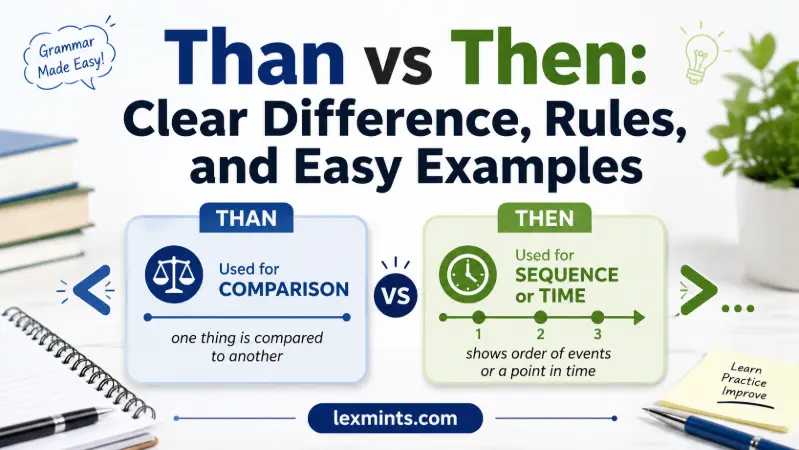
“Than” and “then” look almost identical, and they can sound close in quick conversation. Their jobs, however, are different. “Than” normally connects a comparison, while “then” usually points to time, sequence, or a result.
That difference matters in schoolwork, emails, texts, reports, and everyday writing. Once you identify what the sentence is doing, the choice becomes much easier.
Quick Answer
Use than when you compare people, things, amounts, choices, or qualities: “This laptop is lighter than mine.”
Use then when you mean “at that time,” “next,” or “in that case”: “Finish the form, then send it.” They are both standard English words, but they are not interchangeable.
Why People Confuse Them
The words differ by only one letter. In fast speech, than may also be pronounced with a reduced vowel, so it can sound closer to then than its spelling suggests.
The confusion becomes stronger in sentences about time that still contain a comparison, such as “no later than Friday.” The sentence mentions time, but than is correct because it compares the deadline with Friday.
Key Differences At A Glance
| Feature | than | then |
|---|---|---|
| Main job | Shows comparison | Shows time, sequence, or consequence |
| Common role | Conjunction or preposition | Usually an adverb; also noun or adjective |
| Typical signals | more, less, better, rather | next, after that, at that time, in that case |
| Example | She arrived earlier than I did. | She arrived, then called me. |
The fastest check is simple: comparison = than; time/next/result = then.
Meaning and Usage Difference
Than introduces the second side of a comparison. It often follows comparative words such as better, faster, more, less, or older: “The new route is shorter than the old one.” It also appears in established expressions such as “rather than” and “other than.”
Then most often refers to a point in time or what happens next: “I lived in Denver then” or “We ate dinner, then watched a movie.” It can also show a consequence: “If the office is closed, then we’ll call tomorrow.”
Tone, Context, and Formality
Neither word is inherently more formal. Both belong in casual and professional American English when used correctly.
What changes is the structure around them. Than often appears in comparisons, measurements, limits, and preferences. Then fits timelines, instructions, narratives, and conditional statements. Informal expressions such as “okay then” also use then naturally.
Which One Should You Use?
| Context | Best Choice | Why |
| Comparing two things | than | It introduces the comparison |
| Comparing an amount or number | than | It sets a limit or reference point |
| Expressing a preference | than | It works in structures such as “rather than” |
| Referring to a past or future time | then | It means “at that time” |
| Showing the next step | then | It marks sequence |
| Showing a consequence | then | It can mean “in that case” |
| Making an exception with “other” | than | “Other than” is the standard expression |
When One Choice Sounds Wrong
A comparative form followed by then is usually wrong when you are actually comparing: “faster then,” “more then,” and “better then” should normally be “faster than,” “more than,” and “better than.”
Likewise, than does not normally mark a sequence. “Submit the application, than check your email” should use then because the second action happens next.
Context still matters. “The service was better then” is correct when then means “at that time.”
Common Mistakes (and Quick Fixes)
- Wrong: “The ticket costs more then $50.”
Fix: “The ticket costs more than $50.” - Wrong: “Other then Monday, I’m free.”
Fix: “Other than Monday, I’m free.” - Wrong: “We finished dinner, than drove home.”
Fix: “We finished dinner, then drove home.” - Wrong: “Back than, the store closed at six.”
Fix: “Back then, the store closed at six.” - Wrong: “If traffic is heavy, than take the train.”
Fix: “If traffic is heavy, then take the train.”
Everyday Examples
- My new phone charges faster than my old one.
- We’ll stop for coffee, then head to the airport.
- The package arrived earlier than expected.
- I worked downtown back then.
- She chose the train rather than driving.
- If the meeting runs late, then text me.
- The repair should cost less than $200.
- Since then, the schedule has changed.
- No one other than Maya knew the code.
- Finish your homework; then you can play.
Dictionary-Style Word Details
Verb
than: Not commonly used as a verb in standard US English.
then: Not commonly used as a verb in standard US English.
Noun
than: Not commonly used as a noun in standard US English.
then: Can function as a noun meaning “that time,” especially in expressions such as “since then” and “until then.”
Synonyms
than: Exact substitutes depend on the construction. Closest plain alternatives can include “compared with” or “instead of” in some contexts.
then: Closest plain alternatives include “at that time,” “next,” “afterward,” or “in that case,” depending on meaning.
Example Sentences
than: “This option is cheaper than the monthly plan.”
than: “I’d rather leave early than miss the flight.”
then: “We lived near the beach then.”
then: “Check the address, then place the order.”
Word History
Than and then developed from closely related Old English forms and were historically connected. Over time, their spellings and functions separated. Modern English now gives them distinct jobs: than for comparison and then mainly for time, sequence, and consequence.
Phrases Containing
than: rather than, other than, more than, less than, better than
then: since then, back then, now and then, then and there, and then some
FAQs
Can “than” and “then” ever be interchangeable?
No. In standard American English, they do different jobs. Use “than” for comparisons, preferences, and phrases such as “other than.” Use “then” for time, sequence, or a result. Replacing one with the other usually changes the meaning or creates an error.
Is it “better than” or “better then”?
Use “better than” when you compare two people, things, choices, or situations. For example, “This route is better than the highway.” “Better then” can work only when “then” means “at that time,” as in “The service was better then.”
Should I write “more than” or “more then”?
Write “more than” when “more” introduces a comparison, amount, degree, or limit: “more than ten minutes” or “more than I expected.” “More then” is possible only when “then” independently means “at that time” or “next,” which is much less common.
Does “then” always refer to time?
No. Time and sequence are its most familiar uses, but “then” can also show a consequence or conclusion. In “If the store is closed, then we’ll come back tomorrow,” “then” means roughly “in that case,” not a specific point in time.
Can “than” come before a pronoun such as “me” or “I”?
Yes. Both forms can be correct depending on the sentence structure and intended meaning. “She is taller than me” is standard in everyday English, while “She is taller than I am” makes the implied clause explicit and can sound more formal.
What is the easiest way to remember than vS then ?
Connect “than” with comparison and “then” with time or next steps. Ask what the sentence is doing: comparing, or showing when/what happens next? This quick check handles most cases, while phrases such as “rather than” and “since then” reinforce the pattern.
Conclusion
Use than for comparisons and then for time, sequence, or consequence. That rule covers most everyday cases without oversimplifying the words.
When you hesitate, identify the sentence’s job first. If it compares, choose than. If it tells when, what happens next, or what follows from a condition, choose then.