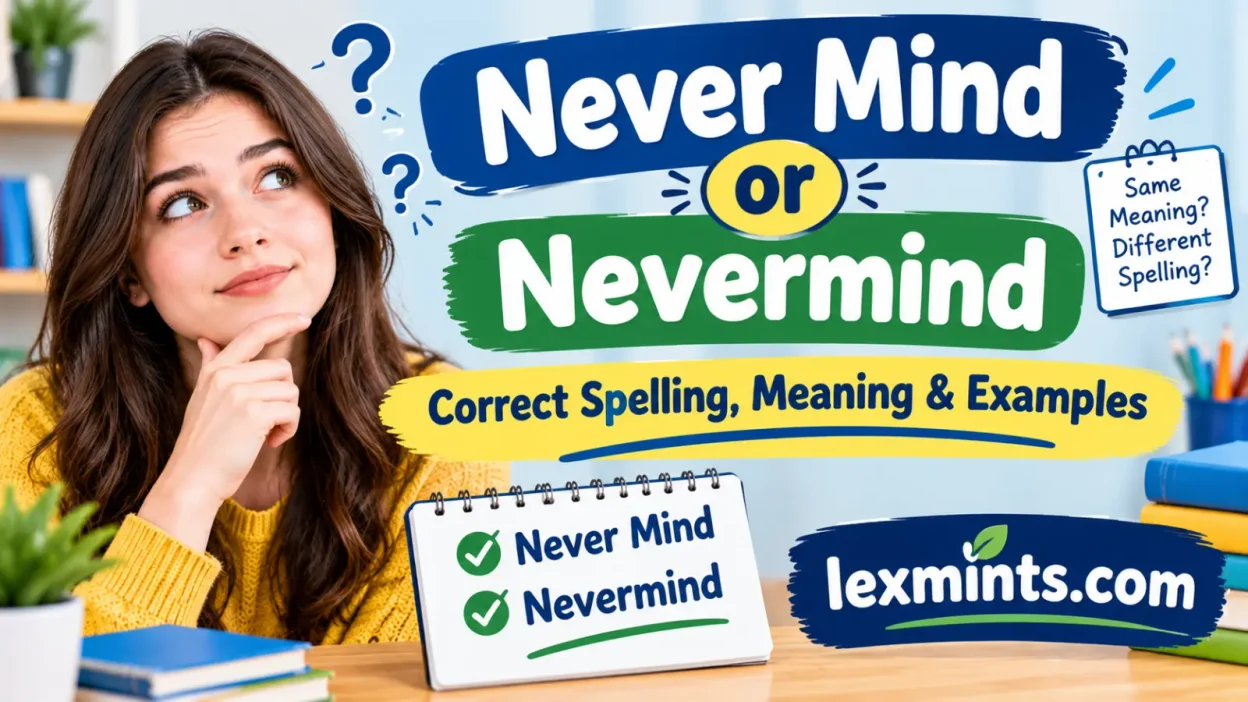
Have you ever typed nevermind in a text message and wondered whether it should be two words? This small spelling question can create confusion in everyday English. Both forms appear in writing, online conversations, song titles, and other media.
However, they do not have exactly the same status. Never mind is the standard expression used in everyday American English. People use it to tell someone not to worry, forget a question, or stop considering something.
The one-word form, nevermind, also appears in English. It has a narrower history and can function as an old-fashioned or regional noun. It is also familiar from popular culture.
Understanding the distinction helps you write more clearly. This guide explains both forms, their meanings, grammatical roles, examples, and common mistakes.
Quick Answer: Never Mind or Nevermind?
Never mind is the correct standard spelling for the everyday expression. Use it when telling someone not to worry, forget something, or disregard a previous statement.
Nevermind is a recognized but less common one-word form. It can function as a dialectal or old-fashioned noun meaning attention or concern.
TL;DR
- Never mind is the standard two-word expression.
- It can mean forget it or don’t worry.
- It can also mean let alone in certain sentences.
- Nevermind is an uncommon noun in regional English.
- Use never mind in professional and academic writing.
- Do not automatically combine the words into one.
What Does Never Mind Mean?
Never mind is an English expression that tells someone something is not important or no longer needs attention. It can also suggest that someone should stop worrying about a situation.
The meaning changes slightly depending on the conversation. It is usually friendly and informal, although it can sometimes sound impatient.
For example:
- Never mind about the mistake. We can correct it.
- Never mind, I’ll handle the problem myself.
- Never mind what they said. Focus on your work.
In each example, the expression tells someone to stop focusing on something.
Never Mind as a Way to Say Don’t Worry
One common meaning is don’t worry about it. People use this expression to comfort someone after a small mistake or disappointment.
Examples:
- “I’m sorry I spilled your coffee.” “Never mind. It happens.”
- “I forgot to bring your notebook.” “Never mind. I have another one.”
- “I’m sorry I arrived late.” “Never mind. You’re here now.”
Here, the expression helps make a conversation less uncomfortable.
Never Mind as a Way to Say Forget It
Another meaning is forget what I just said or asked. Someone might use it after changing their mind or deciding that a question is unnecessary.
Examples:
- Never mind, I found my keys.
- Actually, never mind. I don’t need your help anymore.
- Can you call the office? Never mind, I’ll do it tomorrow.
This usage is common in everyday conversations and text messages.
Never Mind as Let Alone
Never mind can also emphasize that something is even more difficult, unlikely, or surprising than another thing.
In this construction, it has a meaning similar to let alone.
Examples:
- He cannot afford a used car, never mind a new one.
- I barely have time to cook dinner, never mind prepare a full meal.
- She has never visited another state, never mind another country.
The second idea is usually more extreme than the first.
What Does Nevermind Mean?
Nevermind is a one-word form that has a limited place in English. It is mainly recorded as an old-fashioned or regional noun.
As a noun, it can mean attention, notice, concern, or something that matters to someone. It generally appears in older or informal expressions.
Examples:
- Don’t pay him no nevermind.
- It’s no nevermind of yours.
- The matter was treated as no nevermind.
These examples reflect dialectal or old-fashioned usage. They are not suitable for most formal writing.
The word also appears in music, entertainment, and other cultural contexts. For example, Nevermind is the title of a famous 1991 album.
Remember that a title does not establish the standard spelling of an everyday expression.
What Is the Difference Between Never Mind and Nevermind?
The main difference involves spelling, grammatical function, and context.
Never mind is a standard expression with several everyday meanings. Nevermind is a less common noun associated with older or regional English.
| Context | Best Choice | Why |
|---|---|---|
| Telling someone not to worry | Never mind | Standard expression |
| Asking someone to forget something | Never mind | Standard expression |
| Meaning let alone | Never mind | Established phrase |
| Old-fashioned noun meaning attention | Nevermind | Dialectal usage |
| Professional writing | Never mind | Clear and widely accepted |
| Casual text messages | Never mind | Safest spelling |
Examples showing the distinction:
- Correct: Never mind, I already finished the assignment.
- Not standard: Nevermind, I already finished the assignment.
- Dialectal: Don’t pay him no nevermind.
For ordinary writing, choose the two-word version.
How to Use Never Mind Correctly
Use never mind as two separate words in ordinary sentences. Its meaning depends on the words and situation surrounding it.
Here are the most common ways to use it.
Use It to Reassure Someone
When someone apologizes or feels embarrassed, never mind can show that the situation is not serious.
Examples:
- Never mind about the broken glass. Nobody got hurt.
- Never mind the delay. We still have enough time.
- Never mind your small mistake. Everyone makes mistakes.
This use sounds reassuring and friendly.
Use It to Cancel a Request
You can use never mind when you no longer need something you previously requested.
Examples:
- Could you bring me some water? Never mind, I found my bottle.
- Please send me the address. Never mind, I already have it.
- Can you help me with this question? Never mind, I figured it out.
It signals that the earlier request is no longer necessary.
Use It to Change the Subject
Sometimes, people use never mind to move away from an uncomfortable or unnecessary topic.
Examples:
- Never mind what happened yesterday. Let’s discuss today’s plans.
- Never mind the argument. We need to finish our work.
- Never mind that old problem. We have something more important to handle.
This use can sound direct, depending on the speaker’s tone.
When Should You Use Never Mind?
Never mind works in many everyday situations. It is especially useful in conversations where someone needs reassurance or wants to dismiss something.
Consider these common situations:
Everyday conversations: Use it when correcting yourself or changing your mind.
Example: Never mind, I don’t need that information anymore.
Apologies: Use it to tell someone that a small mistake is acceptable.
Example: Never mind. You didn’t know about the change.
Workplace communication: Use it when a previous request is no longer necessary.
Example: Never mind the earlier email. I have sent the updated document.
School and education: Use it when a student decides not to ask a question.
Example: Never mind, I understand the lesson now.
Online messaging: Use it when canceling a request or changing the subject.
Example: Never mind, I’ll message you later.
Although the expression is widely understood, consider your tone. It can sometimes sound dismissive when someone expects a serious answer.
When Should You Avoid Never Mind?
Never mind is not always the best choice. Sometimes, another expression communicates your intention more clearly.
For example, using it in a serious workplace discussion might sound impatient. A more polite sentence can prevent misunderstanding.
Consider these alternatives:
- Instead of “Never mind,” say “Please disregard my previous request.”
- Instead of “Never mind the mistake,” say “There’s no need to worry about the mistake.”
- Instead of “Never mind, forget it,” say “It’s no longer necessary.”
Avoid using nevermind as one word in standard business documents, school assignments, and professional emails.
Also, do not use never mind to replace every expression involving the word mind. For example, “Would you mind helping me?” has a different grammatical structure and meaning.
Part of Speech and Grammatical Function
Never mind is generally classified as an idiomatic expression or phrase. It does not function like an ordinary single-word noun or verb in its standard everyday use.
Its grammatical role depends on how it appears in a sentence.
Never Mind as an Imperative Expression
It often works as an imperative expression. This means the speaker tells someone to stop worrying, disregard something, or leave a matter alone.
Examples:
- Never mind the noise outside.
- Never mind what happened earlier.
- Never mind about the extra cost.
The implied subject is usually “you.”
Never Mind as a Discourse Expression
It can also function as a conversational expression. Speakers use it to change direction, withdraw a question, or respond to disappointing news.
Examples:
- Never mind. I’ll find another solution.
- Oh, never mind. We can discuss it tomorrow.
- Never mind, I understand what you mean.
It helps connect ideas and manage conversations.
Nevermind as a Noun
The one-word form has a separate, limited noun use.
Examples:
- Pay no nevermind to the rumors.
- It was no nevermind of his.
This usage is dialectal or old-fashioned. It should not be confused with the everyday expression.
Common Contexts Where People See Never Mind
People encounter never mind in conversations, entertainment, written messages, and everyday situations.
Understanding these contexts makes the expression easier to recognize.
Text Messages and Social Media
In digital conversations, people often use never mind to withdraw a question or cancel a request.
Examples:
- “Are you coming tonight?” “Never mind, I know you’re busy.”
- “Can you send the picture?” “Never mind, I found it.”
- “Never mind, we can talk tomorrow.”
The expression is natural in casual messages.
Movies and Television
Characters may say never mind when they decide not to explain something or want someone to stop asking questions.
For example:
- Never mind. You wouldn’t understand.
- Oh, never mind. Let’s go home.
- Never mind what I said earlier.
The intended meaning depends on the scene and tone.
Music and Popular Culture
The one-word spelling is recognizable because of Nevermind by Nirvana.
The album’s title uses one word as a deliberate title choice. However, it does not change the standard spelling of the everyday expression.
Common Mistakes When Writing Never Mind
Writers sometimes combine the two words because they sound like one expression. However, pronunciation does not determine standard spelling.
Here are mistakes worth avoiding.
Mistake: Writing nevermind in ordinary sentences
Incorrect: Nevermind, I don’t need your help.
Correct: Never mind, I don’t need your help.
Mistake: Using never mind when another expression is clearer
Unclear: Never mind your previous email.
Clearer: Please disregard your previous email.
Mistake: Confusing never mind with don’t mind
Incorrect meaning: Never mind if you want coffee.
Better: I don’t mind if you want coffee.
These expressions have different meanings. Don’t mind generally means that something does not bother you or that you have no objection.
Mistake: Assuming every dictionary entry makes a form suitable for formal writing
A word can have a recognized regional meaning without being appropriate in every situation.
Use the standard phrase when writing for a broad American audience.
Origin and History of Never Mind and Nevermind
Never mind developed from the ordinary English words never and mind. The expression became established as a way to dismiss a concern or tell someone not to worry.
The one-word noun has a separate historical record. Dictionary sources place its recorded use around the early twentieth century.
Its noun meaning includes attention, notice, and concern. It commonly appears in negative expressions, such as “pay no nevermind.”
The one-word spelling also became widely recognizable through popular culture. Nirvana released its album Nevermind in 1991.
However, the album title is not a spelling rule for ordinary English sentences. The standard expression remains two words. dictionary.com+2
Synonyms and Related Expressions
Never mind has several close alternatives. The best choice depends on the intended meaning and level of formality.
| Expression | Meaning | Context |
|---|---|---|
| Forget it | Stop considering something | Informal |
| Don’t worry | Do not feel concerned | Friendly |
| It’s okay | The situation is acceptable | Reassuring |
| Disregard it | Ignore something | Formal |
| Let it go | Stop focusing on something | Conversational |
| Let alone | Emphasizes a stronger example | Comparative construction |
Examples of Similar Expressions
- Never mind the delay. Don’t worry about it.
- Never mind the old message. Please disregard it.
- Never mind the argument. Let’s move forward.
- He cannot buy lunch, let alone dinner.
These alternatives are not always interchangeable. Choose one that matches your intended message.
Does Never Mind Have an Antonym?
There is no exact opposite of never mind because the phrase has several meanings.
However, certain expressions communicate the opposite idea in particular contexts.
- Pay attention: Opposite of ignoring something.
- Keep worrying: Opposite of reassuring someone not to worry.
- Remember it: Opposite of telling someone to forget something.
- Take it seriously: Opposite of dismissing something as unimportant.
These are contextual opposites, not exact dictionary antonyms.
Never Mind Examples in Everyday English
The following sentences demonstrate how Americans commonly use the standard two-word expression.
At home:
- Never mind the dishes. I’ll wash them later.
- Never mind about dinner. We can order pizza.
- Never mind, I already found my phone.
At school:
- Never mind the question. I understand the answer now.
- Never mind the missing page. The teacher gave us another copy.
- Never mind, I’ll ask after class.
At work:
- Never mind the earlier instructions. Please follow the updated version.
- Never mind the meeting notes. I have already shared them.
- Never mind, we can finish the report tomorrow.
With friends:
- Never mind, let’s watch a movie instead.
- Never mind what he said. Enjoy your evening.
- Never mind, I’ll call you when I arrive.
These examples show why two-word spelling is the safest everyday choice.
Quick Test: Never Mind or Nevermind?
Test your understanding with these short questions.
Choose the correct answer for each sentence.
1. _____, I already found my wallet.
A. Never mind
B. Nevermind
2. Please don’t worry about the mistake. _____.
A. Nevermind
B. Never mind
3. He cannot afford a bicycle, _____ a car.
A. never mind
B. nevermind
4. Which spelling is preferred in professional writing?
A. Nevermind
B. Never mind
5. In older regional usage, which form can mean attention?
A. Never mind
B. Nevermind
Answer Key
- A — Never mind
- B — Never mind
- A — Never mind
- B — Never mind
- B — Nevermind
If you answered all five correctly, you understand the main distinction.
FAQs
Is never mind one word or two words?
Never mind is two words in standard American English. Use this spelling when telling someone not to worry, forget something, or stop paying attention.
Is nevermind ever correct?
Yes, nevermind has a recognized but limited use as an old-fashioned or regional noun. It can mean attention, notice, or concern. However, it is not the standard spelling of the everyday expression.
What does never mind mean in a text message?
In text messages, never mind usually means forget it, don’t worry, or I no longer need what I asked for. For example, “Never mind, I found the information myself.”
Is never mind formal or informal?
Never mind is generally conversational and informal. However, it is widely understood and acceptable in many everyday written situations. In formal communication, “please disregard my previous message” may sound more professional.
Does never mind mean forget about it?
Yes, it can mean forget about it. People use it when withdrawing a question, canceling a request, or deciding that something is no longer important.
Why is Nirvana’s album spelled Nevermind?
Nevermind uses the one-word spelling as its official title. It is a cultural title, not a general spelling rule. The everyday English expression is still written as two words.
What is another word for never mind?
Possible alternatives include forget it, don’t worry, disregard it, and let it go. The best alternative depends on the sentence. For example, “don’t worry” works when reassuring someone.
Conclusion
Never mind is the standard spelling for everyday American English. Use it when telling someone not to worry, forget something, or stop considering an issue.
Although nevermind has limited noun usage, the two-word form is the safest choice. Remember this distinction, and your everyday writing will be clearer and more accurate.