
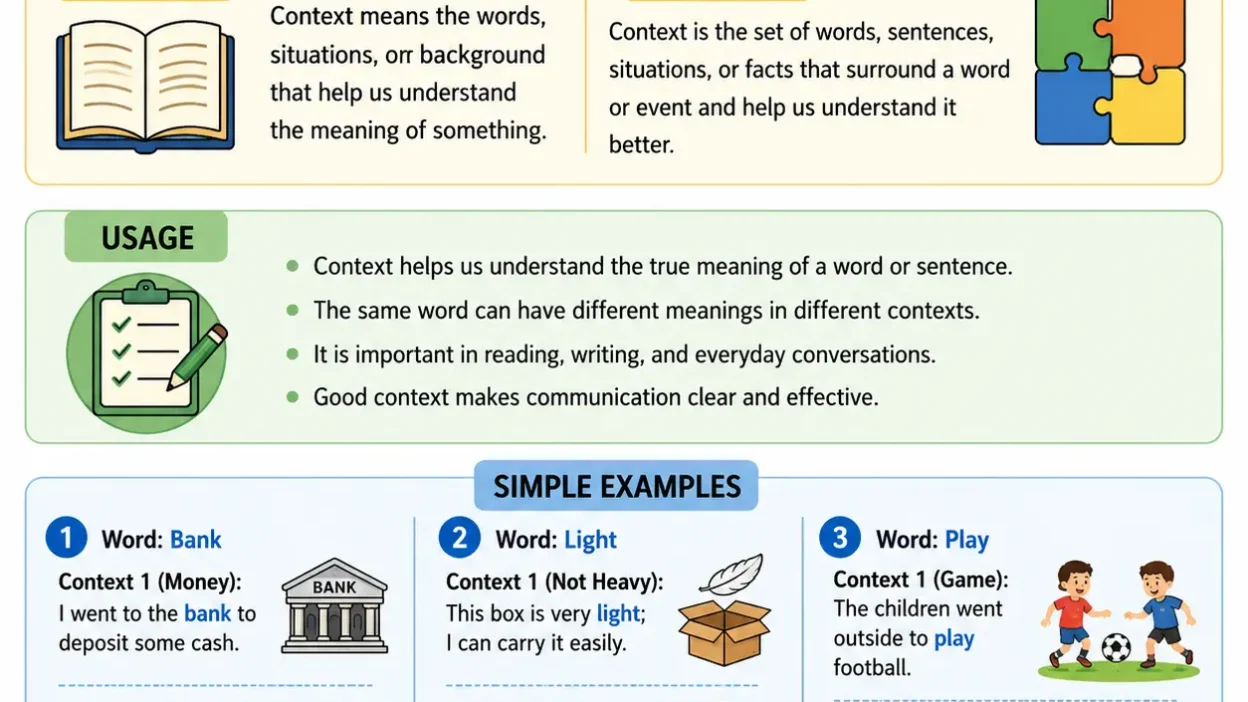
Context helps you understand what a word, phrase, statement, or event really means based on the information around it. The context meaning of something comes from its surrounding words, situation, background, or circumstances, which can change how a message should be understood.
Understanding context matters because the same word or expression can have different meanings in different situations. Without enough context, a sentence may seem unclear, misleading, or easy to misunderstand. Knowing how context works can improve reading, writing, conversation, and vocabulary skills. This guide explains what context means, how it affects meaning, and how to recognize and use it correctly in everyday English.
QUICK ANSWER
Context means the situation or information around a word or event that helps explain its meaning. It shows how and why something is understood in a certain way.
TL;DR
• Context is surrounding information that explains meaning
• It helps words and sentences make sense
• Meaning changes depending on situation
• Used in writing, speech, and reading
• Important for clear communication
WHAT IS CONTEXT?
Context is the background information that helps you understand meaning clearly. It can be the situation, words around a sentence, or the setting where something happens.
In language, context tells you what a word really means. A single word can change meaning depending on where it is used.
Example:
• “Bank” can mean a river side or a money institution
The context decides the correct meaning
DEFINITION IN SIMPLE ENGLISH
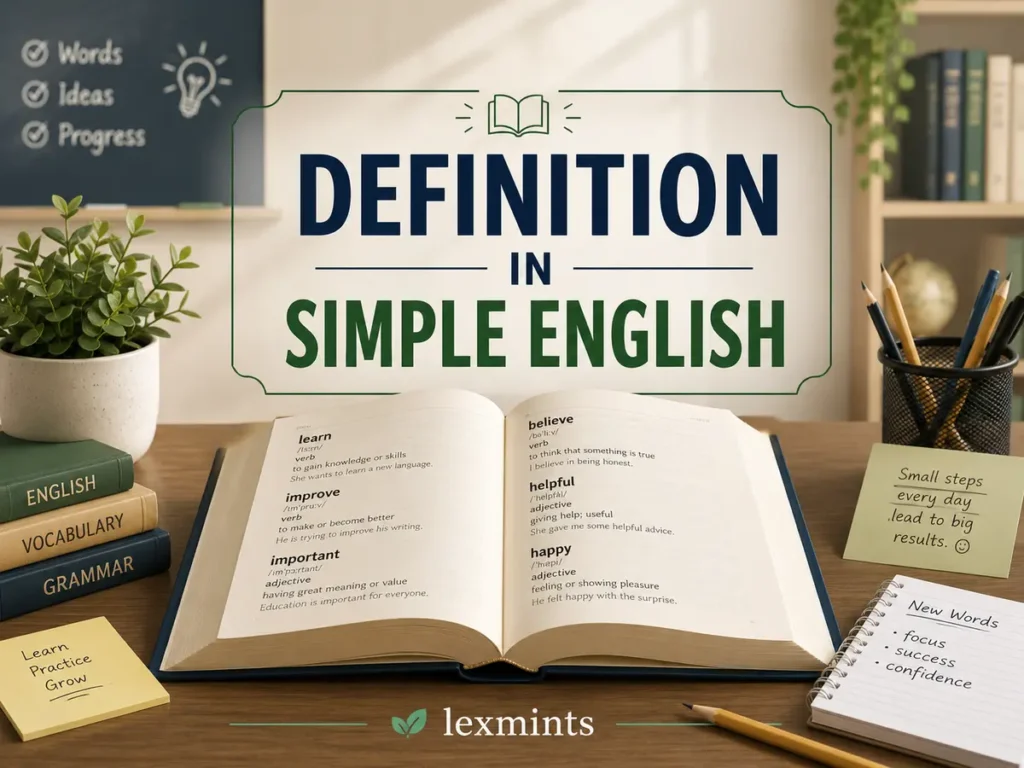
Context is the extra information that surrounds words or events and helps explain their meaning.
It answers questions like:
• Where is this happening?
• What is being talked about?
• Who is involved?
Without context, communication becomes unclear or confusing.
PART OF SPEECH
“Context” is a noun.
It refers to a thing or idea, not an action.
Examples:
• The context of the story is important
• You must understand the context first
TYPES OF CONTEXT
Context is not only one thing. It has different types depending on use.
• Linguistic context: Words around a sentence
• Social context: Situation or people involved
• Cultural context: Traditions or beliefs behind meaning
Each type helps shape understanding in different ways.
HOW CONTEXT CHANGES MEANING
The same word or sentence can mean different things depending on context.
Example:
• “That’s cold”
– In weather: low temperature
– In behavior: rude or unfriendly
Context removes confusion and gives correct meaning.
WHEN CONTEXT IS USED
Context is used every day in:
• Reading books and articles
• Understanding conversations
• Interpreting jokes or sarcasm
• Writing clear messages
Without it, communication often fails.
WHEN NOT TO IGNORE CONTEXT
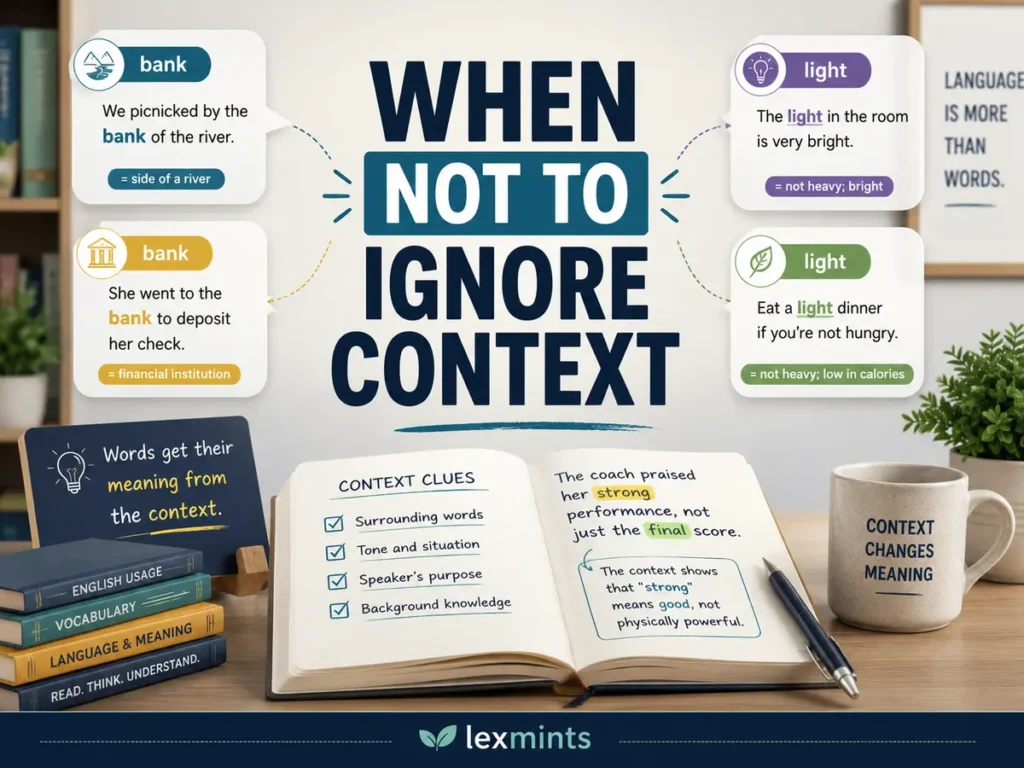
Ignoring context can lead to misunderstandings.
Example mistake:
• Taking sarcasm literally
• Misreading short text messages
Always check surrounding information before deciding meaning.
CONTEXT IN READING (CONTEXT CLUES)
In reading, context clues are hints around an unknown word that help you understand it.
Example:
• “The icy road was slippery and dangerous”
Even if you don’t know “icy,” the sentence explains it is cold and frozen
COMMON MISTAKES
• Thinking one word has only one meaning
• Ignoring situation or background
• Misinterpreting tone in messages
Correction:
Always look at the full sentence or situation before deciding meaning.
SYNONYMS AND RELATED TERMS
Close ideas:
• Background
• Situation
• Setting
• Circumstances
These are not exact replacements but help explain similar ideas.
Source Article URL Source Topic Target Article URL Target Topic Anchor Text Anchor Type Internal Link Sentence With HTML Placement Section Relevance Score /100 Priority Cannibalization Risk Notes
https://lexmints.com/context-meaning/ Context meaning, surrounding information, and interpretation https://lexmints.com/arbitrary-meaning/ Arbitrary meaning, personal judgment, and decisions without clear rules arbitrary decision Partial-Match Contextual Anchor For example, context helps explain why an arbitrary decision is based on personal judgment rather than pure chance. HOW CONTEXT CHANGES MEANING — place after the example explaining how one expression can carry different meanings 92 High No Both pages were accessible and reviewed. This link creates a strong semantic bridge between contextual interpretation and the distinction between arbitrary and random. The target page already links back to the context article, creating a useful reciprocal topical connection.
MINI QUIZ
- What does context help you understand?
- Is context a noun or verb?
- What changes word meaning in different situations?
Answers:
- Meaning of words or situations
- Noun
- Context
However, when the surrounding details still support more than one interpretation, the wording may be ambiguous and require further clarification.
FAQ
What does context mean in English?
It means the situation or information around something that helps explain its meaning.
Why is context important?
It helps avoid misunderstanding and gives correct meaning to words or actions.
What is an example of context?
The word “light” means different things in “light bulb” and “light food.”
What are context clues?
They are hints in a sentence that help you understand unknown words.
Can context change meaning?
Yes, the same word can mean different things in different situations.
Where do we use context?
In speaking, writing, reading, and daily communication.
For example, exploring the different meanings of manifest shows how one word can describe something obvious, an action becoming visible, or a passenger and cargo list depending on the context.
CONCLUSION
Context is a key part of understanding language and communication. It shows how meaning depends on situation, words, and surroundings. Without context, messages can become confusing or misleading.


[…] meaning depends on context. It can stand for “as hell” in informal slang, “age, sex, location” in traditional online […]