
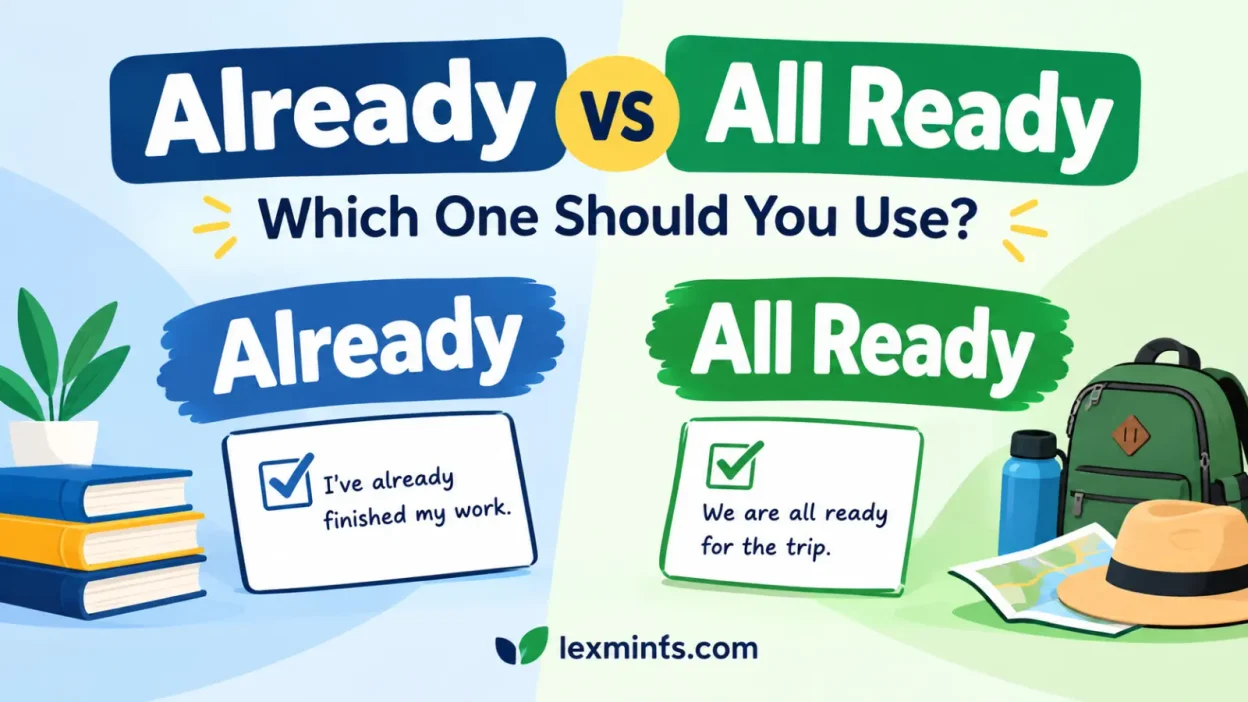
Already vs all ready is a common English usage question because these two expressions sound almost identical when spoken. However, already and all ready have different meanings and grammatical functions.
The easiest way to remember the difference is this:
- Already is one word. It usually means by this time, before now, or sooner than expected.
- All ready is two words. It means completely prepared or fully ready.
For example:
- I have already finished my homework.
- We are all ready to leave.
In the first sentence, already tells us that something happened before now. In the second sentence, all ready describes a state of complete preparation.
Understanding this small difference can help you avoid one of the most common spelling and word-choice mistakes in everyday English.
Already vs All Ready: Quick Difference
The main difference between already and all ready is their meaning.
| Term | Meaning | Example |
|---|---|---|
| Already | By now; before a particular time | I have already eaten. |
| All ready | Completely prepared | We are all ready to go. |
Already is generally an adverb. It modifies a verb or describes when an action has happened.
All ready is a phrase made up of the adjective ready and the word all. It describes people or things that are completely prepared.
Compare these examples:
- She has already left.
- She is all ready to leave.
The first sentence means that she left before now or before the expected time. The second means that she is completely prepared to leave.
What Does Already Mean?
Already is an adverb that generally means before now, by a particular time, or sooner than expected.
It is commonly used when an action has happened before the present moment or before another event.
For example:
- I have already finished the report.
- He already knows the answer.
- They have already arrived.
- She already bought the tickets.
- We already discussed this issue.
In each example, already indicates that something happened or became true before the relevant time.
The word can also express surprise that something happened sooner than expected.
For example:
Is it already midnight?
Here, the speaker is surprised that midnight has arrived so quickly.
Another example is:
You are already home?
This suggests that the speaker expected the person to arrive later.
What Does All Ready Mean?
All ready is a two-word phrase that means completely prepared or fully prepared.
Here, ready is an adjective, while all emphasizes the extent of the readiness.
Examples include:
- We are all ready for the meeting.
- The students are all ready for the test.
- Are you all ready to leave?
- The equipment is all ready for use.
- Everyone is all ready for the presentation.
The phrase all ready can often be replaced with completely ready or fully prepared.
For example:
We are all ready to go.
means approximately:
We are completely ready to go.
This substitution is a useful trick for determining whether you need all ready.
Already vs All Ready in Simple Terms
If you are confused about already vs all ready, ask yourself one simple question:
Am I talking about something that happened before now, or am I talking about being prepared?
If you mean before now or by now, use already.
I have already called him.
If you mean completely prepared, use all ready.
We are all ready for the trip.
This distinction works in most everyday situations.
Already = Before Now
Use already when you are talking about something that has happened before a particular time.
- She has already finished.
- I already know.
- They have already arrived.
All Ready = Completely Prepared
Use all ready when people or things are completely prepared.
- We are all ready.
- The children are all ready for school.
- The bags are all ready for the trip.
Examples of Already
Here are several examples showing how already works in sentences.
Example 1
I have already eaten breakfast.
This means breakfast was eaten before now.
Example 2
She already knows about the change.
This means she knew about the change before the current conversation.
Example 3
They have already completed the project.
The project was completed before the relevant time.
Example 4
We already bought the tickets.
The tickets were purchased earlier.
Example 5
He is already at the office.
He arrived at the office before now.
Example 6
The movie has already started.
The movie started before the current moment.
Example 7
I already told you the answer.
The speaker told the listener earlier.
Example 8
It is already getting dark.
The speaker is pointing out that darkness has begun sooner or earlier than expected.
Examples of All Ready
Now consider examples using all ready.
Example 1
We are all ready for the meeting.
Everyone is completely prepared for the meeting.
Example 2
Are you all ready to leave?
The speaker is asking whether everyone is completely prepared.
Example 3
The children are all ready for school.
The children have everything they need and are prepared to go to school.
Example 4
The guests are all ready for dinner.
The guests are completely prepared for dinner.
Example 5
The documents are all ready for review.
The documents have been prepared and are ready to be reviewed.
Example 6
We are all ready to begin.
Everyone is completely prepared to start.
Example 7
The players are all ready for the game.
The players are prepared to participate.
Example 8
The bags are all ready for the flight.
The bags have been prepared for the trip.
How to Tell the Difference Between Already and All Ready
One of the easiest ways to distinguish these expressions is to look at the words around them.
If already is being used to describe when something happened, already is usually the correct choice.
She has already finished her work.
If the sentence is describing people or things as completely prepared, all ready is appropriate.
The team is all ready for the game.
Another helpful test is to replace all ready with completely ready.
If the sentence still makes sense, all ready may be correct.
For example:
We are all ready to leave.
Replace it:
We are completely ready to leave.
The meaning remains essentially the same.
Now consider:
We have already left.
Replacing already with completely ready produces:
We have completely ready left.
That does not make sense. Therefore, already is the correct form.
Already vs All Ready in Questions
Both expressions can appear naturally in questions, but they ask about different things.
Questions With Already
Already can be used when asking whether something has happened before now.
- Have you already finished?
- Did she already leave?
- Has the meeting already started?
- Are they already here?
These questions focus on timing or whether an action has happened.
Questions With All Ready
All ready can be used when asking whether someone or something is completely prepared.
- Are you all ready?
- Are the children all ready for school?
- Is everyone all ready to go?
- Are we all ready for the presentation?
These questions focus on preparation.
Compare:
Have you already left?
This asks whether the person left before now.
Are you all ready to leave?
This asks whether the person or group is completely prepared to leave.
The difference is significant even though the expressions sound similar.
Already vs All Ready in Everyday Conversation
Both expressions are extremely useful in everyday American English.
Imagine a family preparing to leave for a vacation.
One person might ask:
Are you all ready to go?
This means:
Is everyone completely prepared?
After they leave, another person might say:
We have already left the house.
This means:
We left the house before now.
Another example:
A: Are you all ready for the meeting?
B: Yes. I have already printed the documents.
The first sentence is about preparation. The second is about an action that happened earlier.
This is why the two expressions should not be treated as interchangeable.
Common Mistakes With Already and All Ready
Because already and all ready sound similar, writers sometimes use the wrong form.
Mistake 1: Using All Ready for “By Now”
Incorrect:
I have all ready finished my work.
If the intended meaning is that the work was finished before now, the correct sentence is:
I have already finished my work.
Mistake 2: Using Already for “Completely Prepared”
Incorrect:
We are already to leave.
If the intended meaning is that everyone is completely prepared, use:
We are all ready to leave.
Mistake 3: Confusing “All Ready” With “Already”
Incorrect:
Are you already to go?
Correct:
Are you all ready to go?
The phrase describes preparation, so it needs two words.
Can Already and All Ready Ever Appear in the Same Sentence?
Yes. In fact, a sentence can contain both expressions because they can communicate different ideas.
For example:
We are all ready, and the driver has already arrived.
Here, all ready means everyone is prepared, while already means the driver arrived before now.
Another example:
The students are all ready, but the teacher has already started the lesson.
Again, the two expressions have completely different functions.
This can be a useful way to understand the distinction: already relates to timing, while all ready relates to preparation.
Already vs All Ready With “To”
The word to can make the distinction especially easy to see.
Consider:
We are all ready to leave.
Here, all ready means completely prepared.
You can replace it with:
We are completely ready to leave.
Now compare:
We have already left.
Here, already means that the action happened before now.
A useful pattern is:
all ready + to + verb
For example:
- all ready to go
- all ready to start
- all ready to eat
- all ready to leave
- all ready to begin
However, already can appear in many different grammatical positions because it is an adverb:
- already finished
- already started
- already arrived
- already knew
- already have
- has already happened
Already in Different Tenses
Already is commonly used with several verb tenses.
Present Perfect
I have already finished the assignment.
This indicates that the action has happened before now.
Past Simple
In informal American English, already can also appear naturally with the simple past.
I already finished the assignment.
This is common in everyday US English.
Present Simple
She already knows the answer.
The knowledge exists now and was acquired earlier.
Present Progressive
He is already working on the project.
The action is happening now, and it began earlier than expected or relevant.
Future
Already can also refer to something that will have happened by a future point.
By Friday, they will already have completed the project.
Here, already emphasizes that the completion will occur before the future reference point.
All Ready and Group Meaning
The phrase all ready can sometimes create confusion because all may refer to a group.
For example:
We are all ready to leave.
Here, all means everyone in the group is ready.
Compare that with:
We are already ready to leave.
This sentence is grammatically possible, but it has a different emphasis. Already suggests that the state of being ready exists by now or sooner than expected.
The two sentences can therefore communicate slightly different ideas:
We are all ready to leave.
Everyone is prepared.
We are already ready to leave.
We became ready earlier than expected or by this point.
This distinction shows why context matters.
A Simple Memory Trick
A quick memory trick can make already vs all ready easier to remember.
Think:
Already = earlier
Both ideas relate to something happening before now.
I already know.
Think:
All ready = everyone/everything is prepared
We are all ready.
You can also remember that all ready contains the complete word ready, which directly describes preparation.
When you see all ready, ask:
Is someone or something prepared?
If yes, all ready is likely correct.
When you see already, ask:
Did something happen before now or sooner than expected?
If yes, already is likely the right choice.
Already vs All Ready: Side-by-Side Examples
The following examples make the difference clear.
| Already | All Ready |
|---|---|
| I have already eaten. | We are all ready to eat. |
| She already knows. | The students are all ready. |
| They have already arrived. | They are all ready to leave. |
| He already finished the task. | He and his team are all ready. |
| The movie has already started. | The audience is all ready for the show. |
| We already bought tickets. | We are all ready for the trip. |
| She is already at home. | The family is all ready to go. |
| I already sent the email. | The documents are all ready. |
The left column focuses on something that happened earlier. The right column focuses on preparation.
Is “Already” One Word or Two?
Already is correctly written as one word when it means by now, before now, or sooner than expected.
Correct:
I have already finished.
Incorrect for this meaning:
I have all ready finished.
The two-word form all ready has a separate meaning related to complete preparation.
Correct:
We are all ready.
So, when the meaning is “by now,” write already as one word.
Is “All Ready” One Word or Two?
When you mean completely prepared, the correct expression is all ready, written as two words.
Correct:
We are all ready to go.
Here, all modifies or emphasizes ready.
It should not be written as already when the intended meaning is “completely prepared.”
Compare:
They are already here.
This means they arrived before now.
They are all ready.
This means they are completely prepared.
These are different meanings, even though the pronunciation can make them easy to confuse.
Which Is Correct: Already or All Ready?
Both already and all ready are correct English expressions. The correct choice depends entirely on what you mean.
Use already when you mean:
- by now
- before now
- previously
- sooner than expected
Example:
I have already completed the form.
Use all ready when you mean:
- completely prepared
- fully prepared
- everyone prepared
- everything prepared
Example:
We are all ready for the event.
Therefore, neither expression is universally “more correct.” They perform different grammatical and semantic functions.
FAQs
What is the difference between already and all ready?
Already is an adverb that generally means “by now,” “before now,” or “sooner than expected.” All ready is a two-word phrase meaning “completely prepared” or “fully prepared.” For example, “I have already finished” refers to timing, while “We are all ready to leave” refers to preparation.
Is already one word or two words?
Already is correctly written as one word when it means “by now,” “before now,” or “sooner than expected.” For example, “She has already arrived.” The two-word expression all ready has a different meaning and refers to being completely prepared.
Is it correct to say all ready?
Yes. All ready is correct when you mean “completely ready” or “fully prepared.” For example, “Are you all ready to go?” means “Are you completely prepared to go?”
Which is correct: I am already or I am all ready?
Both can be correct, but they have different meanings. “I am already…” normally means something is true by now or happened sooner than expected, such as “I am already at home.” “I am all ready…” means “I am completely prepared,” as in “I am all ready for the meeting.”
How can I remember the difference between already and all ready?
Use already when you mean “by now” or “before now.” Use all ready when you mean “completely prepared.” A simple memory trick is: already = earlier; all ready = prepared.
Conclusion
The difference between already vs all ready is simple once you focus on meaning.
Already is one word and usually refers to something that happened before now, by a certain time, or sooner than expected.
She has already finished her work.
All ready is two words and means completely prepared.
She is all ready for the meeting.
Remember this quick formula:
Already = by now
All ready = completely prepared
If you can replace the phrase with “by now” or “before now,” choose already.
If you can replace it with “completely ready” or “fully prepared,” choose all ready.
Once you understand that distinction, choosing between these two expressions becomes much easier in writing and conversation.


