
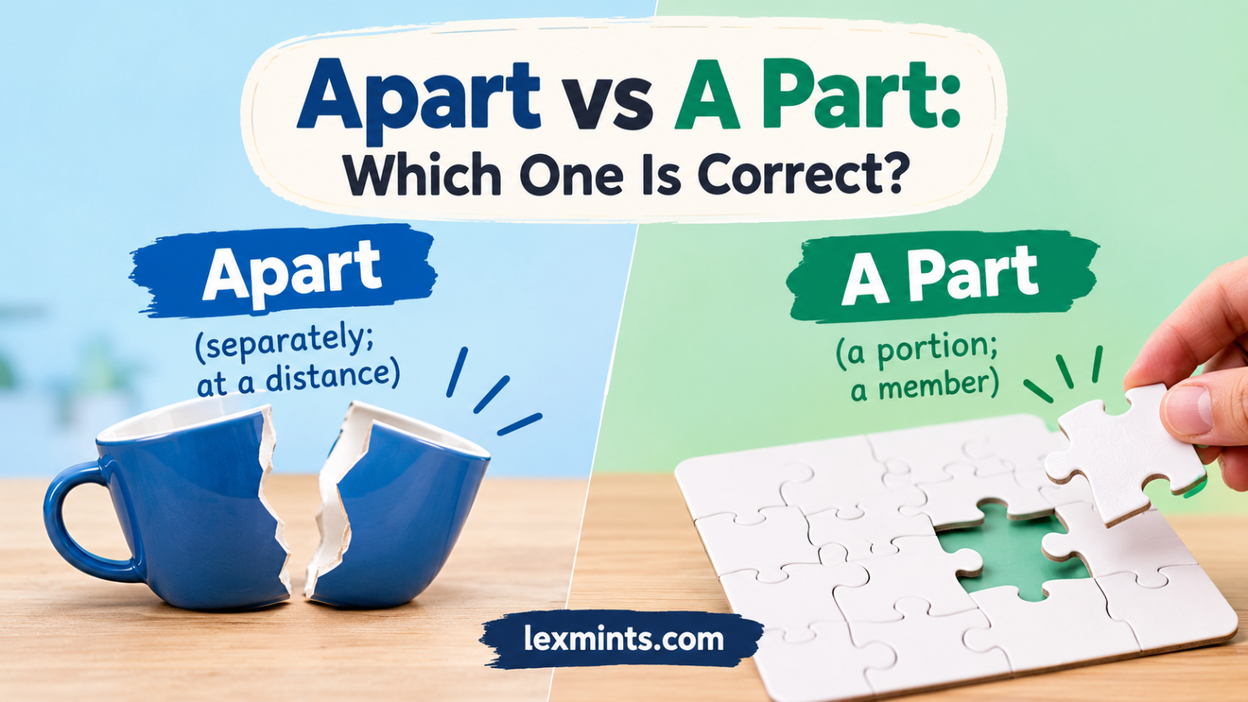
If you are confused about apart vs a part, you are not alone. These two expressions look and sound similar, but they have different meanings and grammatical functions. Choosing the wrong one can change the meaning of a sentence completely.
The good news is that the difference is easy to understand once you know what each form means.
Apart is usually an adverb or adjective that describes things being separated, distant, or different. A part is a noun phrase that means one piece, section, member, or portion of something larger.
For example:
- The two houses are far apart.
- She is a part of our team.
In the first sentence, apart means separated by distance. In the second sentence, a part means one member of a larger group.
This guide explains apart vs a part, including their meanings, grammar rules, common mistakes, examples, and simple ways to remember which form to use.
Apart vs A Part: The Quick Answer
The easiest way to understand apart vs a part is to focus on their meanings.
| Word or Phrase | Meaning | Common Function | Example |
|---|---|---|---|
| apart | separated, away from each other, or separately | Adverb/adjective | The chairs were placed far apart. |
| a part | one piece, section, or member of something | Noun phrase | He is a part of the organization. |
Use apart when you mean separated, away, or individually.
Use a part when you mean one piece or one member of a larger whole.
Compare These Examples
The twins live apart.
Here, apart means they live separately.
The twins are a part of the same family.
Here, a part means they belong to or are included in the same larger group.
The space between the words matters because it changes the meaning.
What Does Apart Mean?
Apart generally means separated from something or someone else. It can describe physical distance, emotional separation, differences, or the way something is divided.
For example:
- The children sat apart from each other.
- Keep the two documents apart.
- The old friends have grown apart.
- The machine was taken apart for repairs.
- The two opinions are far apart.
In each case, apart communicates some idea of separation or distinctness.
Apart as an Adverb
The most common grammatical role of apart is as an adverb.
Examples include:
- The students stood apart.
- The two buildings are several miles apart.
- The pieces fell apart.
- They decided to live apart.
- The argument pulled the group apart.
In these sentences, apart modifies an action or describes a relationship between things.
Apart Can Also Mean Separately
Sometimes apart means that something is considered separately rather than together.
For example:
The two issues should be considered apart.
This means the issues should be considered separately.
Another example:
Their personal and professional lives should be kept apart.
Here, apart means separate from each other.
What Does A Part Mean?
A part consists of the article a plus the noun part. It means one piece, section, element, or member of something larger.
For example:
- I am a part of the team.
- This chapter is a part of the book.
- Every employee is a part of the company.
- The engine is a part of the machine.
- She played a part in the project.
The word part refers to something that belongs to a larger whole.
A Part as a Noun Phrase
Because a part contains the noun part, it functions as a noun phrase.
Consider this sentence:
This section is a part of the report.
The word part identifies one section of the larger report.
Similarly:
He wants to be a part of the community.
Here, a part refers to membership or inclusion.
Apart vs A Part: The Main Difference
The central difference between apart and a part is simple:
Apart = separated
A part = one piece or member of something
Compare:
The books are apart on the shelf.
This means the books are separated from each other.
Now compare:
This book is a part of the collection.
This means the book belongs to the larger collection.
The meanings are completely different even though the words sound similar when spoken quickly.
Another Easy Comparison
The two friends moved apart.
They became separated.
The two friends are a part of the same organization.
They are members of the same organization.
Understanding this basic distinction will help you avoid most apart vs a part mistakes.
When to Use Apart
Use apart when you are talking about separation, distance, or something being divided.
1. Physical Separation
Use apart when people or objects are physically separated.
Examples:
- Place the chairs two feet apart.
- The houses are far apart.
- The children stood apart.
- Keep these chemicals apart.
- The two cars were parked several spaces apart.
2. Emotional Separation
Apart can also describe people becoming emotionally or socially separated.
Examples:
- The disagreement drove them apart.
- They have grown apart over the years.
- The experience pulled the family apart.
- Distance kept the couple apart.
3. Taking Something Apart
One very common expression is take apart.
To take something apart means to separate it into pieces.
Examples:
- The mechanic took the engine apart.
- She took the toy apart to see how it worked.
- We need to take the machine apart before repairing it.
Here, apart clearly indicates separation into individual pieces.
4. Falling Apart
Another common expression is fall apart.
It can mean physically breaking into pieces or emotionally becoming unable to cope.
Examples:
- The old chair is falling apart.
- The box fell apart in the rain.
- His plan began to fall apart.
- She felt like everything was falling apart.
When to Use A Part
Use a part when you mean one component, section, element, or member of a larger whole.
1. Membership
Use a part to describe being included in a group.
Examples:
- She is a part of our team.
- I am proud to be a part of this community.
- He wants to become a part of the organization.
- They are a part of the school program.
2. A Portion of Something
Use a part when you mean one portion of something larger.
Examples:
- This is a part of the final report.
- The kitchen is a part of the house.
- The introduction is a part of the article.
- This chapter is a part of the larger story.
3. A Component
Use a part when discussing a component of a machine, system, or object.
Examples:
- The battery is a part of the device.
- This small component is a part of the larger system.
- The wheel is a part of the bicycle.
In these examples, part means a component or section.
Apart vs A Part in Sentences
Looking at the two forms side by side makes the distinction easier.
Apart
The two teams were kept apart.
Meaning: The teams were separated.
A Part
Each team is a part of the tournament.
Meaning: Each team is one component or participant in a larger event.
Apart
The children sat apart during the activity.
Meaning: They sat separately.
A Part
Each child was a part of the activity.
Meaning: Each child participated in or belonged to the activity.
Apart
The old book fell apart.
Meaning: The book broke into pieces.
A Part
This page is a part of the old book.
Meaning: The page is one section of the book.
Is Apart One Word?
Yes. Apart is normally written as one word when it means separated, away from each other, or separately.
Correct:
The houses are far apart.
Incorrect:
The houses are far a part.
The second version changes the grammatical structure and does not express the intended meaning.
Similarly:
- Keep them apart.
- They live apart.
- The pieces came apart.
- The two groups were separated and kept apart.
When the meaning is separation, use the single word apart.
Is A Part Two Words?
Yes. A part is written as two words when a is the article modifying the noun part.
Examples:
- She is a part of the team.
- This is a part of the process.
- He played a part in the decision.
- Every detail is a part of the design.
You can usually recognize a part because part is functioning as a noun.
A useful test is to replace a part with phrases such as one piece, one section, or one member.
For example:
She is a part of the team.
You could say:
She is one member of the team.
That confirms that a part is appropriate.
The Common Phrase “A Part Of”
One of the most common uses of a part is in the phrase a part of.
It means that someone or something belongs to or constitutes one portion of a larger whole.
Examples:
- He is a part of the team.
- This is a part of the process.
- Education is a part of personal development.
- The kitchen is a part of the house.
- She wants to be a part of the project.
However, there is an important nuance.
In many sentences, part of without a is also natural and often more concise:
She is part of the team.
This means essentially the same thing as:
She is a part of the team.
The version without a is extremely common in modern English.
“Part Of” vs “A Part Of”
Because apart vs a part is commonly confused, it is worth looking at part of as well.
Both of these can be grammatical:
I am part of the team.
I am a part of the team.
The first is often more direct and natural when talking about membership or inclusion.
The second emphasizes the idea of being one component or member of a larger whole.
For example:
Your feedback is part of the process.
This simply says that the feedback is included in the process.
Your feedback is a part of the process.
This can place slightly more emphasis on feedback as one component among several.
The exact nuance depends on context.
Apart vs A Part: Common Mistakes
The similarity in pronunciation causes several common mistakes.
Mistake 1: Using A Part for Separation
Incorrect:
The two buildings are far a part.
Correct:
The two buildings are far apart.
Why? Because the sentence describes distance between the buildings.
Mistake 2: Using Apart for Membership
Incorrect:
She is apart of the team.
Correct:
She is a part of the team.
Or more naturally:
She is part of the team.
Why? Because the sentence describes membership, not separation.
Mistake 3: Confusing “Take Apart” With “Take A Part”
These have different meanings.
The technician will take the machine apart.
This means the technician will disassemble the machine.
But:
The technician will take a part from the machine.
This means the technician will remove one component from the machine.
The meanings are very different.
How to Remember Apart vs A Part
A simple memory trick can make this distinction easy.
Remember: Apart = Away
The word apart contains the idea of things being away from each other.
Think:
apart = separated
Examples:
- Stand apart.
- Live apart.
- Keep apart.
- Pull apart.
- Fall apart.
Remember: A Part = A Piece
Think:
a part = a piece
If you can replace the phrase with a piece, a section, or a member, use a part.
For example:
This component is a part of the machine.
Think:
This component is a piece of the machine.
That makes the correct form easier to identify.
Apart vs A Part: Examples in Everyday English
Here are several examples that show how native US English speakers use these forms.
Examples With Apart
- The two stores are several blocks apart.
- Keep the files apart until we organize them.
- The children sat apart from the adults.
- The old shoes are beginning to fall apart.
- The disagreement pushed the friends apart.
- The two ideas are worlds apart.
- The shelves are six inches apart.
- The pieces came apart during shipping.
- The couple decided to live apart.
- The two events happened years apart.
Examples With A Part
- She is a part of the team.
- This chapter is a part of the book.
- The battery is a part of the system.
- He played a part in the project.
- Everyone wants to feel like a part of the community.
- This section is a part of the agreement.
- The roof is a part of the building.
- Her role was a part of the overall plan.
- This tradition is a part of the culture.
- Each employee is a part of the organization.
Apart vs A Part in Formal Writing
Both forms are appropriate in formal writing when used correctly.
Apart is common when discussing separation, differences, distance, or independent treatment.
For example:
The two variables should be analyzed apart.
A part is appropriate when referring to a component or element.
For example:
Each section represents a part of the overall argument.
In academic, professional, and business writing, choosing the correct form is important because the meaning can change significantly.
Apart vs A Part in Professional Communication
Business writing frequently uses both expressions.
Apart
The departments operate apart from one another.
This means the departments operate separately.
A Part
Each department is a part of the larger organization.
This means each department belongs to the larger organization.
Notice the contrast:
apart emphasizes separation.
a part emphasizes inclusion.
This is one of the easiest ways to remember the difference.
Can Apart and A Part Be Used in the Same Sentence?
Yes. In fact, using both in the same sentence can clearly demonstrate their different meanings.
For example:
Although the departments work apart, they are still a part of the same company.
Here:
- apart = separately
- a part = members/components of a larger organization
Another example:
The two buildings stand apart, but each is a part of the same complex.
Again, the first form describes separation, while the second describes membership in a larger whole.
Apart vs A Part: Quick Grammar Test
When you are unsure which form to use, ask yourself one question:
Am I talking about separation or membership/one piece?
If the answer is separation, choose apart.
The students stood apart.
If the answer is one piece, section, or member, choose a part.
Each student is a part of the class.
Another useful test is to substitute the word separately.
If separately makes sense, apart is probably correct.
They worked apart.
→ They worked separately.
If one piece or one member makes sense, a part is probably correct.
She is a part of the team.
→ She is one member of the team.
Apart vs A Part: Which One Should You Use?
The correct choice depends entirely on the intended meaning.
Use apart when you mean:
- separated
- away from each other
- separately
- divided
- at a distance
- into pieces
- emotionally separated
Use a part when you mean:
- one piece
- one section
- one component
- one member
- one element
- a portion of a larger whole
Simple Rule
Apart = separate
A part = one piece of a whole
If you remember this rule, most apart vs a part questions become straightforward.
Frequently Asked Questions About Apart vs A Part
Is “apart” one word or two?
Apart is one word when it means separated, distant, or separately.
Example:
The two friends live apart.
Is “a part” always two words?
Yes, when you are using a as an article before the noun part, it is written as two words.
Example:
She is a part of the organization.
Is “apart of” correct?
Usually, no. When you mean membership or inclusion, the correct expression is a part of or, often more naturally, part of.
Correct:
She is a part of the team.
Also correct:
She is part of the team.
Incorrect for this meaning:
She is apart of the team.
What is the difference between “apart” and “a part”?
Apart means separated or away from each other. A part means one piece, section, or member of a larger whole.
For example:
The houses are far apart.
This house is a part of the neighborhood.
Which is correct: “I am apart of the team” or “I am a part of the team”?
I am a part of the team is correct. I am part of the team is also correct and very common.
I am apart of the team is incorrect when you mean membership.
5 Strong SEO FAQs
1. What is the difference between apart and a part?
Apart means separated, distant, or separately, while a part means one piece, section, component, or member of a larger whole. For example, “The houses are far apart” describes separation, while “She is a part of the team” describes membership.
2. Is it correct to say “apart of the team”?
No. When you mean membership, the correct forms are “a part of the team” or “part of the team.” For example: “She is a part of the team.”
3. Is “apart” one word or two?
Apart is one word when it means separated or away from each other. For example: “The two buildings are several miles apart.”
4. Should I use “a part” or “apart”?
Use apart when you mean separated or independently. Use a part when you mean one piece, section, or member of something larger. For example, “The chairs are far apart” but “He is a part of the organization.”
5. Is “part of” the same as “a part of”?
In many contexts, part of and a part of have essentially the same meaning. “She is part of the team” and “She is a part of the team” are both grammatical. Part of is often more concise and natural.
Conclusion
The difference between apart vs a part is mainly a difference in meaning.
Apart is used when things are separated, distant, divided, or considered separately.
The two offices are located far apart.
A part is used when something is one piece, section, component, or member of a larger whole.
This office is a part of the company.
The quickest way to remember the difference is:
Apart = separated
A part = one piece of a whole
When you mean that people or things are separate, use apart. When you mean that someone or something belongs to a larger group or is one component of something bigger, use a part.
Once you focus on the meaning rather than the similar pronunciation, choosing between these two forms becomes much easier.


