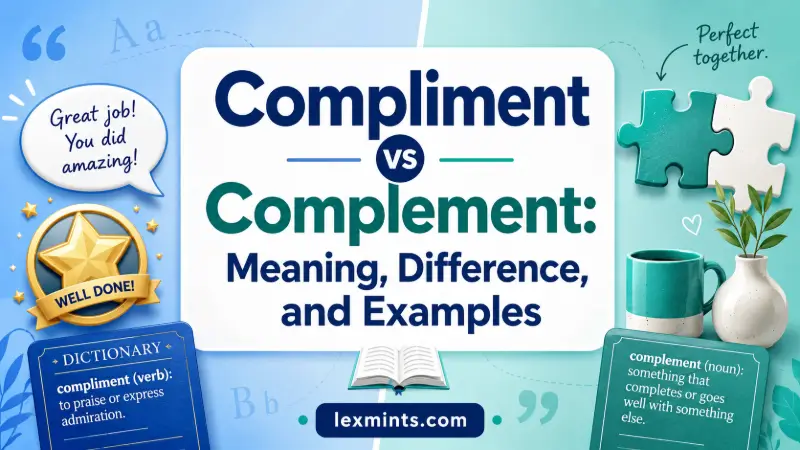
Compliment and complement sound the same and differ by only one letter, but they do different jobs in English. A compliment is connected with praise, admiration, or respectful approval. A complement is something that completes, improves, or works well with something else.
The difference matters in everyday writing. You might compliment a coworker on a strong presentation, while a clear chart can complement that presentation by making the information easier to understand.
Both words can function as nouns and verbs, so grammar alone will not always tell you which spelling to choose. Meaning is the key. Once you connect compliment with praise and complement with completion or enhancement, the choice becomes much easier.
Quick Answer
Use compliment when you mean praise or admiration. Use complement when you mean complete, enhance, match, or work well with.
- Compliment: “She complimented me on my presentation.”
- Complement: “The charts complement the presentation.”
A useful memory trick is to connect the e in complement with the e in complete. Both words are pronounced alike, so you must rely on meaning and spelling rather than sound.
Why People Confuse Them
These words are easy to mix up because they are homophones: they are pronounced alike even though their spellings and meanings differ. They also look almost identical, with the key difference appearing in the middle: compliment has an i, while complement has an e.
Another source of confusion is grammar. Each word can be a noun or a verb. You can give a compliment or compliment someone. Likewise, something can be a complement to something else or complement it.
Because the sentence structure can look similar, the intended meaning must decide the word.
Key Differences At A Glance
- Compliment: connected with praise, admiration, approval, or respectful recognition.
- Complement: connected with completion, enhancement, matching, or forming a good combination.
- Both: can be nouns and verbs in standard English.
- Sound: both are pronounced roughly KAHM-pluh-ment, so pronunciation does not separate them in ordinary speech.
- Memory clue: complement relates closely to complete.
The simplest test is this: if someone is saying or showing something positive about a person or thing, choose compliment. If one thing improves, completes, or pairs well with another, choose complement.
Meaning and Usage Difference
As a noun, compliment means an expression of praise, admiration, respect, or approval.
“Your report was very clear” is a compliment. So is telling a friend that their new haircut looks great.
As a verb, compliment means to give that praise or approval.
“The client complimented Maya on her clear explanation.”
By contrast, complement as a noun refers to something that completes, enhances, or forms a satisfying combination with something else.
“The side salad was a good complement to the sandwich.”
As a verb, complement means to complete or enhance something by adding a useful or fitting quality.
“The warm lighting complements the room’s natural wood.”
Complement also has a standard noun sense meaning the full number or amount needed for something, as in a full complement of staff. That meaning still belongs to the idea of completeness.
The two words are therefore not interchangeable. Their sentence roles may match, but their meanings do not.
Tone, Context, and Formality
Neither word is automatically more formal than the other. Both are standard in everyday, academic, professional, and edited English. The correct choice depends on what you mean.
Compliment often appears in social or professional situations involving people, performance, appearance, work, or behavior. A manager may compliment an employee, or a customer may compliment a restaurant on its service.
Complement often appears when describing combinations. Colors can complement each other. Skills can complement each other. A side dish can complement a meal, and a graphic can complement written information.
The contrast is about meaning, not politeness level or formality.
Which One Should You Use?
| Context | Best Choice | Why |
|---|---|---|
| Praising someone’s work | compliment | It expresses approval or admiration. |
| Saying two colors work well together | complement | The colors enhance each other. |
| Describing a positive remark | compliment | The noun refers to praise. |
| Describing a fitting addition to a meal | complement | The addition improves the whole combination. |
| Saying a team has all required members | complement | It can mean the full number needed. |
| Sending praise to a chef | compliment | Praise belongs to the meaning of compliment. |
When in doubt, replace the word mentally. If praise fits, choose compliment. If complete, enhance, or match well fits, choose complement.
When One Choice Sounds Wrong
Using the wrong word can create an unintended meaning.
“The blue tie compliments the gray suit” suggests, literally, that the tie expresses praise. If you mean the colors look good together, write: “The blue tie complements the gray suit.”
“She complemented me on my presentation” is also wrong if she praised you. The correct sentence is: “She complimented me on my presentation.”
The pattern compliment someone on something is especially common when talking about praise. For combinations, complement something or be a complement to something is usually the right structure.
Common Mistakes (and Quick Fixes)
A common mistake is choosing by sound. That does not work because the two words are pronounced alike. Check the meaning instead.
Another mistake appears with clothing, food, design, and colors. If an item makes another item look or work better, use complement: “The shoes complement the dress.”
When referring to praise, use compliment: “Everyone complimented her on the dress.”
Also remember two common expressions. Compliments to the chef means praise for the chef. A full complement of staff means the complete number of workers needed or expected.
A quick fix is to ask one question: Am I talking about praise or completion? Praise takes compliment; completion or enhancement takes complement.
Everyday Examples
Here are natural examples that show the difference clearly:
Compliment
- I complimented Jordan on the way he handled the meeting.
- That comment about my writing felt like a real compliment.
- Customers often compliment the staff on their friendly service.
- She smiled when she received a compliment on her jacket.
Complement
- The simple logo complements the clean website design.
- Her planning skills complement his creative approach.
- Fresh fruit is a light complement to the rich dessert.
- The new shelves complement the room without making it feel crowded.
Notice that compliment usually involves praise or approval, while complement describes how parts fit, improve, or complete a larger whole.
Dictionary-Style Word Details
Verb
Compliment: To express praise, admiration, respect, or approval to someone or about something.
Example: “The supervisor complimented the team on its careful work.”
Complement: To complete, enhance, or work well with something.
Example: “The updated layout complements the new branding.”
Both verbs normally take an object in standard modern use.
Noun
Compliment: A remark, action, or expression that shows praise, admiration, respect, or approval. It can also appear in plural expressions involving regards or good wishes.
Complement: Something that completes, enhances, or pairs well with something else. It can also mean the full number or amount required, as in “a full complement of employees.”
Synonyms
Compliment: Common alternatives include praise, commendation, and, in some contexts, tribute. A clear opposite in the praise sense is insult.
Complement: Closest plain alternatives include enhancement, match, counterpart, or finishing addition, depending on context. As a verb, complete and enhance often fit. There is no single antonym that works across all senses.
Example Sentences
Compliment: “The professor complimented Ava on the clarity of her argument.”
Compliment: “I took his comment as a compliment.”
Complement: “The soft background music complements the relaxed atmosphere.”
Complement: “The workshop has a full complement of instructors today.”
Word History
Compliment and complement ultimately trace back to related Latin ideas involving filling or completing. Over time, English separated their modern meanings. Complement kept senses tied to completion and making a whole, while compliment developed the distinct sense of praise, respect, or admiration.
That shared background helps explain why the words look so similar even though their current meanings are different.
Phrases Containing
Compliment: pay a compliment, take it as a compliment, return the compliment, compliments of, compliments to the chef.
Complement: a perfect complement to, full complement, complement each other, serve as a complement to.
These phrases can help reinforce the difference: compliment phrases center on praise or regard, while complement phrases center on completion, fit, or a complete amount.
FAQs
Is compliment or complement correct when praising someone?
Use compliment when you mean praise, approval, admiration, or a positive remark. You can give someone a compliment or compliment them on something they did. Complement is wrong in that meaning because it refers to completing, matching, or enhancing.
Which word means two things go well together?
Use complement when two things work well together or when one improves the effect of another. For example, a dark frame may complement a bright print. Compliment would suggest that one thing is somehow expressing praise, which is not the intended meaning.
Can compliment and complement both be verbs?
Yes. Compliment as a verb means to express praise, as in “The manager complimented her on the presentation.” Complement as a verb means to complete or enhance, as in “The graphics complement the written instructions.” The grammar is similar, but the meanings differ.
Are compliment and complement interchangeable?
No. In modern standard English, they have separate meanings. Compliment belongs to the idea of praise or respectful approval, while complement belongs to completion or a good pairing. Because they sound alike, the wrong spelling may look plausible even when the meaning is incorrect.
Is “compliments to the chef” correct?
Yes. Compliments to the chef is correct because it means praise, thanks, or respectful approval for the chef’s work. Complements to the chef would not express that idea. A side dish, however, could be a complement to the chef’s main course.
What is the easiest way to remember the difference?
Connect the e in complement with the e in complete. If something completes, matches, or enhances something else, choose complement. If you are praising someone or giving an admiring remark, choose compliment with an i.
Conclusion
The choice between compliment and complement comes down to meaning. Use compliment for praise, admiration, or approval. Use complement when something completes, enhances, matches, or forms a good combination with something else.
Both can be nouns and verbs, and both sound alike, so pronunciation will not solve the problem. The easiest memory clue is simple: complement with an e connects to complete. If praise is the idea, choose compliment with an i.