
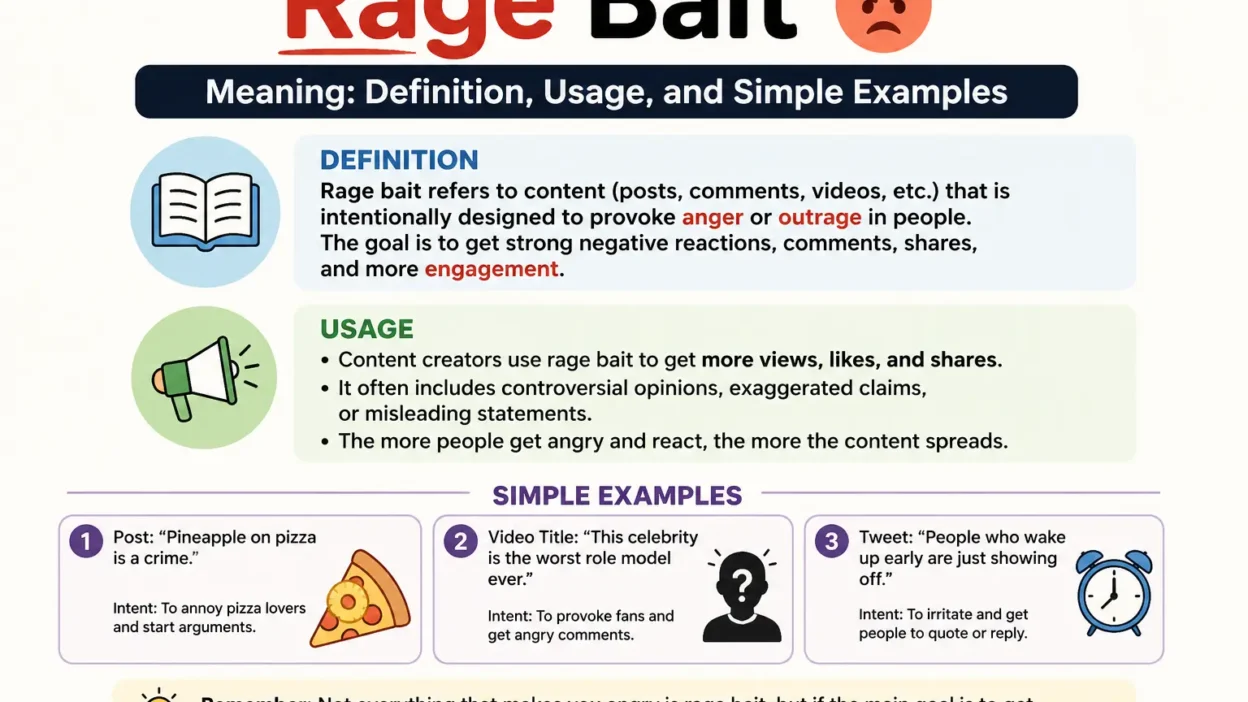
You may have seen the phrase rage bait while scrolling on TikTok, Instagram, or YouTube comments. It often appears when people argue online or react strongly to a post. The term has become very common in internet conversations, especially in 2025–2026, as social media users notice more content designed to trigger emotions.
Understanding rage bait helps you see why certain posts go viral so quickly. It also explains why people get drawn into arguments online even when the topic is simple. This article breaks down the meaning, usage, examples, and real-life context of the term in clear, beginner-friendly English.
We will also look at how it works, when people use it, and how to recognize it in everyday scrolling.
Quick Answer
Rage bait meaning is online content made to deliberately provoke anger or strong reactions so people engage with it.
It is used on social media posts, videos, and comments to get attention through emotional responses.
TL;DR
- Rage bait is content designed to make people angry
- It is common on social media platforms
- It increases comments, shares, and reactions
- Often used to boost attention or visibility
- Similar to clickbait but focused on anger
What Does Rage Bait Mean?
Rage bait refers to online content that is made on purpose to make people angry or upset. The goal is not discussion but reaction.
It is often used in posts, headlines, memes, or videos that feel frustrating or offensive. Cambridge Dictionary reference
People react strongly by commenting, arguing, or sharing the post. That reaction is exactly what the creator wants.
Rage Bait Meaning in Simple English
In simple words, rage bait means:
- “Something posted online to make you mad on purpose.”
It works by triggering emotions instead of logic.
For example:
- A post saying “This popular movie is the worst ever” just to start fights
Part of Speech
“Rage bait” is mainly used as:
- Noun: This is rage bait.
- Verb (informal): He is rage-baiting people online.
Both forms are used in internet slang.
How Rage Bait Works
Rage bait works because emotional reactions drive engagement.
Typical pattern:
- Post says something controversial
- People get angry or defensive
- They comment and argue
- The post spreads further
This cycle increases visibility on platforms.
Examples of Rage Bait
Here are simple examples:
- “All people who like this show have bad taste.”
- “This food is disgusting and anyone who eats it is wrong.”
- “Unpopular opinion: everything you love is overrated.”
These are designed to trigger reactions, not conversation.
Rage Bait vs Clickbait
| Type | Meaning | Goal |
| Rage bait | Provokes anger | Comments & arguments |
| Clickbait | Grabs attention | Clicks & views |
Rage bait is more emotional and aggressive.
When People Use the Term
People say “that’s rage bait” when:
- A post feels intentionally provocative
- Someone is clearly trying to start arguments
- The content seems fake or exaggerated
Example:
- “Don’t fall for it, that’s just rage bait.”
Common Contexts
Rage bait is mostly used in:
- TikTok comments
- Instagram reels
- YouTube discussions
- Twitter/X threads
It is especially common in viral debates.
When Not to Use It
Not every strong opinion is rage bait.
Avoid using it when:
- Someone shares a real personal opinion
- A discussion is honest but emotional
- There is no clear intent to provoke
Pronunciation
Rage bait is pronounced:
- /rayj bayt/
Easy breakdown:
- rage = anger
- bait = lure
Synonyms and Related Terms
Close terms include:
- outrage content
- flame bait
- engagement bait
There is no perfect antonym, but neutral content is the opposite idea.
Why Rage Bait Exists
Rage bait exists because:
- Angry reactions increase engagement
- More engagement means more visibility
- Viral content spreads faster
This makes emotional posts more common online.
Common Mistakes
People often:
- Call any disagreement “rage bait”
- Assume every viral post is fake
- React emotionally without checking intent
Correct approach:
- Look for clear intention to provoke before labeling it
Mini Quiz
- What is rage bait designed to do?
- Where do you usually see it?
- Is rage bait always true information?
Answers:
- Make people angry
- Social media platforms
- No, it may be exaggerated or misleading
Source Article URL Source Topic Target Article URL Target Topic Anchor Text Anchor Type Internal Link Sentence With HTML Placement Section Relevance Score /100 Priority Cannibalization Risk Notes
https://lexmints.com/rage-bait-meaning/ Rage bait meaning and engagement-driven social media content https://lexmints.com/slop-meaning/ Slop meaning, including low-quality online content and AI slop low-quality online slop Partial-match contextual anchor When provocative posts become repetitive, careless, or mass-produced, users may also dismiss them as low-quality online slop. Why Rage Bait Exists — insert after “This makes emotional posts more common online.” 91 High None Both pages were accessible. The topics have a strong contextual overlap around manipulative or low-quality internet content, but they target clearly different meanings and search intents.
FAQ
What does rage bait mean on social media?
It means posts designed to make people angry so they react or comment.
Is rage bait the same as clickbait?
No, clickbait focuses on clicks, while rage bait focuses on anger.
Why do people use rage bait?
To get attention, comments, and more visibility online.
Is rage bait a real word?
Yes, it is widely recognized in modern English usage.
How can you spot rage bait?
If a post feels overly provocative or designed to start arguments, it may be rage bait.
Source Article URL Source Topic Target Article URL Target Topic Anchor Text Anchor Type Internal Link Sentence With HTML Placement Section Relevance Score /100 Priority Cannibalization Risk Notes
https://lexmints.com/rage-bait-meaning/ Rage bait meaning, usage, and online engagement tactics https://lexmints.com/brain-rot-meaning/ Brain rot meaning, digital fatigue, and internet slang brain rot is used in online slang Partial-match contextual For another term connected with online content habits, see how brain rot is used in online slang to describe mental fatigue from excessive or repetitive scrolling. Synonyms and Related Terms — place after the existing related-terms list 91 High No Strong topical connection within the internet-slang cluster. The articles serve different intents: rage bait explains deliberately provocative content, while brain rot explains mental fatigue associated with consuming online content. Add this as an in-content link even though a previous/next navigation link already exists.
Conclusion
Rage bait is a modern internet term that describes content made to trigger anger for engagement. It appears often on social media where reactions drive visibility.


