
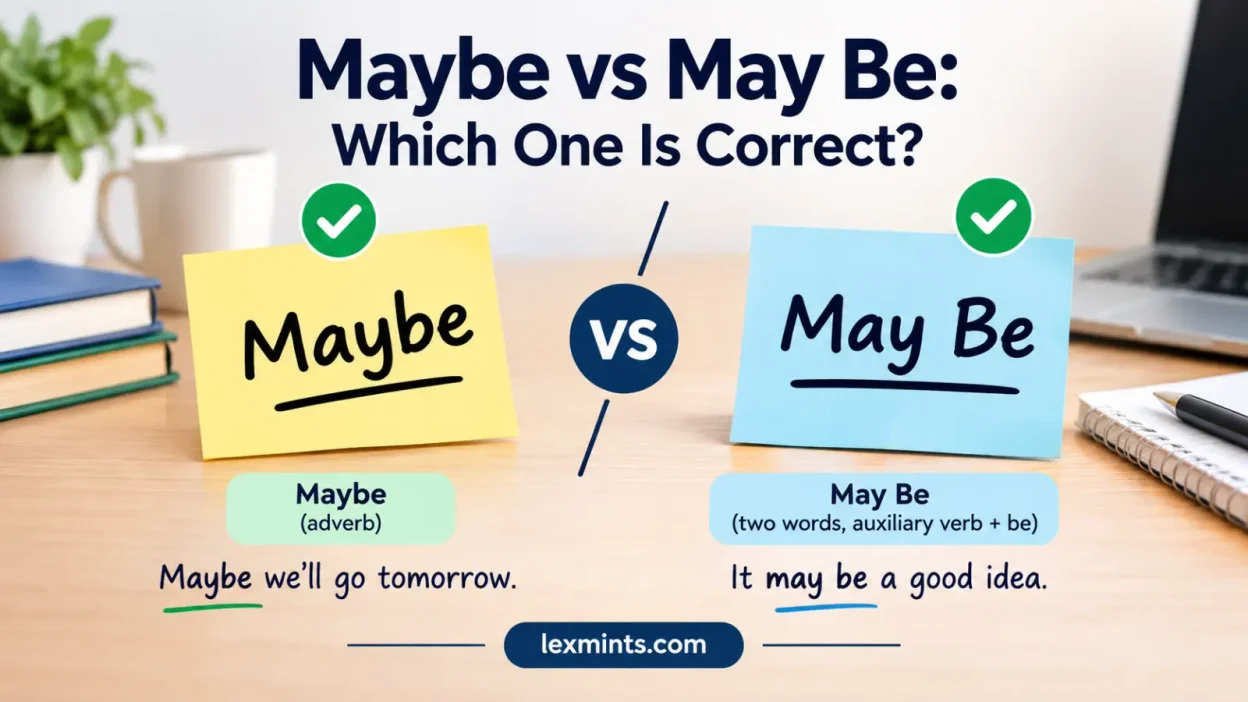
Maybe vs may be is a common English grammar and word-choice confusion. The two forms look almost identical, but they do not always function the same way in a sentence. Maybe is usually an adverb meaning “perhaps,” while may be is a verb phrase made up of the modal verb may and the verb be.
Understanding the difference between maybe vs may be can help you write clearer emails, essays, messages, and everyday English. The good news is that there is a simple way to tell them apart: if you can replace the expression with “perhaps,” you usually need maybe. If the sentence needs may + be as part of its verb structure, you need may be.
Let’s examine the difference with clear rules and examples.
Maybe vs May Be: The Quick Answer
The easiest distinction is based on meaning and grammatical function.
- Maybe is one word and usually means perhaps.
- May be is two words and contains the modal verb may followed by be.
- Maybe commonly expresses uncertainty, possibility, or a suggestion.
- May be is used when may helps form the verb phrase in a sentence.
- Maybe can often be moved around in a sentence without changing its basic meaning.
- May be usually needs to connect to a subject and the rest of a verb phrase.
Examples
Maybe it will rain later.
Here, maybe means perhaps.
It may be difficult to finish the project today.
Here, may be forms part of the verb phrase may be difficult.
A useful test is to replace maybe with perhaps:
Maybe she is at home.
Becomes:
Perhaps she is at home.
The meaning remains essentially the same, so maybe is correct.
Now consider:
She may be at home.
Replacing may be with “perhaps” changes the structure:
She perhaps at home.
That sentence is incorrect. Therefore, may be is required.
What Does Maybe Mean?
Maybe is an adverb that means perhaps, possibly, or it is possible that.
It is used when a speaker or writer is not completely certain about something.
For example:
- Maybe John will call tonight.
- Maybe we should leave early.
- Maybe she forgot the appointment.
- I will maybe see you tomorrow.
- Maybe they are already there.
In each example, maybe expresses uncertainty or possibility.
Because maybe is an adverb, it can modify a whole sentence, clause, or sometimes a verb phrase.
Maybe as “Perhaps”
One of the easiest ways to recognize maybe is to substitute perhaps.
Maybe we should wait.
Perhaps we should wait.
Both sentences communicate the same basic idea.
Another example:
Maybe he knows the answer.
Perhaps he knows the answer.
Again, maybe and perhaps have nearly the same meaning.
This substitution test is one of the most useful ways to solve maybe vs may be questions.
What Does May Be Mean?
May be consists of two separate words:
- may — a modal auxiliary verb
- be — the base form of the verb “to be”
Together, they can express possibility.
For example:
She may be tired.
The structure is:
She + may + be + tired
Here, may indicates possibility, while be connects the subject to the adjective tired.
Other examples include:
- He may be busy.
- They may be ready.
- The answer may be correct.
- This may be difficult.
- She may be waiting outside.
- We may be late.
In these sentences, may be is part of the verb phrase.
Maybe vs May Be: The Main Grammar Difference
The most important difference is grammatical.
Maybe = Adverb
Maybe is generally an adverb.
Example:
Maybe I will go tomorrow.
Here, maybe modifies the entire idea that the speaker will go tomorrow.
May Be = Modal Verb + Be
May be is a verb construction.
Example:
She may be at work.
The modal verb may expresses possibility, and be functions as the base form of the verb “to be.”
This distinction explains why the two forms cannot simply be used interchangeably.
Compare:
Maybe he is right.
and:
He may be right.
Both sentences express possibility, but their grammatical structures are different.
The “Perhaps” Test
The perhaps test is one of the fastest ways to determine whether you need maybe or may be.
If you can replace the expression with perhaps and the sentence still works, use maybe.
Example 1
Maybe Sarah will join us.
Replace “maybe” with “perhaps”:
Perhaps Sarah will join us.
The sentence remains correct.
Therefore, maybe is correct.
Example 2
Sarah may be tired.
Try replacing “may be” with “perhaps”:
Sarah perhaps tired.
That does not work grammatically.
Therefore, may be is correct.
This simple test works in many everyday situations.
Maybe: Common Sentence Patterns
Maybe can appear in several positions, although it is especially common at the beginning of a sentence.
At the Beginning
Maybe we should call him.
Maybe they are running late.
Maybe I misunderstood the question.
This is very common in conversational English.
Before a Verb
I maybe misunderstood what she meant.
This construction can occur, although in many contexts writers may prefer a more natural placement depending on the sentence.
As a Short Response
Maybe can also stand alone as a response.
“Are you coming with us?”
“Maybe.”
Here, maybe means “perhaps” or “I am not sure.”
It is particularly common in casual conversations.
May Be: Common Sentence Patterns
May be usually appears after a subject and forms part of the predicate.
Subject + May Be + Adjective
The task may be difficult.
She may be tired.
The weather may be unpredictable.
Subject + May Be + Noun
He may be the right person for the job.
This may be the best solution.
Subject + May Be + Prepositional Phrase
She may be at home.
They may be in the office.
Your keys may be on the table.
Subject + May Be + -ing Verb
He may be sleeping.
They may be working.
She may be waiting outside.
These patterns make may be easy to identify once you understand its grammatical role.
Maybe vs May Be Examples
Compare the following pairs:
Example 1
Maybe he will come later.
He may be late.
The first sentence uses maybe to mean “perhaps.” The second uses may be as part of the verb phrase.
Example 2
Maybe she is busy.
She may be busy.
Both sentences express uncertainty, but their structures are different.
Example 3
Maybe we should leave now.
We may be ready to leave now.
In the first sentence, maybe introduces a suggestion. In the second, may be is part of the verb phrase may be ready.
Example 4
Maybe they forgot.
They may be confused.
Again, the first uses an adverb, while the second uses a modal verb construction.
Why Do People Confuse Maybe and May Be?
The confusion exists because maybe and may be can sometimes communicate very similar ideas.
For example:
Maybe she is at home.
and:
She may be at home.
Both suggest that it is possible that she is at home.
The meaning is similar, but the grammar is not.
The first sentence uses maybe as an adverb. The second uses may be as part of the verb phrase.
English contains many pairs in which spacing changes the grammatical function or meaning. Maybe vs may be is one of the most recognizable examples.
A Simple Trick to Remember the Difference
Remember this rule:
Maybe = perhaps
May be = might be
The first substitution is especially reliable:
Maybe he is coming.
=
Perhaps he is coming.
For may be, you can often think:
He may be coming.
≈
He might be coming.
The words may and might are both modal verbs that can express possibility.
For example:
She may be busy.
She might be busy.
Both are grammatically structured as modal verb + be.
This makes may be easier to recognize.
Maybe vs May Be in Questions
Both forms can appear in questions, but they work differently.
Maybe in Questions
Maybe can introduce a suggestion or possibility.
Maybe we should ask for help?
Maybe you should check the address?
In casual communication, this can sound like a suggestion.
May Be in Questions
May be can appear in a question when it forms part of the verb phrase.
Could this be the correct answer?
A question containing may be could also occur in structures such as:
Who may be responsible for this?
Here, may be is clearly functioning as part of the verb phrase.
Maybe vs May Be in Formal Writing
Both forms are grammatically correct, but their use depends on the sentence.
Maybe is perfectly acceptable in standard English and is not inherently informal.
For example:
Maybe additional research is needed.
This is grammatically correct and can be appropriate in professional or academic contexts.
However, formal writing may sometimes prefer more precise wording such as perhaps, possibly, or a complete construction with may.
For example:
Additional research may be needed.
This sentence uses may be and sounds appropriately cautious.
The important point is not that one form is “formal” and the other is “informal.” The important point is whether the grammar of the sentence requires an adverb or a verb phrase.
Common Mistakes With Maybe and May Be
Mistake 1: Writing “May be” When You Mean “Perhaps”
Incorrect:
May be we should wait.
Correct:
Maybe we should wait.
Why? Because maybe means “perhaps.”
Mistake 2: Writing “Maybe” When You Need a Verb Phrase
Incorrect:
She maybe tired.
Correct:
She may be tired.
Why? The sentence needs the verb phrase may be tired.
Mistake 3: Confusing Meaning With Spelling
Because both forms express possibility in some contexts, writers sometimes choose based only on pronunciation.
Instead, examine the grammatical structure.
Ask:
Does the sentence mean “perhaps”?
If yes, maybe may be correct.
Ask:
Does the sentence need “may” + “be” as its verb phrase?
If yes, use may be.
Maybe vs May Be in Everyday English
Here are several natural examples you might encounter in everyday American English.
Maybe I’ll call you tonight.
She may be at the grocery store.
Maybe we can meet tomorrow.
He may be running late.
Maybe they don’t know.
They may be waiting for us.
Maybe I should try again.
This may be the right answer.
Notice how maybe often introduces a possibility or suggestion, while may be connects a subject to a description, location, identity, or ongoing action.
Maybe vs May Be: A Quick Comparison Table
| Feature | Maybe | May Be |
|---|---|---|
| Number of words | One | Two |
| Part of speech | Adverb | Modal verb + verb |
| Basic meaning | Perhaps | Is possibly / might be |
| Main function | Expresses possibility | Forms a verb phrase |
| Example | Maybe she will come. | She may be late. |
| Easy substitute | Perhaps | Might be |
| Can stand alone? | Yes | Usually no |
| Common mistake | Using it instead of “may be” | Using it instead of “maybe” |
How to Choose the Correct Form
When you are unsure between maybe and may be, follow these steps.
Step 1: Look at the Meaning
Ask whether you mean perhaps.
If yes, use maybe.
Maybe he will call.
Step 2: Look at the Grammar
If you have a subject followed by may + be, use two words.
He may be busy.
Step 3: Try “Perhaps”
Replace maybe with perhaps.
If the sentence still works, maybe is probably correct.
Step 4: Try “Might Be”
If the expression can naturally be replaced by might be, may be may be the correct structure.
She may be tired.
She might be tired.
Both work.
More Examples of Maybe
Here are additional examples using maybe correctly:
- Maybe we should leave early.
- Maybe he forgot the meeting.
- Maybe I will order pizza tonight.
- Maybe they are already home.
- Maybe you are right.
- Maybe she needs some help.
- Maybe the store is closed.
- Maybe we can solve this problem.
- Maybe I’ll see you this weekend.
- Maybe there is another explanation.
In all of these examples, maybe could be replaced by perhaps.
More Examples of May Be
Here are examples of may be used correctly:
- She may be tired.
- He may be at work.
- They may be ready.
- The answer may be incorrect.
- This may be a better option.
- Your package may be outside.
- The meeting may be canceled.
- He may be waiting for you.
- The information may be outdated.
- She may be the person we need.
In these sentences, may be forms part of the verb phrase.
Is “Maybe” Always an Adverb?
In standard modern English, maybe is generally treated as an adverb when it means “perhaps.”
For example:
Maybe it will snow.
It modifies the possibility expressed by the rest of the sentence.
It is important not to analyze maybe as simply the words may + be without a space. Although the spelling looks like a combination of two words, maybe functions as its own word.
That is why:
Maybe she knows.
is correct, while:
May be she knows.
is not correct in standard English.
Is “May Be” Always Two Words?
When may functions as a modal verb and be is the base form of “to be,” they are written as two separate words.
For example:
He may be right.
She may be home.
They may be working.
Do not combine these into maybe when the sentence requires the verb construction.
For example:
He maybe right. ❌
He may be right. ✅
The spacing changes the grammatical function.
Maybe vs May Be: Final Rule
The difference between maybe and may be becomes much easier when you focus on grammar instead of pronunciation.
Use maybe when you mean:
perhaps / possibly
Example:
Maybe she will come.
Use may be when you need:
may + the verb “be”
Example:
She may be busy.
The simplest memory rule is:
Maybe = perhaps.
May be = may + be.
Whenever you are uncertain, try the perhaps test. If “perhaps” fits naturally, choose maybe. If the sentence requires a modal verb followed by be, choose may be.
FAQs
What is the difference between maybe and may be?
Maybe is one word and means “perhaps” or “possibly.” May be is two words and contains the modal verb may followed by the verb be.
Example: Maybe she will come.
Example: She may be late.
Is “maybe” one word or two words?
Maybe is one word when it means “perhaps.”
Correct: Maybe we should leave.
Incorrect: May be we should leave.
However, may be is correctly written as two words when may and be form part of a verb phrase.
How do you know whether to use maybe or may be?
Use maybe when you can replace it with “perhaps.” Use may be when the sentence needs may + be as part of the verb phrase.
For example:
Maybe he is busy.
This means:
Perhaps he is busy.
But:
He may be busy.
Here, may be is the verb phrase.
Which is correct: “He maybe tired” or “He may be tired”?
The correct sentence is:
He may be tired.
May be is required because may is the modal verb and be is the verb connecting he with the adjective tired.
“He maybe tired” is incorrect in standard English.
Which is correct: “Maybe she will come” or “May be she will come”?
The correct sentence is:
Maybe she will come.
Here, maybe means “perhaps.” You could also write:
Perhaps she will come.
“May be she will come” is not grammatically correct in standard English.
Conclusion
Understanding maybe vs may be is an easy way to improve your English grammar and writing accuracy. Although the two forms sound similar and can express related ideas, they have different grammatical functions.
Maybe is one word and usually means perhaps. It is an adverb used to express uncertainty, possibility, or a suggestion.
May be is two words. It consists of the modal verb may and the verb be, and it forms part of a larger verb phrase.
Compare these two sentences:
Maybe he is busy.
He may be busy.
Both communicate possibility, but the grammatical structure is different.
When choosing between them, remember the simple rule: if you can replace the word with “perhaps,” use “maybe.” If you need “may” followed by the verb “be,” use “may be.”
Once you recognize this difference, choosing the correct form becomes much easier in everyday conversations, emails, academic writing, and professional communication.


