
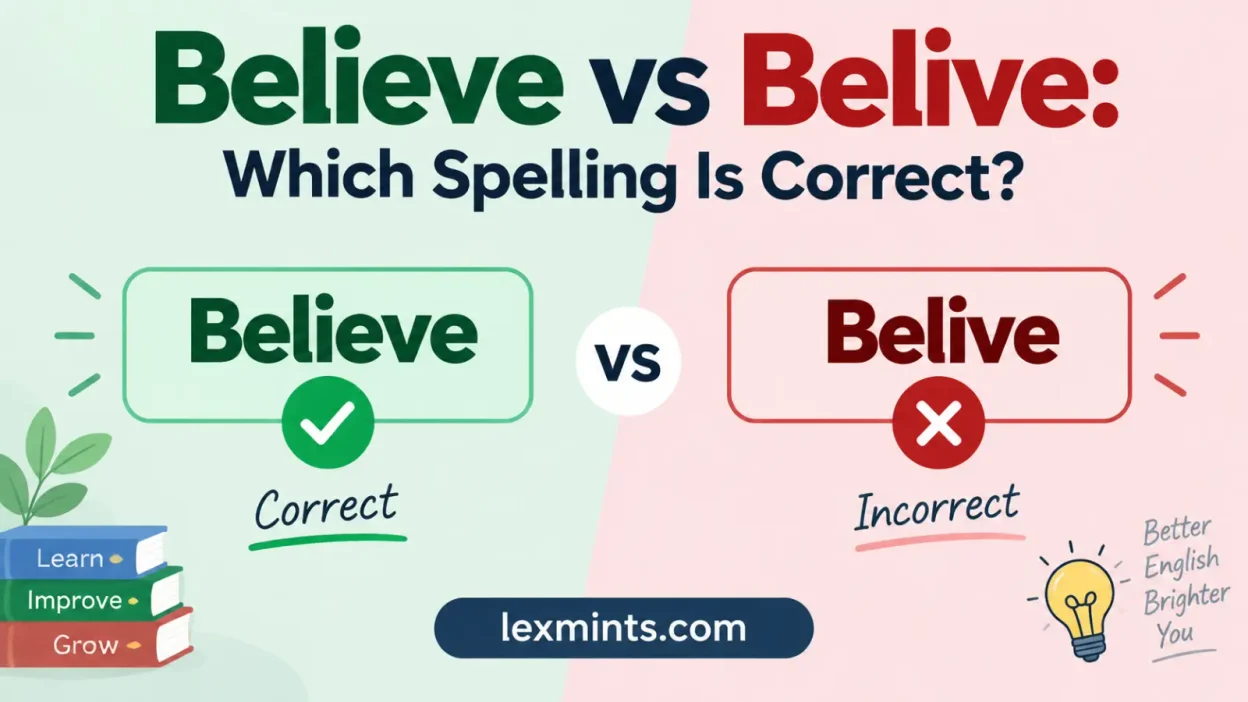
Believe vs belive is a common spelling question, but the answer is simple: believe is the correct spelling, while belive is a misspelling. If you are writing in standard American English, always use believe.
The word believe is a verb that can mean to accept something as true, trust what someone says, think that something is true, or have confidence in a person or idea.
For example:
I believe you.
We believe the story is true.
She believes in herself.
The spelling belive may look close to the correct form, but it is not an accepted alternative spelling. The difference is only one letter, which is why the mistake is easy to make.
A useful way to remember the correct spelling is:
be + lieve = believe
Not:
be + live = belive
If you are writing an email, school assignment, professional document, article, or everyday message, choose believe.
Quick Answer
Believe is correct. Belive is incorrect.
There is no standard US-English spelling difference between these two forms. Belive is not an alternative American spelling of believe. It is simply a misspelling of the same word.
| Feature | Believe | Belive |
|---|---|---|
| Standard spelling | Correct | Incorrect |
| Standard US English | Yes | No |
| Dictionary headword | Yes | No |
| Part of speech | Verb | Not a standard verb |
| Meaning | To accept as true, think, trust, or have faith | None as a standard English word |
| Recommended in formal writing | Yes | No |
The easiest rule is simple:
Always write “believe” with the extra “e” before the final consonant.
A useful visual pattern is:
be + lieve = believe
Not:
be + live = belive
The incorrect spelling belive can look reasonable because English contains the word live, but believe does not follow the spelling pattern of live. The correct spelling needs -lieve.
Why People Confuse Them
The main reason people confuse believe and belive is that English spelling does not always match pronunciation perfectly.
Believe is pronounced approximately bih-LEEV. The final part sounds like leev, which can make it tempting to spell the word as though it were built from familiar letters such as live.
Another reason is simple visual familiarity. People often type quickly and may accidentally leave out the second e.
Compare the two forms:
believe
belive
Only one letter separates them, so a quick glance may not immediately reveal the error.
The problem becomes especially common when someone is writing from memory. If you remember how the word sounds but are unsure of the exact spelling, you might naturally write belive.
Typing habits can also contribute to the mistake. Someone who writes quickly may accidentally omit a letter without noticing. Spell-checking can catch many such errors, but not every writing environment will immediately highlight a misspelled word.
There is also a useful reason to be careful with the spelling: believe is closely connected to other familiar forms such as believed, believing, and believer.
For example:
- believe
- believed
- believing
- believer
- believable
- unbelievably
Seeing the word family repeatedly can help reinforce the correct spelling.
A simple memory strategy is to focus on the middle:
be-LIEVE
The ending begins with l-i-e-v-e, not l-i-v-e.
Key Differences At A Glance
There is no real meaning difference between believe and belive because they are not two accepted spellings of the same standard word.
Instead, the distinction is between the correct form and a misspelled form.
The correct word is believe.
The form belive should be corrected to believe.
Here are the most important points:
| Context | Best Choice | Why |
|---|---|---|
| Formal writing | believe | It is the standard spelling |
| School assignments | believe | It is the accepted spelling |
| Business emails | believe | It is clear and professional |
| Personal messages | believe | It is still the correct spelling |
| Academic writing | believe | Standard English requires the correct form |
| “I ___ you.” | believe | The verb is spelled with -lieve |
| “I ___ in you.” | believe | The standard phrasal form uses believe |
| belive | Avoid | It is a misspelling |
The most important difference can be summarized in one sentence:
Believe is a standard English word; belive is a spelling error.
This means you should not try to assign different meanings to the two forms. If you see belive in a sentence intended to use the verb believe, the correct fix is simply to change it to believe.
Are They the Same Word?
They are intended to represent the same word in most spelling mistakes, but they are not equal spelling variants.
Believe is the standard English verb. Major dictionaries define it as a verb meaning, among other related uses, to accept something as true, accept someone’s statement, think something is true, or have faith or confidence in someone or something.
Belive, by contrast, is not the standard spelling of that verb.
For example:
Correct:
I believe everything will work out.
Incorrect:
I belive everything will work out.
The intended meaning is obvious in the second sentence, but the spelling is still wrong.
This distinction matters because a misspelling can sometimes look like a legitimate alternative. In this case, it is not. There is no standard US-English rule that allows belive as an alternate form of believe.
The correct word can also appear with different grammatical constructions.
For example:
Believe + that clause
I believe that she is telling the truth.
Believe + object
I believe him.
Believe in + noun
She believes in hard work.
Believe in + person
We believe in you.
Believe in + activity or idea
He believes in giving people another chance.
The spelling remains believe in each construction.
The word can also express an opinion when the speaker is not presenting something as absolute certainty:
I believe the meeting starts at nine.
Here, believe can communicate the speaker’s understanding or opinion rather than absolute proof.
US vs UK Preference
There is no US-versus-UK spelling difference between believe and belive.
American English uses believe.
British English also uses believe.
The incorrect form belive does not become correct because of regional English differences.
This is important because English does have many genuine spelling differences between American and British usage. For example, some words may appear with different endings or letters depending on the variety of English being used. But believe is not one of those words.
You should therefore use:
US English: believe
UK English: believe
The same basic spelling applies in both varieties.
This means that if you are writing for an American audience, there is no reason to choose belive. It is not a special US form, informal American spelling, or alternate dictionary spelling.
The safest approach is simply to remember the standard form:
believe
If you are editing American English, correct belive to believe whenever the intended word is the verb believe.
Which Spelling Should You Use?
Use believe.
This is the correct choice in virtually every normal English-writing situation.
You should use believe in:
- School papers
- College assignments
- Professional emails
- Business documents
- Resumes and cover letters
- Reports
- Blog posts
- Articles
- Text messages
- Social media posts
- Personal letters
- Everyday conversation written down
The fact that a setting is informal does not make belive correct.
For example, even in a casual text message, write:
I believe you.
Not:
I belive you.
Likewise, write:
I believe we should leave early.
Not:
I belive we should leave early.
If you are unsure, remember that the correct spelling contains -lieve-:
be-lieve
A useful mental check is to pause before typing the word and look at the middle:
believe
If you have written belive, you have left out the second e.
Another useful approach is to remember related words. The correct spelling of believed also contains the ie sequence:
I believed her.
The same pattern begins with believe.
When One Spelling Looks Wrong
The form belive may look acceptable at first because English has many words that contain live, including alive, lively, and lifestyle. However, the verb believe has its own established spelling.
The incorrect form becomes especially noticeable in formal writing.
Consider these examples:
Incorrect:
I belive this is the best option.
Correct:
I believe this is the best option.
Incorrect:
We belive the information is accurate.
Correct:
We believe the information is accurate.
Incorrect:
She doesn’t belive his explanation.
Correct:
She doesn’t believe his explanation.
Incorrect:
I belive in you.
Correct:
I believe in you.
The misspelling does not normally change what the reader understands. Most people will recognize what the writer intended. However, that does not make it an accepted spelling.
In professional and academic contexts, repeated spelling mistakes can make writing look less carefully edited. Correcting belive to believe is therefore a small but worthwhile improvement.
One important point is that belive should not be treated as an informal version. Informal English may contain abbreviations, slang, and conversational spellings, but that does not turn every common typo into a standard spelling.
Common Mistakes (and Quick Fixes)
The most common mistake is leaving out the second e.
Mistake 1: Writing “belive”
Wrong: I belive you.
Right: I believe you.
Remember:
believe = b-e-l-i-e-v-e
Mistake 2: Confusing the middle letters
Some writers remember the word as belive because they connect it mentally with live.
Instead, break the word into a helpful visual pattern:
be + lieve
That gives:
believe
Mistake 3: Forgetting the spelling in related forms
The correct word family includes forms such as:
- believe
- believed
- believing
- believer
- believable
For example:
Correct: She believed the story.
Correct: He is a believer in lifelong learning.
Correct: The explanation was believable.
Mistake 4: Using “belive” in professional writing
Even when the intended meaning is clear, belive is still a spelling mistake.
Replace it with believe before sending an email, submitting an assignment, publishing an article, or completing an important document.
Mistake 5: Assuming pronunciation gives the spelling
The pronunciation of believe does not make its spelling immediately obvious.
Rather than spelling it only by sound, remember the written form:
believe
The spelling is more reliable than trying to reconstruct every letter from pronunciation.
Everyday Examples
Seeing believe in natural sentences is one of the easiest ways to remember its spelling.
Believing something is true
I believe the package will arrive tomorrow.
She believes the report is accurate.
We believe the store closes at eight.
They believe the problem can be solved.
Trusting someone
I believe you.
Do you believe him?
She didn’t believe his explanation.
The witness said she believed the caller.
Expressing an opinion
I believe this is the right decision.
I believe we should wait another day.
He believes the company needs a new plan.
I believe the meeting starts at noon.
Having confidence
I believe in your ability to succeed.
Our coach believes in the team.
She believes in herself.
We believe in giving everyone a fair chance.
Religious or philosophical belief
Many people believe in a higher power.
He believes in God.
She believes that prayer is important to her.
The spelling does not change across these uses. Whether believe means accepting something as true, trusting someone, holding an opinion, or having confidence in a person or idea, the spelling remains the same.
Dictionary-Style Word Details
Verb
Believe is a verb.
It can be used as a transitive verb when someone accepts something as true or accepts what another person says.
Examples include:
I believe the report.
I believe you.
It can also be used in constructions such as:
I believe that the plan will work.
Believe can also be used without a direct object in constructions involving in, such as:
I believe in you.
They believe in hard work.
The word can express acceptance, opinion, trust, confidence, or religious conviction depending on its context.
Belive is not the standard spelling of this verb. When a writer intends the verb believe, the correct form is believe.
The grammatical forms of the correct verb include:
- believe — present/base form
- believes — third-person singular present
- believed — past tense and past participle
- believing — present participle and gerund
For example:
I believe you.
She believes you.
They believed you.
He is believing in himself more each day.
The spelling belive should not be substituted for any of these forms.
Noun
Believe is not normally used as a noun in standard English.
Belive is also not a standard noun spelling.
The related noun is belief.
For example:
Her belief in the project was strong.
His beliefs are important to him.
This distinction is useful because believe and belief look similar but have different grammatical roles.
Believe = verb
Belief = noun
For example:
I believe the story.
Here, believe is the verb.
Her belief in the story was strong.
Here, belief is the noun.
The incorrect form belive should not be used as a noun.
Synonyms
For believe, the best synonym depends on the specific context.
When believe means accepting something as true, useful alternatives can include:
- accept
- trust
- credit
- accept as true
When it means holding an opinion, a close alternative can be:
- think
When it means having confidence in someone or something, a close alternative can be:
- trust
These are not interchangeable in every sentence. For example, think and believe can overlap when expressing an opinion, but they do not always carry exactly the same nuance.
Belive has no separate synonym set because it is not a standard spelling of a different English word. When you see belive used where believe is intended, the appropriate correction is simply believe.
A common opposite of believe is disbelieve when the intended meaning is to reject something as untrue.
For example:
She believed the story.
She disbelieved the story.
However, the exact opposite depends on context, so disbelieve should not be treated as a universal replacement in every sentence.
Example Sentences
Here are examples using the correct spelling believe:
- I believe you are telling the truth.
- We believe the new schedule will work.
- She believes in herself.
- They believe the package was delivered yesterday.
- I couldn’t believe what I saw.
- Do you believe his explanation?
- He believes that everyone deserves a fair opportunity.
- We believe in helping our neighbors.
- She believed the information was accurate.
- I believe this is the best choice for the team.
- They didn’t believe the rumor.
- He wants people to believe in his idea.
Now compare the incorrect form:
Incorrect: I belive you.
Correct: I believe you.
Incorrect: She belives in herself.
Correct: She believes in herself.
Incorrect: We belived the report.
Correct: We believed the report.
These examples also show why it is important to learn the spelling pattern rather than only memorizing one isolated form.
Word History
The spelling and history of believe are well established, and the word has a long history in English. Modern dictionaries trace it through Middle English to Old English forms, with related Germanic connections.
For a spelling comparison, however, the important point is simple: the standard modern English form is believe.
There is no established US-versus-UK spelling history that makes belive a legitimate alternative. The missing e in belive is best understood as a spelling error rather than a separate historical or regional form of the standard verb.
Because the main issue here is spelling accuracy, there is no need to assign a special historical meaning to belive.
Phrases Containing
Believe appears in many common English phrases and constructions.
Believe in
This can mean having confidence in someone or something, or accepting the reality or value of something.
I believe in you.
She believes in hard work.
Believe that
This construction introduces a statement that the speaker considers true or likely to be true.
I believe that we made the right choice.
Believe someone
This means accepting what someone says as true.
I believe you.
Believe something
This means accepting a statement, explanation, or idea as true.
I believe the report.
Believe it or not
This is a common expression used before something surprising or unexpected.
Believe it or not, we finished the entire project in one day.
Can’t believe
This expression often shows surprise, disbelief, or amazement.
I can’t believe how quickly the year went by.
Seeing is believing
This familiar expression means that direct experience or evidence can make something easier to accept as true.
In every one of these expressions, the correct spelling is believe, never belive.
FAQs
Is “belive” a correct spelling?
No. Belive is a misspelling of believe. The correct spelling is believe, whether you are writing in American or British English.
How do you spell believe correctly?
The correct spelling is believe: B-E-L-I-E-V-E. A helpful way to remember it is the common spelling rule: “i before e” in believe.
Why do people spell believe as belive?
People often write belive because the word is pronounced “bih-LEEV,” which can make the spelling less obvious. The repeated vowel pattern in believe can also be easy to forget when typing quickly.
Is believe spelled differently in American and British English?
No. Believe is spelled the same way in both American and British English. There is no standard British spelling belive.
What is the difference between believe and belive?
Believe is the correct English word and means to accept something as true, trust someone, or hold an opinion. Belive is simply a misspelling and should not be used in standard English writing.
Conclusion
When choosing between believe vs belive, use believe.
Believe is the correct standard spelling of the English verb. Belive is a misspelling and should be corrected whenever the intended word is believe.
There is no meaningful US-versus-UK spelling difference between the two forms. American and British English both use believe.
The word can mean to accept something as true, trust someone’s statement, hold an opinion, or have confidence in someone or something. Its grammatical role is primarily that of a verb, while the related noun is belief.
If you often forget the spelling, focus on the middle of the word:
be-LIEVE
The key is the -lieve- sequence.
So, when writing a sentence such as “I ___ you,” the correct answer is always:
I believe you.
Not:
I belive you.
Once you remember the extra e, this spelling choice becomes much easier.


