
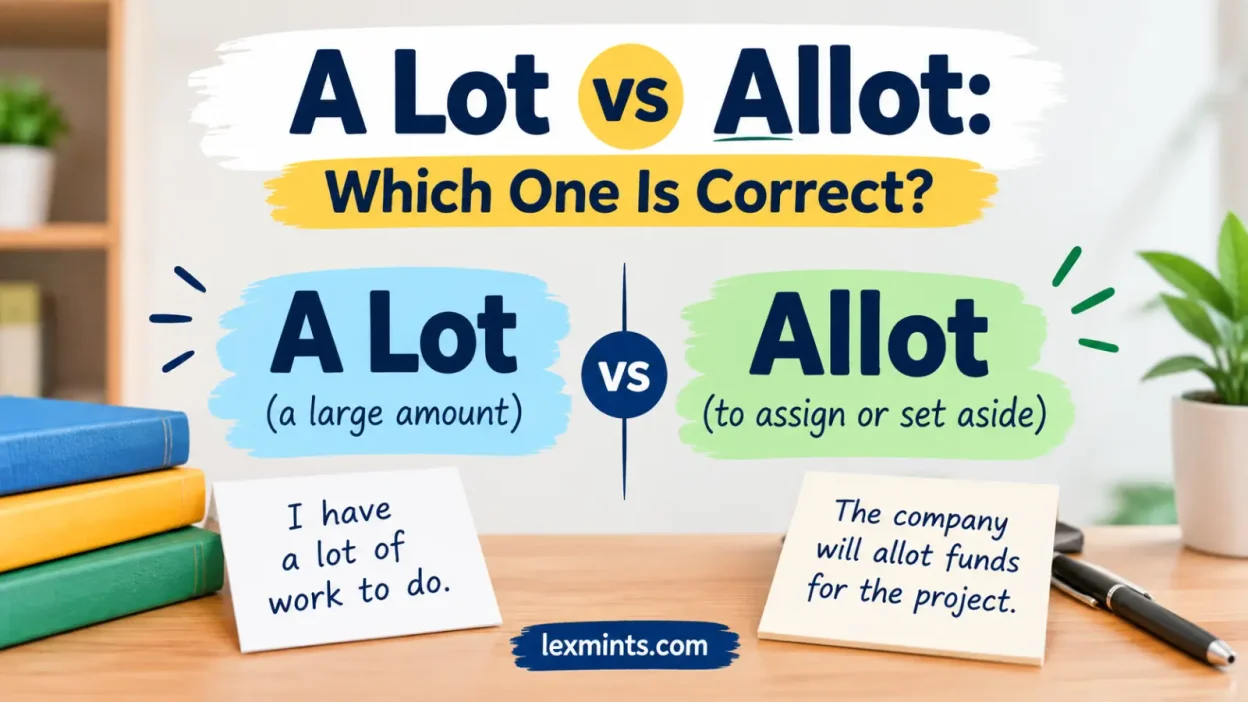
If you have ever wondered whether to write “a lot” or “allot,” you are not alone. These two expressions look and sound similar, but they have completely different meanings and grammatical functions. Choosing the wrong one can change the meaning of your sentence.
The good news is that the difference between a lot vs allot is easy to understand once you know what each term means.
A lot is usually used to mean a large amount, a large number, or frequently, depending on the context. It is commonly used in everyday English.
Allot is a verb that means to distribute, assign, or give a specific amount of something to someone or something.
For example:
- I have a lot of work to finish today.
- The manager will allot each employee a specific amount of time.
In the first sentence, a lot means “a large amount.” In the second sentence, allot means “to distribute or assign.”
Understanding this simple distinction will help you use both terms correctly in writing and conversation.
A Lot vs Allot: The Quick Difference
The easiest way to remember the difference is this:
| Term | Meaning | Part of Speech | Example |
|---|---|---|---|
| a lot | A large amount or number; frequently | Phrase/adverbial expression | I have a lot of books. |
| allot | To distribute, assign, or give a share | Verb | We will allot ten minutes to each speaker. |
A lot is normally written as two separate words when it means “a large amount” or “a large number.”
Allot is written as one word when it means “to distribute” or “to assign.”
This distinction is especially important because the two terms sound very similar in spoken English.
What Does “A Lot” Mean?
A lot is a common English expression used to indicate a large quantity, large number, or high frequency.
When it refers to a large quantity, a lot is often followed by of.
For example:
- She has a lot of experience.
- We need a lot of information.
- There are a lot of people at the event.
- He drinks a lot of water.
- They have a lot of questions.
The expression can be used with both countable and uncountable nouns.
A Lot With Countable Nouns
Countable nouns are things that can be counted individually, such as books, cars, people, or questions.
Examples:
- I have a lot of books.
- There were a lot of people at the concert.
- She received a lot of emails.
- We saw a lot of cars on the highway.
Here, a lot of means “many.”
A Lot With Uncountable Nouns
Uncountable nouns describe things that are generally treated as a mass or quantity rather than individual units.
Examples include water, time, money, information, advice, and work.
Examples:
- I need a lot of time.
- He has a lot of money.
- We received a lot of information.
- She gave me a lot of advice.
- There is a lot of work to do.
Here, a lot of means “much” or “a large amount of.”
What Does “Allot” Mean?
Allot is a verb. It means to distribute, assign, or set aside a particular amount of something for a person, group, activity, or purpose.
For example:
- The teacher will allot ten minutes for questions.
- The company allotted more money to the project.
- Each student was allotted twenty minutes for the exam.
- We need to allot enough time for preparation.
- The committee allotted funds to several departments.
In each example, something is being deliberately assigned or distributed.
Unlike a lot, allot does not mean “many” or “much.”
A Lot vs Allot in Grammar
The grammatical difference is one of the easiest ways to tell these terms apart.
“A Lot” Is a Phrase
When a lot means “a large amount” or “a large number,” it is written as two words.
Examples:
- She has a lot of friends.
- We have a lot of work.
- They spend a lot of time together.
It can also be used to mean “frequently” when functioning adverbially.
For example:
- I a lot enjoy this movie.
However, this construction is less natural in many contexts. More commonly, English speakers say:
- I enjoy this movie a lot.
- We talk a lot.
- She travels a lot.
“Allot” Is a Verb
Allot is a single-word verb.
Examples:
- The school will allot resources to the program.
- The judge allotted each side thirty minutes.
- The budget allots money for maintenance.
Because allot is a verb, it can take different forms:
- allot
- allots
- allotted
- allotting
For example:
- We allot enough time for each task.
- The manager allots resources carefully.
- The committee allotted additional funds.
- They are allotting more space to the project.
A Lot Means “A Large Amount”
One of the most common uses of a lot is to describe a large quantity.
Examples:
- She has a lot of patience.
- We need a lot of information.
- There is a lot of traffic today.
- He spends a lot of money on books.
In these sentences, replacing a lot of with a large amount of would preserve the basic meaning.
For example:
I have a lot of work.
means approximately:
I have a large amount of work.
A Lot Means “A Large Number”
With plural countable nouns, a lot of means “a large number of.”
Examples:
- There are a lot of students in the class.
- She owns a lot of shoes.
- We visited a lot of places.
- He has a lot of friends.
You can often replace a lot of with many:
A lot of people attended the meeting.
Many people attended the meeting.
Both sentences are grammatically correct, although a lot of is generally more conversational.
A Lot Can Also Mean “Frequently” or “Very Much”
A lot can also function as an adverbial expression.
For example:
- I travel a lot.
- She talks a lot.
- They laugh a lot.
- We see each other a lot.
- He likes the new restaurant a lot.
In these sentences, a lot does not describe a quantity of a noun. Instead, it modifies an action or describes degree.
For example:
She talks a lot.
means that she talks frequently or extensively.
Similarly:
I like this song a lot.
means that I like the song very much.
Allot Means “To Assign”
One major meaning of allot is to assign something to someone.
Examples:
- The teacher allotted five minutes to each student.
- The manager allotted specific tasks to each employee.
- The coach allotted equal practice time to the players.
- The committee allotted responsibilities among its members.
The important idea is that something is being assigned according to a plan or decision.
Allot Means “To Distribute”
Allot can also mean to distribute something among people, groups, or purposes.
For example:
- The organization allotted funds to local programs.
- The government allotted resources to the project.
- The company allotted office space to each department.
- The team allotted responsibilities among its members.
The distribution does not have to be perfectly equal. The key idea is that an amount or share is deliberately assigned.
Common Examples of “A Lot”
Here are several natural examples of a lot:
- I have a lot of homework tonight.
- She has a lot of experience in marketing.
- We spent a lot of time preparing.
- There are a lot of reasons to consider this option.
- He drinks a lot of coffee.
- They have a lot of questions.
- I travel a lot for work.
- She talks a lot during meetings.
- We learned a lot from the experience.
- He likes his new job a lot.
Notice that a lot can be followed by of + noun, or it can appear later in the sentence without a noun.
Common Examples of “Allot”
Here are examples showing the correct use of allot:
- The teacher will allot ten minutes for discussion.
- The manager allotted each employee a specific task.
- The committee allotted funds to the new program.
- We should allot enough time for testing.
- The company allots money for employee training.
- Each participant was allotted a seat.
- The organizer allotted space for each vendor.
- The school allotted additional resources to the library.
- The project manager allotted two weeks for development.
- The team is allotting more resources to research.
These sentences all involve assigning or distributing something.
A Lot vs Allot: Common Mistakes
Because a lot and allot sound alike, they are frequently confused in writing.
Incorrect: “I have allot of work.”
This is incorrect when the intended meaning is “a large amount.”
Correct: “I have a lot of work.”
Here, a lot of correctly means “a large amount of.”
Another common mistake is using a lot when the writer means “assign.”
Incorrect: “The manager will a lot ten minutes to each speaker.”
Correct: “The manager will allot ten minutes to each speaker.”
In this sentence, the manager is assigning time, so allot is the correct word.
“A Lot” vs “Allot” vs “Alot”
There is another spelling issue worth knowing.
A lot is correct when you mean “a large amount,” “a large number,” or “frequently.”
Allot is correct when you mean “to assign or distribute.”
Alot is generally not considered a standard spelling for either meaning.
For example:
- Correct: I have a lot of work.
- Correct: We will allot one hour to the meeting.
- Incorrect: I have alot of work.
The form alot is commonly seen as a spelling mistake in standard English.
Why Is “A Lot” Written as Two Words?
The phrase a lot developed from the noun lot, which can refer to a portion, share, group, or quantity.
In modern everyday English, a lot commonly functions as an expression meaning a large quantity or number.
Because it is a phrase rather than the verb allot, the words remain separate when used in this sense.
Compare:
A lot of people came.
with:
The organizer allotted seats to the guests.
The first describes a large number of people. The second describes the assignment of seats.
Why Is “Allot” Written as One Word?
Allot is an established verb meaning to distribute or assign.
It is not simply a shortened version of a lot.
That is why you should not substitute one for the other.
For example:
The company allotted $5,000 to the project.
Here, allotted means that the company assigned or designated that amount for the project.
It has nothing to do with saying that there was “a large amount.”
How to Remember the Difference
A simple memory trick can make the distinction easy.
Think of a lot as meaning many or much.
Think of allot as meaning assign.
A Lot = Many or Much
- a lot of books = many books
- a lot of water = much water
- a lot of time = much time
Allot = Assign
- allot time = assign time
- allot money = assign money
- allot tasks = assign tasks
If you can replace the word with many, much, or frequently, you probably need a lot.
If you can replace it with assign, distribute, or designate, you probably need allot.
A Lot vs Allot in Formal Writing
Both terms are grammatically correct, but they are used differently.
A lot is very common in everyday American English. It is natural in conversations, emails, blogs, and many types of informal or general writing.
Examples:
- We have a lot of work to complete.
- She has a lot of experience.
In highly formal writing, alternatives such as many, much, numerous, or a significant amount of may sometimes be preferred depending on the sentence.
Allot, meanwhile, is perfectly standard and can be used in formal, professional, academic, and administrative contexts.
Examples:
- The department will allot funds to the research project.
- Each applicant was allotted an equal amount of time.
A Lot vs Allot in American English
For a US English audience, the distinction remains straightforward:
A lot means a large amount, a large number, or frequently/very much depending on its grammatical position.
Allot means to assign or distribute.
Examples of natural American English include:
- We have a lot of options.
- She spends a lot of time studying.
- The committee will allot funds to each department.
- The teacher allotted fifteen minutes for the exercise.
Neither word is a US-versus-UK spelling difference. They have different meanings in standard English.
A Lot of vs Lots of
You may also see lots of, which has a meaning similar to a lot of.
For example:
- We have a lot of work.
- We have lots of work.
Both mean a large amount of work.
Lots of is generally informal and conversational.
However, neither a lot of nor lots of means “to assign.”
For that meaning, use allot.
Compare:
- The company has a lot of money.
- The company will allot money to the project.
The first sentence describes quantity. The second describes allocation.
A Lot vs Much and Many
When a lot of describes quantity, it can often be replaced with much or many, depending on the noun.
Use a lot of with both countable and uncountable nouns:
- a lot of books
- a lot of water
- a lot of people
- a lot of information
With more formal or traditional grammatical choices:
- many books
- much water
- many people
- much information
This flexibility is one reason a lot of is so common in everyday English.
Allot, Allocate, and Assign
The meaning of allot is closely related to words such as allocate and assign.
For example:
- The manager allotted time to each employee.
- The manager allocated time to each employee.
- The manager assigned tasks to each employee.
These words can overlap, but they are not always interchangeable in every context.
Allot emphasizes giving or distributing a particular share.
Allocate often emphasizes distributing resources for specific purposes.
Assign often emphasizes giving a task, responsibility, role, or duty to someone.
Understanding these related meanings can make allot easier to remember.
A Lot vs Allot in Everyday Sentences
Consider these pairs:
Pair 1
I have a lot of work.
This means I have a large amount of work.
My manager will allot me two hours for the task.
This means my manager will assign two hours to me.
Pair 2
There are a lot of students in the room.
This means there are many students.
The teacher will allot each student five minutes.
This means the teacher will give each student five minutes.
Pair 3
We need a lot of money.
This means we need a large amount of money.
The organization will allot money to the project.
This means the organization will designate or distribute money for the project.
These examples demonstrate why context matters.
Quick Test: Which Word Should You Use?
When you are unsure about a lot vs allot, ask yourself one question:
Am I talking about quantity, or am I talking about assigning something?
If you are talking about quantity, use a lot.
- a lot of people
- a lot of time
- a lot of money
- a lot of information
If you are talking about assigning or distributing something, use allot.
- allot time
- allot money
- allot resources
- allot responsibilities
This test works in most everyday situations.
Examples of Incorrect and Correct Usage
Here are some common mistakes corrected:
Incorrect: I have allot of homework.
Correct: I have a lot of homework.
Incorrect: The teacher will a lot ten minutes for the activity.
Correct: The teacher will allot ten minutes for the activity.
Incorrect: She has alot of experience.
Correct: She has a lot of experience.
Incorrect: The company will a lot resources to the project.
Correct: The company will allot resources to the project.
Incorrect: There were allot of people at the event.
Correct: There were a lot of people at the event.
The key is to focus on meaning rather than pronunciation.
FAQs
What is the difference between a lot and allot?
A lot means a large amount, a large number, frequently, or very much. Allot is a verb meaning to assign, distribute, or give a particular amount of something. For example, “I have a lot of work” and “The manager will allot two hours for the task.”
Is “a lot” one word or two words?
A lot is correctly written as two words when it means a large amount, a large number, or frequently. For example, “She has a lot of experience.” The spelling “alot” is not standard English.
Is “allot” a correct English word?
Yes. Allot is a correct English verb that means to assign, distribute, or designate a particular amount of something. For example, “The teacher will allot ten minutes to each student.”
Is it “a lot of” or “allot of”?
The correct phrase is “a lot of” when you mean a large amount or number. For example, “There are a lot of people here.” “Allot of” is incorrect in this context.
How can I remember the difference between a lot and allot?
Remember this simple rule: a lot = many or much, while allot = assign or distribute. If you are talking about quantity, use a lot. If you are talking about giving or assigning a share, use allot.
Conclusion
So, which is correct: a lot or allot?
Both are correct, but they have different meanings.
Use a lot when you mean:
- a large amount
- a large number
- frequently
- very much
Examples:
- I have a lot of work.
- She has a lot of friends.
- We travel a lot.
- I like this book a lot.
Use allot when you mean:
- assign
- distribute
- designate a share
- give a particular amount for a purpose
Examples:
- The manager will allot time to each employee.
- The committee allotted funds to the project.
- Each student was allotted fifteen minutes.
The simplest rule is:
A lot = many, much, or frequently.
Allot = assign or distribute.
And remember that alot is not the standard spelling when you mean “a lot.”
Once you connect a lot with quantity and allot with assignment, the difference becomes much easier to remember and apply correctly.


