
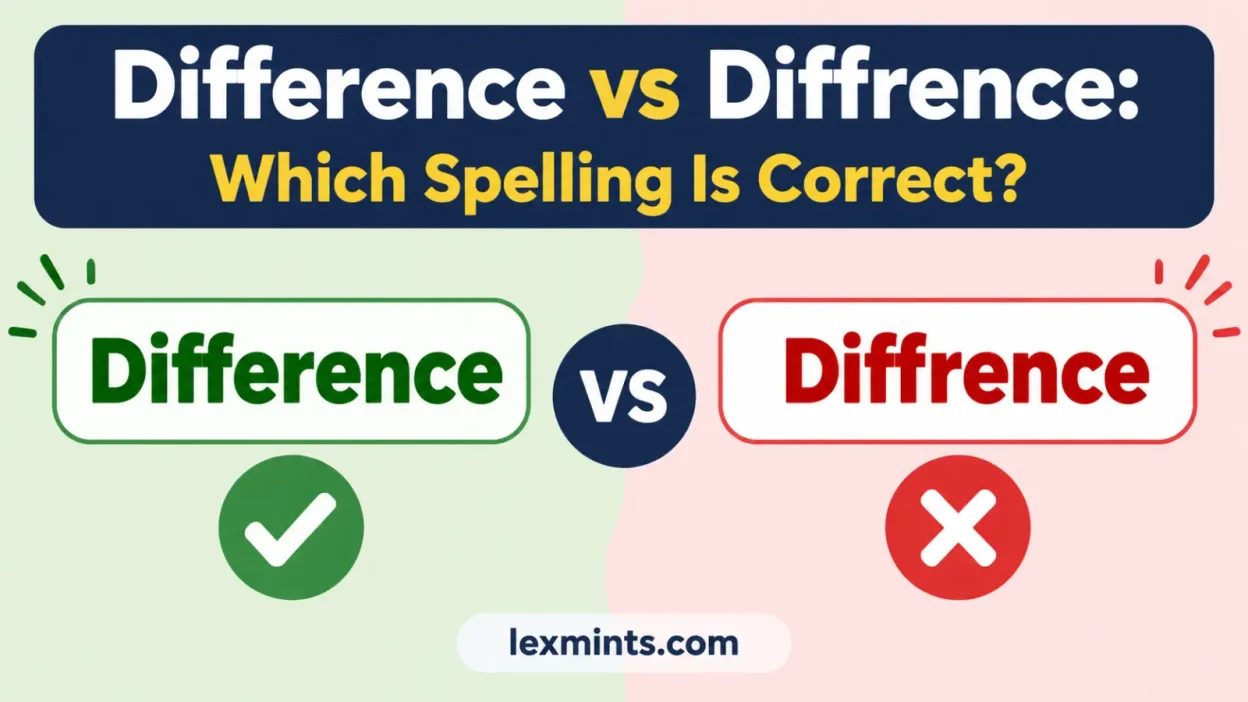
If you have ever typed “diffrence” instead of “difference,” you are not alone. This is a common spelling mistake because the word is pronounced quickly and the middle vowel can be easy to overlook. However, when it comes to standard English spelling, there is a clear answer.
Difference is the correct spelling.
Diffrence is an incorrect spelling and should not be used in standard English writing.
The correct word, difference, is a noun that refers to a way in which two or more things are not the same. It can describe a variation, distinction, disagreement, or change between people, objects, ideas, situations, or qualities.
For example:
- There is a big difference between the two plans.
- Can you explain the difference between these words?
- The new policy made a noticeable difference.
- We noticed a significant difference in quality.
In this guide, we will examine difference vs diffrence, explain why people confuse these spellings, show how to use difference correctly, and provide practical examples to help you remember the correct spelling.
Difference vs Diffrence: The Quick Answer
The correct spelling is difference.
| Spelling | Correct? | Explanation |
|---|---|---|
| Difference | ✅ Yes | Standard English spelling |
| Diffrence | ❌ No | Common spelling mistake |
The easiest way to remember the correct spelling is to notice the “e” after the “f” in the middle of the word:
D-I-F-F-E-R-E-N-C-E
The incorrect form diffrence leaves out this important e.
If you are writing an email, school assignment, article, report, business document, or professional message, always use difference.
What Does Difference Mean?
Difference is a noun meaning a way in which two or more things, people, ideas, or situations are different.
It can refer to a distinction in appearance, size, quality, opinion, behavior, meaning, amount, or many other characteristics.
For example:
There is a noticeable difference between the old and new versions.
Here, difference refers to the way the two versions are not the same.
The word can also describe disagreement between people.
For example:
They had a difference of opinion about the decision.
In this sentence, the word refers to a disagreement or contrasting viewpoint.
Difference can also describe an effect or change.
For example:
Your support made a big difference.
Here, difference means an important effect or improvement.
Because it has several related meanings, difference is an extremely common word in everyday and professional English.
Why Is Diffrence Incorrect?
Diffrence is incorrect because it leaves out the e that appears after the first two f’s.
The correct spelling is:
difference
The incorrect spelling is:
diffrence
Compare the two:
- difference ✅
- diffrence ❌
The spelling mistake usually happens because people remember the consonants d-f-f-r but forget the vowel between the double f and r.
When spoken naturally, the word can sound like the middle vowel is less noticeable. This can make it tempting to write diffrence.
However, pronunciation does not change the standard spelling. The correct form always includes the e:
difference
How to Spell Difference Correctly
The word difference contains nine letters:
D-I-F-F-E-R-E-N-C-E
Breaking it into smaller parts can make it easier to remember:
diff + er + ence
Another useful approach is to focus on the middle:
diff-e-rence
The important point is that difference contains an e immediately after ff.
A common mistake is:
diff + rence
But the correct spelling is:
diff + erence
So remember:
difference = double f + e
This small spelling detail can prevent the most common error.
Difference in a Sentence
The word difference can be used in many different sentence structures.
Here are some examples:
- I can see a clear difference between the two pictures.
- What is the difference between these products?
- The price difference was smaller than expected.
- Experience can make a major difference in the workplace.
- We noticed a significant difference in performance.
- There is a huge difference between the two approaches.
- The teacher explained the difference clearly.
- Their opinions show a major difference in perspective.
- A small change can make a big difference.
- Can you tell the difference between these sounds?
In every example, difference is spelled with the e after the double f.
Difference Between Two Things
One of the most common uses of difference is when comparing two things.
The phrase “difference between” is especially common.
For example:
What is the difference between a laptop and a desktop computer?
Another example is:
She explained the difference between the two methods.
This structure is useful when discussing distinctions, comparisons, characteristics, or meanings.
You can also use the plural form differences when discussing more than one distinction.
For example:
There are several differences between the two designs.
Notice that the plural form is:
differences
not:
diffrences
The same spelling rule applies.
Difference as a Change or Effect
Difference can also mean an effect or result produced by an action.
For example:
Exercise can make a positive difference in your daily routine.
Another example:
The extra practice made a noticeable difference in her performance.
The common expression “make a difference” means to have an effect or produce a meaningful change.
Examples include:
- Your advice made a difference.
- Every small effort can make a difference.
- The new system made a big difference.
- His support made a positive difference.
This is one of the most common expressions containing the word.
Difference as a Disagreement
The word difference can also refer to a disagreement or difference of opinion.
For example:
They had a difference of opinion about how to handle the situation.
The phrase “difference of opinion” is common in both everyday and formal English.
Another example:
Despite their differences, they continued working together.
Here, differences can refer to disagreements, contrasting personalities, opinions, or perspectives.
Common Phrases With Difference
Learning common phrases can make the correct spelling easier to remember.
Difference between
What is the difference between these two options?
Make a difference
Your help can make a difference.
Big difference
The updated version makes a big difference.
Significant difference
Researchers found a significant difference between the groups.
Major difference
There is a major difference in the two approaches.
Noticeable difference
We noticed a noticeable difference in quality.
Difference of opinion
They had a difference of opinion.
Spot the difference
Can you spot the difference between the two images?
Each expression uses difference, not diffrence.
Difference vs Diffrence in Formal Writing
Correct spelling becomes particularly important in formal writing.
If you are preparing a professional email, academic assignment, business report, résumé, website article, or presentation, writing diffrence can make the text appear careless.
For example, this sentence is incorrect:
There is a significant diffrence between the two results.
The corrected version is:
There is a significant difference between the two results.
The second version follows standard English spelling and is appropriate for formal communication.
Even though readers may understand diffrence, understanding the intended meaning does not make the spelling correct.
Common Mistakes With Difference
There are several ways people accidentally misspell difference.
Mistake 1: Leaving Out the E
Incorrect:
diffrence
Correct:
difference
This is the main mistake discussed in difference vs diffrence.
Mistake 2: Using One F
Incorrect:
diference
Correct:
difference
The word has two f’s.
Mistake 3: Changing the Middle Letters
Incorrect forms may include:
- diffrence
- diference
- differance
The standard spelling is:
difference
Remembering the sequence ff-e-r can help.
Difference vs Different
Another useful spelling connection is between difference and different.
Both words come from the same word family.
- different = adjective
- difference = noun
Examples:
These two products are different.
There is a clear difference between these products.
The adjective different describes things that are not the same.
The noun difference identifies the distinction itself.
This connection can help you remember the spelling.
Different → difference
Although the endings change, both forms contain the important diff beginning.
Difference vs Differences
The singular form is:
difference
The plural form is:
differences
For example:
There is one important difference.
But:
There are several important differences.
The spelling remains consistent when you add -s.
Incorrect:
diffrences
Correct:
differences
If you are unsure, first spell the singular word correctly:
difference
Then add s:
differences
How to Remember the Correct Spelling
A simple memory trick is:
“Difference has an E after FF.”
Think of the spelling this way:
DIFF + E + RENCE
The important section is:
FF-E-R
Do not remove the e.
You can also connect the word with different:
different → difference
Both begin with diff, which can help reinforce the correct spelling.
Another useful technique is to type the word correctly several times:
- difference
- difference
- difference
- difference
- difference
Repeated exposure helps make the correct spelling familiar.
Is Diffrence Ever Correct?
No. Diffrence is not a standard English spelling.
It may appear in online posts, informal messages, comments, or user-generated content because of typing mistakes, but it should not be used as the correct spelling in standard English.
If you encounter diffrence, interpret it as a misspelling of difference.
When writing, editing, or publishing content, replace it with difference.
Difference in American English
For American English readers, difference is the standard spelling.
There is no standard American English spelling in which diffrence is accepted as the correct form.
This makes the choice straightforward:
Use difference.
Whether you are writing for school, work, a website, social media, or everyday communication, difference is the appropriate spelling.
Examples: Difference vs Diffrence
Here are more examples showing the correct usage.
Correct
What is the difference between these two answers?
Incorrect
What is the diffrence between these two answers?
Correct
The new design made a significant difference.
Incorrect
The new design made a significant diffrence.
Correct
I noticed a small difference in the results.
Incorrect
I noticed a small diffrence in the results.
Correct
Their differences did not prevent them from working together.
Incorrect
Their diffrences did not prevent them from working together.
These examples show why remembering the e in difference is important.
FAQs
Is “difference” or “diffrence” correct?
Difference is correct. Diffrence is an incorrect spelling. The correct word contains an e after the double f.
Why do people spell difference as diffrence?
People often spell difference as diffrence because the middle vowel may be easy to overlook when the word is pronounced quickly. Typing quickly can also lead to the omission of the e.
What is the correct spelling of difference?
The correct spelling is difference:
D-I-F-F-E-R-E-N-C-E
Is diffrence a word?
No. Diffrence is not the standard English spelling of a word. It is a common misspelling of difference.
How do you use difference in a sentence?
You can use difference when describing how two or more things are not the same. For example: “There is a clear difference between the two options.”
What is the plural of difference?
The plural of difference is differences. For example: “There are several important differences between the two products.”
What is the easiest way to remember the spelling of difference?
Remember that difference contains FF-E in the middle. Think of it as DIFF + E + RENCE. The e after the double f should not be omitted.
Conclusion
When comparing difference vs diffrence, there is only one correct choice.
Difference is the correct standard English spelling.
Diffrence is a misspelling and should be avoided.
The word difference is a noun used to describe a distinction, variation, disagreement, or effect. It is commonly used in phrases such as “difference between,” “make a difference,” “difference of opinion,” and “spot the difference.”
The easiest spelling reminder is:
D-I-F-F-E-R-E-N-C-E
Pay special attention to the e after the double f.
If you remember “FF + E”, you will be much less likely to write diffrence by mistake.
So, whenever you are unsure, choose:
Difference ✅
Diffrence ❌
Using the correct spelling will make your writing clearer, more professional, and consistent with standard English.


