The tenure definition can vary by context, but it generally refers to the length or conditions of holding a job, position, property, or official role. In education, tenure often means a protected employment status granted to qualified teachers or professors after a review period, while workplace tenure may simply describe how long someone has served an employer.
Understanding the term matters because its meaning changes across academic, legal, property, and employment settings. Readers may also confuse tenure with job security, ownership, or seniority, even though these ideas are not always identical. This guide explains the meaning of tenure clearly and uses practical examples to show how the word works in different situations.
QUICK ANSWER
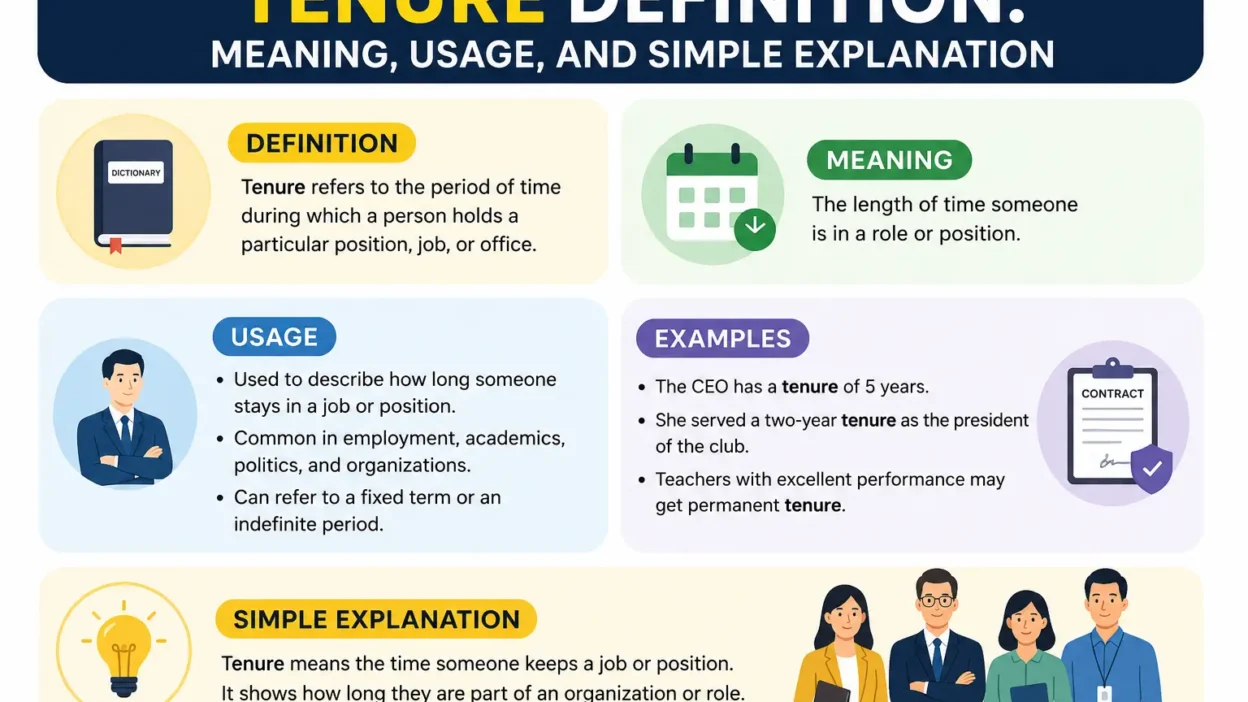
Tenure definition is the length of time someone holds a job or position, often with job security in academic or professional roles.
TL;DR
• Tenure means holding a job or position for time
• Common in universities and government jobs
• Often linked with job security
• Can apply to property or legal rights
• Not all jobs offer tenure
WHAT DOES TENURE MEAN?
Tenure refers to the period someone holds a position or job. It also can mean the right to keep that position, especially in academic roles.
In simple English, it means “how long someone has stayed in a role” or “protected job status.”
Example:
• A professor’s tenure may begin after years of teaching performance.
TENURE IN SIMPLE ENGLISH

In everyday language, tenure is about stability. It tells you how long someone has worked in one place.
For example:
• “Her tenure at the company lasted 10 years.”
It does not always mean permanent work, but it often suggests long-term employment.
PART OF SPEECH
Tenure is a noun.
It describes:
• Time in a job
• Duration of holding office
• A protected job position in some systems
Example:
• “His tenure as manager was successful.”
TENURE IN JOBS
In employment, tenure means how long an employee has worked for a company or organization.
It may also relate to job security in some roles.
Example:
• Long tenure often leads to higher trust and responsibility.
Important note:
Not every job offers tenure protection. Many private jobs are contract-based.
ACADEMIC TENURE
In universities, tenure is a system that gives professors long-term job security after evaluation.
Once granted, it protects them from being easily fired without cause.
Example:
• A professor receives tenure after years of teaching and research.
This system supports academic freedom and long-term research.
TENURE IN LAW OR PROPERTY

In legal contexts, tenure can also refer to holding land or property rights.
It explains how someone owns or uses land under law.
Example:
• A person may hold land under a specific tenure system.
WHEN TO USE “TENURE”

Use “tenure” when talking about:
• Job duration
• Academic positions
• Official roles
• Legal property holding
It is common in formal writing and professional discussions.
WHEN NOT TO USE IT
Do not use “tenure” for:
• Short temporary jobs
• Casual work situations
• Informal experiences
Wrong example:
• “My 2-day internship tenure was fun” ❌
Better:
• “My internship lasted 2 days” ✔
COMMON CONFUSIONS
Many people confuse tenure with “permanent job.”
However:
• Tenure = long-term status or duration
• Permanent job = contract with no end date
They are related but not identical.
SYNONYMS AND ANTONYMS
Possible synonyms:
• duration (general meaning)
• service period (job context)
• term (formal role context)
Antonyms:
There is no exact opposite, but:
• temporary status
• short-term role
COMMON MISTAKES
• Thinking tenure always means lifetime job
• Using it for short-term work
• Confusing academic tenure with promotion
Correct understanding depends on context.
EXAMPLES
• “Her tenure as CEO lasted five years.”
• “The professor earned tenure after review.”
• “Employee tenure affects retirement benefits.”
MINI QUIZ
- What does tenure mean in simple terms?
- Is tenure always permanent?
- Where is tenure commonly used?
Answers:
- Time holding a job or position
- No
- Universities and professional jobs
Source Article URL Source Topic Target Article URL Target Topic Anchor Text Anchor Type Internal Link Sentence With HTML Placement Section Relevance Score /100 Priority Cannibalization Risk Notes
https://lexmints.com/tenure-definition/ Tenure definition, employment duration, academic tenure, and property rights https://lexmints.com/context-meaning/ Context meaning and how surrounding information clarifies words meaning of context Partial-match contextual anchor Because tenure can refer to job duration, academic protection, or property rights, understanding the meaning of context helps readers interpret the word correctly. Common Mistakes — place immediately after “Correct understanding depends on context.” 94 High None Both pages were accessible and reviewed. The link supports the source article’s explanation that the correct meaning of “tenure” depends on its employment, academic, or legal context.
FAQ
What does tenure mean in simple terms?
It means how long someone holds a job or position. It often shows experience or job stability.
What is academic tenure?
It is job security given to professors after evaluation. It protects them from unfair dismissal.
Does tenure mean permanent job?
Not always. It usually means long-term or protected status, depending on context.
What is tenure in employment?
It refers to the length of time someone has worked in a job.
Can tenure be removed?
Yes, but usually only under serious conditions in academic systems.
What is tenure track?
It is a career path that can lead to academic tenure.
CONCLUSION
Tenure definition is simple when broken down into real-life use. It mainly refers to how long someone holds a job or position, especially in formal systems like universities or government work.