You may hear the word “serendipity” in movies, books, or everyday conversation. It often appears when something unexpectedly good happens in real life. People use it to describe moments that feel surprising but positive at the same time.
This word is common in storytelling, friendships, travel, and even science. It helps explain those situations where you find something valuable without planning for it. In this article, you will learn what serendipity means, how to use it correctly, and see real examples that make the idea easy to understand.
QUICK ANSWER
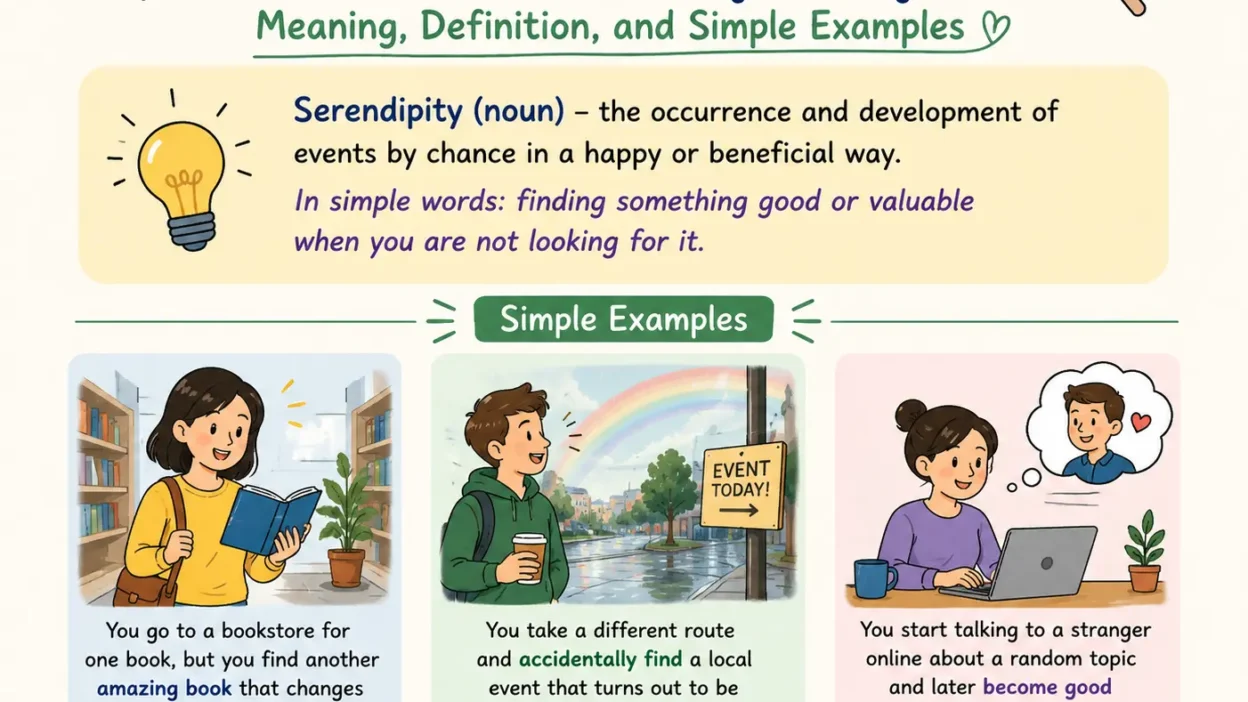
Serendipity meaning is the experience of finding something good or valuable by chance. It describes a lucky moment that happens when you are not expecting it.
TL;DR
• Finding something good without looking for it
• Often described as a happy accident
• Used in daily life and storytelling
• Can refer to discoveries or personal moments
• Common in both casual and formal English
WHAT SERENDIPITY MEANS

Serendipity is a noun. It describes a situation where something positive happens unexpectedly.
In simple words, it means a “happy accident.” You were not searching for it, but you found something valuable anyway.
A basic definition used in learning sources describes it as finding something interesting or useful by chance .
SIMPLE DEFINITION IN ENGLISH
Serendipity means a lucky discovery that happens without planning.
It often includes:
• Surprise
• Good outcome
• No intentional search
Example:
“I found my old photo album while cleaning my room—that was pure serendipity.”
PART OF SPEECH
Serendipity is a noun.
It is used to name an idea or experience, not an action.
Example:
• Correct: “That meeting was serendipity.”
• Incorrect: “I serendipity something.”
PRONUNCIATION
Serendipity is pronounced as:
seh-ren-DIP-ih-tee
Common mistake:
Some people stress the first syllable, but the stress is on “DIP.”
HOW TO USE SERENDIPITY
You use serendipity when something good happens by chance.
Examples:
• “We met at the airport by serendipity.”
• “Finding that job felt like serendipity.”
• “It was serendipity that I found this book.”
WHEN TO USE IT
Use serendipity when:
• Something positive happens unexpectedly
• You discover something useful by accident
• A random event leads to a good outcome
It fits casual and formal writing.
WHEN NOT TO USE IT
Do not use serendipity when:
• The event is planned
• The outcome is negative
• There is no element of surprise
Wrong:
“I studied for the test, and I passed—serendipity.”
Correct:
“I accidentally found the answers while reviewing notes—serendipity.”
COMMON CONTEXTS
Serendipity often appears in:
• Travel discoveries
• Friendships
• Scientific inventions
• Career opportunities
• Everyday life moments
It is also used in storytelling to describe lucky events.
SERENDIPITY IN REAL LIFE EXAMPLES

• Finding money in an old jacket pocket
• Meeting a friend in a foreign city
• Discovering a helpful video by accident
• Getting a job through an unexpected connection
These moments feel unplanned but meaningful.
SYNONYMS AND ANTONYMS
Synonyms:
• Happy accident
• Chance discovery
• Lucky coincidence
Antonyms:
• Misfortune
• Bad luck
• Planned outcome (opposite idea)
SERENDIPITY VS LUCK
| Context | Best Choice | Why |
| Random positive event | Serendipity | Includes discovery element |
| General fortune | Luck | Broader idea |
| Planned success | Neither | Not accidental |
Serendipity is more specific than luck because it involves discovery.
ORIGIN OF SERENDIPITY
The word comes from an old story called “The Three Princes of Serendip.”
It was later used in English to describe lucky discoveries made by accident.
The idea became popular because it explains how unexpected events can lead to valuable outcomes.
MINI QUIZ
- What does serendipity mean?
- Is it planned or accidental?
- Is it positive or negative?
- Give one example of serendipity.
Answers:
- Finding something good by chance
- Accidental
- Positive
- Any valid happy accident example
To understand how a word’s meaning can change depending on the situation, explore our guide to context meaning and see how context shapes interpretation.
FAQ
What is the simple meaning of serendipity?
It means finding something good or useful without looking for it.
Is serendipity the same as luck?
Not exactly. Serendipity includes discovery, not just fortune.
Can serendipity be used in sentences?
Yes. It is often used to describe unexpected positive events.
Is serendipity formal or informal?
It can be used in both formal writing and casual speech.
What is an example of serendipity?
Meeting someone important by accident is a common example.
Sometimes, a moment of serendipity can carry a <a href=”https://lexmints.com/profound-meaning/“>profound meaning</a>, especially when an unexpected discovery changes how you see a person, place, or experience.
CONCLUSION
Serendipity meaning is all about unexpected positive discoveries in life. It helps describe moments that feel surprising but meaningful.