
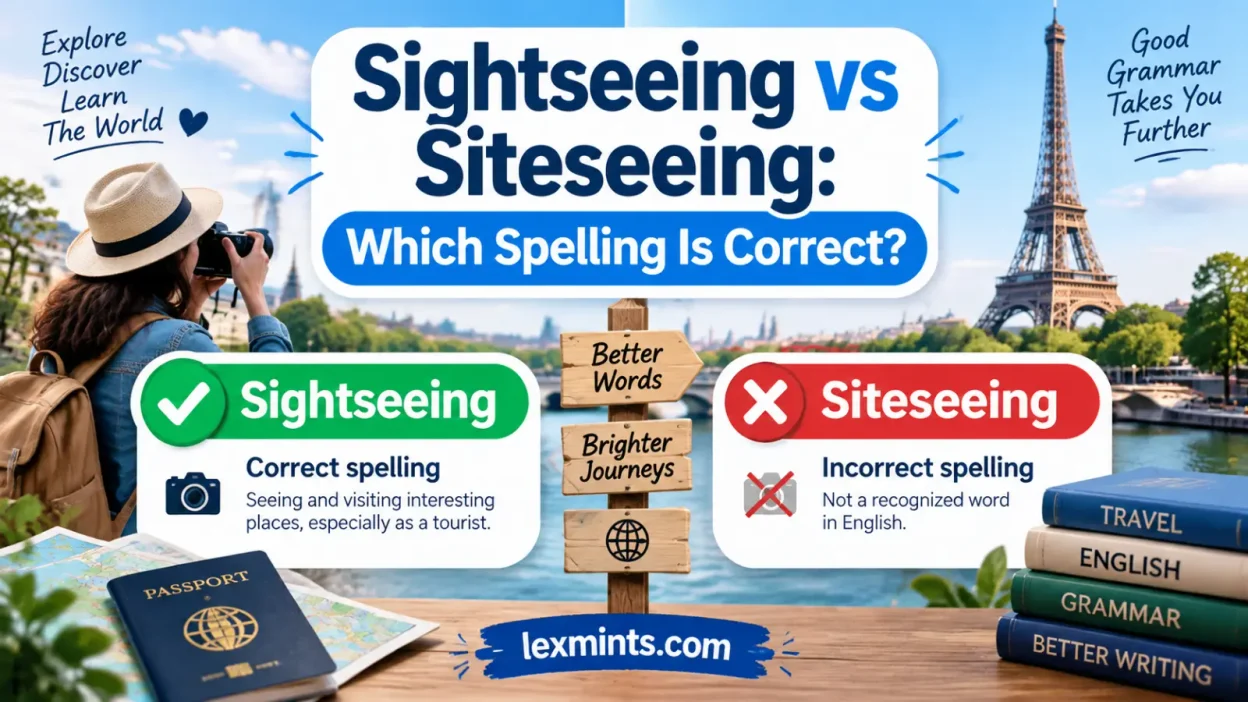
If you are confused about “sightseeing vs siteseeing,” you are not alone. The two spellings look very similar, but only one is the standard English spelling for visiting interesting places and attractions.
The correct spelling is sightseeing.
Siteseeing is generally considered a misspelling when you mean traveling around a place to visit famous landmarks, attractions, museums, historical sites, or other points of interest.
For example:
- Correct: We spent the afternoon sightseeing in New York City.
- Incorrect: We spent the afternoon siteseeing in New York City.
The word sightseeing combines sight, meaning something worth seeing, and seeing, meaning looking at or observing something. The spelling siteseeing is easy to create by mistake because travelers often visit different “sites,” but that is not the standard spelling of the activity.
Sightseeing vs Siteseeing: Quick Answer
Sightseeing is the correct spelling when you mean visiting and looking at interesting places or attractions, especially while traveling.
Siteseeing is not the standard spelling for this meaning.
| Spelling | Correct? | Meaning |
|---|---|---|
| Sightseeing | Yes | Visiting interesting or famous places and attractions |
| Siteseeing | No | Usually a misspelling of “sightseeing” |
Correct example
We went sightseeing after checking into our hotel.
Incorrect example
We went siteseeing after checking into our hotel.
If you are writing an article, travel guide, email, school assignment, or social media post, use sightseeing.
What Does Sightseeing Mean?
Sightseeing refers to the activity of visiting and observing interesting, famous, beautiful, or historically important places, especially while traveling.
People commonly go sightseeing when they visit a new city, country, or tourist destination.
For example:
- We went sightseeing around Washington, D.C.
- They spent two days sightseeing in Paris.
- She loves sightseeing when she travels.
- Our tour includes sightseeing at several historic landmarks.
Sightseeing can include visiting:
- Famous landmarks
- Museums
- Historic buildings
- Monuments
- Natural attractions
- Parks
- Cultural sites
- Famous neighborhoods
- Scenic viewpoints
- Tourist attractions
The central idea is that you are looking at and experiencing places of interest.
Why Is Sightseeing the Correct Spelling?
The spelling sightseeing comes from the word sight, not site.
A sight can mean something that is worth seeing or observing. When you travel to look at notable places and attractions, you are going sightseeing.
The word is formed from:
sight + seeing = sightseeing
The first part is sight, which connects to seeing or viewing something.
This is why sightseeing is the established spelling for the travel activity.
Many people mistakenly write siteseeing because a tourist often visits different sites. However, the meaning of the word is connected to sights, not simply to sites.
Compare these words
Sight means something seen or something worth seeing.
The Grand Canyon is an amazing sight.
Site usually means a particular location or place.
The museum was built on the site of an old building.
Both words are correct English words, but they have different meanings.
What Does Siteseeing Mean?
Siteseeing is generally a spelling mistake when someone intends to write sightseeing.
The confusion is understandable because site is a real English word.
A site can refer to a location, especially a particular place where something exists, happens, or is built.
For example:
- The construction site is closed.
- This is the site of the new hospital.
- Archaeologists discovered an ancient site.
- The company chose a new site for its headquarters.
However, these examples do not describe the tourist activity of visiting attractions.
When you mean traveling around a destination to see interesting places, use sightseeing.
Remember the difference
Sightseeing → visiting attractions and things worth seeing.
Site → a particular location or place.
This distinction makes the correct spelling easier to remember.
Sightseeing: Meaning and Usage
Sightseeing is commonly used as a noun to describe the activity of visiting attractions.
For example:
We went sightseeing during our vacation.
It can also appear in common travel expressions such as:
- go sightseeing
- enjoy sightseeing
- sightseeing tour
- sightseeing trip
- sightseeing bus
- sightseeing cruise
- sightseeing destination
- sightseeing activity
- sightseeing excursion
Here are some examples:
We went sightseeing after breakfast.
The hotel is close to several popular sightseeing attractions.
They booked a sightseeing tour of the city.
Our first day was spent sightseeing and taking photographs.
The river cruise is a popular sightseeing activity.
These examples show how naturally sightseeing fits into travel-related English.
Is Sightseeing One Word or Two?
The standard spelling is sightseeing, written as one word.
Correct:
We spent the day sightseeing.
Incorrect:
We spent the day sight seeing.
The compound noun sightseeing has become established as one word.
You will commonly see it in travel writing, tourism websites, advertisements, hotel descriptions, tour packages, and everyday conversation.
Correct forms
- sightseeing
- sightseeing tour
- sightseeing trip
- sightseeing bus
- sightseeing attractions
The word remains sightseeing when used as part of these expressions.
Is Sightseeing a Noun or a Verb?
This is another common point of confusion.
Sightseeing is generally used as a noun for the activity of visiting attractions.
For example:
Sightseeing is one of my favorite parts of traveling.
It also appears in the expression go sightseeing, where the phrase describes an activity.
We plan to go sightseeing tomorrow.
Although seeing is a form of the verb see, the complete word sightseeing functions as an established compound noun in common usage.
You do not normally write:
We went sight seeing.
Instead, write:
We went sightseeing.
Sightseeing vs Sight Seeing
Another spelling question involves “sightseeing” and “sight seeing.”
For the travel activity, sightseeing is the standard form.
For example:
We spent Saturday sightseeing in Chicago.
However, the separate words sight and seeing can appear together in a sentence for completely different grammatical reasons.
For example:
The accident was a frightening sight, and seeing it made everyone nervous.
Here, sight and seeing are separate words because they perform different grammatical functions.
The important rule is simple:
Use “sightseeing” as one word when you mean visiting attractions or interesting places.
Sightseeing vs Site: What Is the Difference?
Understanding sight and site is the easiest way to remember the spelling.
Sight
Sight relates to seeing, viewing, or something that is seen.
Example:
The sunset was a beautiful sight.
Site
Site refers to a location or place.
Example:
The workers prepared the site for construction.
The two words sound alike in many varieties of English, but they have different spellings and meanings.
That makes them homophones: words that sound the same but have different meanings and spellings.
When you combine the word with seeing to describe tourist activities, the correct form is:
sight + seeing = sightseeing
Not:
site + seeing = siteseeing
Common Examples of Sightseeing
Here are several natural examples using the correct spelling sightseeing:
- We went sightseeing in Boston.
- They spent the weekend sightseeing.
- I enjoy sightseeing when I visit a new city.
- The hotel offers a daily sightseeing tour.
- We took a bus for sightseeing.
- She went sightseeing with her family.
- Our vacation included plenty of sightseeing.
- We spent the morning sightseeing and the afternoon shopping.
- The city is famous for its sightseeing attractions.
- They booked a private sightseeing tour.
All of these sentences use sightseeing correctly.
Common Mistakes With Sightseeing
Because sightseeing and siteseeing look and sound similar, several mistakes are common.
Mistake 1: Writing Siteseeing
Incorrect:
We went siteseeing around the city.
Correct:
We went sightseeing around the city.
The activity is spelled sightseeing.
Mistake 2: Writing Sight Seeing
Incorrect:
We spent the weekend sight seeing.
Correct:
We spent the weekend sightseeing.
When referring to the tourist activity, write it as one word.
Mistake 3: Confusing Sight and Site
Incorrect reasoning:
Tourists visit different sites, so the word must be “siteseeing.”
The correct word is still sightseeing.
Although tourists may visit many sites, the established word for the activity is based on sight.
Sightseeing in American English
For a US audience, sightseeing is the standard spelling.
You will commonly encounter the word in American travel content, tourism information, hotel descriptions, vacation planning, and everyday conversation.
Examples include:
We are going sightseeing in San Francisco tomorrow.
The city has plenty of sightseeing opportunities.
Our hotel is within walking distance of several major sights.
We booked a sightseeing tour for Saturday.
There is no standard American-English spelling change that turns sightseeing into siteseeing.
Therefore, if you are writing for readers in the United States, sightseeing is the form to use.
Sightseeing in Travel Writing
The word sightseeing is especially common in travel-related writing.
Travel websites often use it to describe activities visitors can enjoy at a destination.
For example:
New York offers countless sightseeing opportunities.
Visitors can spend the day sightseeing around the city.
The tour combines sightseeing with a relaxing boat ride.
The guide includes recommendations for the best sightseeing spots.
Because travel content frequently discusses attractions and destinations, spelling sightseeing correctly is important.
A misspelling such as siteseeing can make otherwise professional travel content look careless.
Sightseeing vs Sightseeing Tour
The terms sightseeing and sightseeing tour are closely related but are not identical.
Sightseeing is the general activity.
We spent the afternoon sightseeing.
A sightseeing tour is an organized tour designed to show visitors attractions or points of interest.
We booked a sightseeing tour of the city.
Other common expressions include:
- sightseeing bus
- sightseeing cruise
- sightseeing excursion
- sightseeing trip
- sightseeing route
- sightseeing guide
- sightseeing attractions
All of these use the spelling sightseeing.
How to Remember the Correct Spelling
A simple memory trick can help you remember sightseeing.
Think:
Sight = something worth seeing.
Then:
Sight + seeing = sightseeing.
You can also remember this sentence:
When you go sightseeing, you see sights.
The words sight and sights are directly connected to the activity.
By contrast, site refers to a location.
For example:
We visited several historical sites while sightseeing.
Notice that both words can appear in the same sentence, but they have different meanings.
- sites = locations
- sightseeing = the activity of visiting and viewing attractions
Sightseeing vs Siteseeing Examples
The following examples make the difference clear.
Example 1
Correct:
We went sightseeing in Los Angeles.
Incorrect:
We went siteseeing in Los Angeles.
Example 2
Correct:
Our sightseeing tour begins at 9 a.m.
Incorrect:
Our siteseeing tour begins at 9 a.m.
Example 3
Correct:
I love sightseeing when I travel.
Incorrect:
I love siteseeing when I travel.
Example 4
Correct:
The city is known for its beautiful sights.
Correct:
The city has several historic sites.
These last two sentences demonstrate why sight and site should not be treated as interchangeable words.
Is Siteseeing Ever Correct?
In standard English, siteseeing is generally not the spelling you should use when referring to tourism or visiting attractions.
If you intend to describe the activity of looking at attractions while traveling, choose sightseeing.
You may occasionally encounter siteseeing as a typo, informal error, or wordplay involving the word site, but it should not replace the standard spelling in professional or educational writing.
For websites, blogs, school assignments, business communication, travel guides, and published content, sightseeing is the safe and standard choice.
Sightseeing: Synonyms and Related Expressions
If you want to avoid repeating sightseeing, several related expressions may work depending on the sentence.
Possible alternatives include:
- visiting attractions
- exploring the city
- touring the area
- visiting landmarks
- exploring local sights
- taking a tour
- visiting tourist attractions
- exploring points of interest
For example:
We spent the day sightseeing.
You could also write:
We spent the day exploring the city.
Or:
We spent the day visiting local attractions.
However, these alternatives do not mean exactly the same thing in every context. Sightseeing remains the most direct term for the general activity.
FAQs
Is sightseeing or siteseeing correct?
Sightseeing is correct when you mean visiting interesting or famous places while traveling. Siteseeing is generally a misspelling of sightseeing.
Is sightseeing one word?
Yes. When referring to the tourist activity, sightseeing is normally written as one word.
Why is sightseeing spelled with “sight”?
The word is connected to sight, meaning something that can be seen or is worth seeing. The established compound is sightseeing, not “siteseeing.”
Is siteseeing a word?
Siteseeing is not the standard spelling for the tourist activity of visiting attractions. In most contexts, it should be corrected to sightseeing.
What is the difference between sightseeing and visiting sites?
Sightseeing means traveling around to see interesting attractions or places. Visiting sites simply means going to particular locations. A person can visit many sites while sightseeing, but the two expressions are not interchangeable.
What is the correct phrase: sightseeing tour or siteseeing tour?
The correct phrase is sightseeing tour. For example: “We booked a sightseeing tour of the city.”
Conclusion
When choosing between sightseeing vs siteseeing, the correct spelling for the travel activity is sightseeing.
Sightseeing means visiting and viewing interesting, famous, beautiful, or historically important places, especially while traveling.
Siteseeing is generally a misspelling and should not be used in standard English for this meaning.
The easiest way to remember the difference is:
Sight + seeing = sightseeing
Think of it as seeing sights while traveling.
Quick rule
- ✅ Sightseeing — correct
- ❌ Siteseeing — incorrect for the standard tourism meaning
- ✅ Sightseeing tour — correct
- ❌ Siteseeing tour — incorrect
- ✅ Go sightseeing — correct
- ❌ Go siteseeing — incorrect
So, if you are writing about travel, vacations, landmarks, attractions, or exploring a new city, always choose sightseeing.


