
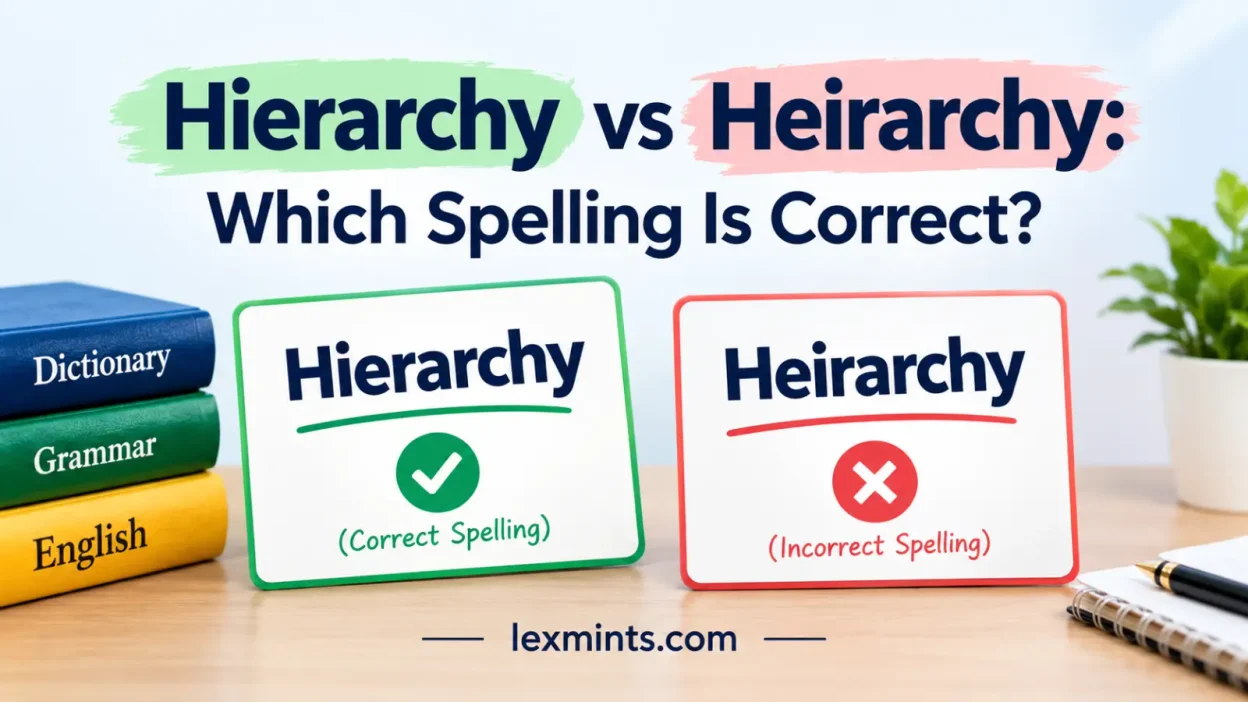
Hierarchy vs heirarchy is a common spelling confusion because both versions look similar, and the word contains a sequence of letters that can be difficult to remember. However, there is only one correct standard spelling in modern English.
The correct spelling is hierarchy.
Heirarchy is a misspelling and should not be used in formal writing, academic work, professional communication, or published content.
The word hierarchy refers to a system in which people, groups, objects, or ideas are arranged according to levels of importance, authority, rank, or status. You may encounter the word when discussing businesses, governments, social structures, organizations, computer systems, biology, or general categories of importance.
If you often write heirarchy instead of hierarchy, the easiest way to avoid the mistake is to remember that the correct word begins with hier-, not heir-.
Hierarchy vs Heirarchy: Quick Answer
The correct spelling is hierarchy.
- Correct: hierarchy
- Incorrect: heirarchy
Hierarchy is a noun that describes an arrangement based on levels, ranks, authority, or importance.
For example:
The company has a clear management hierarchy.
Another example is:
The organization follows a strict hierarchy of authority.
The spelling heirarchy is incorrect. Although it is a common spelling error, it is not the standard English form of the word.
What Does Hierarchy Mean?
Hierarchy means an organized system in which people, groups, things, or concepts are placed at different levels.
Usually, the levels represent differences in authority, power, importance, status, or responsibility.
For example, a large company may have several levels of management. A chief executive officer may be at the top, followed by senior managers, department managers, supervisors, and employees. This arrangement can be described as a management hierarchy.
The word can also be used outside the workplace.
Consider these examples:
- A military organization has a hierarchy of ranks.
- A school may have a hierarchy of administrative roles.
- A website can have a hierarchy of pages and categories.
- A biological system can have different levels of classification.
- A person may have a hierarchy of priorities.
In each case, hierarchy describes an ordered structure.
Why Is “Heirarchy” Incorrect?
Heirarchy is incorrect because it rearranges part of the spelling of hierarchy.
The correct spelling is:
H-I-E-R-A-R-C-H-Y
The incorrect version is:
H-E-I-R-A-R-C-H-Y
The confusion often happens because English contains the word heir, which is spelled H-E-I-R. An heir is a person who is legally or traditionally entitled to receive property, a title, or another inheritance.
Because hierarchy sounds somewhat similar to a word containing “heir,” some writers accidentally spell it as heirarchy.
However, the two words are unrelated in spelling.
A useful visual comparison is:
hierarchy → hier-
heirarchy → heir-
Only the first form is correct.
How to Spell Hierarchy Correctly
A simple way to remember the spelling is to divide the word into parts:
hier + arch + y
This gives:
hierarchy
The middle portion, arch, can also help you remember the structure.
Another useful approach is to focus on the first four letters:
H-I-E-R
Do not replace them with H-E-I-R.
So remember:
hierarchy starts with “hier,” not “heir.”
The correct spelling is hierarchy, with ie after the initial h.
Hierarchy: Meaning and Definition
As a noun, hierarchy refers to a system or structure in which elements are arranged into levels.
Those levels may be based on:
- Authority
- Rank
- Importance
- Power
- Status
- Responsibility
- Classification
- Priority
For example:
The manager occupies a high position in the company’s hierarchy.
Here, hierarchy describes the organizational structure that determines who has greater authority or responsibility.
Another example:
Safety should be at the top of the hierarchy of workplace priorities.
In this sentence, the word describes an ordered set of priorities.
Examples of Hierarchy in Everyday English
The word hierarchy appears in many everyday situations.
Workplace Hierarchy
Companies often have organizational hierarchies.
For example:
The company’s hierarchy includes executives, managers, supervisors, and employees.
This means the organization has several levels of authority.
Social Hierarchy
The word can also describe relationships between groups or individuals.
The animals established a social hierarchy within the group.
Here, the hierarchy refers to differences in social position.
Organizational Hierarchy
Schools, nonprofits, government agencies, and other institutions may have formal hierarchies.
The department follows a clear hierarchy of leadership.
This means different positions have different levels of authority.
Information Hierarchy
Websites and documents can also have a hierarchy.
For example:
The website uses a simple hierarchy that makes information easy to find.
In this context, hierarchy describes how information is organized from broad categories to more specific topics.
Is Hierarchy a Noun?
Yes. Hierarchy is a noun.
It names a system or arrangement based on levels.
Examples include:
- The company has a strict hierarchy.
- The hierarchy of the organization is clearly defined.
- Managers occupy different positions within the hierarchy.
- The website has a logical information hierarchy.
- The military uses a formal hierarchy of ranks.
The plural form is hierarchies.
For example:
Different organizations may have different hierarchies.
Notice that the ending changes from -y to -ies in the plural.
Hierarchy vs Hierarchical
The adjective form of hierarchy is hierarchical.
Hierarchy is the noun:
The company has a complex hierarchy.
Hierarchical is the adjective:
The company has a hierarchical management structure.
Both words are related, but they serve different grammatical purposes.
Other related forms include hierarchically, which is an adverb.
For example:
The information is organized hierarchically.
Understanding these forms can make it easier to recognize the correct spelling.
Common Sentences With Hierarchy
Here are several natural examples using hierarchy correctly:
- The organization has a clear hierarchy of leadership.
- Employees understand their position within the hierarchy.
- The military operates according to a strict hierarchy.
- The company is changing its management hierarchy.
- Social hierarchy can influence group behavior.
- The website has a simple information hierarchy.
- The manager sits near the top of the corporate hierarchy.
- Each department has its own hierarchy.
- The new system reduced unnecessary levels in the hierarchy.
- Understanding the hierarchy makes the organization easier to navigate.
These examples demonstrate how flexible the word can be.
Common Mistake: Heirarchy
One of the most common mistakes is writing:
Heirarchy
instead of:
Hierarchy
This error is understandable because heir is a real English word.
For example:
The heir inherited the family property.
In this sentence, heir is correct because it refers to a person who receives an inheritance or title.
However, hierarchy has a completely different meaning.
Compare:
The prince was the heir to the throne.
and:
The kingdom had a strict social hierarchy.
The first sentence uses heir. The second uses hierarchy.
Keeping these words separate can help prevent the spelling mistake.
Heir vs Hierarchy
The words heir and hierarchy may look related, but they should not be confused.
Heir
Heir is a noun referring to someone who is entitled to inherit property, money, a title, or another possession.
Example:
She was the heir to the family estate.
Hierarchy
Hierarchy is a noun referring to a system of levels or ranks.
Example:
The company has a traditional management hierarchy.
The important distinction is:
heir = person who inherits
hierarchy = system of levels
Remembering the meanings makes the spelling difference easier to retain.
Why Do People Spell Hierarchy as Heirarchy?
There are several reasons people make this mistake.
First, the pronunciation does not always make every letter obvious. English spelling frequently contains letters that are difficult to hear clearly.
Second, the word heir is familiar to English speakers. Because heir is spelled H-E-I-R, people may unconsciously insert that sequence into hierarchy.
Third, the sequence hier is relatively unusual compared with many common English letter combinations.
Finally, typing quickly can lead to spelling errors, especially when a person has seen the incorrect form repeatedly.
The important point is that heirarchy may be common as an error, but frequency does not make it correct.
Hierarchy in Business Writing
Hierarchy is especially common in business and professional writing.
It can describe management structures, reporting relationships, job positions, or organizational authority.
Examples:
The new structure simplifies the company’s hierarchy.
Employees can report concerns through the established management hierarchy.
The organizational hierarchy has been updated to reflect the company’s growth.
When writing business documents, using the correct spelling hierarchy is important because spelling mistakes can make otherwise professional writing look less polished.
Hierarchy in Academic Writing
The word is also widely used in academic contexts.
Students and researchers may discuss hierarchies in sociology, psychology, biology, computer science, education, political science, and other fields.
For example:
Researchers examined the social hierarchy within the group.
Or:
The classification system creates a hierarchy of categories.
When using the word in essays or research papers, always use hierarchy, not heirarchy.
Hierarchy in Technology and Web Design
The term hierarchy is common in technology, information architecture, and web design.
A website may have a hierarchy that begins with broad categories and moves toward individual pages.
For example:
Homepage → Category → Subcategory → Article
This structure can be described as a website hierarchy.
Designers may also discuss visual hierarchy, which refers to the way design elements are arranged so that users notice certain information before other information.
For example:
Good visual hierarchy helps users identify the most important information quickly.
Thus, hierarchy is not limited to people or organizations. It can also describe how information and visual elements are arranged.
Hierarchy in Biology
The word is also used in scientific contexts.
Biological classification organizes living organisms into different taxonomic ranks. Depending on the classification system, these ranks can include broad groups and increasingly specific categories.
You may therefore see phrases such as:
- taxonomic hierarchy
- biological hierarchy
- classification hierarchy
For example:
The taxonomic hierarchy organizes organisms into increasingly specific groups.
Again, the correct spelling is hierarchy.
Hierarchy in Social Structures
In social discussions, hierarchy can describe differences in status or influence between people or groups.
For example:
The study examined how social hierarchy affected group interactions.
The term does not necessarily mean that every hierarchy is formal or written down. Some hierarchies are informal and develop through social relationships.
This broad meaning is why hierarchy is useful in many different areas of writing.
Synonyms for Hierarchy
Depending on the context, possible alternatives to hierarchy include:
- Ranking
- Order
- Structure
- Scale
- System
- Organization
- Classification
- Chain of command
- Levels
- Grading
However, these words are not always exact replacements.
For example, chain of command specifically emphasizes authority and reporting relationships, while hierarchy can describe many kinds of ordered structures.
Antonyms and Contrasting Concepts
Depending on context, concepts that contrast with hierarchy may include:
- Equality
- Flat structure
- Decentralization
- Nonhierarchical organization
- Equal ranking
For example:
The company moved from a traditional hierarchy to a flatter organizational structure.
Here, hierarchy describes the traditional arrangement of multiple authority levels.
Memory Trick for Hierarchy
If you frequently misspell hierarchy, use this simple memory trick:
HIERARCHY has “HIER” at the beginning.
Think:
HIER + ARCH + Y = HIERARCHY
Do not think:
HEIR + ARCH + Y
Another way to remember it is to connect the word with hierarchical:
hierarchy → hierarchical
Both forms begin with hier-.
This can help reinforce the correct spelling.
Hierarchy vs Heirarchy in American English
For American English, the standard spelling is:
hierarchy
There is no standard American English variant spelled heirarchy.
If you are writing for a US audience, use hierarchy in:
- Blog posts
- Business documents
- Emails
- Academic papers
- Reports
- Websites
- Presentations
- Professional communication
The same standard spelling is also used broadly in standard English outside the United States.
Correct and Incorrect Examples
Here are some quick comparisons:
| Incorrect | Correct |
|---|---|
| heirarchy | hierarchy |
| organizational heirarchy | organizational hierarchy |
| social heirarchy | social hierarchy |
| management heirarchy | management hierarchy |
| corporate heirarchy | corporate hierarchy |
| information heirarchy | information hierarchy |
| hierarchical heirarchy | hierarchical hierarchy |
The key lesson is simple: whenever you mean an ordered system of levels, use hierarchy.
How to Avoid the Mistake
If hierarchy vs heirarchy is a recurring spelling problem, try these strategies.
Remember “HIER”
Memorize the first four letters:
H-I-E-R
This is the most important part of the spelling.
Connect It With Hierarchical
Remember:
hierarchy → hierarchical
Both start with hier-.
Associate the Meaning
Think:
hierarchy = levels
Then associate the word hierarchy with a ladder or organizational structure.
Use Spell Check
Modern word processors and browsers can identify heirarchy as a spelling error. However, learning the correct spelling is better than relying entirely on automatic correction.
Frequently Asked Questions
Is “hierarchy” or “heirarchy” correct?
Hierarchy is correct. Heirarchy is a misspelling.
What does hierarchy mean?
Hierarchy means a system in which people, groups, things, or ideas are arranged into levels according to factors such as authority, rank, importance, or status.
How do you spell hierarchy?
The correct spelling is H-I-E-R-A-R-C-H-Y: hierarchy.
Why is heirarchy wrong?
Heirarchy is a spelling error caused partly by confusion with the word heir. The standard spelling is hierarchy, which begins with hier-.
What is the plural of hierarchy?
The plural is hierarchies.
For example:
Different organizations have different hierarchies.
Is hierarchy a noun?
Yes. Hierarchy is a noun that refers to an organized system of levels or ranks.
What is the adjective form of hierarchy?
The adjective is hierarchical.
For example:
The company has a hierarchical management structure.
Is hierarchy used in American English?
Yes. Hierarchy is standard in American English and is widely used in professional, academic, technical, and everyday writing.
Conclusion
When choosing between hierarchy vs heirarchy, there is no difficult spelling variation to remember.
Hierarchy is correct.
Heirarchy is incorrect.
The best way to remember the spelling is to focus on the opening letters:
HIER-
not:
HEIR-
So whenever you want to describe a system of levels, ranks, authority, importance, or classification, write hierarchy.
Correct: The company has a clear management hierarchy.
Incorrect: The company has a clear management heirarchy.
Learning this small spelling distinction can help you avoid a common error in professional, academic, and online writing.


