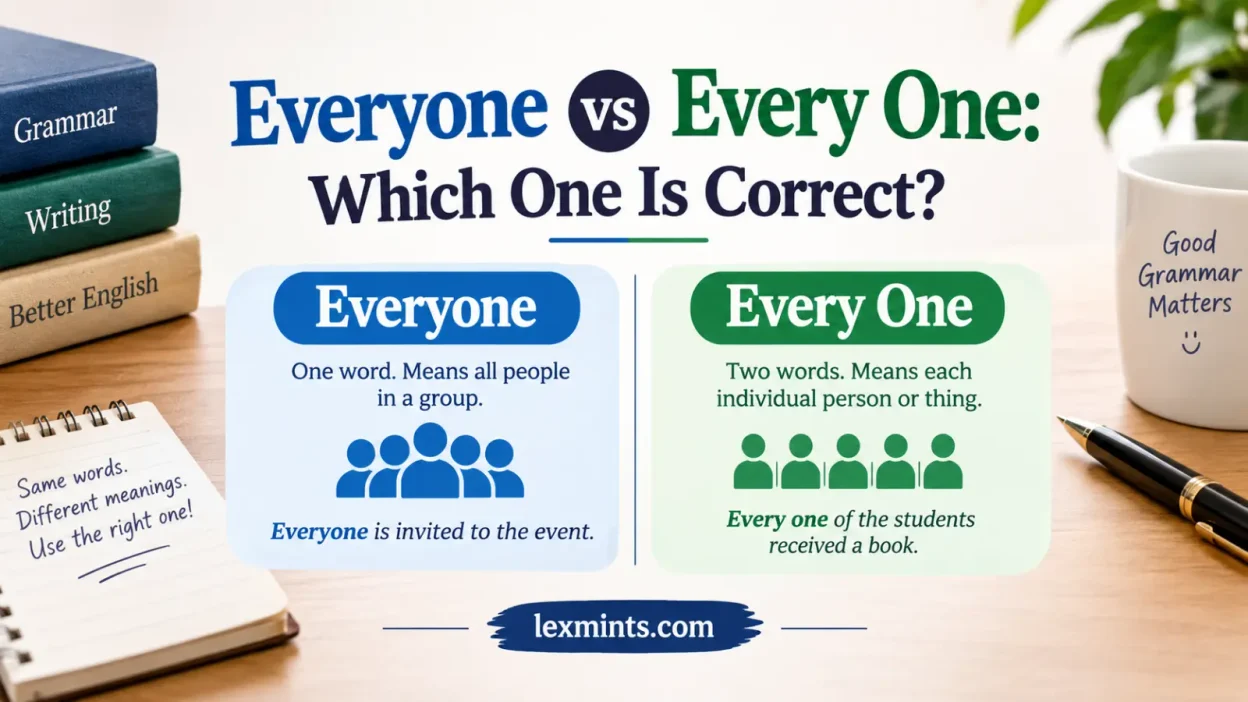
Everyone vs every one is a common English usage question. Although these two expressions look almost identical, they are not always used in the same way. The key difference is simple: everyone is an indefinite pronoun meaning “all people,” while every one means “each individual person or thing” and usually emphasizes the members of a group separately.
For example:
- Everyone enjoyed the party.
- Every one of the students submitted the assignment.
Both forms are correct, but they serve different grammatical purposes.
Understanding the difference between everyone vs every one can help you avoid common writing mistakes and choose the right expression in emails, essays, professional writing, and everyday communication.
Everyone vs Every One: The Quick Answer
Everyone is written as one word when it means all people or all the people in a particular group.
Everyone was excited about the trip.
Every one is written as two words when you mean each individual person or thing, especially when it is followed by of + noun or pronoun.
Every one of the employees received a bonus.
A useful shortcut is:
- Everyone = all people
- Every one = each individual person or thing
The distinction becomes especially clear when you look at the words that follow them.
What Does “Everyone” Mean?
Everyone is an indefinite pronoun. It refers to all people in a particular group or situation.
It is similar in meaning to everybody.
For example:
Everyone is welcome at the meeting.
Here, everyone means all the people who are invited or expected to attend the meeting.
Other examples include:
- Everyone enjoyed the movie.
- Everyone needs a break sometimes.
- Everyone knows the answer.
- Everyone was ready to leave.
- Everyone in the office received an email.
- Everyone should bring a notebook.
In each sentence, everyone refers to people collectively.
Everyone Is One Word
When you are using the word to mean all people, it should be spelled as one word:
Correct: Everyone
Incorrect: Every one
For example:
Everyone deserves respect.
You would not normally write:
Every one deserves respect.
The second version could theoretically have a different meaning in a carefully constructed context, but when you simply mean “all people,” everyone is the standard choice.
What Does “Every One” Mean?
Every one is a two-word expression. It emphasizes individual members or items within a group.
It can refer to people or things, depending on the context.
For example:
Every one of the students passed the test.
Here, every one means each individual student.
It can also refer to objects:
I checked every one of the documents.
In this sentence, every one means each individual document.
This is one of the most useful ways to recognize the difference between the two forms.
“Every One” Often Uses “Of”
A common structure is:
every one + of + noun/pronoun
Examples:
- Every one of the students
- Every one of the books
- Every one of my friends
- Every one of these questions
- Every one of them
- Every one of us
For example:
The phrase emphasizes each answer individually.
Everyone vs Every One: The Main Difference
The main difference is grammatical and semantic.
Everyone refers to people as a whole group.
Every one focuses on each individual member of a group or each individual item.
Compare these examples:
Everyone in the class passed the exam.
This means all members of the class passed.
Now consider:
Every one of the students in the class passed the exam.
This also means all students passed, but every one emphasizes each student individually.
The difference can be subtle because the overall meaning may be very similar. However, the grammatical structure tells you which form to use.
Examples of “Everyone”
Here are several examples showing how everyone is normally used:
Example 1
Everyone is invited to the celebration.
Here, everyone means all people who may attend.
Example 2
Everyone enjoyed the presentation.
The sentence refers to all the people who watched the presentation.
Example 3
Everyone needs to complete the form.
The word everyone refers to all members of the relevant group.
Example 4
Everyone in the room became quiet.
The expression means all people in the room.
Example 5
Everyone wants to feel appreciated.
The sentence makes a general statement about people.
In these examples, everyone is functioning as an indefinite pronoun.
Examples of “Every One”
Now look at examples using every one:
Example 1
Every one of the students completed the project.
The phrase refers to each student individually.
Example 2
I read every one of the articles.
Here, every one refers to each article.
Example 3
Every one of her answers was accurate.
The phrase emphasizes each individual answer.
Example 4
He inspected every one of the machines.
The expression refers to each machine separately.
Example 5
Every one of them agreed with the decision.
Here, every one emphasizes each person within the group.
Notice how frequently every one is followed by of. This is an important clue when deciding between the two forms.
Everyone vs Every One in Sentences
Comparing the two expressions side by side can make the difference easier to understand.
Everyone
Everyone was happy with the result.
Meaning: All the people were happy.
Every One
Every one of the team members was happy with the result.
Meaning: Each individual team member was happy.
Another comparison:
Everyone received a certificate.
This means all people received a certificate.
Every one of the participants received a certificate.
This emphasizes each individual participant.
Both sentences can communicate nearly the same basic idea, but the second construction places more emphasis on individual members.
Can “Every One” Refer to Things?
Yes. This is an important distinction.
Everyone normally refers to people.
Every one can refer to people or things.
For example:
Everyone was invited.
This refers to people.
But:
Every one of the paintings was sold.
Here, every one refers to paintings.
You can also say:
Every one of the cookies was eaten.
Because cookies are things, every one is the appropriate form.
This provides a useful test:
If you are referring to individual things, use every one, not everyone.
Everyone vs Every One With “Of”
The phrase every one of is extremely common in standard English.
Examples include:
Every one of the players worked hard.
Every one of these books is useful.
Every one of my friends attended the event.
Every one of the questions was answered.
Every one of them received a message.
In these sentences, every one means each individual member or item in the group.
A common mistake is to remove the space:
Everyone of the players worked hard.
This is incorrect when the intended structure is every one of.
The correct sentence is:
Every one of the players worked hard.
However, notice that this is different from:
Everyone worked hard.
Here, everyone is correct because it means all people.
Subject-Verb Agreement With “Everyone”
Although everyone refers to multiple people, it is grammatically treated as a singular indefinite pronoun.
Therefore, it normally takes a singular verb.
Correct:
Everyone is ready.
Correct:
Everyone has a copy.
Correct:
Everyone wants to participate.
Incorrect in standard formal English:
Everyone are ready.
Incorrect:
Everyone have a copy.
The same principle generally applies to every one when it functions as a singular expression:
Every one of the students is prepared.
Every one of the books has a different cover.
The noun after of may be plural, but the grammatical subject every one is singular.
Everyone vs Every One With Pronouns
Both expressions can appear with pronouns, but they work differently.
For example:
Everyone should bring their own notebook.
Here, everyone means all people.
With every one, you might say:
Every one of them should bring a notebook.
The phrase every one of them emphasizes each individual member of the group.
Another example:
Everyone was invited.
versus:
Every one of them was invited.
The first is more general. The second specifically emphasizes the individual people in the group.
Common Mistakes With Everyone and Every One
Because the expressions sound almost identical when spoken, they are frequently confused in writing.
Mistake 1: Using “Everyone” Before “Of”
Incorrect:
Everyone of the employees attended.
Correct:
Every one of the employees attended.
When of + group follows the expression, every one is usually the correct choice.
Mistake 2: Using “Every One” for “All People”
Incorrect in ordinary usage:
Every one should respect the rules.
Correct:
Everyone should respect the rules.
If you simply mean all people, use everyone.
Mistake 3: Using “Everyone” for Objects
Incorrect:
Everyone of the computers was inspected.
Correct:
Every one of the computers was inspected.
Since computers are things rather than people, every one is needed here.
Mistake 4: Forgetting the Singular Verb
Incorrect:
Everyone are excited.
Correct:
Everyone is excited.
Because everyone is grammatically singular, use a singular verb.
How to Remember the Difference
A simple memory trick can make this distinction much easier.
Think of everyone as a replacement for everybody.
If you can replace the expression with everybody, use everyone.
For example:
Everyone enjoyed the concert.
You can say:
Everybody enjoyed the concert.
The meaning remains essentially the same.
Now consider:
Every one of the books was expensive.
You cannot naturally replace every one of with everybody because the phrase refers to books.
Another helpful trick is to look for of.
If your sentence has this structure:
_____ of the group
you probably need:
every one
For example:
Every one of the employees
Every one of the houses
Every one of the questions
Every one of the children
Everyone vs Every One: A Quick Comparison Table
| Expression | Meaning | Refers To | Example |
|---|---|---|---|
| Everyone | All people | People | Everyone is ready. |
| Every one | Each individual member/item | People or things | Every one of the books is new. |
| Everyone of | Incorrect for the intended “each of” structure | — | Avoid this form. |
| Every one of | Each individual member/item | People or things | Every one of them agreed. |
The table shows why the space between every and one can change the grammatical structure of the sentence.
Everyone vs Every One in Formal Writing
Both forms are standard English when used correctly.
In formal writing, clarity is especially important because readers cannot rely on pronunciation or context as easily as they might in conversation.
For example:
Everyone in the department received a copy.
This is clear and concise.
If you want to emphasize individual items, use:
Every one of the reports was reviewed.
This tells the reader that each individual report was reviewed.
In professional emails, academic writing, reports, and articles, choosing the correct form helps make your writing precise.
Everyone vs Every One in Everyday English
In casual conversation, the distinction may not feel important because everyone and every one can sometimes communicate similar ideas.
For example:
Everyone at the party had fun.
and:
Every one of the guests had fun.
Both indicate that all the people had fun.
However, the second sentence gives more attention to the individual guests.
The distinction becomes more important in writing, particularly when every one refers to objects or follows of.
Is “Everyone” Always About People?
In standard English, everyone is used for people.
For things, use every one.
For example:
Everyone in the office received an invitation.
Here, everyone refers to people.
But:
Every one of the invitations was printed correctly.
Here, every one refers to invitations.
This is one of the easiest ways to distinguish the two forms.
Is “Every One” Grammatically Correct?
Yes. Every one is completely correct when it means each individual person or thing.
For example:
Every one of these products has been tested.
Every one of the children received a gift.
Every one of my questions was answered.
The important point is that every one is not simply an alternative spelling of everyone. The two forms have different grammatical functions.
Everyone vs Every One: Which One Should You Use?
Use everyone when you mean:
all people or every person in a particular group.
Examples:
Everyone is welcome.
Everyone knows that rule.
Everyone enjoyed the event.
Use every one when you mean:
each individual person or thing, especially when followed by of.
Examples:
Every one of the students passed.
Every one of the books was useful.
Every one of them agreed.
A quick question can help:
Am I talking about all people generally?
If yes, use everyone.
Am I emphasizing each individual person or thing in a group?
If yes, use every one.
FAQs
What is the difference between everyone and every one?
Everyone is one word and means “all people.” Every one is two words and means “each individual person or thing.” For example, “Everyone is welcome” refers to all people, while “Every one of the books is useful” refers to each individual book.
Is everyone one word or two words?
Everyone is one word when it means “all people” or “every person.” For example, “Everyone enjoyed the party.” When you mean each individual person or thing, use the two-word form every one.
When should I use every one instead of everyone?
Use every one when you want to emphasize each individual person or thing, especially before of. For example: “Every one of the students completed the assignment.” It can refer to people or objects.
Can every one refer to things?
Yes. Every one can refer to individual people or things. For example, “Every one of the documents was reviewed.” Everyone, on the other hand, normally refers to people.
Is “everyone of them” correct?
No. When you mean each individual member of a group, the correct expression is “every one of them.” For example: “Every one of them received a certificate.” Use everyone when you simply mean all people, as in “Everyone received a certificate.”
Conclusion
The difference between everyone vs every one is small in appearance but important in grammar.
Everyone is one word and means all people.
Everyone is invited.
Every one is two words and means each individual person or thing.
Every one of the guests is invited.
Remember these two formulas:
Everyone = all people
Every one = each individual person or thing
If you see of immediately after the expression, every one is usually the correct choice:
Every one of the students…
Every one of the answers…
Every one of them…
When you simply mean “all people,” use **everyone”:
Everyone is ready.
Once you understand this distinction, choosing between everyone and every one becomes straightforward. The key is to focus on whether you are referring to people as a whole or emphasizing each individual member or item.