
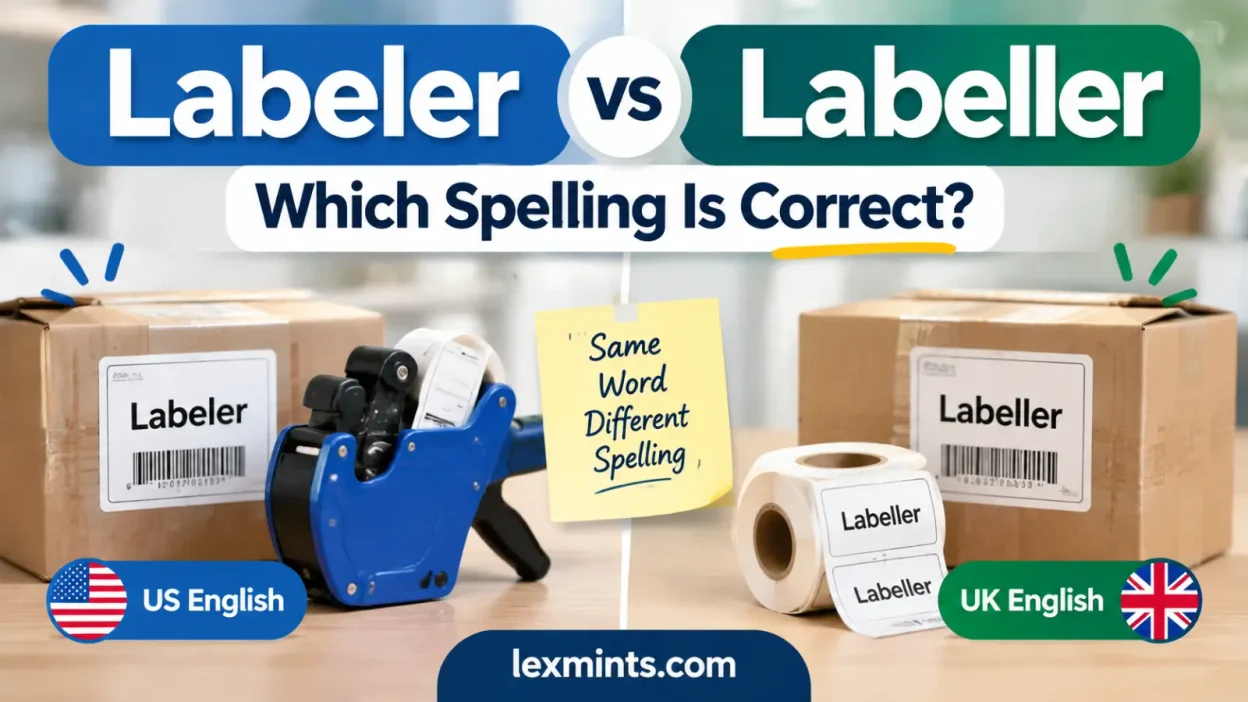
If you are wondering whether labeler or labeller is the correct spelling, both forms are valid, but the preferred spelling depends on the variety of English you are using.
Labeler is the standard spelling in American English, while labeller is more common in British English and other varieties that generally follow British spelling conventions.
Both words refer to a person, machine, or device that labels something. The difference is mainly a matter of spelling style rather than meaning.
For example:
- American English: The labeler printed the shipping labels quickly.
- British English: The labeller printed the shipping labels quickly.
If you are writing for a U.S. audience, use labeler. If you are following British English, labeller is the more typical choice.
Labeler vs Labeller: Quick Answer
The correct spelling depends on your preferred English variety:
| Spelling | English Variety | Meaning |
|---|---|---|
| Labeler | American English | A person or machine that labels something |
| Labeller | British English and other varieties | A person or machine that labels something |
In American English
Labeler is the preferred spelling.
The factory uses an automatic labeler to mark every package.
In British English
Labeller is commonly used.
The factory uses an automatic labeller to mark every package.
The two words have the same basic meaning. The extra l in labeller reflects the spelling convention commonly used in British English when forming certain words from label.
What Does Labeler Mean?
Labeler is a noun formed from the verb label. It describes someone or something that applies a label to an object.
A labeler may be:
- A person who puts labels on products
- A machine that attaches labels to packages
- A device used to print or apply labels
- Someone who identifies or categorizes things
The exact meaning depends on context.
For example:
The warehouse employee works as a labeler.
Here, labeler refers to a person whose job involves labeling items.
In another sentence:
The automatic labeler can process hundreds of bottles per hour.
Here, labeler refers to a machine.
The word can therefore describe either a human or a piece of equipment that performs the action of labeling.
What Does Labeller Mean?
Labeller has essentially the same meaning as labeler. It is the spelling commonly associated with British English.
For example:
The factory installed a new labeller for its beverage bottles.
The machine applies labels to the bottles, so labeller functions as a noun describing the device.
A person can also be called a labeller:
She worked as a labeller at the packaging facility.
In both examples, labeller means someone or something that labels.
The main difference is not meaning. It is the spelling convention used in different forms of English.
Why Are Labeler and Labeller Spelled Differently?
The difference comes from how English handles words ending in a single consonant when adding certain suffixes.
The base word is:
label
When the suffix -er is added, American English commonly produces:
label + er = labeler
British English often doubles the final l:
label + ler = labeller
This pattern can also be seen in other words.
For example:
- American English: traveler
- British English: traveller
And:
- American English: canceled
- British English: cancelled
The same general spelling distinction helps explain:
- labeler vs. labeller
- modeler vs. modeller
- traveling vs. travelling
However, English spelling conventions are not perfectly uniform, and individual dictionaries or style guides may differ.
Is Labeler Correct?
Yes. Labeler is a correct English spelling.
In particular, it is the standard and preferred form in American English.
If you are writing an article, business document, product description, instruction manual, or website content for readers in the United States, labeler is usually the best choice.
Examples:
The labeler automatically applies labels to each package.
We purchased a new labeler for the production line.
The software can control multiple industrial labelers.
The employee operates the bottle labeler.
These sentences use labeler naturally in American English.
Is Labeller Correct?
Yes. Labeller is also a correct English spelling.
It is commonly used in British English and other varieties of English influenced by British spelling conventions.
Examples:
The labeller automatically applies labels to each container.
The company purchased a new labeller for its packaging department.
The machine operator checked the labeller before starting production.
Therefore, labeller is not a misspelling. It simply follows a different spelling convention.
Labeler or Labeller in American English?
For American English, choose labeler.
This is especially important if your content is intended for a U.S. audience.
American English
The company bought a new labeler for its warehouse.
Less typical for a U.S. style
The company bought a new labeller for its warehouse.
The second sentence is understandable to American readers, but labeler is generally the preferred American spelling.
If your website consistently follows U.S. English, maintaining the spelling labeler throughout your content will make your writing more consistent.
Labeler or Labeller in British English?
For British English, labeller is the more typical spelling.
For example:
The manufacturer replaced its old labeller.
British spelling conventions often double the final l when adding certain suffixes to words such as label.
This is why you may encounter labeller in British publications, product documentation, and websites.
The important point is consistency. If a document follows British English throughout, labeller fits naturally with that style.
Labeler vs Labeller: Meaning
There is no significant difference in meaning between labeler and labeller.
Both can refer to:
- A person who labels something
- A machine that applies labels
- A device used for labeling
- Someone or something involved in assigning labels or classifications
Compare these sentences:
The labeler attached the shipping labels.
The labeller attached the shipping labels.
The meaning is essentially identical. The spelling changes according to the English variety being used.
Examples of Labeler in American English
Here are several natural examples using labeler:
Example 1
The warehouse uses an automatic labeler to prepare packages for shipping.
Example 2
The new labeler can print and apply labels automatically.
Example 3
The technician repaired the industrial labeler.
Example 4
Each labeler must be inspected regularly.
Example 5
The company purchased two high-speed labelers for its production line.
Example 6
The labeler stopped working during the afternoon shift.
Example 7
Employees were trained to operate the new labeler.
These examples show how labeler can refer to both people and machines, depending on context.
Examples of Labeller in British English
Here are equivalent examples using labeller:
Example 1
The warehouse uses an automatic labeller to prepare packages for dispatch.
Example 2
The new labeller can print and apply labels automatically.
Example 3
The technician repaired the industrial labeller.
Example 4
Each labeller must be inspected regularly.
Example 5
The company purchased two high-speed labellers for its production line.
Example 6
The labeller stopped working during the afternoon shift.
Example 7
Employees were trained to operate the new labeller.
Again, the meaning remains essentially the same. The spelling reflects the variety of English being used.
Labeler vs Labeller in Business Writing
Choosing between labeler and labeller can matter when you are preparing professional content.
Suppose an American company is creating a product page:
Our automatic labeler improves packaging efficiency.
Using labeler fits American English.
A British company might write:
Our automatic labeller improves packaging efficiency.
Both versions are grammatically acceptable.
The key is to match the spelling to your company’s target market and established style guide.
Labeler vs Labeller in Technical Writing
Technical writing often requires consistent terminology.
If a manual is written in American English, you might see:
The labeler must be connected to the conveyor before operation.
A British-English manual may instead use:
The labeller must be connected to the conveyor before operation.
Neither form changes the operation being described.
For international documentation, companies sometimes select one spelling and use it consistently throughout the entire manual.
Labeler vs Labeller in Job Titles
The word can also describe a worker whose duties involve labeling.
For example:
The company is hiring a labeler for its distribution center.
This is a natural American-English usage.
In British English, the corresponding form may be:
The company is hiring a labeller for its distribution centre.
Notice that spelling differences may appear elsewhere too. For example, American English commonly uses center, while British English uses centre.
This demonstrates why writers should consider the overall language variety rather than changing only one word.
Labeler vs Labeller: Pronunciation
The pronunciation of labeler and labeller is generally very similar.
The extra l in the spelling labeller does not create a major difference in pronunciation.
Both forms are derived from label, so the basic pronunciation of the word remains recognizable.
The important distinction is therefore primarily written spelling, not pronunciation.
Is Labeler More Common in the United States?
Yes. Labeler is the form generally preferred in American English.
American dictionaries and usage patterns commonly use the single-l form for this word.
If your content is aimed at American readers, especially for a U.S.-based website, labeler is the safest standard choice.
For example:
The labeler automatically attaches product information to each box.
This sentence follows standard American spelling.
Is Labeller More Common in the United Kingdom?
Yes. Labeller is commonly used in British English.
British spelling conventions frequently preserve the doubled l when adding certain suffixes to words ending in l.
For example:
- label → labelling
- label → labelled
- label → labeller
By comparison, American English commonly uses:
- label → labeling
- label → labeled
- label → labeler
This difference is part of a broader pattern between American and British spelling.
Labeler, Labelled, and Labeling
Understanding related forms can make the difference easier to remember.
In American English, you will commonly see:
- label
- labeled
- labeling
- labeler
Examples:
The boxes were labeled yesterday.
The machine is labeling the products.
The labeler is operating normally.
In British English, you will commonly encounter:
- label
- labelled
- labelling
- labeller
Examples:
The boxes were labelled yesterday.
The machine is labelling the products.
The labeller is operating normally.
The spelling pattern is consistent within each variety.
Labeler vs Labeller: Which One Should You Use?
Use labeler when writing in American English.
Use labeller when writing in British English or another variety that follows the British spelling convention.
A simple way to remember it is:
U.S. English → labeler
British English → labeller
If your audience includes both American and British readers, either form may be understood, but consistency is important. Choose the spelling that matches the primary style of your content.
Common Mistakes With Labeler and Labeller
One common mistake is assuming that one spelling is always correct and the other is always wrong.
That is not the case.
Mistake 1: Calling Labeller Incorrect
❌ Labeller is always wrong.
This is incorrect because labeller is a legitimate spelling used in British English.
Mistake 2: Calling Labeler Incorrect
❌ Labeler is a misspelling.
This is also incorrect. Labeler is a standard American-English spelling.
Mistake 3: Mixing Styles
A document might use:
The machine is labeling products with a new labeller.
The sentence is understandable, but it mixes American labeling with British labeller.
For a consistent American style, write:
The machine is labeling products with a new labeler.
For a consistent British style, write:
The machine is labelling products with a new labeller.
Consistency makes professional writing clearer and more polished.
How to Remember Labeler vs Labeller
A simple memory trick can help.
Think:
America = one L before -er → labeler
British = double L → labeller
You can also remember the related forms:
American English
labeled → labeling → labeler
British English
labelled → labelling → labeller
This makes it easier to choose the appropriate form when writing.
Labeler vs Labeller in Search Queries
People may search for both labeler and labeller, especially when looking for labeling equipment, job descriptions, software, or definitions.
However, the spelling you use in your content should match your target audience.
For a U.S.-focused website, phrases such as these are natural:
- automatic labeler
- industrial labeler
- bottle labeler
- package labeler
- labeler machine
- product labeler
For British audiences, you may encounter:
- automatic labeller
- industrial labeller
- bottle labeller
- package labeller
- labeller machine
- product labeller
Search engines can generally understand spelling variations, but maintaining the expected regional spelling improves consistency and user experience.
Labeler vs Labeller: Quick Comparison
| Feature | Labeler | Labeller |
|---|---|---|
| Correct spelling? | Yes | Yes |
| American English | Preferred | Less typical |
| British English | Less typical | Preferred |
| Meaning | Person or machine that labels | Person or machine that labels |
| Extra “l” | No | Yes |
| Common related form | labeling | labelling |
| Past-tense form | labeled | labelled |
The main distinction is therefore regional spelling.
FAQs
Is it labeler or labeller?
Both labeler and labeller are correct spellings. Labeler is preferred in American English, while labeller is commonly used in British English.
Is labeler the American spelling?
Yes. Labeler is the standard American English spelling. If you are writing for a U.S. audience, use labeler rather than labeller.
Is labeller the British spelling?
Yes. Labeller is commonly used in British English. It follows the British spelling pattern of doubling the final l in related forms such as labelled and labelling.
What is the difference between labeler and labeller?
There is essentially no difference in meaning. Both words can refer to a person, machine, or device that applies labels. The main difference is regional spelling: labeler is American English, while labeller is British English.
Which spelling should I use: labeler or labeller?
Use labeler if your content follows American English. Use labeller if you are following British English. The most important thing is to remain consistent with your chosen English style throughout your writing.
Conclusion
Both labeler and labeller are correct English spellings.
Labeler is the preferred form in American English, while labeller is commonly preferred in British English.
If you are writing for readers in the United States, choose:
Labeler
If you are writing according to British English conventions, choose:
Labeller
Neither spelling changes the basic meaning of the word. Both describe a person, machine, or device that labels something.
For a U.S.-focused website, the best choice is therefore labeler.
Final Examples
American English:
The automatic labeler applies labels to each package.
British English:
The automatic labeller applies labels to each package.
Both sentences are correct within their respective spelling conventions.
The easiest rule to remember is:
Labeler = American English
Labeller = British English
When in doubt, identify your target audience first and then use the spelling consistently throughout your article, website, product documentation, or professional writing.


