You may hear the word “hiatus” in school, work updates, or entertainment news. It often appears when something pauses for a short time but is expected to continue later. For example, TV shows go on hiatus between seasons, and teams may take a break from projects.
The word is common in news, social media updates, and everyday English conversations. It helps describe temporary breaks in activity without meaning something has ended completely.
In this article, you will learn the clear meaning of hiatus, how it is used, its grammar role, and real-life examples. You will also see common mistakes and simple ways to use it correctly in sentences.
QUICK ANSWER
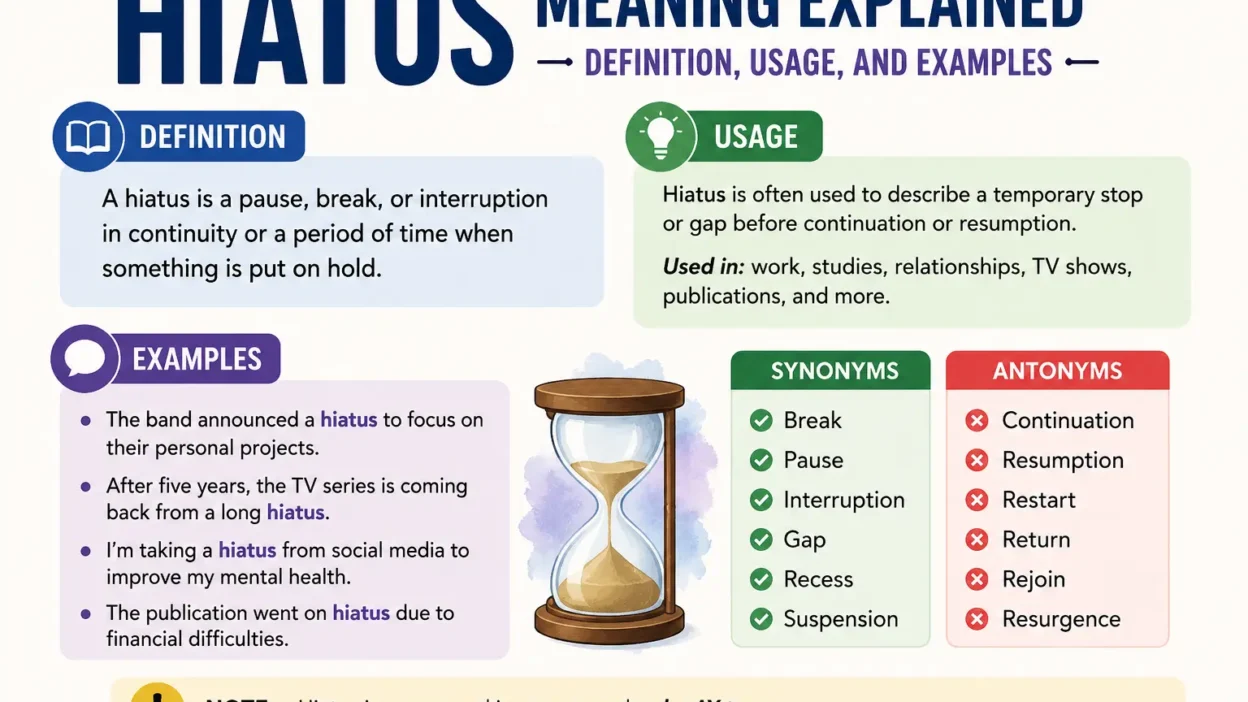
Hiatus meaning refers to a temporary break or pause in an activity, process, or series. It usually means something will continue later after stopping for a short time.
TL;DR
• Hiatus means a temporary break or pause
• It is not a permanent stop
• Common in TV, work, and projects
• Used as a noun in English
• Often implies something will continue later
WHAT DOES HIATUS MEAN?
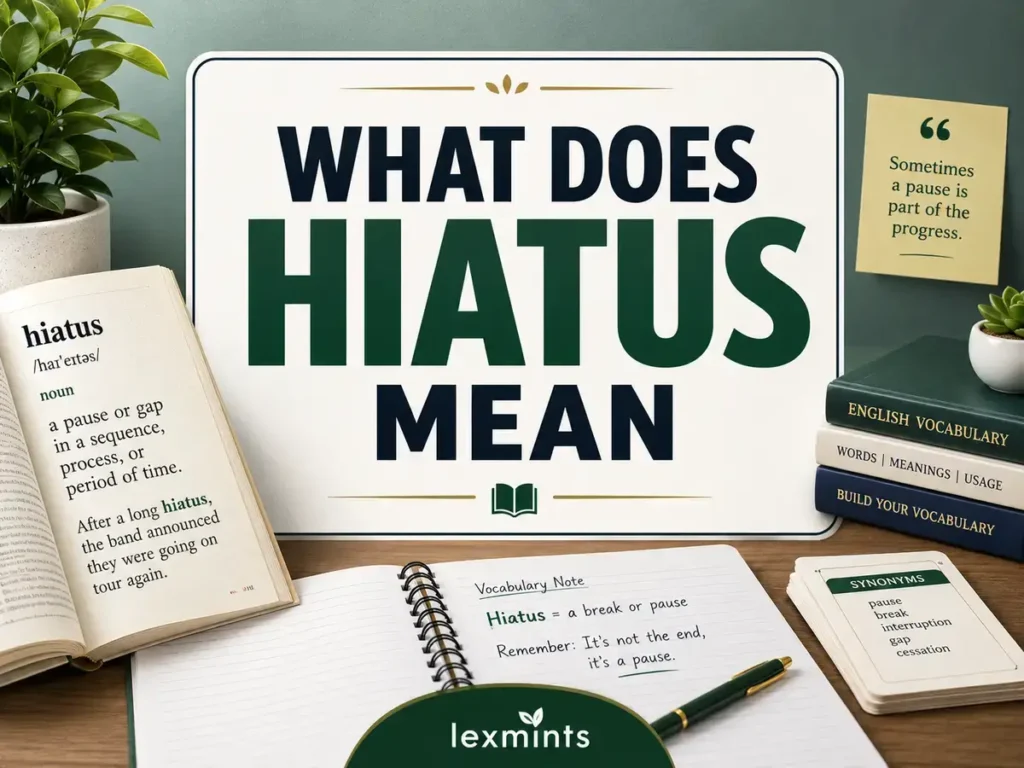
Hiatus is a noun in English. It means a short-term break or interruption in something that usually continues.
In simple terms, it is a pause, not an ending. The activity is expected to restart later.
Example:
• “The band is on hiatus” means the band is taking a break.
HIATUS IN SIMPLE ENGLISH

In everyday language, hiatus means “a break in action.”
It is often used when:
• Work stops temporarily
• A TV show pauses airing
• A project is delayed
The key idea is continuation after the pause.
PART OF SPEECH
Hiatus is a noun.
It refers to:
• A break in time
• A gap in activity
• A missing or paused period
Example:
• “There was a long hiatus in production.”
HOW HIATUS IS USED
Hiatus is used when something pauses but is expected to return.
Common uses include:
• TV shows
• Work or business projects
• Music bands
• Academic schedules
It shows temporary interruption, not failure.
Source Article URL Source Topic Target Article URL Target Topic Anchor Text Anchor Type Internal Link Sentence With HTML Placement Section Relevance Score /100 Priority Cannibalization Risk Notes
https://lexmints.com/hiatus-meaning/ Meaning and usage of “hiatus” as a temporary break https://lexmints.com/touch-grass-meaning/ Meaning and usage of the internet slang phrase “touch grass” touch grass Natural exact-match phrase A hiatus can also involve taking a break from online activity; in internet slang, someone may be told to touch grass when they need to step away from screens and reconnect with real life. Place in “HOW HIATUS IS USED,” immediately after “It shows temporary interruption, not failure.” 90 High No The pages have distinct primary search intents: one defines a general noun for a temporary pause, while the other explains an informal internet expression. The link creates a useful semantic connection around taking a break without suggesting that the terms are exact synonyms.
WHEN TO USE HIATUS
Use “hiatus” when:
• Something stops for a short time
• There is a planned or expected return
• The pause is not permanent
Example:
• “She took a short hiatus from work.”
WHEN NOT TO USE HIATUS
Do not use “hiatus” when:
• Something is permanently finished
• There is no plan to continue
Wrong:
• “The company closed on hiatus.”
Correct:
• “The company closed permanently.”
COMMON CONTEXTS
Hiatus appears often in:
• Entertainment (TV shows, music bands)
• Education (semester breaks)
• Work (career breaks)
• Business (project pauses)
It is widely used in news updates.
PRONUNCIATION
Hiatus is pronounced as:
hi-AY-tus
People sometimes stress the middle syllable.
SYNONYMS
Common synonyms include:
• Break
• Pause
• Interval
• Gap
• Interruption
These words are close but not always identical.
ANTONYMS
There is no perfect antonym, but opposite ideas include:
• Continuation
• Ongoing activity
COMMON MISTAKES
Wrong:
• “Hiatus means the end of something.”
Correct:
• “Hiatus means a temporary pause.”
Many learners confuse it with permanent stopping.
TV HIATUS EXAMPLE
In television, hiatus means a break between episodes or seasons.
Example:
• “The show is on winter hiatus.”
This means no new episodes are airing temporarily.
MINI QUIZ
- What does hiatus mean?
- Is it permanent or temporary?
- What part of speech is hiatus?
- Give one example sentence
Answers:
- A break or pause
- Temporary
- Noun
- “He is on hiatus from work.”
The exact sense of “hiatus” depends on the situation, so understanding the surrounding context can help you interpret whether it describes a break in work, entertainment, education, or another activity.
FAQ
What does hiatus mean in simple words?
It means a temporary break in something. The activity is expected to continue later.
Is hiatus a permanent stop?
No, it always refers to something temporary. It suggests continuation.
How do you use hiatus in a sentence?
You can say, “The project is on hiatus until next month.”
What is TV hiatus?
It is a break in a TV show’s schedule between episodes or seasons.
Is hiatus formal?
Yes, it is generally a formal or neutral word.
What is a synonym for hiatus?
Words like break, pause, or interval are common synonyms.
CONCLUSION
Hiatus is a simple but important word in English. It describes a temporary break, not a final stop. You will often see it in media, work, and everyday communication.