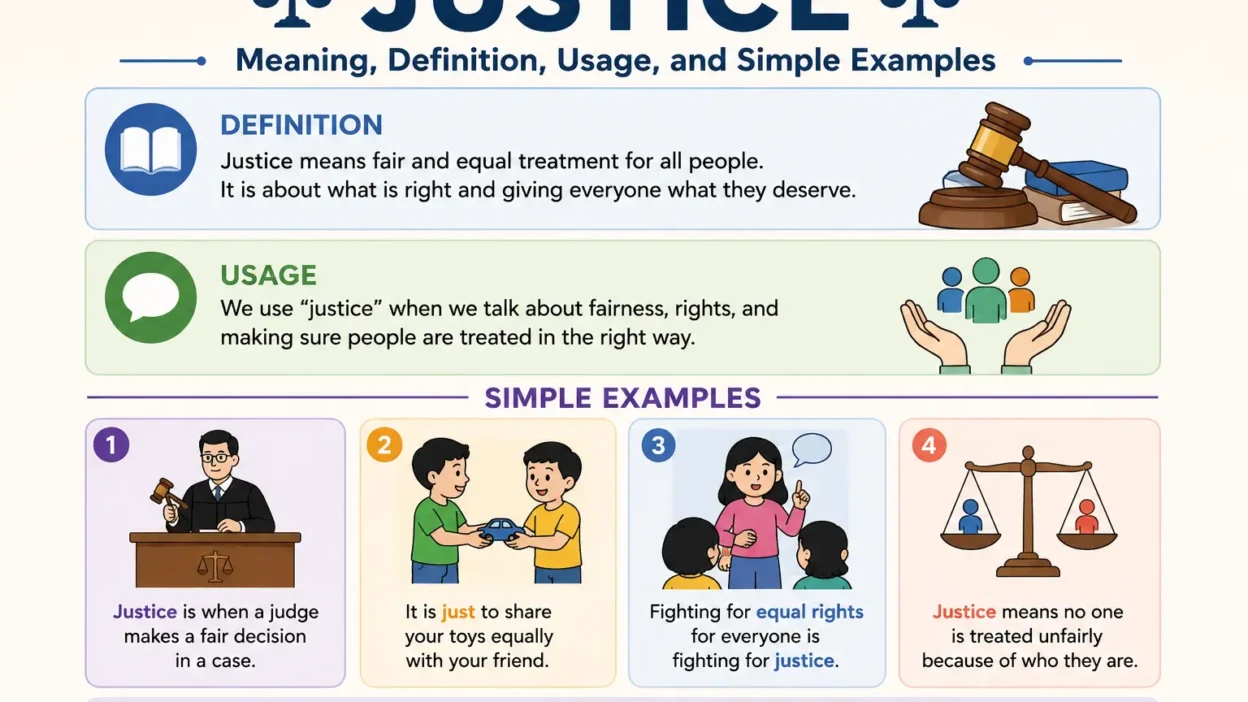
People often hear the word “justice” in news reports, court cases, movies, and daily conversations. It is a common English word with an important meaning. The term usually relates to fairness, laws, and treating people equally.
You may also hear phrases like “justice was served” or “bring someone to justice.” These expressions appear often in American English. Because of that, many English learners want a simple explanation.
This guide explains the justice meaning in plain English. You will learn how the word is used, how to pronounce it, common phrases, examples, and mistakes to avoid.
Quick Answer
Justice meaning refers to fairness and the proper treatment of people. It often relates to laws, rights, and equal treatment.
The word can also refer to a judge in a high court.
TL;DR
• Justice usually means fairness or equal treatment.
• It is commonly used in law and society.
• “Justice” is a noun in English.
• The word also means a high court judge.
• Common phrases include “justice served.”
• The opposite of justice is injustice.
What Does Justice Mean?
Justice means treating people fairly and correctly. It often involves following laws and protecting rights.
The word is strongly connected to fairness. If someone is punished fairly after a crime, people may say justice was done.
In simple terms, justice means:
• fairness
• equal treatment
• moral rightness
• proper use of laws
Example:
• The family wanted justice after the robbery.
Justice Definition in Plain English
In everyday English, justice means people receive fair treatment. Good actions are rewarded, and wrong actions are handled properly.
The meaning can change slightly by context.
| Context | Best Choice | Why |
| Court case | Justice | Connected to law and punishment |
| Equal treatment | Fairness | Focuses on balanced treatment |
| Moral behavior | Justice | Includes right and wrong |
Justice is often connected to:
• courts
• judges
• police
• human rights
• equality
Pronunciation of Justice
Justice is pronounced as:
/ˈdʒʌs.tɪs/
Simple pronunciation:
“JUHS-tiss”
The first part sounds like “just.”
Common mistake:
• Wrong: “joo-STICE”
• Correct: “JUHS-tiss”
Part of Speech: Is Justice a Noun?
Yes. Justice is mainly used as a noun.
Example:
• Justice matters in every society.
The word can also be a title for a judge.
Example:
• Justice Roberts spoke during the hearing.
In this case, “Justice” is a formal title.
Common Ways People Use “Justice”
People use the word in both formal and everyday situations.
Legal Use
In law, justice refers to fair judgment and punishment.
Examples:
• The court tried to deliver justice.
• Police promised justice for the victims.
Social Use
People also use the word when discussing equality and rights.
Examples:
• Many groups fight for social justice.
• Students demanded justice and fairness.
Justice in Everyday English
You do not need to work in law to use this word. Many people use it in daily speech.
Examples:
• It is not justice if only one side is heard.
• She wanted justice after being treated unfairly.
• Parents should teach children about justice.
The word often carries a serious tone. It is more formal than “fairness.”
Common Phrases With Justice
Bring Someone to Justice
This means making someone face legal punishment.
Example:
• The police worked hard to bring the criminal to justice.
Justice Is Served
This phrase means fairness or punishment finally happened.
Example:
• After the decision, many people felt justice was served.
Poetic Justice
This means someone experiences a result they deserve, often in an ironic way.
Example:
• The dishonest player lost the game. It was poetic justice.
Synonyms and Antonyms of Justice
Synonyms
Some close synonyms include:
• fairness
• equity
• impartiality
• righteousness
These words are similar but not always exact matches.
For example, “equity” often focuses on equal opportunity.
Antonyms
The main antonym is:
• injustice
Example:
• Many people protested against injustice.
Justice vs Fairness
Justice and fairness are closely related, but they are not always identical.
Fairness usually means treating people equally. Justice may also involve laws, rights, and moral responsibility.
Example:
• Fairness: Every student gets the same test.
• Justice: A disabled student receives needed support.
Justice can sometimes require different treatment to achieve fairness.
Common Mistakes When Using “Justice”
Using It Like a Verb
Justice is not commonly used as a verb.
• Wrong: “The court justiced the case.”
• Correct: “The court delivered justice.”
Confusing Justice With Revenge
Justice focuses on fairness and law. Revenge focuses on personal anger.
• Wrong idea: Justice means hurting someone back.
• Better idea: Justice means fair consequences.
Overusing It in Casual Situations
The word sounds serious. In casual speech, “fair” may sound more natural.
• Formal: “We demand justice.”
• Casual: “That is not fair.”
Examples of Justice in Sentences
• The judge promised justice for the victims.
• Everyone deserves justice under the law.
• She fought for justice in her community.
• The decision brought a sense of justice.
• Justice was finally served after many years.
• The Supreme Court justice wrote the opinion.
Mini Quiz
1. What does justice usually mean?
A. Noise
B. Fair treatment
C. Celebration
2. Is justice a noun?
A. Yes
B. No
3. What is the opposite of justice?
A. Equality
B. Fairness
C. Injustice
4. What does “bring to justice” mean?
A. Celebrate someone
B. Punish fairly through law
C. Ignore a crime
Answer Key
- B
- A
- C
- B
FAQ
What does justice mean in simple words?
Justice means fairness and proper treatment. It often relates to laws, rights, and equal treatment.
Is justice a noun or verb?
Justice is mainly a noun. It is not commonly used as a verb in modern English.
What is justice in law?
In law, justice means fair judgment and punishment through the legal system.
How do you pronounce justice?
Justice is pronounced “JUHS-tiss.”
Can justice mean a judge?
Yes. In American English, “Justice” can be a title for a high court judge.
What does “justice served” mean?
It means fairness or proper punishment finally happened.
What is the opposite of justice?
The opposite of justice is injustice.
Conclusion
The justice meaning centers on fairness, equal treatment, and proper use of laws. It is an important word in both daily English and legal discussions.
Understanding how to use “justice” correctly can improve your speaking and writing. Try using the example sentences above in your own conversations.