
You often see the word “arbitrary” in school, law, or everyday writing. It usually describes decisions or actions that are made without clear rules or logic. This can feel confusing because it does not always mean “random.”
Understanding this word helps you read instructions, legal texts, and opinions more clearly. It also helps you notice when a decision is based on personal choice instead of fair reasoning.
In this guide, you will learn the meaning of arbitrary, how it is used, common examples, pronunciation, and simple mistakes to avoid. Everything is explained in clear, everyday English.
QUICK ANSWER
The arbitrary meaning refers to something decided without clear reason, system, or fairness. It often depends on personal choice instead of rules.
TL;DR
• Means based on personal choice, not rules
• Often used in law and decision-making
• Can describe unfair or random actions
• Not always the same as “random”
• Common in formal writing and speech
WHAT DOES ARBITRARY MEAN?

“Arbitrary” describes something done without a clear plan, rule, or reason. It often depends on personal judgment instead of logic.
For example, if a teacher picks a student without a system, that choice can be called arbitrary.
It is commonly used in formal writing, law, and discussions about fairness.
ARBITRARY AS A PART OF SPEECH

“Arbitrary” is an adjective. It describes nouns like decisions, rules, or actions.
Examples:
• arbitrary decision
• arbitrary rule
• arbitrary behavior
It is not used as a verb or noun in standard English.
SIMPLE MEANING IN ENGLISH
In simple words, arbitrary means “chosen without a clear reason.”
It can describe:
• A choice made without explanation
• A rule based on personal preference
• A judgment not based on facts
Example:
The manager made an arbitrary decision to change schedules.
IS ARBITRARY THE SAME AS RANDOM?
Not exactly.
| Context | Best Choice | Why |
| No pattern at all | random | no control or intent |
| Personal decision | arbitrary | based on judgment |
Arbitrary often includes human choice, while random removes control completely.
COMMON CONTEXTS
You will see “arbitrary” in:
• Law and government decisions
• Workplace rules
• School policies
• Academic writing
• Everyday opinions
Example:
An arbitrary rule at work might feel unfair if it changes often.
ARBITRARY IN LAW AND RULES

In legal use, arbitrary means a decision made without fair reasoning or legal standards.
It often describes:
• unfair punishment
• uncontrolled authority
• inconsistent rules
Example:
A court may reject an arbitrary penalty if it lacks justification.
SYNONYMS AND ANTONYMS
Synonyms:
• random (sometimes)
• subjective
• capricious
• uncontrolled
Antonyms:
• fair
• logical
• structured
• consistent
PRONUNCIATION
arbitrary: /ˈɑːr-bɪ-trer-i/
Many people stress the first syllable: AR-bi-truh-ree
Common mistake:
Saying “arbi-trary” with equal stress on all parts.
COMMON MISTAKES
People often think:
• Arbitrary always means random → not always true
• Arbitrary means fair → incorrect
Correct understanding:
It usually means based on personal choice, not structured rules.
EXAMPLES
• The teacher made an arbitrary seating arrangement.
• The rule seemed arbitrary and unfair to students.
• The company avoided arbitrary pricing changes.
WHEN TO USE IT
Use “arbitrary” when describing:
• decisions without clear rules
• actions based on personal judgment
• systems that feel inconsistent
WHEN NOT TO USE IT
Avoid it when:
• something is fully random with no control
• a system is clearly structured and fair
MINI QUIZ
- What does arbitrary mean?
- Is it always positive?
- Give one example sentence.
Answers:
- Based on no clear rule or reason
- No, often neutral or negative
- Any correct sentence using the word
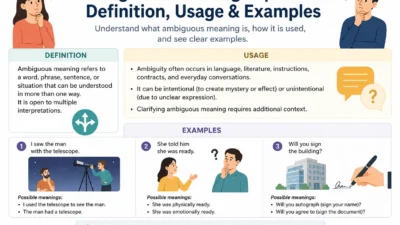
If you’re also unsure how unclear or open-to-more-than-one-meaning language works, explore our guide to <a href=”https://lexmints.com/ambiguous-meaning/“>ambiguous meaning</a> for a clear definition, examples, and everyday usage.
FAQ
What does arbitrary mean in simple words?
It means something decided without clear rules or reason. It depends on personal judgment.
Is arbitrary positive or negative?
It is usually neutral but often used negatively when describing unfair decisions.
What is an example of arbitrary?
Choosing a winner without rules is an arbitrary choice.
Does arbitrary mean random?
Not always. It can involve personal choice, not pure chance.
What is the opposite of arbitrary?
Fair, logical, or structured decisions.
Something can be unclear without being arbitrary. Learn the ambiguous meaning to understand how unclear wording can allow more than one possible interpretation.
CONCLUSION
The word arbitrary describes decisions made without clear rules or structure. It often depends on personal judgment and can feel unfair in some situations.
To understand how context shapes the meaning of a word, phrase, or idea, read our complete guide to <a href=”https://lexmints.com/context-meaning/“>context meaning</a> with clear explanations and examples.