Empathy is one of the most important words in modern communication, psychology, and everyday life. It describes how people understand and emotionally connect with others.
You hear it in conversations about relationships, workplace behavior, education, mental health, and leadership because it plays a key role in how humans interact.
This guide explains the full empathy meaning in simple, clear English with examples, comparisons, and real-world usage so you can fully understand how it works.
What Is Empathy? (Simple Meaning)
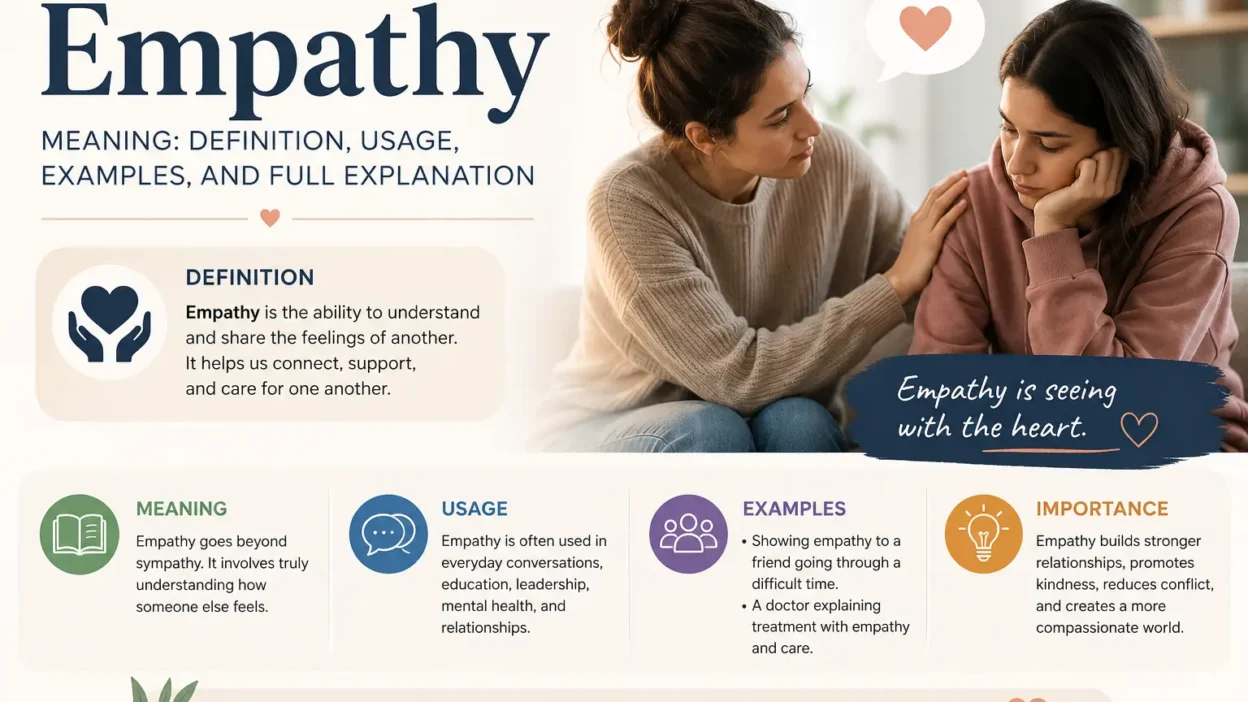
Empathy means the ability to understand and share another person’s feelings by putting yourself in their situation.
In simple words, it is:
- Understanding how someone feels
- Feeling emotionally connected to their experience
- Seeing a situation from another person’s perspective
It is often described as “putting yourself in someone else’s shoes.”
Empathy is often discussed alongside other types of perception and understanding in language and psychology. To explore how personal interpretation shapes meaning, you can also read about subjective meaning, which explains how individuals interpret ideas differently based on personal experience and perspective.
Empathy Definition in English
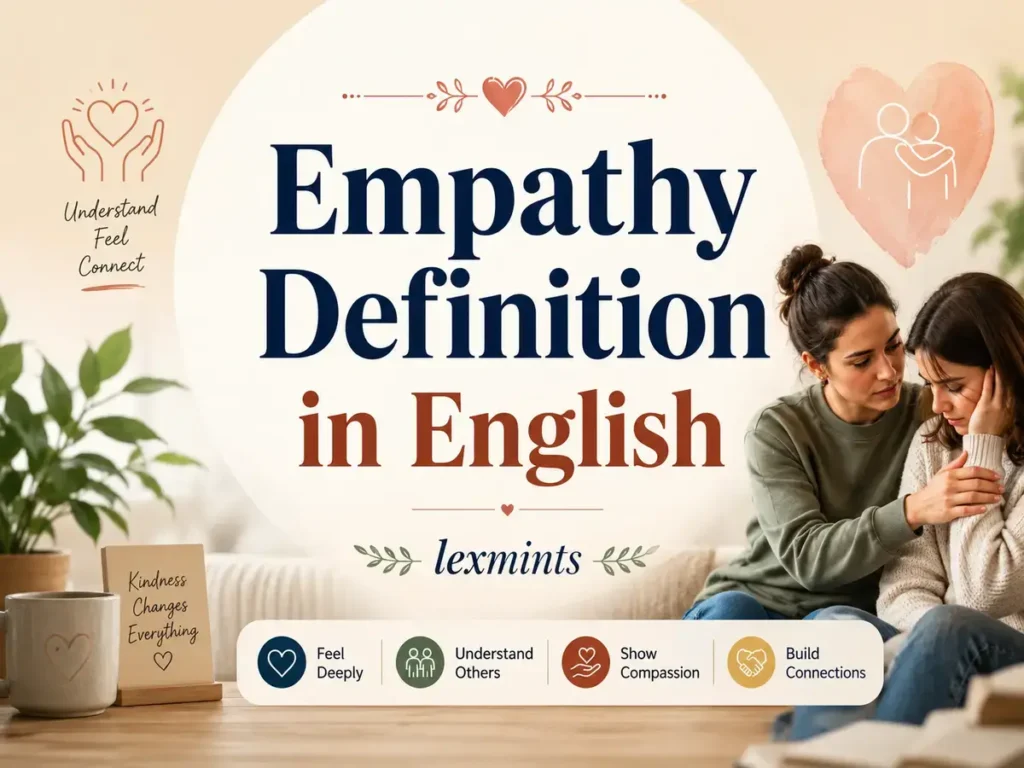
Empathy is a noun that refers to the emotional ability to understand another person’s thoughts, feelings, and experiences.
It goes beyond just noticing emotions—it involves mentally and emotionally connecting with them.
Etymology (Origin of the Word Empathy)
The word “empathy” comes from the Greek word “empatheia”, meaning “passion” or “physical affection.”
It was later adapted into modern psychology to describe emotional understanding between individuals.
Types of Empathy
Understanding empathy becomes easier when you know its main types:
Cognitive Empathy
The ability to understand what someone else is thinking.
Example: A manager understands why an employee feels stressed.
Emotional (Affective) Empathy
Actually feeling what another person feels.
Example: Feeling sad when a friend is crying.
Compassionate Empathy
Understanding feelings and taking action to help.
Example: Helping someone in need after understanding their struggle.
In today’s fast-paced online world, emotional expression often blends with internet culture and Gen Z slang meaning, shaping how people communicate feelings quickly.
How to Pronounce Empathy
Empathy is pronounced as:
em-puh-thee
The stress is on the first syllable: EM
Part of Speech and Word Forms
Empathy is a noun.
Related Words:
- Empathy (noun): “She showed empathy.”
- Empathetic (adjective): “He is empathetic.”
- Empathic (adjective): “She gave an empathic response.”
- Empathize (verb): “I empathize with your situation.”
Empathy in Real-Life Situations
Empathy appears in many everyday contexts:
In Relationships
Understanding a partner’s emotional struggles without judgment.
In Schools
Teachers helping students feel understood and supported.
In Healthcare
Doctors comforting patients with emotional awareness.
In Workplaces
Managers understanding employee stress and workload pressure.
In Social Media
Responding to others with kindness instead of criticism.
Examples of Empathy in Sentences
- “She showed empathy when her friend lost a loved one.”
- “Doctors must use empathy when treating patients.”
- “Good leaders practice empathy in decision-making.”
- “He listened with empathy instead of judging.”
- “Empathy helps build strong relationships.”
Empathy vs Sympathy vs Compassion
These three words are related but not the same.
| Concept | Meaning | Example |
| Empathy | Understanding someone’s feelings | “I understand your pain.” |
| Sympathy | Feeling sorry for someone | “I feel bad for you.” |
| Compassion | Understanding + desire to help | “I want to help you.” |
Simple Explanation:
- Empathy = Feel with someone
- Sympathy = Feel for someone
- Compassion = Act to help someone
In today’s digital world, empathy is also important in online conversations, especially when understanding tone, intent, and modern internet slang and expressions used across social media platforms.
Why Empathy Is Important
Empathy plays a major role in:
- Building strong relationships
- Improving communication
- Reducing conflicts
- Strengthening leadership
- Enhancing emotional intelligence
- Creating social trust
People with strong empathy tend to connect better with others and resolve problems more effectively.
Empathy and Emotional Intelligence

Empathy is a key part of emotional intelligence (EQ).
It helps people:
- Understand emotions (their own and others’)
- Respond appropriately in social situations
- Build trust and cooperation
Without empathy, communication often becomes cold or ineffective.
How to Develop Empathy
Empathy can be improved with practice:
- Listen without interrupting
- Try to understand others’ perspectives
- Pay attention to body language
- Avoid quick judgment
- Ask thoughtful questions
- Practice active listening
Common Mistakes With Empathy
Mistake 1: Confusing empathy with sympathy
Empathy is deeper emotional understanding, not just feeling sorry.
Mistake 2: Using it as an adjective
Incorrect: “She is empathy.”
Correct: “She is empathetic.”
Mistake 3: Overusing the word
Not every polite reaction is empathy.
Synonyms and Related Words
- Understanding
- Compassion
- Sensitivity
- Emotional awareness
- Connection
Antonyms of Empathy
- Indifference
- Insensitivity
- Coldness
- Detachment
FAQs
what is the simple meaning of empathy?
Empathy means understanding and sharing another person’s feelings.
is empathy a skill or a feeling?
Empathy is both an emotional ability and a skill that can be developed.
what is the difference between empathy and sympathy?
Empathy means understanding feelings deeply, while sympathy means feeling sorry for someone.
can empathy be learned?
Yes, empathy can be improved through listening, awareness, and practice.
why is empathy important in daily life?
It helps people build better relationships, communicate clearly, and reduce misunderstandings.
Conclusion
Empathy meaning refers to the ability to understand and emotionally connect with another person’s experience. It is a key part of human communication, emotional intelligence, and healthy relationships.