You may see the word “ambiguous” in school, books, conversations, or online comments. It often appears when something is not fully clear or can be understood in more than one way. Writers, lawyers, teachers, and even social media users use it when meaning is open to interpretation.
Understanding this word helps you avoid confusion in reading and communication. It also helps you write more clearly when needed. In this article, you’ll learn what “ambiguous meaning” is, how it works, and how people use it in real life. You’ll also see examples, common mistakes, and simple tips to recognize it quickly.
QUICK ANSWER
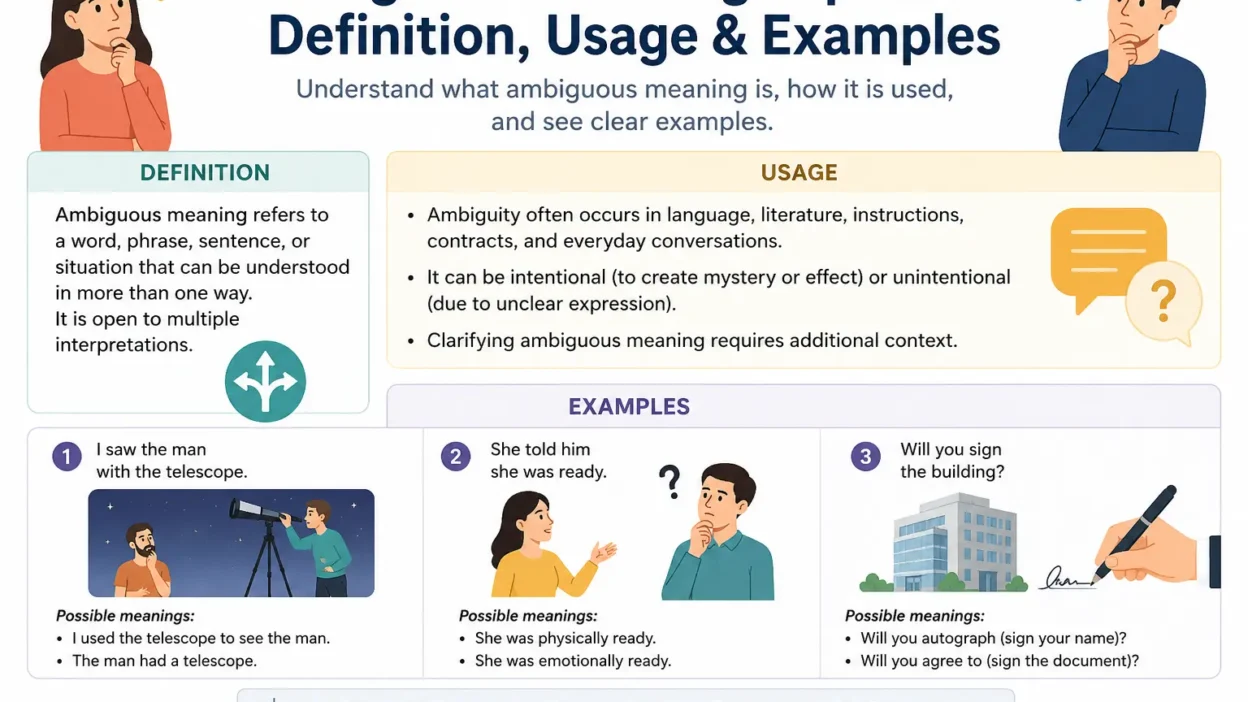
Ambiguous meaning refers to something that can be understood in more than one way. It creates uncertainty because the message is not fully clear or has multiple interpretations.
TL;DR
• Means something has more than one possible meaning
• Often causes confusion in sentences or messages
• Can be intentional or accidental
• Common in writing, speech, and law
• Opposite of clear or unambiguous meaning
WHAT “AMBIGUOUS” MEANS
“Ambiguous” is an adjective. It describes language, statements, or situations that are not clear. A single sentence can be ambiguous if it supports more than one meaning.
For example, a sentence like “I saw her duck” is ambiguous. It can mean a bird or a movement.
The word comes from Latin roots meaning “to wander between two choices,” which fits its modern use.
SIMPLE DEFINITION IN EVERYDAY ENGLISH
In simple terms, ambiguous means:
• Not clearly understood
• Having two or more meanings
• Open to different interpretations
If someone says something ambiguous, you may need more context to understand it correctly.
PRONUNCIATION
Ambiguous is pronounced:
• am-BIG-yoo-us
People sometimes stress the wrong part, but the middle syllable “BIG” is strongest.
PART OF SPEECH
Ambiguous is an adjective.
It describes nouns like:
• statement
• sentence
• answer
• situation
Example:
• “His answer was ambiguous.”
HOW AMBIGUOUS IS USED
Ambiguous is used when meaning is unclear or confusing. It often appears in:
• Writing and grammar
• Legal documents
• Conversations
• News or headlines
Example:
• “The instructions were ambiguous, so students got confused.”
COMMON TYPES OF AMBIGUITY
1. Sentence Ambiguity
A full sentence has two meanings.
Example:
• “She told him she was late.” (Who was late?)
2. Word Ambiguity
A single word has multiple meanings.
Example:
• “Bat” (animal or sports equipment)
COMMON MISTAKE
People sometimes confuse “ambiguous” with “ambivalent.”
Wrong:
• “I feel ambiguous about pizza.”
Correct:
• “I feel ambivalent about pizza.” (mixed feelings)
Ambiguous is about unclear meaning, not emotions.
SYNONYMS AND ANTONYMS
Synonyms (similar meaning)
• unclear
• vague
• unclear
• confusing
Antonyms (opposite meaning)
• clear
• obvious
• unambiguous
AMBIGUOUS VS CLEAR
| Situation | Best Choice | Why |
| legal contract | clear | avoids misunderstanding |
| poetry | ambiguous | allows multiple meanings |
| instructions | clear | reduces confusion |
REAL-LIFE EXAMPLES
• “The teacher gave an ambiguous answer.”
• “The movie ending was ambiguous.”
• “His message sounded ambiguous in text.”
WHEN TO USE “AMBIGUOUS”
Use it when:
• meaning is not fixed
• interpretation can vary
• clarity is missing
Avoid using it when something is simply “hard” or “difficult.” Those are different ideas.
WHEN NOT TO USE IT
Do not use “ambiguous” when:
• something is just complex
• something is clearly wrong or clear
• there is only one meaning
RELATED WORDS
• ambiguity (noun form)
• clarify
• interpretation
• vagueness
MINI QUIZ
- What does ambiguous mean?
- Is it the same as clear?
- Give one example sentence.
- What part of speech is it?
Answers:
- More than one meaning
- No
- Any correct sentence
- Adjective
When a word or sentence has more than one possible interpretation, understanding the <a href=”https://lexmints.com/context-meaning/“>meaning of context</a> can help you use surrounding details to identify the intended meaning more clearly.
FAQ
What is ambiguous meaning in simple words?
It means something that can be understood in more than one way.
Is ambiguous a negative word?
Not always. It depends on context. It can be useful in writing.
Can a person be ambiguous?
Yes, if their actions or words are unclear.
What is the opposite of ambiguous?
Clear or unambiguous.
Why is ambiguity used in writing?
To create multiple interpretations or artistic meaning.
What is ambiguity in grammar?
It happens when a sentence structure allows more than one meaning.
Not every unclear choice is ambiguous. When a decision seems to have no clear rule, reason, or consistent basis, understanding the arbitrary meaning can help you choose the more accurate word.
CONCLUSION
“Ambiguous meaning” is about language or messages that can be understood in more than one way. It often appears in daily communication and writing.