
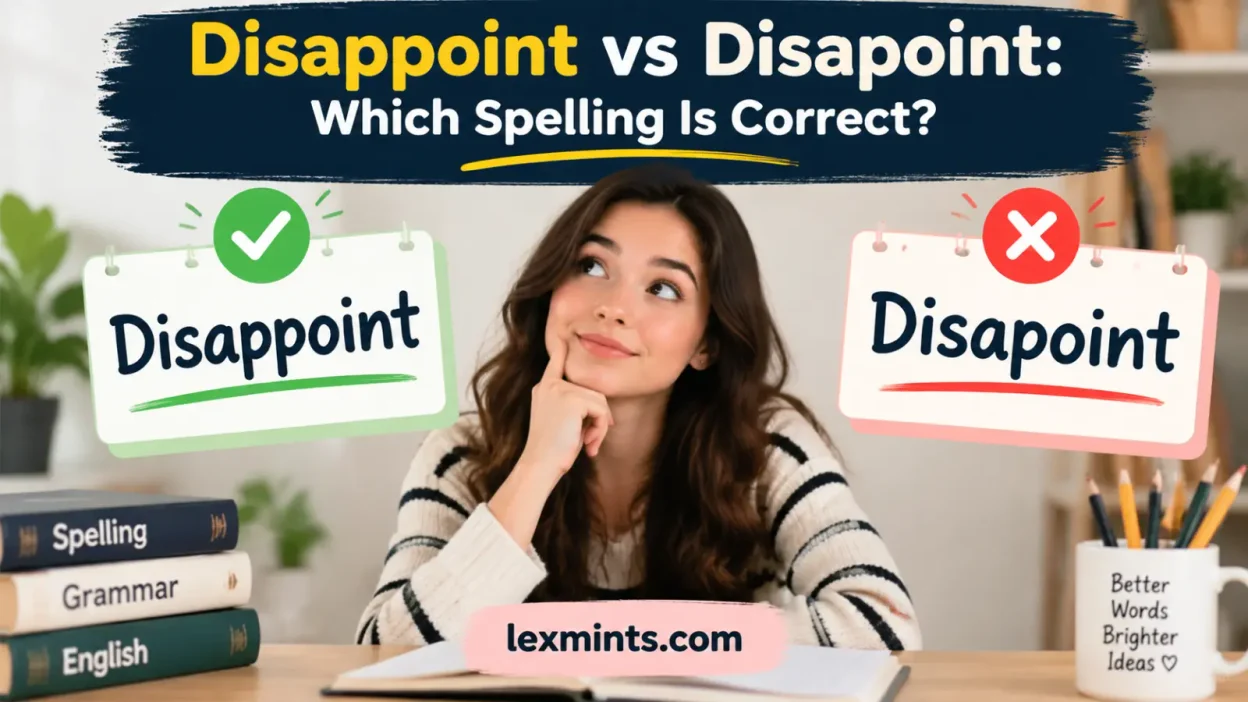
When writing in English, it is easy to make a small spelling mistake in a word that contains repeated letters. Disappoint vs disapoint is a common example. The two spellings look almost identical, but only one is correct in standard English.
The correct spelling is disappoint.
Disapoint is an incorrect spelling and should not be used in formal or standard English writing.
The word disappoint is a verb that means to fail to meet someone’s expectations, hopes, or wishes. You can disappoint a person, disappoint a team, disappoint your family, or even be disappointed by an event or result.
The main reason people misspell disappoint as disapoint is that the word contains a double p, which can be easy to overlook when writing quickly. Learning the correct spelling and understanding how the word is formed can make it much easier to remember.
Disappoint vs Disapoint: The Quick Answer
If you are unsure whether to write disappoint or disapoint, remember this simple rule:
- Disappoint = correct spelling
- Disapoint = incorrect spelling
The correct word contains two p’s:
D-I-S-A-P-P-O-I-N-T
The incorrect form contains only one:
D-I-S-A-P-O-I-N-T
Correct:
I don’t want to disappoint my parents.
Incorrect:
I don’t want to disapoint my parents.
The second sentence contains a spelling error. In standard English, always use disappoint.
What Does Disappoint Mean?
Disappoint means to fail to satisfy someone’s expectations, hopes, or wishes.
For example, imagine that someone has been preparing for a concert for months. They expect the concert to be excellent, but the performance is poorly organized. They might say:
The concert disappointed me.
Here, disappointed means that the concert did not meet the person’s expectations.
The word can describe both major and minor situations. You might disappoint someone by forgetting an important appointment, failing to keep a promise, receiving a lower grade than expected, or not achieving a goal.
Examples of Disappoint
- I don’t want to disappoint my teacher.
- The final score disappointed the fans.
- She promised herself that she would not disappoint her family.
- The movie disappointed many viewers.
- We were disappointed by the unexpected cancellation.
In each example, disappoint describes a failure to meet expectations.
Why Is Disappoint Spelled With Two P’s?
One of the easiest ways to understand the spelling is to look at the structure of the word.
Disappoint comes from the prefix dis- combined with appoint.
The base word is:
appoint
When the prefix dis- is added, the result is:
dis + appoint = disappoint
Notice that appoint already begins with app-, which contains two p’s. The double p remains in the complete word.
This gives us:
dis + appoint → disappoint
That is why writing disapoint removes a letter that belongs to the original word.
A useful spelling memory trick is to think of the word as:
DIS + APPOINT
If you remember how to spell appoint, it becomes easier to spell disappoint correctly.
Why Do People Spell It “Disapoint”?
The incorrect spelling disapoint is understandable because English spelling does not always perfectly match pronunciation.
When people say disappoint, the double p is not pronounced as two separate sounds. The word sounds approximately like:
dis-uh-POINT
Because you do not hear two distinct p sounds, it is easy to write only one p.
This is a common type of spelling error. Writers may unconsciously spell a word according to how it sounds rather than how it is conventionally written.
The same issue can happen with other words containing double consonants.
For example:
- accommodate
- necessary
- recommend
- embarrass
- occurrence
Remembering the written form is therefore important.
With disappoint, the easiest solution is to connect it to the base word appoint.
Is “Disapoint” a Word?
No. Disapoint is not the standard English spelling of the word.
If you see disapoint in a sentence, it is almost certainly a misspelling of disappoint.
For formal writing, academic work, professional communication, websites, applications, and other polished content, use disappoint.
Incorrect:
I hope I don’t disapoint you.
Correct:
I hope I don’t disappoint you.
The meaning is clear even when disapoint is written incorrectly, but the spelling should still be corrected.
How to Use Disappoint in a Sentence
Disappoint is a verb, so it usually describes an action or experience involving expectations.
Here are several natural examples:
I don’t want to disappoint you.
The team’s performance disappointed its supporters.
We tried our best, but we may disappoint some customers.
The results disappointed everyone in the room.
She worked hard because she did not want to disappoint her family.
The word can be used with people, groups, events, products, results, and situations.
For example:
The new restaurant disappointed us.
This means the restaurant did not meet the expectations of the people who visited it.
Disappoint, Disappointed, and Disappointing
Understanding related forms of the word can also help you remember the correct spelling.
Disappoint
Disappoint is the base verb.
I don’t want to disappoint my friends.
Disappointed
Disappointed is commonly used to describe how someone feels after expectations are not met.
I was disappointed with the result.
Here, the person experiences disappointment.
Disappointing
Disappointing describes something that causes disappointment.
The final result was disappointing.
A simple way to remember the difference is:
- Disappoint = the action
- Disappointed = how a person feels
- Disappointing = something that causes disappointment
All three forms retain the double p.
Disappoint vs Disappointed: What Is the Difference?
Although these words are closely related, they have different grammatical roles.
Disappoint is a verb describing what causes someone to have unmet expectations.
The decision disappointed me.
Disappointed is an adjective or past participle describing the person’s emotional response.
I was disappointed by the decision.
Compare the two:
The news disappointed Sarah.
Sarah experienced disappointment because of the news.
Sarah was disappointed by the news.
This sentence focuses on Sarah’s feeling.
The spelling remains consistent: disappoint, disappointed, and disappointing all contain the double p.
Disappoint vs Disappointment
Another related word is disappointment.
Disappointment is a noun referring to the feeling or experience that occurs when expectations are not met.
For example:
Losing the championship was a major disappointment.
Here, disappointment is the noun.
Compare these sentences:
The loss disappointed the players.
The loss caused great disappointment.
The first uses the verb disappoint, while the second uses the noun disappointment.
Both words retain the double p:
disappoint
disappointment
This connection can make the spelling easier to remember.
Common Mistakes With Disappoint
The most common spelling mistake is dropping one of the two p’s.
Mistake 1: Writing “Disapoint”
Incorrect:
I don’t want to disapoint anyone.
Correct:
I don’t want to disappoint anyone.
The correction is simple: add the second p.
Mistake 2: Writing “Disapointed”
Incorrect:
He was disapointed with the results.
Correct:
He was disappointed with the results.
The past-tense form also keeps the double p.
Mistake 3: Writing “Disapointing”
Incorrect:
That was a very disapointing performance.
Correct:
That was a very disappointing performance.
Again, the double p is required.
Mistake 4: Forgetting the Connection to “Appoint”
If you remember the spelling of appoint, you can use it as a memory aid:
appoint → disappoint
The word appoint has two p’s, and those two p’s remain when dis- is added.
A Simple Trick to Remember the Correct Spelling
One of the best spelling tricks is:
“Disappoint has an appointment with two P’s.”
The word appoint is inside disappoint:
DIS + APPOINT
Since appoint has two p’s, disappoint also has two p’s.
You can mentally break the word apart:
DIS | APPOINT
Rather than trying to memorize every letter individually, remember the familiar word appoint.
This is particularly useful for students, English learners, and anyone who frequently types quickly.
Examples of Disappoint in Everyday English
The word disappoint is common in everyday conversations.
Family
I don’t want to disappoint my parents.
School
I was afraid that my grades would disappoint my teacher.
Work
We don’t want to disappoint our customers.
Sports
The team’s loss disappointed thousands of fans.
Entertainment
The ending of the movie disappointed many viewers.
Personal Goals
She promised herself that she would not disappoint her teammates.
These examples show how flexible the word is. It can be used whenever an outcome fails to match someone’s expectations.
Formal and Informal Use
Disappoint is a standard English word and is appropriate in both formal and informal contexts.
You can use it in everyday conversation:
I don’t want to disappoint you.
You can also use it in professional writing:
The company apologized for the delay and acknowledged that the service had disappointed customers.
It is also perfectly appropriate in academic writing:
The study’s findings may disappoint researchers who expected a different outcome.
The important point is not the level of formality. The important point is spelling the word correctly.
Disappoint in American English
In American English, the correct spelling is disappoint.
There is no standard American English variant spelled disapoint.
The same applies to related forms:
- disappoint
- disappointed
- disappointing
- disappointment
All of these forms use the double p.
If you are writing for a U.S. audience, such as in an email, school assignment, business document, blog post, or website, disappoint is the form you should use.
Disappoint vs Disapoint: Side-by-Side Comparison
| Feature | Disappoint | Disapoint |
|---|---|---|
| Correct spelling | Yes | No |
| Standard English | Yes | No |
| Part of speech | Verb | — |
| Contains double “p” | Yes | No |
| Meaning | To fail to meet expectations | No standard meaning |
| Suitable for formal writing | Yes | No |
The difference is only one letter, but that letter matters.
Synonyms for Disappoint
Sometimes you may want to avoid repeating the word disappoint. Several alternatives can express a similar idea depending on the context.
Possible synonyms include:
- let down
- discourage
- dishearten
- upset
- frustrate
- fail
- underwhelm
For example:
The result disappointed me.
Could become:
The result let me down.
However, these words are not always exact substitutes. Disappoint specifically focuses on the gap between what someone expected and what actually happened.
Antonyms of Disappoint
The opposite of disappointing someone is generally to satisfy, please, or delight them.
For example:
The performance disappointed the audience.
The opposite could be:
The performance delighted the audience.
Other possible opposites include:
- satisfy
- please
- impress
- delight
- fulfill
- exceed expectations
These words can help you understand the meaning of disappoint more clearly.
How to Avoid the “Disapoint” Spelling Error
If you frequently make this mistake, try these simple strategies.
1. Remember “Appoint”
Think:
dis + appoint = disappoint
The word appoint already contains two p’s.
2. Visualize the Double P
When writing the word, deliberately pause at:
dis-a-pp-oint
The double p becomes easier to notice.
3. Use It in Sentences
Writing the word repeatedly in meaningful sentences can strengthen your memory.
For example:
I don’t want to disappoint my family.
The result disappointed everyone.
The experience was disappointing.
4. Check Before Publishing
If you are writing an article, assignment, email, or professional document, use a spelling checker as a final step. However, understanding the spelling is better than relying entirely on automatic correction.
FAQs
Is “disappoint” or “disapoint” correct?
Disappoint is correct. Disapoint is a misspelling. The correct word contains two p’s: d-i-s-a-p-p-o-i-n-t.
Why does disappoint have two p’s?
The word is formed from dis- and appoint. Since appoint contains two p’s, the complete word is spelled disappoint.
What does disappoint mean?
Disappoint means to fail to meet someone’s expectations, hopes, or wishes. For example, “I don’t want to disappoint my parents” means the speaker does not want to fail their parents’ expectations.
Is disapoint a real English word?
No. Disapoint is not the standard English spelling. The correct spelling is disappoint.
How do you spell disappointed?
The correct spelling is disappointed, with two p’s: d-i-s-a-p-p-o-i-n-t-e-d.
How do you spell disappointing?
The correct spelling is disappointing, also with two p’s: d-i-s-a-p-p-o-i-n-t-i-n-g.
What is an easy way to remember disappoint?
Remember the phrase “dis + appoint.” The word appoint has two p’s, so disappoint must have two p’s as well.
Conclusion
When choosing between disappoint vs disapoint, there is a clear winner: disappoint.
Disappoint is the correct standard English spelling, while disapoint is an incorrect spelling.
The easiest way to remember the difference is to recognize that disappoint contains the word appoint:
dis + appoint = disappoint
Because appoint has two p’s, disappoint has two p’s too.
So, whenever you need to describe something that fails to meet someone’s expectations, use disappoint.
Correct: I hope I don’t disappoint you.
Incorrect: I hope I don’t disapoint you.
A single extra letter makes the difference, so keep the double P in mind whenever you write disappoint.


