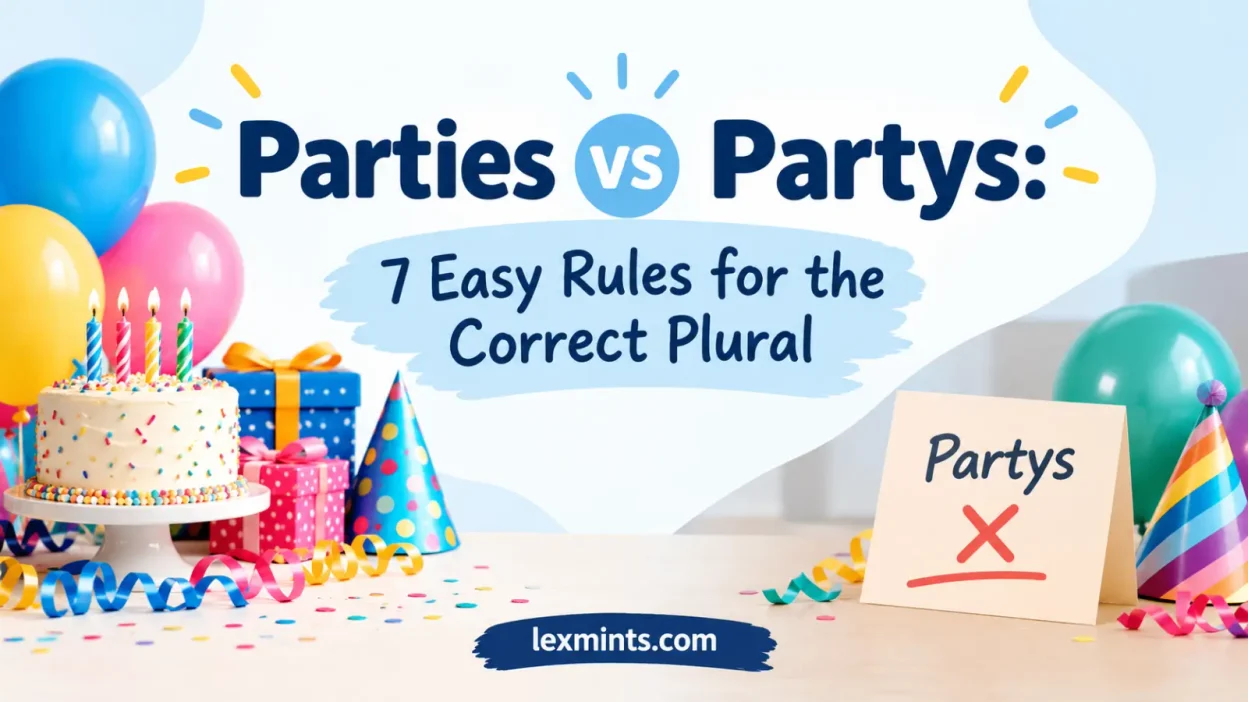
Parties vs Partys is a common question for people learning English or checking their writing. Both forms may look reasonable at first, but only one is the standard plural form of the noun party.
The correct spelling is parties. The form partys is incorrect when you want to describe more than one party in standard American English.
For example:
- Correct: We attended three birthday parties last month.
- Incorrect: We attended three birthday partys last month.
The reason is a common English spelling rule. When a noun ends in a consonant followed by the letter y, the y usually changes to i before -es is added.
This rule applies to words such as party, city, family, and company. Their plural forms are parties, cities, families, and companies.
However, there is another detail worth understanding. The word parties can also be the third-person singular form of the verb party. In addition, party’s and parties’ are different forms with different grammatical functions.
This guide explains how to choose the correct form, apply the plural rule, and avoid common mistakes in everyday, academic, and professional writing.
Parties vs Partys is a common spelling question in American English. If you are wondering whether to write parties or partys, the correct plural form is parties. The word partys is not the standard plural spelling of party. Understanding the simple pluralization rule will help you avoid this common mistake in school assignments, business documents, and everyday writing.
Quick Answer
Use parties when you mean more than one party. Do not use partys as the standard plural.
The basic forms are:
- Party: One party.
- Parties: Two or more parties.
- Partys: Incorrect as the standard plural.
- Party’s: Usually shows possession by one party.
- Parties’: Shows possession by multiple parties.
Examples:
- We planned two birthday parties.
- Both parties signed the agreement.
- The party’s location changed.
- The parties’ representatives met yesterday.
Notice that the apostrophe changes the function of the word. The ordinary plural parties does not require an apostrophe.
The easiest rule to remember is simple: change the final y to i and add -es when forming the plural of party.
What Is Correct?
Parties is the correct plural form of party in standard American English.
The noun party can refer to a social event, a political organization, a group of people, or one side involved in an agreement. The plural form remains parties in each of these contexts.
Examples:
- Social events: We attended several holiday parties.
- Political groups: Several political parties participated in the election.
- Agreements: The two parties reached a settlement.
- Groups of guests: The restaurant welcomed three large parties.
The meaning of party changes with the situation, but the plural spelling does not.
The form partys does not follow the standard plural pattern for this word. Even if the sentence is informal, the correct plural remains parties.
Consider these examples:
Incorrect: Our school organized two partys this year.
Correct: Our school organized two parties this year.
Incorrect: The political partys announced their plans.
Correct: The political parties announced their plans.
In both cases, changing partys to parties corrects the sentence.
The Core Rule
The plural of party follows the consonant-plus-y rule.
When a noun ends in a consonant followed by y, the usual plural pattern is to change the y to i and add -es.
The process looks like this:
party → parties
The letter immediately before the final y is t, which is a consonant. Therefore, the word follows the -ies pattern.
Other examples include:
- City → cities
- Family → families
- Baby → babies
- Country → countries
- Company → companies
- Story → stories
- Lady → ladies
- Activity → activities
The same general pattern explains why party becomes parties, not partys.
However, not every noun ending in y follows this rule. When a vowel comes immediately before the final y, the plural usually takes -s without changing the y.
For example:
- Boy → boys
- Toy → toys
- Key → keys
- Day → days
- Monkey → monkeys
Compare party with toy. The word party ends in consonant + y, while toy ends in vowel + y.
That difference determines the usual plural pattern.
Parties vs Partys: The Main Difference
The main difference between parties vs partys is correctness. Parties is the standard plural form of party, while partys is incorrect in ordinary writing. Use parties when referring to multiple celebrations, political groups, or people involved in an agreement.
For example, “We attended three birthday parties” is correct. Writing “We attended three birthday partys” is incorrect because the noun follows the consonant-plus-y plural rule.
When Each Form Is Correct
Although parties is the correct plural noun, other related forms are correct in specific situations.
| Form or Pattern | Best Use | Why |
|---|---|---|
| Party | One event, group, or participant | Singular noun |
| Parties | More than one party | Standard plural |
| Partys | Not standard as the plural | Does not follow the usual pattern |
| Party’s | Possession by one party | Singular possessive |
| Parties’ | Possession by multiple parties | Plural possessive |
Using Party
Use party when you are talking about one event, group, or participant.
Examples:
- My birthday party starts at six.
- The political party announced its plan.
- One party requested a change to the agreement.
Using Parties
Use parties when you mean two or more events, groups, or participants.
Examples:
- We attended two birthday parties.
- Several political parties supported the proposal.
- Both parties accepted the new terms.
Using Party’s
Use party’s when something belongs to or is associated with one party.
Examples:
- The party’s decorations looked beautiful.
- The party’s start time changed.
- The party’s leader addressed the crowd.
Using Parties’
Use parties’ when something belongs to or is associated with multiple parties.
Examples:
- The parties’ representatives attended the meeting.
- The parties’ interests were different.
- The parties’ signatures appear on the final document.
The choice depends on the sentence’s meaning. An apostrophe is not needed simply because a noun is plural.
When It Is Incorrect or Less Natural
The form partys is incorrect in standard writing when used as the plural of party.
For example:
Incorrect: We received invitations to three partys.
Correct: We received invitations to three parties.
Incorrect: Several partys joined the discussion.
Correct: Several parties joined the discussion.
Incorrect: The company hosted two holiday partys.
Correct: The company hosted two holiday parties.
The mistake often happens because many English nouns form plurals by adding -s. Words such as book, car, and chair become books, cars, and chairs.
However, English has different plural patterns. The consonant-plus-y pattern requires a change in the final letters.
Another common mistake is using party’s as though it means multiple parties.
Incorrect: Three party’s attended the meeting.
Correct: Three parties attended the meeting.
The first sentence incorrectly uses a possessive form where an ordinary plural is needed.
There are situations in which Partys might appear as a deliberately chosen brand name, username, or stylized title. Such a special use does not make it the standard plural spelling of party.
For ordinary sentences, use parties.
Meaning, Structure, or Emphasis Differences
The difference between parties and partys is not a difference in meaning, tone, or formality. It is a difference between the standard plural form and an incorrect spelling.
The word parties can have different meanings depending on the context.
For example:
- We attended three parties this summer.
- Several parties signed the contract.
- The restaurant can accommodate parties of eight.
In the first sentence, parties means social events. In the second, it refers to people or groups involved in an agreement. In the third, it means groups of guests.
The context tells readers which meaning applies.
The form party’s has a different function because it usually indicates possession by one party.
For example:
The party’s schedule was updated.
Here, the schedule belongs to or is associated with one party.
In contrast:
The parties’ schedules were updated.
Here, the schedules are associated with multiple parties.
Finally, parties can function as a verb.
For example:
He parties with his friends on weekends.
In this sentence, parties is the present-tense verb form used with he. It does not mean multiple social events.
This is a legitimate use of the same spelling, but it does not make partys correct as a plural noun.
Real-World Examples
The following examples show how to use parties naturally in modern American English.
Social Events
- We attended two birthday parties last weekend.
- My neighbors host summer parties every year.
- She planned separate parties for her children.
- The school organizes holiday parties for students.
- They received invitations to several graduation parties.
Each sentence refers to more than one social event.
Business and Agreements
- Both parties signed the agreement.
- The parties agreed to review the proposal.
- All parties must follow the terms of the contract.
- The two parties scheduled another meeting.
- Several interested parties requested additional information.
In these examples, parties refers to people, organizations, or groups involved in an arrangement.
Politics and Organizations
- Several political parties participated in the debate.
- The parties presented different proposals.
- Local parties organized meetings for their members.
- The candidates discussed their plans with party representatives.
The plural form remains parties even when the word refers to political groups rather than celebrations.
Hospitality and Reservations
- The restaurant welcomes parties of six or more.
- Two large parties arrived at the same time.
- The host seated the parties in separate areas.
- We reserved tables for three different parties.
These examples show another common use: a party can mean a group of people dining or traveling together.
Possessive Examples
- The party’s invitation included the address.
- The parties’ lawyers reviewed the agreement.
- The party’s organizers confirmed the time.
- The parties’ responsibilities were listed in the document.
These examples also demonstrate why it is important to distinguish an ordinary plural from a possessive form.
Common Mistakes (and Quick Fixes)
Mistake: Adding Only -s
Incorrect: We attended two partys.
Correct: We attended two parties.
Quick fix: When a noun ends in a consonant followed by y, check whether it needs the -ies ending.
Mistake: Adding an Apostrophe to a Simple Plural
Incorrect: We planned three party’s.
Correct: We planned three parties.
Quick fix: Do not use an apostrophe just to make a noun plural.
Mistake: Confusing Party’s With Parties’
Incorrect: The parties’s representatives attended the meeting.
Correct: The parties’ representatives attended the meeting.
Quick fix: For a plural noun ending in s, place the possessive apostrophe after the final s.
Mistake: Changing Every Final Y to I
Incorrect: The children played with several toies.
Correct: The children played with several toys.
Quick fix: Check the letter before the final y. A vowel before y usually means you simply add -s.
Mistake: Using the Plural When You Mean One
Incorrect: The parties starts at seven.
Correct: The party starts at seven.
Quick fix: Match the noun to the number you intend. Use party for one event and parties for more than one.
Mistake: Overlooking the Verb Form
Incorrect: He partys every weekend.
Correct: He parties every weekend.
Quick fix: The verb party also changes its final y to i before adding -es in the third-person singular present tense.
Grammar Rule Details
Rule
The standard plural of party is parties. Because the word ends in a consonant followed by y, the final y changes to i before -es is added.
Remember:
party → parties
Correct Usage
Use parties for more than one event, group, or participant.
Examples:
- We attended two parties.
- Both parties signed the document.
- Several political parties joined the discussion.
Use party’s for the possessive form associated with one party and parties’ for the possessive form associated with multiple parties.
Incorrect or Less Natural Usage
Do not use partys as the ordinary plural.
Incorrect: The neighborhood held three partys.
Correct: The neighborhood held three parties.
Do not use party’s when you simply mean multiple parties.
Incorrect: Several party’s attended the event.
Correct: Several parties attended the event.
Examples
- One party became three parties.
- One city became several cities.
- One family became two families.
- One company became several companies.
- One toy became several toys.
The examples show why the letter before the final y matters.
Common Mistakes
The most frequent errors are writing partys, adding an unnecessary apostrophe, and confusing a plural noun with a possessive noun.
Check whether you mean one party, several parties, or something belonging to a party before choosing the form.
Exceptions
There is no meaningful exception to the standard plural spelling of party in ordinary American English.
A business, brand, or username may deliberately use a nonstandard spelling. That is a special naming choice, not the regular plural rule.
Quick Test
Ask yourself: Does the sentence refer to more than one party?
- If yes, write parties.
- If it refers to one party, write party.
- If something belongs to one party, consider party’s.
- If something belongs to several parties, consider parties’.
Example: We attended four birthday ____.
The correct answer is parties.
Usage Notes
The plural parties works in casual conversation, school assignments, business documents, legal agreements, and formal writing.
The same spelling is also used for the verb in a sentence such as “She parties with her friends.” Use the sentence structure to determine whether it is a noun or a verb.
FAQs
Is Parties or Partys Correct?
Parties is correct when you mean more than one party. Partys is not the standard plural spelling in American English.
What Is the Plural of Party?
The plural is parties. For example, “We attended two birthday parties last weekend.”
Why Does Party Become Parties?
The word ends in a consonant followed by y. In this common plural pattern, the y changes to i and -es is added.
Is Party’s the Same as Parties?
No. Party’s usually indicates possession by one party, while parties is the ordinary plural.
Example: “The party’s location changed” refers to one party. “Several parties attended” refers to multiple parties.
When Should I Use Parties’?
Use parties’ to show possession by multiple parties.
Example: “The parties’ representatives met on Monday.”
Can Parties Be a Verb?
Yes. Parties can be the third-person singular present form of the verb party.
Example: “He parties with his friends on weekends.”
Is Partys Ever Acceptable?
It may appear as a deliberately chosen name or stylized label, but it is not the standard plural of party. In ordinary writing, use parties.
Which Is Correct: Birthday Partys or Birthday Parties?
Birthday parties is correct.
Example: “We planned two birthday parties for the weekend.”
Conclusion
The choice between parties and partys is straightforward: parties is the standard plural form of party in American English.
The rule is to change the final y to i and add -es when a noun ends in a consonant followed by y. This same pattern appears in words such as cities, families, and companies.
Remember that party’s and parties’ serve different purposes because they show possession. An ordinary plural does not need an apostrophe.
Whether you are writing about birthday celebrations, political groups, restaurant guests, or parties to a contract, choose the form that fits your sentence.
For the plural of party, the correct choice is always parties in standard English—not partys.