
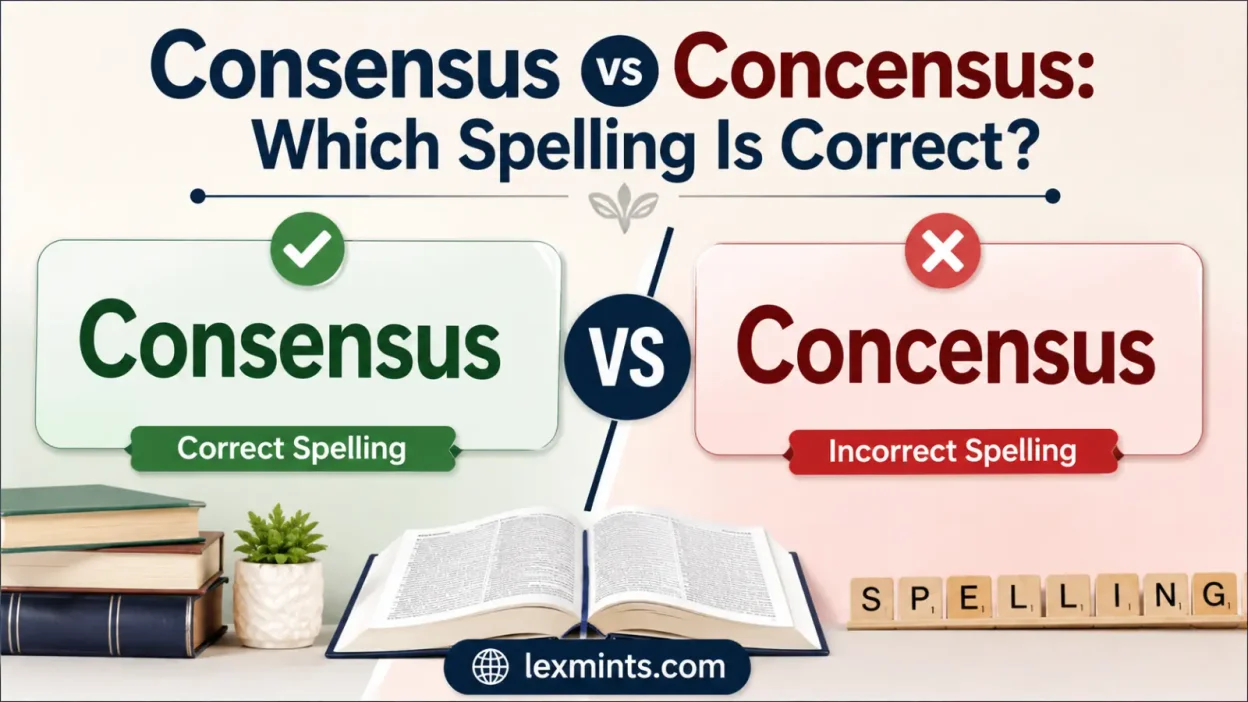
If you have ever written the word consensus, you may have wondered whether it should actually be spelled concensus. The two versions look very similar, and the incorrect form can seem natural because of the way the word is pronounced. However, there is an important difference between them.
Consensus is the correct spelling in standard English. Concensus is a common misspelling and is not accepted as the standard spelling of the word.
The correct word, consensus, refers to general agreement or a shared opinion among a group of people. You might use it when discussing a team decision, a political agreement, a scientific conclusion, a workplace discussion, or any situation in which several people reach the same general view.
For example:
The committee reached a consensus after several hours of discussion.
In this sentence, consensus means that the members of the committee reached general agreement.
Understanding the difference between consensus vs concensus is useful because this spelling mistake is easy to make. Once you learn where the extra n belongs, remembering the correct form becomes much easier.
Consensus vs Concensus: The Quick Answer
The correct spelling is consensus.
- Consensus — Correct
- Concensus — Incorrect
- Consensus means general agreement or a shared opinion.
- Concensus is a misspelling and should not be used in standard English.
The correct spelling contains one “n” after the “o”:
C-O-N-S-E-N-S-U-S
A useful way to remember it is to focus on the beginning:
con + sensus = consensus
The incorrect spelling concensus adds a second c after “con,” producing a form that looks plausible but is not standard English.
If you are writing an essay, business email, academic paper, report, article, or professional document, always use consensus.
What Does Consensus Mean?
Consensus is a noun meaning general agreement among members of a group.
It does not necessarily mean that every person agrees with every detail. Instead, it usually describes a broad or overall agreement that allows a group to move forward with a decision, opinion, or conclusion.
For example:
The team reached a consensus on the best way to complete the project.
Here, the team members have reached general agreement about the approach they should take.
Another example is:
There is a growing consensus among researchers that the problem requires further investigation.
In this case, consensus describes a broad agreement among researchers.
The word can be used in everyday conversations as well as formal writing.
Examples of Consensus
- The board reached a consensus on the new policy.
- After a long discussion, the group finally reached consensus.
- There was a general consensus that the proposal needed improvement.
- The committee could not reach a consensus.
- A consensus emerged among the members of the organization.
- The team reached a consensus about the project timeline.
In each example, consensus refers to general agreement.
Why Is Concensus Incorrect?
The spelling concensus is incorrect because it does not follow the standard spelling of the English word.
People often write concensus because English spelling does not always correspond perfectly to pronunciation. When people hear the word, the middle sounds can make the spelling less obvious. The repeated consonant pattern can also lead writers to insert an extra c.
However, the standard spelling is:
consensus
Not:
concensus
This is an important distinction because spell-checkers, dictionaries, academic writing standards, and professional editors recognize consensus as the correct form.
If you are unsure while writing, remember that the word begins with:
CON-SEN-SUS
not:
CON-CEN-SUS
The first part is con, followed by sen.
Consensus vs Concensus in a Sentence
Seeing the two spellings side by side can make the difference easier to remember.
Correct
The members reached a consensus after discussing the issue.
Incorrect
The members reached a concensus after discussing the issue.
The first sentence uses the standard English spelling. The second sentence contains a spelling error.
Here are more examples:
Correct:
There was a strong consensus among the committee members.
Incorrect:
There was a strong concensus among the committee members.
Correct:
The scientists reached a consensus after reviewing the evidence.
Incorrect:
The scientists reached a concensus after reviewing the evidence.
Correct:
We need to reach a consensus before making a final decision.
Incorrect:
We need to reach a concensus before making a final decision.
The meaning does not change because of the spelling mistake, but concensus should still be corrected to consensus in standard written English.
How Do You Pronounce Consensus?
The pronunciation of consensus can contribute to the spelling confusion.
In American English, consensus is commonly pronounced approximately as:
kuhn-SEN-sus
The middle sound may make it tempting to write concensus, especially if you are spelling the word based on how it sounds.
However, pronunciation should not be used as the only guide for spelling. English contains many words whose spelling is not completely predictable from their pronunciation.
For this reason, it is helpful to memorize the written form:
consensus
rather than trying to construct the spelling from its sound.
Consensus Meaning in Simple English
If you are learning English, consensus can be understood simply as:
“general agreement.”
For example, imagine five coworkers discussing where to hold a company event. After discussing several possibilities, four strongly prefer one location and the fifth agrees that it is a reasonable choice.
You could say:
The coworkers reached a consensus about the location.
This means they reached a general agreement.
Another simple example is a family deciding what movie to watch:
After discussing several movies, the family reached a consensus.
The group has agreed on one option.
Therefore, whenever you see consensus, think:
consensus = general agreement
Consensus Does Not Always Mean Complete Agreement
One important point about the word consensus is that it does not necessarily mean that everyone has exactly the same opinion.
A consensus can exist even when individuals have different preferences, concerns, or minor disagreements.
For example:
The committee reached a consensus to approve the proposal, although several members had concerns.
This sentence makes sense because the group has reached enough general agreement to make a decision, even though some members still have reservations.
This distinction is especially useful in formal discussions. Consensus often emphasizes a shared position rather than perfect unanimity.
Consensus vs Unanimity
The words consensus and unanimity are related, but they are not always identical.
Consensus means general agreement.
Unanimity means everyone is in complete agreement.
For example:
The committee reached a consensus.
This means the committee generally agreed.
By contrast:
The committee voted unanimously.
This indicates that everyone voted the same way.
Understanding this difference can help you use consensus more accurately in professional and academic writing.
Common Phrases With Consensus
The word consensus appears in several common expressions.
Reach a consensus
This means to arrive at general agreement.
The two groups worked together to reach a consensus.
Build consensus
This means to encourage agreement among people with different opinions.
The manager worked hard to build consensus among the employees.
General consensus
This phrase means a widely shared opinion or agreement.
The general consensus was that the plan needed more work.
Although consensus already implies general agreement, general consensus is a very common expression in English.
Broad consensus
This means widespread agreement.
There is broad consensus that the policy should be reviewed.
Consensus among
This construction identifies the group that shares the agreement.
There was consensus among the experts.
Reach a consensus on
This identifies the topic of agreement.
The members reached a consensus on the proposed changes.
These expressions are common in business, politics, education, journalism, science, and everyday communication.
Is Consensus a Noun or a Verb?
Consensus is a noun.
You can say:
The team reached a consensus.
You should not normally use consensus as a verb in standard English.
Instead, use verbs such as:
- agree
- reach
- establish
- build
- develop
- achieve
For example:
The team agreed on the final proposal.
Or:
The team reached a consensus on the final proposal.
Both sentences communicate a similar idea, but the grammatical structures are different.
Knowing that consensus is a noun can help you construct sentences correctly.
Consensus in American English
Consensus is standard in American English and is widely used in professional, academic, and everyday writing.
You may encounter it in:
- business reports
- academic research
- news articles
- government documents
- workplace communication
- scientific writing
- political discussions
- team meetings
- essays
- presentations
For example:
The scientific consensus has changed as new evidence has become available.
Or:
The leadership team reached a consensus after reviewing the proposal.
In all of these situations, consensus is the correct spelling.
The misspelling concensus should be avoided in formal and informal writing alike.
Why Do People Spell Consensus as Concensus?
There are several reasons this spelling error occurs.
1. Pronunciation Can Be Misleading
English pronunciation does not always make spelling obvious. When someone hears consensus, they may incorrectly reconstruct the word as concensus.
2. Visual Pattern Confusion
English contains many words beginning with con-, and writers may unconsciously insert another c when moving into the next syllable.
3. Memory of the Word’s Sound
People often spell unfamiliar words according to how they think they sound. This can produce errors such as concensus.
4. Typing Quickly
When writing quickly, especially on a phone or keyboard, an extra letter can easily appear.
5. Repeated Exposure to the Misspelling
If someone frequently sees concensus written incorrectly online, they may begin to think that it is an accepted spelling.
The best solution is simply to memorize the correct form and check it whenever you are uncertain.
Easy Memory Tricks for Consensus
A simple spelling trick can help you remember consensus.
Think of the word as:
CON + SEN + SUS
That gives you:
CON-SEN-SUS
Notice that there is only one c in the entire word.
Another useful memory sentence is:
“Consensus starts with CON, then SEN.”
You can also associate the word with its meaning:
Consensus = common agreement.
Both consensus and common begin with a “con” sound, which can serve as a small memory cue.
Most importantly, remember:
❌ concensus
✅ consensus
If you repeatedly write the correct form, it will eventually become automatic.
Consensus vs Concensus: Common Writing Mistakes
The most common mistake is adding an unnecessary c.
Incorrect:
We reached a concensus.
Correct:
We reached a consensus.
Another mistake is forgetting that consensus is a noun.
Incorrect:
The group consensused on the issue.
Better:
The group reached a consensus on the issue.
You can also say:
The group agreed on the issue.
A third issue is assuming that consensus always means unanimous agreement. As explained earlier, consensus generally means broad or general agreement, not necessarily absolute agreement from every individual.
Examples of Consensus in Everyday Writing
Here are several natural examples to help you understand how consensus works.
After several meetings, the employees reached a consensus.
The committee could not reach a consensus on the proposal.
There is a growing consensus that the project needs additional funding.
The group reached a consensus about how to handle the situation.
The general consensus was that the restaurant offered excellent service.
The researchers found little consensus on the causes of the problem.
The leaders worked together to build consensus.
A broad consensus emerged after the discussion.
These examples show that consensus can be used in both formal and ordinary situations.
How to Correct the Mistake Automatically
If you frequently type concensus, you can train yourself to catch the mistake.
First, remember that the correct spelling is:
consensus
Second, when proofreading, search specifically for:
concensus
If you find it, replace it with:
consensus
Many modern writing applications will also identify concensus as a spelling error. However, you should not rely completely on automatic correction. Learning the correct spelling is more useful because it helps you recognize the mistake yourself.
For important documents, always proofread manually even when your software provides spell-checking.
Consensus vs Concensus: A Quick Comparison
| Spelling | Status | Meaning | Example |
|---|---|---|---|
| Consensus | Correct | General agreement | The team reached a consensus. |
| Concensus | Incorrect | No standard meaning as a separate English word | Avoid this spelling. |
The key point is simple: consensus is the correct word.
If you are writing a sentence and mean “general agreement,” choose consensus.
FAQs
Is consensus or concensus correct?
Consensus is the correct spelling. Concensus is a common misspelling and should be avoided in standard English writing.
What does consensus mean?
Consensus means general agreement or a shared opinion among members of a group. It does not always mean that every person agrees completely.
How do you spell consensus correctly?
The correct spelling is C-O-N-S-E-N-S-U-S: consensus. A useful way to remember it is CON-SEN-SUS.
Is concensus a word?
Concensus is not the standard spelling of the English word. If you mean general agreement, use consensus.
What is an example of consensus?
An example is: “After several discussions, the committee reached a consensus.” This means the committee reached general agreement.
Does consensus mean everyone agrees?
Not necessarily. Consensus usually means general or broad agreement. Complete agreement by everyone is more accurately described as unanimity.
What is the easiest way to remember consensus?
Remember the spelling as CON-SEN-SUS. The correct word is consensus, with only one c.
Conclusion
When deciding between consensus vs concensus, the answer is clear:
Consensus is correct. Concensus is incorrect.
Use consensus whenever you mean general agreement or a shared opinion.
For example:
The committee reached a consensus after a lengthy discussion.
Do not write:
The committee reached a concensus after a lengthy discussion.
The incorrect form is easy to make because the pronunciation can lead writers toward the wrong spelling. However, remembering the structure CON-SEN-SUS makes the correct spelling much easier to recognize.
If you need one simple rule to remember, use this:
Consensus has one “c,” not two.
So whenever you are unsure, choose:
CONSENSUS ✅
not:
CONCENSUS ❌
Learning this small spelling distinction can help you write more accurately and confidently in emails, essays, reports, academic assignments, workplace documents, and everyday communication.


