
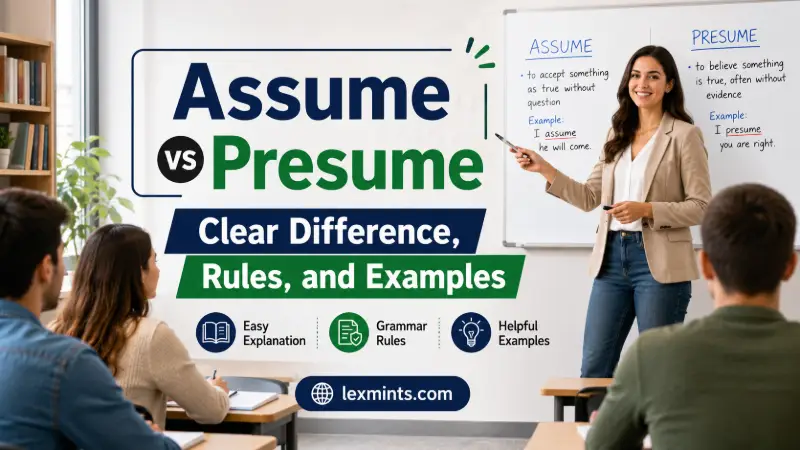
Assume vs presume is confusing because both verbs can mean accepting something as true before you know it for certain. The difference is usually about what supports that belief. Assume often works when you take something as true without checking or when you use it as a starting point. Presume more often suggests that probability, prior knowledge, circumstances, or an established rule gives you some reason to believe it.
That distinction is useful, but it is not absolute. Real English allows overlap, and both words have additional meanings that are not interchangeable. You can assume responsibility, for example, but you would not normally presume responsibility with the same meaning. Likewise, someone may presume to speak for others, meaning that the person takes a liberty he or she may not have.
Quick Answer
Use assume when you accept something as true without verification or use it as a working starting point. Use presume when your conclusion has a reasonable basis, such as probability, prior experience, circumstances, or a recognized rule.
The verbs overlap in their “suppose” meaning, so context matters. Their other meanings are more clearly separate: assume can mean “take on,” while presume can mean “take the liberty to do something.”
Why People Confuse Them
The confusion starts with a real overlap. Both words can introduce a belief that has not been proved.
If a coworker has not arrived yet, you might say, “I assume she is running late.” You could also say, “I presume she is running late,” especially if traffic is unusually heavy or she has already warned the team about a delay.
That makes the difference feel smaller than it is. The key question is not whether you have perfect proof. Neither verb requires certainty. Instead, ask whether the belief is simply being accepted or whether the situation gives you a stronger reason to expect it.
Their related meanings add another layer. Assume has several common “take on” senses, while presume has a “take a liberty” sense and an established use in legal reasoning.
Key Differences At A Glance
| Context | Best Choice | Why |
|---|---|---|
| Little or no verification | assume | You are accepting something without confirming it. |
| Reasonable probability or prior clues | presume | The conclusion has some basis. |
| Working condition for discussion | assume | The idea is temporarily accepted so reasoning can continue. |
| Taking responsibility or a role | assume | “Assume” can mean take on or undertake. |
| Acting beyond permission or authority | presume | “Presume to” can mean take an unwarranted liberty. |
| Established legal treatment of a fact | presume | Legal usage often treats something as true unless rebutted. |
The safest memory aid is simple: assume often starts with acceptance; presume often starts with reasons. Then check whether the sentence is using one of their separate meanings.
Meaning and Usage Difference
Both words are verbs, and both can take a direct object or a clause. In their shared sense, they describe treating something as true without complete certainty.
| Feature | assume | presume |
| Shared idea | Accept or suppose something as true | Accept or suppose something as true |
| Typical basis | May have little support or may simply be a working premise | Often based on probability, circumstances, or prior knowledge |
| Other common meaning | Take on a role, duty, control, appearance, or obligation | Take a liberty; act without proper permission |
| Legal use | Possible in general reasoning | Established in expressions such as “presumed innocent” |
Consider the difference in context:
“I assumed the café would be open” can mean you never checked.
“I presumed the café would be open because its posted hours said 7 a.m.” makes the basis of the expectation clearer.
Still, do not treat this as a mathematical rule. Speakers sometimes choose either verb in situations where the amount of evidence is not important.
Tone, Context, and Formality
Both words belong to standard American English. Assume is common in conversation, business, school, technical discussion, and everyday decision-making. Presume also appears in ordinary speech, but some of its uses can sound more deliberate or formal.
The difference should not be reduced to “assume is informal; presume is formal.” That rule is too broad. In the shared “suppose” sense, meaning is usually more important than formality.
Certain constructions do carry a stronger tone. “I would not presume to tell you how to raise your child” sounds restrained and somewhat formal because presume to means taking a liberty. Legal expressions with presume also have specialized force.
By contrast, assume sounds completely natural in professional writing: “For this estimate, assume a 5 percent increase.”
Which One Should You Use?
Choose assume when you are accepting a point without checking it, setting up a hypothetical condition, or taking on something.
Examples:
- “I assumed the deadline was Friday, so I did not check the calendar.”
- “Let’s assume the budget stays the same.”
- “Jordan will assume responsibility for the morning shift.”
Choose presume when the conclusion follows from a reasonable expectation, when a rule tells you to treat something as true, or when you mean taking an unwarranted liberty.
Examples:
- “The lights are off, so I presume the office is closed.”
- “A defendant is presumed innocent.”
- “I would not presume to make that decision for you.”
When either verb seems possible, focus on what the sentence is trying to emphasize: unsupported acceptance, reasoned expectation, or one of the separate meanings.
When One Choice Sounds Wrong
Some sentences clearly favor one verb because the meaning does not overlap.
“Maria assumed control of the department” means Maria took control. “Maria presumed control of the department” would sound unusual if that is all you mean.
“Alex assumed a calm expression” means Alex adopted that appearance. Presumed does not normally carry that sense.
The reverse happens with presume to:
“I would never presume to speak for the entire group” means “I would never take that liberty.” Replacing presume with assume changes the construction and does not express the same idea.
Legal language also has established wording. “Presumed innocent” describes a recognized status or rule. Replacing it with “assumed innocent” weakens that established meaning.
Common Mistakes (and Quick Fixes)
One common mistake is treating the evidence distinction as absolute.
Too rigid: “If there is any evidence at all, you must use presume.”
Better: Use presume when reasonable grounds are part of what you want to communicate. Use assume when the basis is weak, unverified, or simply being accepted for discussion.
Another mistake is choosing based only on formality.
Too simple: “Presume is the formal version of assume.”
Better: Both are standard. Some presume constructions sound more formal, but the verbs differ mainly in meaning and context.
A third mistake is forgetting their separate senses.
Wrong for “take on”: “She presumed the duties of manager.”
Better: “She assumed the duties of manager.”
Wrong for “take the liberty”: “I would not assume to question your decision.”
Better: “I would not presume to question your decision.”
Everyday Examples
Here are natural situations where the distinction helps:
At work: “I assumed the meeting was virtual because no room was listed.”
With supporting context: “Since everyone else joined by video, I presumed the meeting was virtual.”
In planning: “Assume the drive takes two hours, and we can estimate our arrival time.”
With prior knowledge: “Traffic is usually light on Sunday morning, so I presume two hours will be enough.”
With responsibility: “After the director resigned, Elena assumed leadership of the project.”
With restraint: “I do not presume to know what the client will decide.”
With appearance: “He assumed a serious tone when the conversation turned to safety.”
With a recognized rule: “The document is presumed valid unless evidence shows otherwise.”
These examples show why the words are close in one meaning but clearly different in others.
Dictionary-Style Word Details
Verb
Assume: A verb meaning to accept something as true without complete proof or verification. It can also mean to take on a role, responsibility, duty, position, control, appearance, or condition.
Presume: A verb meaning to accept something as true because it appears likely or has reasonable support. It can also mean to take an unwarranted liberty, especially in the pattern presume to + verb.
Noun
Assume: Not commonly used as a noun in standard American English. The related noun is assumption, but assume itself functions as a verb.
Presume: Not commonly used as a noun in standard American English. The related noun is presumption, but presume itself functions as a verb.
Synonyms
Assume: In the “accept as true” sense, closest plain alternatives include suppose, take for granted, and sometimes believe. In the “take on” sense, alternatives include undertake, adopt, or take over, depending on context.
Presume: In the “accept as likely” sense, closest plain alternatives include suppose, expect, or take to be true. In the “take a liberty” sense, dare can be close in some constructions.
Because both verbs have several senses, no single synonym replaces either word in every sentence.
Example Sentences
Assume: “Do not assume the package arrived just because the tracking page changed.”
Assume: “Priya will assume the role of team lead next month.”
Presume: “The front door is locked, so I presume everyone has left.”
Presume: “I would not presume to change the policy without approval.”
Word History
Assume: The word came into English through Latin-based forms connected with the idea of taking something to oneself. That history helps explain modern senses such as taking on a duty, role, appearance, or responsibility.
Presume: The word traces to a Latin form built around the idea of taking beforehand or taking in advance. Its history fits later senses involving prior expectation, taking something for granted, or taking a liberty.
The words share an old “take” element, which helps explain why their meanings developed close to each other.
Phrases Containing
Assume: Common combinations include assume responsibility, assume office, assume control, assume a role, assume a position, and assume that.
Presume: Common constructions include presume that, presume to, presume on, presume upon, and established expressions built around being presumed innocent or presumed valid.
FAQs
Can assume and presume be used interchangeably?
Sometimes, but not always. In the shared sense of accepting something as true, they can overlap. Use assume when the belief has little support or serves as a working starting point. Use presume when probability, prior knowledge, or an established rule supports it.
Is presume more formal than assume?
Not as a general rule. Both are standard English verbs. Presume can sound more formal in legal language and in the construction “presume to,” but the main difference is usually the basis for the belief, not simply the level of formality.
Which is more certain, assume or presume?
Presume usually suggests greater confidence because the conclusion has some reasonable basis. That does not make it certain or proven. Assume can also express confidence, especially when a speaker accepts something as a practical starting point without first verifying it.
Can I say “I presume” in everyday conversation?
Yes. “I presume” is normal when you are drawing a likely conclusion from what you know. For example, “I presume Maya is already there; her car is gone.” It may sound slightly more deliberate than “I assume,” but it is not limited to formal writing.
Why do we say “presumed innocent” instead of “assumed innocent”?
Because presumed has an established legal sense: something is treated as true unless evidence establishes otherwise. The phrase describes a rule about how a person must be regarded before guilt is proved. Assumed innocent does not carry that same established legal meaning.
Can assume and presume both take a that-clause?
Yes. Both verbs commonly introduce a clause with that, and the word that can often be omitted. “I assume that she knows” and “I presume she knows” are both grammatical. The choice depends mainly on meaning and context, not clause structure.
Conclusion
The clearest way to handle assume vs presume is to think about what supports the belief. Assume often means accepting something without verification or using it as a starting point. Presume more often suggests a conclusion based on probability, circumstances, prior knowledge, or an established rule.
Do not turn that distinction into an absolute rule, because the verbs overlap in real usage. Pay special attention to their separate meanings instead. Use assume for taking on roles, duties, control, or appearances. Use presume for taking a liberty and in established legal constructions.


