
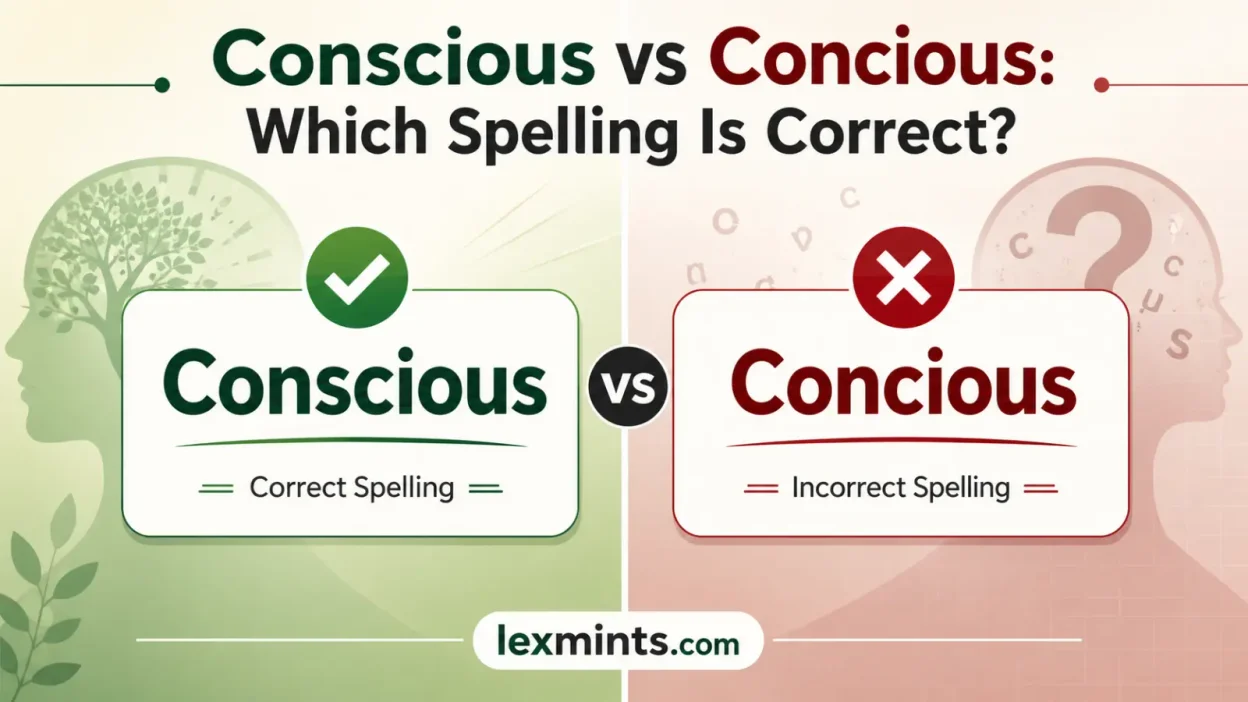
If you have ever hesitated between conscious and concious, you are not alone. These two spellings look almost identical, and the missing “s” in concious can be easy to overlook. However, there is an important difference: conscious is the correct spelling, while concious is a misspelling.
The correct word is conscious. It can describe being awake and aware, noticing something, or having knowledge of your thoughts, feelings, surroundings, or actions.
For example:
- I was conscious of the noise outside.
- She remained conscious after the accident.
- He became conscious of his mistake.
- I am conscious of how much time we have.
By contrast, concious is not the standard spelling in modern English. If you are writing an email, school assignment, professional document, article, or formal message, you should use conscious.
Conscious vs Concious: The Quick Answer
The correct spelling is conscious.
Concious is an incorrect spelling and should generally be avoided in standard English.
| Spelling | Correct? | Meaning |
|---|---|---|
| Conscious | Yes | Awake, aware, or mentally attentive |
| Concious | No | Common misspelling of conscious |
The easiest way to remember the correct spelling is to notice the “s” after “con”:
con + sci + ous = conscious
The word contains the sequence “sci”, which is one reason the spelling can be confusing.
What Does Conscious Mean?
Conscious is an adjective with several closely related meanings. At its most basic level, it describes a person who is awake and aware rather than unconscious.
For example:
The patient was conscious and able to answer questions.
Here, conscious means that the person was awake and aware of what was happening.
The word can also describe awareness of something.
Maria was conscious of the fact that everyone was waiting.
In this sentence, conscious of means aware of or mindful of something.
Another common use relates to deliberate thoughts or decisions.
He made a conscious decision to arrive early.
Here, conscious means intentional or deliberate.
So, depending on the context, conscious can mean:
- Awake
- Aware
- Alert
- Mindful
- Intentional
- Deliberate
- Noticing something
Understanding these meanings makes it easier to recognize why conscious is the correct word in different sentences.
Why Is “Concious” Incorrect?
The spelling concious is incorrect because it leaves out the s that belongs in the standard spelling conscious.
The mistake is understandable because English pronunciation does not always make every letter obvious. When people hear conscious, they may not clearly notice the sound associated with the spelling sci.
As a result, someone may write:
She was concious of the problem.
instead of:
She was conscious of the problem.
The second sentence is correct.
This type of spelling error is especially common with words that contain unusual or less predictable letter combinations. English has many words whose pronunciation does not provide a straightforward guide to spelling.
The important point is simple: concious is a misspelling, not an alternative spelling of conscious.
Conscious: Meaning and Examples
The word conscious is widely used in everyday English, academic writing, medicine, psychology, literature, and professional communication.
Here are some examples showing its different uses.
Conscious Meaning “Awake”
The driver was still conscious after the collision.
In this example, conscious means awake and responsive.
Another example:
The patient remained conscious throughout the procedure.
Conscious Meaning “Aware”
I was conscious of the fact that I had made a mistake.
Here, the word means aware or mindful.
Another example:
She became conscious of someone standing behind her.
This means that she became aware of the person’s presence.
Conscious Meaning “Deliberate”
He made a conscious effort to improve his writing.
The phrase conscious effort means an intentional effort.
Similarly:
She made a conscious choice to save more money.
The decision was deliberate rather than accidental.
Conscious Meaning “Concerned or Mindful”
Many consumers are becoming more conscious of environmental issues.
Here, conscious of means aware of and concerned about something.
This usage appears frequently in phrases such as:
- environmentally conscious
- health-conscious
- safety-conscious
- budget-conscious
- socially conscious
Common Phrases With “Conscious”
Learning common phrases is one of the best ways to remember the correct spelling.
Conscious of
Conscious of means aware of or mindful of something.
He was conscious of the time.
She became conscious of her surroundings.
Conscious effort
A conscious effort is an intentional attempt to do something.
I made a conscious effort to speak more clearly.
Conscious decision
A conscious decision is a deliberate choice.
They made a conscious decision to move closer to their family.
Conscious choice
A conscious choice is a choice made intentionally.
Eating less sugar was a conscious choice.
Self-conscious
Self-conscious describes feeling overly aware of yourself, particularly because you think other people are watching or judging you.
He felt self-conscious about speaking in front of the crowd.
Unconscious
Unconscious is the opposite of conscious in the sense of being awake and aware.
The injured man was unconscious for several minutes.
Recognizing these related forms can make the spelling of conscious much easier to remember.
Conscious vs Unconscious
One useful way to understand conscious is to compare it with its opposite, unconscious.
Conscious generally means awake or aware.
Unconscious generally means not awake or not aware.
For example:
The woman was conscious and talking to the paramedics.
But:
The woman was unconscious and could not respond.
The prefix un- changes the meaning to its opposite.
However, unconscious can also have a psychological meaning. It may refer to thoughts, feelings, or processes that occur outside conscious awareness.
For everyday spelling purposes, the important connection is that both words contain conscious:
conscious → unconscious
This can provide another memory aid for the correct spelling.
Why Do People Spell Conscious as Concious?
There are several reasons people make this mistake.
The Pronunciation Can Be Confusing
The pronunciation of conscious does not make its spelling completely obvious. When a word sounds different from the way its letters appear, spelling mistakes become more likely.
Someone may hear the word and mentally simplify the spelling to concious.
The Word Contains an Unusual Letter Pattern
The sequence sci is easy to overlook.
The correct spelling is:
c-o-n-s-c-i-o-u-s
A common mistake removes the second s:
c-o-n-c-i-o-u-s
That small difference completely changes the spelling.
English Spelling Is Not Always Phonetic
English contains many words whose spellings cannot be predicted perfectly from pronunciation.
For example, learners often struggle with words such as:
- necessary
- definitely
- separate
- conscience
- conscious
Because of these irregularities, memorizing the correct spelling of frequently used words can be helpful.
A Simple Trick to Remember “Conscious”
If you frequently write concious, try breaking the word into parts:
CON + SCI + OUS
That gives:
CONSCIOUS
The key is to remember the SCI sequence in the middle.
You can also connect it with the related word science, which begins with sci.
Think:
con + sci + ous = conscious
Another useful trick is to remember that the correct spelling has two s letters before the “iou” sequence:
conSCIous
Visually focusing on the s can help prevent the common mistake.
Conscious in Example Sentences
Here are more examples of the correct spelling:
- I was fully conscious of what was happening.
- She remained conscious throughout the conversation.
- He made a conscious effort to be more patient.
- They were conscious of the risks involved.
- The patient became conscious after a few minutes.
- She is very conscious of her responsibilities.
- He made a conscious decision to change careers.
- The company is becoming more environmentally conscious.
- I became conscious of how loud I was speaking.
- She was self-conscious about her appearance.
Notice that conscious works naturally in each sentence, while concious would be a spelling error.
Conscious vs Conscience: Do Not Confuse Them
Another word that is often confused with conscious is conscience.
Although the two words are related historically and look similar, they have different meanings.
Conscious refers to being awake, aware, or mentally attentive.
Conscience refers to a person’s inner sense of right and wrong.
For example:
I was conscious of the problem.
But:
My conscience would not allow me to lie.
A useful distinction is:
- conscious = awareness
- conscience = moral sense
The adjective conscious is also part of the phrase conscious of:
She was conscious of the danger.
Meanwhile, conscience is commonly used in phrases such as:
He had a guilty conscience.
Keeping these meanings separate can help you avoid both spelling and vocabulary mistakes.
Is “Concious” Ever Correct?
In standard modern English, concious is not the accepted spelling of the word meaning awake or aware.
If you intend to use the adjective meaning aware, awake, intentional, or mindful, write:
conscious
not:
concious
You may occasionally encounter concious online, in informal posts, comments, user-generated content, or other writing containing spelling errors. Its appearance does not make it a standard spelling.
For professional, academic, or edited writing, always use conscious.
How to Use “Conscious” Correctly
The most common grammatical pattern is:
be conscious of + noun
Examples:
She is conscious of her responsibilities.
They are conscious of the potential problems.
I am conscious of the limited time available.
It can also appear before a noun:
He made a conscious decision.
She made a conscious effort.
They took a conscious approach to the problem.
Another common form is self-conscious:
I felt self-conscious during the presentation.
And consciously is the adverbial form:
She consciously avoided the topic.
These forms all preserve the spelling associated with conscious.
Conscious vs Concious in American English
For American English readers, there is no spelling variation between conscious and concious.
The standard spelling is:
conscious
This is the spelling you should use in:
- American English
- Academic writing
- Business writing
- Professional communication
- School assignments
- Websites and blogs
- Formal correspondence
Unlike some English words that have different American and British spellings, conscious does not have a standard American alternative spelled concious.
Quick Comparison: Conscious vs Concious
The difference can be summarized very simply.
| Feature | Conscious | Concious |
|---|---|---|
| Standard spelling | Yes | No |
| Correct English word | Yes | No |
| Meaning | Awake, aware, mindful, or deliberate | None as a standard spelling |
| Used in formal writing | Yes | No |
| Example | She was conscious of the problem. | She was concious of the problem. ❌ |
If you are unsure which one to choose, select conscious.
Common Mistakes to Avoid
The most common mistake is simply dropping the s.
Incorrect:
He was concious of the danger.
Correct:
He was conscious of the danger.
Another mistake is confusing conscious with conscience.
Incorrect:
She was conscience of the problem.
Correct:
She was conscious of the problem.
And if you are talking about a person’s moral sense, use conscience:
His conscience bothered him.
Remember:
conscious = aware
conscience = moral sense
FAQs
Is conscious or concious correct?
Conscious is correct. Concious is a misspelling and is not the standard spelling in English.
How do you spell conscious correctly?
The correct spelling is C-O-N-S-C-I-O-U-S: conscious.
A useful memory trick is to remember the sci in the middle: con + sci + ous.
What does conscious mean?
Conscious can mean awake, aware, mindful, or deliberate. For example, “She was conscious of the noise” means she was aware of the noise.
Why do people spell conscious as concious?
The mistake usually happens because the pronunciation does not make the spelling completely obvious. Writers may omit the s in the middle and produce the incorrect form concious.
Is concious a word?
No. Concious is generally a misspelling of conscious. In standard English writing, use conscious.
What is the difference between conscious and conscience?
Conscious means awake or aware, while conscience refers to a person’s inner sense of right and wrong.
For example:
I was conscious of the mistake.
My conscience would not let me ignore it.
Conclusion
When choosing between conscious vs concious, the answer is clear: conscious is the correct spelling.
The incorrect form concious is a common spelling mistake, often caused by the unusual letter sequence in conscious. The easiest way to remember the correct spelling is to focus on the “sci” in the middle:
CON + SCI + OUS = CONSCIOUS
Use conscious when you mean awake, aware, mindful, or deliberate.
For example:
She was conscious of the changes around her.
He made a conscious effort to improve.
The patient remained conscious after the incident.
If you remember just one thing, remember this: conscious has an “s” after “con.” Concious does not.


