People often hear the word “democracy” in news reports, school lessons, and political discussions. It is one of the most common government terms in English. Many countries, including the United States, describe themselves as democracies.
Understanding this word helps people follow current events and civic topics more easily. It also helps English learners use the term correctly in conversations and writing.
This article explains the democracy meaning in plain English. You will learn its definition, pronunciation, origin, common examples, types, and everyday usage.
Quick Answer
Democracy meaning refers to a system of government where people choose leaders or make decisions through voting.
In a democracy, citizens have a voice in how the country is governed.
The word is commonly linked with freedom, elections, and equal rights.
TL;DR
• Democracy means rule by the people.
• Citizens usually vote for leaders.
• Democracy is a noun in English.
• The word comes from ancient Greek.
• Common opposite: dictatorship.
• Democracy can be direct or representative.
What Does Democracy Mean?
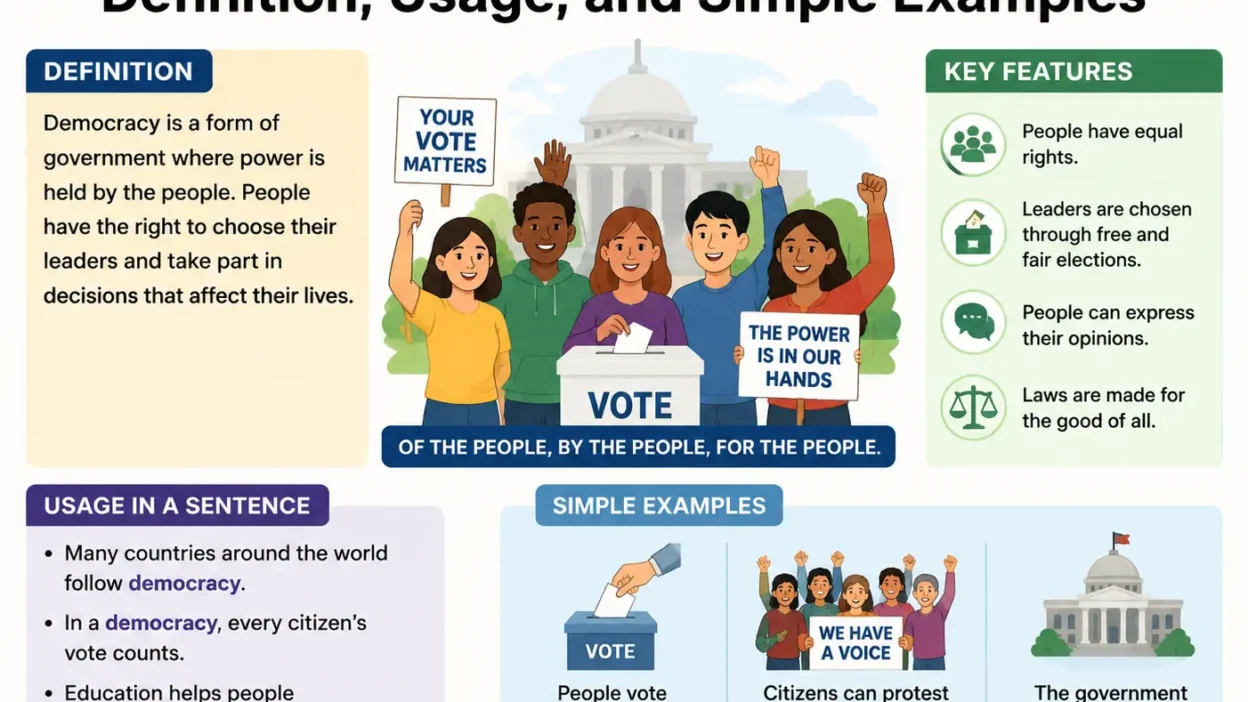
Democracy is a form of government where power belongs to the people. Citizens usually take part by voting in elections.
In simple words, democracy means people have a say in government decisions. They may vote directly on issues or choose representatives to decide for them.
Here is a basic example:
• “People voted in a free election because the country is a democracy.”
The term can also describe a country itself.
Example:
• “Canada is a democracy.”
Democracy Definition in Plain English
A simple definition of democracy is:
A government system where citizens help choose leaders and influence laws.
Most democracies use elections. Adults usually have the right to vote and express opinions freely.
Democracy often includes these ideas:
• Free elections
• Equal voting rights
• Freedom of speech
• Rule of law
• Public participation
A common mistake is thinking democracy only means voting. Voting is important, but democracy also includes rights, fairness, and public involvement.
Democracy is a system of government where power is held by the people, usually through voting and elected representatives. However, its true meaning can change depending on the situation and usage, which is better understood through the concept of context in meaning in language and communication.
Pronunciation and Part of Speech
“Democracy” is a noun.
Simple pronunciation guide:
/dih-MOK-ruh-see/
The stress falls on the second syllable.
Some learners incorrectly say “dee-mock-racy.” The more common American pronunciation sounds closer to “dih-MOK-ruh-see.”
Example sentences:
• “Democracy protects citizens’ voting rights.”
• “Many people value democracy and freedom.”
Where the Word Democracy Comes From

The word comes from ancient Greek.
It combines two Greek words:
• demos = people
• kratos = rule or power
So, democracy literally means “rule by the people.”
The term became widely connected with ancient Athens, where citizens participated in public decision-making.
Main Types of Democracy
There is more than one kind of democracy. The most common types are direct democracy and representative democracy.
Direct Democracy
In direct democracy, citizens vote on laws and decisions themselves.
Example:
• Citizens vote directly in a referendum.
This system is less common in large countries.
Representative Democracy
In representative democracy, people elect leaders to represent them.
The United States uses this system.
Example:
• Americans vote for senators, presidents, and governors.
Constitutional Democracy
This type combines democracy with a constitution that protects citizens’ rights.
Laws and leaders must follow constitutional rules.
How Democracy Is Used in Everyday English
People use “democracy” in political, educational, and social discussions.
Common contexts include:
• News reports
• Government classes
• Election coverage
• Public speeches
• History lessons
Example sentences:
• “The country moved toward democracy after the election.”
• “Freedom of speech is important in a democracy.”
• “Students discussed democracy in history class.”
Sometimes people also use the word informally.
Example:
• “This team is not a democracy.”
Here, it means not everyone gets equal decision-making power.
Democracy is not just a political system—it also carries a deeper layer of human values, equality, and collective decision-making that reflects a more profound meaning of human governance and societal structure beyond its basic definition.
Synonyms and Antonyms of Democracy
Some close synonyms include:
• self-government
• popular government
• representative government
There is no perfect synonym for democracy because the term has a specific political meaning.
Common antonyms include:
• dictatorship
• autocracy
• tyranny
• oligarchy
These words describe systems where power belongs to one person or a small group.
In modern societies, democracy is not just about voting but also about protecting people from manipulation, misinformation, and unfair influence—concepts that also relate to psychological control and awareness of truth, such as in cases explained in Gaslighting Meaning and Real-Life Examples.
Common Mistakes and Confusions
People sometimes confuse democracy with similar government terms.
Democracy vs Republic
A democracy focuses on public participation and voting.
A republic is a government where elected officials represent citizens under a constitution.
Some countries, including the United States, are both a democracy and a republic.
Democracy Does Not Mean Complete Agreement
In democracies, people often disagree. Different opinions are normal.
Majority voting does not mean everyone supports the same idea.
Democracy Is Not Only About Politics
The word can also describe fairness in groups or organizations.
Example:
• “The club uses democracy when choosing activities.”
Small Comparison Table
| Context | Best Choice | Why |
| Citizens vote for leaders | Democracy | Public participation matters |
| One ruler controls decisions | Dictatorship | Power stays with one person |
| Small elite group controls power | Oligarchy | Power belongs to a few |
Mini Quiz
1. What does democracy mean?
A. Rule by one king
B. Rule by the people
C. Military control
2. Is “democracy” a noun?
Yes or No?
3. Which country type usually has elections?
A. Democracy
B. Dictatorship
4. What language did the word democracy come from?
A. Latin
B. Greek
C. French
Answer Key
- B
- Yes
- A
- B
FAQ
What is the simple meaning of democracy?
Democracy means a system where people help choose leaders or decisions. Voting is usually an important part of it.
Is democracy a noun?
Yes. “Democracy” is a noun in English. It names a type of government or political system.
How do you pronounce democracy?
It is commonly pronounced as:
/dih-MOK-ruh-see/
What is an example of democracy?
The United States is often described as a representative democracy because citizens elect leaders through voting.
What is the opposite of democracy?
Common opposites include dictatorship, autocracy, and tyranny. These systems limit public control.
What are the two main types of democracy?
The two main types are direct democracy and representative democracy.
Why is democracy important?
Many people value democracy because it supports voting rights, public participation, and individual freedoms.
Conclusion
The democracy meaning centers on people having a voice in government and public decisions. The word is strongly connected with voting, freedom, and participation.