
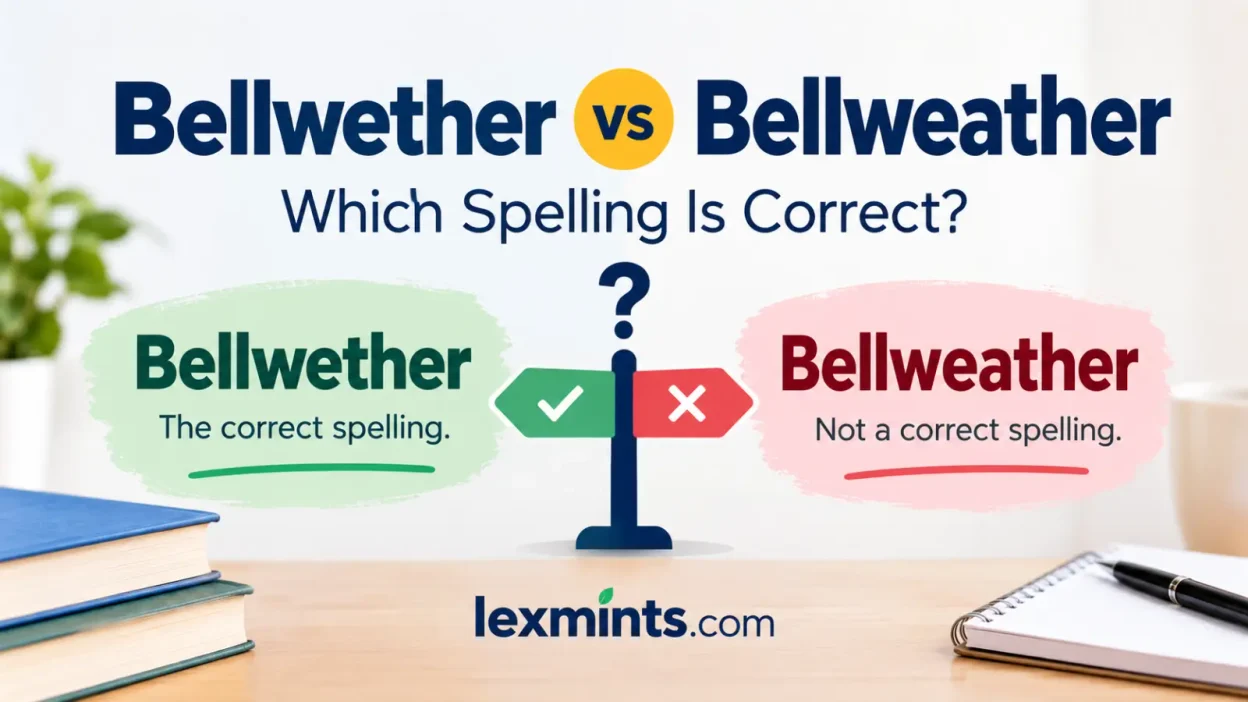
Bellwether vs bellweather is a common spelling confusion, especially because the word weather is familiar and sounds similar to the second part of bellwether. However, only one of these spellings is the standard English word.
The correct spelling is bellwether.
Bellweather is a misspelling when you mean the word that describes a person, group, place, company, or other thing that is considered an indicator of a broader trend.
For example:
- Correct: The state is often considered a bellwether in national elections.
- Incorrect: The state is often considered a bellweather in national elections.
The key spelling to remember is bellwether, with wether, not weather.
Bellwether vs Bellweather: The Quick Answer
If you are wondering whether to write bellwether or bellweather, use bellwether.
| Spelling | Correct? | Meaning |
|---|---|---|
| bellwether | Yes | A person, group, place, or thing that indicates or reflects a broader trend |
| bellweather | No | A common misspelling of bellwether |
Example
Correct:
Consumer spending can be a bellwether of economic confidence.
Incorrect:
Consumer spending can be a bellweather of economic confidence.
The word bellwether is especially common in discussions about politics, economics, business, markets, culture, and public opinion.
What Does Bellwether Mean?
Bellwether is a noun that refers to something or someone that serves as an indicator of a larger trend.
In simple terms, a bellwether is something that people watch because it can provide clues about what may happen more broadly.
For example, if a particular company is known for reflecting changes in an industry, writers may call it a bellwether company.
Consider this sentence:
The retailer is viewed as a bellwether for consumer spending.
This means that the retailer’s performance may provide useful information about wider consumer spending patterns.
The word can describe many different things, including:
- companies
- industries
- markets
- cities
- states
- voters
- products
- economic indicators
- cultural trends
- political regions
- consumer behaviors
The exact meaning depends on the context, but the central idea remains the same: a bellwether provides an indication of a wider trend or direction.
Why Is Bellwether Spelled This Way?
The spelling bellwether comes from an older literal use of the word.
Historically, a wether was a castrated male sheep. A bell could be placed around the neck of a lead sheep so that the rest of the flock could follow it.
That sheep became known as the bellwether.
Over time, the word developed a figurative meaning. Instead of referring only to a sheep leading a flock, bellwether came to describe a person, group, or thing that leads, signals, or indicates a broader direction.
This historical origin explains why the word is spelled bellwether, rather than bellweather.
The spelling can look unusual to modern readers because wether is not a word that people encounter very often outside of this context.
What Is a Wether?
Understanding the word wether can make the spelling of bellwether much easier to remember.
A wether is a male sheep that has been castrated.
The word is uncommon in everyday American English, which is one reason people may be tempted to replace it with the much more familiar word weather.
Compare these words:
- wether = a castrated male sheep
- weather = atmospheric conditions
- whether = used to introduce alternatives or express uncertainty
They sound similar, but they have completely different meanings.
The word bellwether contains wether because of its historical connection to sheep.
So the correct spelling is:
bell + wether = bellwether
Not:
bell + weather = bellweather
Why Do People Spell Bellwether as Bellweather?
The mistake is understandable because weather is an extremely common English word.
When people hear bellwether, they may mentally divide it into:
bell + weather
That makes bellweather seem logical at first glance.
However, this is a false spelling association.
The second part of bellwether is wether, not weather.
Another reason for the confusion is pronunciation. In many varieties of English, wether and weather are pronounced very similarly or identically.
Because the difference is primarily visible in spelling rather than pronunciation, writers may accidentally choose the familiar spelling weather.
This is an example of a spelling error caused by sound-based confusion.
Bellwether Meaning in Business
Bellwether is frequently used in business and economic writing.
A company, product, or industry may be described as a bellwether when its performance is considered a useful indicator of broader market conditions.
For example:
The company’s quarterly results are often treated as a bellwether for the technology sector.
Here, bellwether means that the company’s results may provide clues about the performance or direction of the larger technology sector.
Other examples include:
Retail sales can serve as a bellwether for consumer confidence.
The airline industry is sometimes viewed as a bellwether for travel demand.
The company’s earnings have become a bellwether for the broader market.
In these sentences, bellwether is being used metaphorically to describe something that signals a wider trend.
Bellwether Meaning in Politics
The word bellwether is also common in political reporting.
A voting district, state, demographic group, or community may be described as a bellwether if its behavior has historically been viewed as an indicator of broader electoral trends.
For example:
The county has often been described as a bellwether for statewide elections.
This means observers consider the county’s voting patterns potentially informative about wider electoral trends.
Another example:
Analysts are watching the district as a possible bellwether of changing voter preferences.
The word does not automatically mean that the bellwether always predicts the outcome correctly. It simply describes something that is regarded as an indicator or signal of a broader trend.
Bellwether Meaning in Economics
Economists and financial journalists also use bellwether when discussing economic indicators.
A particular measurement or industry may be called a bellwether if changes in it are viewed as useful clues about the wider economy.
For example:
Housing activity can be a bellwether for consumer confidence.
Or:
Manufacturing orders are sometimes used as a bellwether of economic activity.
In these examples, bellwether means an indicator rather than a guaranteed predictor.
That distinction is important.
A bellwether can signal a trend without necessarily determining what will happen next.
Bellwether as a Noun
Bellwether is primarily used as a noun.
A noun names a person, place, thing, or concept.
Examples include:
The company is a bellwether for the industry.
The city has become a bellwether of changing consumer preferences.
The index is considered a bellwether of market sentiment.
In each sentence, bellwether identifies something that serves as an indicator.
A useful pattern is:
something + is/was/becomes + a bellwether
For example:
The retailer became a bellwether for online shopping.
Common Phrases With Bellwether
You will often see bellwether used in phrases such as:
- bellwether company
- bellwether stock
- bellwether industry
- bellwether state
- bellwether county
- bellwether indicator
- bellwether market
- bellwether product
- bellwether brand
- bellwether region
- bellwether sector
Here are a few examples:
The company is considered a bellwether stock in the industry.
The state has sometimes been described as a bellwether state.
The product became a bellwether for changing consumer habits.
The sector is viewed as a bellwether of economic activity.
These phrases are common in professional, financial, political, and analytical writing.
Bellweather Is a Misspelling
Bellweather is generally not the standard spelling of the word you want.
If you are trying to describe something that indicates a broader trend, write:
bellwether
not:
bellweather
For example:
❌ Bellweather: The company is a bellweather for the industry.
✅ Bellwether: The company is a bellwether for the industry.
The incorrect version contains weather, which refers to atmospheric conditions.
The correct version contains wether, the historical sheep-related word.
Bellwether vs Weather
The easiest way to understand the spelling difference is to compare wether and weather.
Wether
Wether refers to a castrated male sheep.
It is an uncommon word in modern everyday English.
Weather
Weather refers to atmospheric conditions, such as:
- rain
- snow
- wind
- temperature
- storms
- sunshine
For example:
The weather is cold today.
Because weather is much more familiar than wether, people may accidentally write bellweather.
However, the two words should not be confused.
Bellwether vs Whether
There is another word that sounds similar: whether.
Whether is used when discussing alternatives or uncertainty.
For example:
I don’t know whether she will attend.
The three words can therefore be confusing:
- wether = a castrated male sheep
- weather = atmospheric conditions
- whether = introduces alternatives or uncertainty
Only wether appears in bellwether.
A useful spelling reminder is:
bellwether = bell + wether
How to Remember the Correct Spelling
A simple memory trick can help you avoid the bellweather mistake.
Think about the historical image of a sheep wearing a bell.
The word is:
bell + wether
You can remember it as:
A wether is a sheep, and the bellwether was the sheep with the bell.
This connection makes the unusual spelling easier to remember.
Another trick is to remember:
Bellwether has “wether,” not “weather.”
If you are writing about rain, storms, or temperature, you probably need weather.
If you are describing something that indicates a broader trend, you probably need bellwether.
Bellwether vs Bellweather Examples
Here are several examples showing the correct usage.
Example 1: Business
The company is considered a bellwether for the technology industry.
The company is viewed as an indicator of broader industry trends.
Example 2: Economics
Consumer spending is often treated as a bellwether of economic confidence.
Here, spending behavior provides information about wider economic conditions.
Example 3: Politics
The district has been described as a bellwether in statewide elections.
The district is considered potentially indicative of broader voting patterns.
Example 4: Markets
The stock is regarded as a bellwether for the sector.
The stock’s performance may provide clues about the larger sector.
Example 5: Culture
The magazine became a bellwether of changing cultural attitudes.
The magazine was seen as an indicator of broader cultural change.
In all of these examples, bellwether is the correct spelling.
Common Mistakes With Bellwether
The most common mistake is adding an extra a to create weather.
Incorrect:
The company is a bellweather for the market.
Correct:
The company is a bellwether for the market.
Another mistake is assuming that bellwether is related to weather because of its spelling.
It is not.
The word’s historical origin is connected to sheep, not atmospheric conditions.
A third mistake is assuming that bellwether means something that predicts the future with certainty.
It does not necessarily carry that meaning.
A bellwether is an indicator or signal, not a guaranteed predictor.
Is Bellwether a Positive or Negative Word?
Bellwether is generally neutral.
The word itself does not automatically indicate that something is good or bad.
For example:
The company is a bellwether for the industry.
This simply says that the company’s performance may indicate broader industry conditions.
Similarly:
The region became a bellwether of changing consumer preferences.
This describes its role as an indicator.
The broader trend itself may be positive, negative, or neutral. The word bellwether simply describes the relationship between the indicator and the broader trend.
Is Bellwether Singular or Plural?
Bellwether is singular.
The plural form is bellwethers.
Examples:
The company is a bellwether for the industry.
Singular: bellwether
Several companies have emerged as bellwethers for the sector.
Plural: bellwethers
This follows the normal English pattern of adding -s to form the plural.
Bellwether in Formal Writing
Bellwether is appropriate in many forms of formal and professional writing.
You may encounter it in:
- business articles
- financial reports
- economic analysis
- news writing
- academic discussions
- political reporting
- market commentary
- industry research
For example:
The index has become an important bellwether for investor sentiment.
This sentence has a professional and natural tone.
However, if your audience is unfamiliar with the term, a simpler word such as indicator may sometimes be easier to understand.
For example:
The index is an indicator of investor sentiment.
Both sentences can communicate a similar idea, but bellwether adds the specific sense of something being watched as a broader signal.
Bellwether vs Indicator
The words bellwether and indicator are related but not always interchangeable in tone.
An indicator is something that provides information about a condition or trend.
A bellwether is something that is regarded as a particularly useful or notable signal of a broader trend.
Compare:
Inflation is an economic indicator.
with:
Consumer spending is a bellwether for economic confidence.
The first statement simply identifies a measurement or signal.
The second emphasizes something that observers watch as a broader sign of where conditions may be heading.
Bellwether vs Predictor
Bellwether and predictor can also overlap, but they are not identical.
A predictor is something used to help predict a future result.
A bellwether is an indicator or representative signal of a broader trend.
A bellwether may be predictive in practice, but the word itself does not guarantee accurate prediction.
For example:
The industry is considered a bellwether for the broader economy.
This does not mean the industry always predicts the economy correctly. It means its performance may provide useful clues about broader economic conditions.
Why Bellweather Looks Correct but Isn’t
English contains many words in which spelling cannot be predicted perfectly from pronunciation.
Bellwether is a good example.
The familiar word weather makes bellweather look plausible, especially because the two spellings can sound the same when spoken.
But English spelling is often based on word history and established usage rather than simple sound patterns.
The correct form has remained:
bellwether
The incorrect form:
bellweather
is therefore easy to understand but still incorrect when used to mean an indicator of a broader trend.
Quick Comparison: Bellwether vs Bellweather
| Feature | Bellwether | Bellweather |
|---|---|---|
| Standard spelling | Yes | No |
| Standard English word for an indicator | Yes | No |
| Contains “wether” | Yes | No |
| Contains “weather” | No | Yes |
| Common in business writing | Yes | No |
| Common in economic writing | Yes | No |
| Common in political reporting | Yes | No |
| Refers to atmospheric conditions | No | Weather does, but not “bellweather” |
| Recommended usage | Use it | Avoid it |
The important point is simple: bellwether is the correct spelling.
FAQs
Is bellwether or bellweather correct?
Bellwether is correct. Bellweather is a common misspelling. Use bellwether when referring to a person, group, place, company, or thing that serves as an indicator of a broader trend.
What does bellwether mean?
Bellwether means a person, group, place, company, or thing that is considered an indicator or signal of a broader trend. It is commonly used in business, economics, politics, markets, and cultural analysis.
Why is bellwether spelled with wether?
The word comes from the historical use of a wether, meaning a castrated male sheep. A bell was traditionally placed on a lead sheep, giving rise to the word bellwether.
Is bellweather a word?
Bellweather is not the standard spelling of the word meaning an indicator of a broader trend. In standard English usage, the correct spelling is bellwether.
What is the difference between wether and weather?
Wether is a castrated male sheep, while weather refers to atmospheric conditions such as rain, wind, temperature, and storms. The word bellwether contains wether.
What is an example of bellwether?
A company whose performance is closely watched as an indication of broader industry conditions can be called a bellwether company. For example, a sentence might say, “The retailer is a bellwether for consumer spending.”
What is the plural of bellwether?
The plural of bellwether is bellwethers. For example: “Several companies are considered bellwethers for the industry.”
Conclusion
When choosing between bellwether vs bellweather, use bellwether.
Bellwether is the correct standard spelling for a person, group, company, place, or thing that serves as an indicator of a broader trend.
Bellweather is a misspelling caused largely by confusion with the familiar word weather.
The easiest way to remember the difference is:
Bellwether = an indicator or trend signal.
Weather = atmospheric conditions.
So, if you are writing a sentence such as “The company is a ___ for the industry,” the correct choice is:
The company is a bellwether for the industry.
Remember: bellwether has “wether,” not “weather.”


