
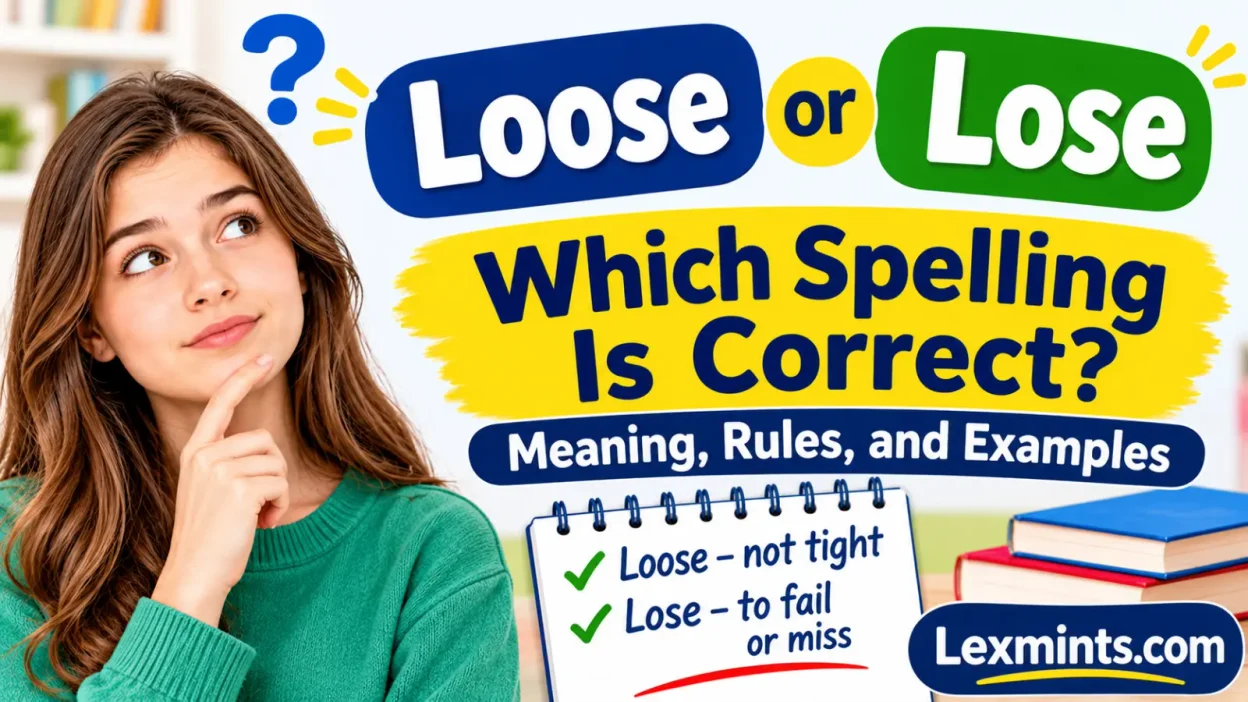
Loose or Lose is a common English spelling confusion. Both words are correct, but they have different meanings, pronunciations, and grammatical uses.
- Loose means not tight, not firmly attached, or free.
- Lose means to misplace something, fail to win, or no longer have something.
For example, you wear loose clothing, but you can lose your keys.
Below is a complete guide explaining their meanings, spelling rules, grammar, sentence examples, common mistakes, and practical usage.
What Does Loose Mean?
Loose is an adjective that describes something that is not tight, firmly attached, or held securely. It can also describe something free, relaxed, or not strictly controlled.
When something is loose, it has room to move. It may not fit properly or stay in its intended position.
For example, a loose shirt does not fit closely around your body. A loose screw may move because it is not tightly secured.
Common meanings of Loose
The word loose has several everyday meanings:
Not tight or fitting closely
Something does not fit firmly around another object or person.
• These jeans are too loose around my waist.
• I prefer loose clothing during the summer.
• The jacket feels loose around my shoulders.
Not firmly attached
Something is not securely connected or fastened.
• One of the buttons on my shirt is loose.
• The kitchen cabinet has a loose handle.
• A loose wire caused the light to flicker.
Free or not restrained
A person or animal is not tied up, locked away, or controlled.
• The dog was running loose in the neighborhood.
• The horses were allowed to roam loose in the field.
• The children were finally let loose after school.
Not strict or exact
Loose can also describe rules, connections, or explanations that are flexible or approximate.
• The teacher gave the students a loose schedule.
• This movie is a loose adaptation of a famous book.
• We have a loose plan for the weekend.
What Does Lose Mean?
Lose is a verb that describes the act of misplacing something, failing to win, or no longer having something.
It can also describe a situation where someone experiences a reduction or loss.
For example, you might lose your wallet, lose a competition, or lose confidence before an important presentation.
Unlike an adjective, lose describes an action, event, or change in condition.
Common meanings of Lose
To misplace something
When you lose something, you cannot find it.
• I always lose my car keys.
• She does not want to lose her phone.
• Please keep your passport safe so you do not lose it.
To fail to win
Lose describes the result of not winning a game, match, or competition.
• Our basketball team might lose tonight.
• They worked hard but lost the championship.
• Nobody wants to lose an important game.
To stop having something
Lose can describe something that is no longer available or part of your life.
• He does not want to lose his job.
• She was afraid of losing her friendship.
• We should not lose this opportunity.
To reduce something
Lose can also describe a decrease in weight, money, time, or another amount.
• She wants to lose weight through healthy habits.
• The company could lose money this year.
• We cannot afford to lose more time.
Loose vs. Lose: Main Differences
Although these words look similar, their meanings and grammatical functions are different.
| Feature | Loose | Lose |
|---|---|---|
| Main meaning | Not tight or secure | Misplace or fail to win |
| Part of speech | Usually adjective | Verb |
| Pronunciation | Looss | Looz |
| Number of O’s | Two | One |
| Example | My shoes are loose. | I might lose my shoes. |
The easiest way to understand the difference is to remember their basic meanings.
Use loose when describing something. Use lose when explaining an action or an unwanted result.
Examples:
• Correct: My shirt is too loose.
• Correct: I do not want to lose my shirt.
• Incorrect: My shirt is too lose.
• Incorrect: I do not want to loose my shirt.
Pronunciation of Loose and Lose
Pronunciation is another helpful way to remember these words.
Both words contain a similar vowel sound, but their final consonants sound different.
Loose: Pronounced like “looss.”
- Phonetic pronunciation: /luːs/
- The final sound is an unvoiced S.
- It rhymes with goose, moose, and juice.
Lose: Pronounced like “looz.”
- Phonetic pronunciation: /luːz/
- The final sound is a voiced Z.
- It rhymes with shoes, choose, and blues.
Why Does Pronunciation Matter?
Many English learners confuse these words because their spelling is almost identical.
However, listening to the final sound can help you identify the correct word.
Try saying these sentences aloud:
• The screw is loose.
• I might lose the screw.
Notice how the final sound changes even though the vowel sound stays similar.
Parts of Speech: How Loose and Lose Work
Understanding grammar makes it easier to choose the right spelling.
Both words can function as verbs, but their most common grammatical roles are different.
Loose as an Adjective
Loose is most commonly an adjective. It describes a noun by explaining its condition, fit, or level of attachment.
Examples:
• She bought a loose sweater for winter.
• The loose floorboard makes a strange noise.
• His loose shoelaces need to be tied.
In these examples, loose describes the sweater, floorboard, and shoelaces.
Loose as a Verb
Loose can also work as a verb, although this use is less common in everyday conversation.
As a verb, it means to release, free, or let something go.
Examples:
• The hunter loosed an arrow.
• The guards loosed the prisoners.
• The organization loosed a statement criticizing the decision.
Its verb forms include:
- Base form: loose
- Past tense: loosed
- Past participle: loosed
- Present participle: loosing
Do not confuse loosing with losing. They have different meanings.
Lose as a Verb
Lose is a verb used to describe misplacing something, experiencing a loss, or failing to win.
Examples:
• I sometimes lose my glasses.
• We do not want to lose the final match.
• She could lose her chance if she waits too long.
Its common verb forms are:
- Base form: lose
- Third-person singular: loses
- Past tense: lost
- Past participle: lost
- Present participle: losing
Remember that lose is an irregular verb.
The past tense is lost, not losed.
When Should You Use Loose?
Use loose when you want to describe something that is not tight, secure, or firmly controlled.
It is especially common when discussing clothing, objects, animals, and physical conditions.
Clothing and Fashion
Loose is commonly used to describe clothes that do not fit tightly.
Examples:
• I bought loose jeans for everyday wear.
• This dress looks too loose around the waist.
• Loose shirts are comfortable in warm weather.
Objects and Equipment
Use loose when something is not securely attached.
Examples:
• The mechanic found a loose bolt.
• A loose door handle needs repair.
• The electrician checked the loose connection.
Animals and Freedom
Loose can describe animals that are not restrained.
Examples:
• There is a dog running loose outside.
• The farmer let the horses loose.
• The cat got loose from its carrier.
Rules and Plans
Loose can also describe something flexible or not strictly organized.
Examples:
• We followed a loose schedule during vacation.
• The manager provided loose guidelines.
• Their agreement was based on a loose understanding.
When Should You Use Lose?
Use lose when describing an action involving something disappearing, becoming unavailable, or failing to achieve a desired result.
Losing Personal Belongings
Examples:
• Do not lose your house keys.
• I might lose my wallet if I am careless.
• She lost her favorite necklace yesterday.
Losing a Game or Competition
Examples:
• Our team does not want to lose the tournament.
• They lost the football game last weekend.
• You can learn something even when you lose.
Losing Money or Opportunities
Examples:
• The business could lose money without proper planning.
• He did not want to lose the opportunity.
• We may lose customers if service becomes poor.
Losing Weight or Interest
Examples:
• She wants to lose weight gradually.
• Students sometimes lose interest in difficult subjects.
• I do not want to lose motivation.
Loose vs. Lose in Everyday Expressions
Both words appear in common English expressions. Learning these expressions can help you recognize their correct spelling.
Common Expressions with Loose
Let loose: To allow someone or something to become free or relaxed.
Example: The children were let loose in the playground.
Loose change: Small coins carried in a pocket, wallet, or bag.
Example: I found some loose change in my car.
On the loose: Free and not under control.
Example: The escaped dog is still on the loose.
Loose ends: Unfinished details or matters that need attention.
Example: I need to finish a few loose ends before leaving.
Hang loose: To stay calm and relaxed.
Example: Hang loose! We still have plenty of time.
Common Expressions with Lose
Lose your temper: To become angry.
Example: Try not to lose your temper during the meeting.
Lose your mind: To become extremely upset or act irrationally.
Example: I thought I would lose my mind waiting for the results.
Lose track: To stop knowing or remembering something.
Example: I lost track of time while reading.
Lose interest: To stop feeling interested in something.
Example: He started to lose interest in the class.
Lose hope: To stop believing that something good will happen.
Example: Never lose hope when facing a difficult situation.
Lose sleep: To worry so much that you cannot sleep.
Example: I will not lose sleep over a small mistake.
Loose or Lose: Common Spelling Mistakes
Many people accidentally use these words incorrectly in emails, text messages, school assignments, and social media posts.
The mistake usually happens because both words have similar spellings.
Here are some common errors and their corrections.
| Incorrect Sentence | Correct Sentence |
|---|---|
| I don’t want to loose my phone. | I don’t want to lose my phone. |
| My shoes are too lose. | My shoes are too loose. |
| Don’t loose your keys. | Don’t lose your keys. |
| The screw is lose. | The screw is loose. |
| She might loose the game. | She might lose the game. |
| His pants are lose. | His pants are loose. |
Why Do People Confuse These Words?
There are several reasons behind this spelling mistake.
Similar spelling: Both words contain almost the same letters, making them easy to mix up.
Similar vowel sounds: Their vowel sounds are identical, although their final consonants differ.
Typing mistakes: People sometimes type the wrong spelling without checking the sentence.
Unfamiliar grammar: English learners may not recognize that loose usually describes something, while lose usually expresses an action.
The best solution is to understand the meaning before choosing the spelling.
Easy Tricks to Remember Loose and Lose
You do not need to memorize complicated grammar rules to remember these words.
A few simple techniques can help you choose correctly.
Remember the Extra O
Loose contains two O’s, while lose contains one.
Think of the two O’s as extra space.
Something loose has extra room because it is not tight.
For example:
• My loose shoes have extra room.
• I do not want to lose my shoes.
This simple connection can help you remember the correct spelling.
Remember the Final S and Z Sounds
Loose ends with an S sound.
Lose ends with a Z sound.
Say both words slowly:
- Loose = Looss
- Lose = Looz
Practicing their pronunciation can help you recognize them in conversation.
Try Replacing the Word
Another useful technique is to replace the word with a simpler expression.
If you can replace it with not tight, use loose.
Example:
The shirt is not tight.
Therefore, the correct sentence is:
The shirt is loose.
If you can replace it with misplace or fail to win, use lose.
Example:
I might misplace my phone.
Therefore, the correct sentence is:
I might lose my phone.
Learn Their Past Forms
Remembering their past forms is another effective trick.
| Word | Present | Past | -ing Form |
|---|---|---|---|
| Loose | Loose | Loosed | Loosing |
| Lose | Lose | Lost | Losing |
Examples:
• The soldiers loosed their arrows.
• I lost my wallet yesterday.
• She is losing interest in the project.
Notice that losing has only one O. Loosing has two O’s and is a different verb form.
Loose vs. Lose: Examples in Sentences
The following examples show how these words appear in everyday American English.
Examples Using Loose
• The dog escaped because its collar was loose.
• My new shirt feels a little loose around the arms.
• Please tighten the loose screws on the chair.
• She prefers loose clothing when exercising.
• The children were allowed to run loose outside.
• I noticed a loose tile in the bathroom.
• His loose grip caused the bag to fall.
• The company introduced a loose dress code.
• The coach gave the players a loose schedule.
• A loose connection caused the computer to shut down.
Examples Using Lose
• I do not want to lose my favorite book.
• Our team cannot afford to lose another game.
• She does not want to lose her job.
• You should never lose confidence in yourself.
• He forgot his password and might lose access to his account.
• We could lose money if the business fails.
• Do not lose your ticket before entering the concert.
• I sometimes lose track of time while working.
• They were disappointed because they lost the competition.
• You should not lose hope after one failure.
Examples Using Both Words Together
Using both words in the same sentence is a great way to understand their difference.
• My loose shoelaces could cause me to lose my balance.
• If you wear loose pants, you might lose your phone from your pocket.
• The loose handle may fall off, and you could lose the screw.
• I do not want to lose my favorite shirt because its buttons are loose.
• The loose dog might get lost if its owner cannot find it.
These examples show that both spellings can be correct in the same sentence.
Related Words: Loosen, Losing, and Lost
Some related words create additional confusion.
Understanding their meanings will help you avoid spelling errors.
Loosen
Loosen is a verb meaning to make something less tight or secure.
Examples:
• Please loosen your tie.
• He loosened the cap before opening the bottle.
• Exercise can help loosen tight muscles.
Loosen is related to loose, not lose.
Losing
Losing is the present participle of lose.
It describes an ongoing action or process of experiencing a loss.
Examples:
• I am losing my patience.
• Our team is losing the game.
• She is losing interest in the conversation.
Remember that losing has one O.
Lost
Lost is the past tense and past participle of lose.
It describes something that someone misplaced or no longer has.
Examples:
• I lost my wallet yesterday.
• She has lost her favorite necklace.
• They lost the championship last year.
Do not write loosed when you mean the past tense of lose.
Loosed
Loosed is the past tense and past participle of the less common verb loose.
It means released or set free.
Example:
The hunter loosed an arrow toward the target.
It is not the correct past tense of lose.
Are Loose and Lose Synonyms or Antonyms?
Loose and lose are not synonyms because they do not share the same meaning.
They also do not function as direct antonyms.
However, each word has related terms that can help explain its meaning.
Synonyms of Loose
Depending on the sentence, possible synonyms include:
• Slack: Not tight or stretched.
• Unfastened: Not securely attached.
• Relaxed: Not strict or tense.
• Free: Not restricted or restrained.
• Baggy: Fitting loosely around the body.
These words are not interchangeable in every situation. Choose one that matches the sentence.
Antonyms of Loose
Possible opposites include:
• Tight
• Secure
• Firm
• Fastened
• Restricted
For example:
The screw is loose.
The screw is tight.
Synonyms of Lose
Depending on the context, possible synonyms include:
• Misplace: To put something somewhere and be unable to find it.
• Forfeit: To give up or lose something as a penalty.
• Surrender: To give something up.
• Miss: To fail to catch, attend, or experience something.
• Fail: To be unsuccessful.
These words have different shades of meaning.
Antonyms of Lose
Possible opposites depend on how lose is used.
• Win: The opposite of losing a competition.
• Find: The opposite of misplacing something.
• Keep: The opposite of no longer having something.
For example:
I do not want to lose my keys.
I want to keep my keys.
FAQs
Is loose or lose correct?
Both loose and lose are correct English words. However, they have different meanings. Loose means not tight or secure, while lose means to misplace something or fail to win.
How do you remember loose vs. lose?
Remember that loose has two O’s and describes something with extra room. Lose has one O and describes an action, such as misplacing something or failing to win.
Is loose an adjective or a verb?
Loose is mainly an adjective describing something that is not tight or firmly attached. It can also function as a less common verb meaning to release or set free.
Is lose a verb?
Yes, lose is a verb. It describes misplacing something, experiencing a loss, or failing to win a competition.
Is it losing or loosing?
Losing is the correct spelling when describing an ongoing action involving loss. Loosing is also a real word, but it means releasing or setting something free.
Examples:
• I am losing my keys.
• The hunter is loosing an arrow.
What is the past tense of lose?
The past tense of lose is lost. For example, “I lost my phone yesterday.” The word losed is incorrect.
What is the difference between loose and loosen?
Loose usually describes something that is not tight or secure. Loosen is a verb meaning to make something less tight.
Example: The screw is loose, so please loosen it carefully.
Mini Quiz: Test Your Understanding
Choose the correct word to complete each sentence.
Question 1: I do not want to ______ my wallet.
a) Loose
b) Lose
Question 2: These shoes are too ______ for me.
a) Loose
b) Lose
Question 3: Please tighten the ______ screw.
a) Loose
b) Lose
Question 4: Our team might ______ the final match.
a) Loose
b) Lose
Question 5: She is ______ interest in the movie.
a) Loosing
b) Losing
Answer Key
- Lose – It means to misplace something.
- Loose – It describes shoes that are not tight.
- Loose – It describes a screw that is not secure.
- Lose – It means to fail to win.
- Losing – It describes an ongoing loss of interest.
If you answered all five correctly, you understand the basic difference between these words.
Conclusion
Understanding loose or lose becomes easier when you remember their meanings and grammatical roles. Loose describes something that is not tight or secure, while lose describes misplacing something or failing to win.
Practice using both words in everyday sentences to improve your spelling and writing. Before choosing a spelling, check what you want to express.
The simple rule is worth remembering: Loose means not tight, and lose means to misplace or fail to win.