
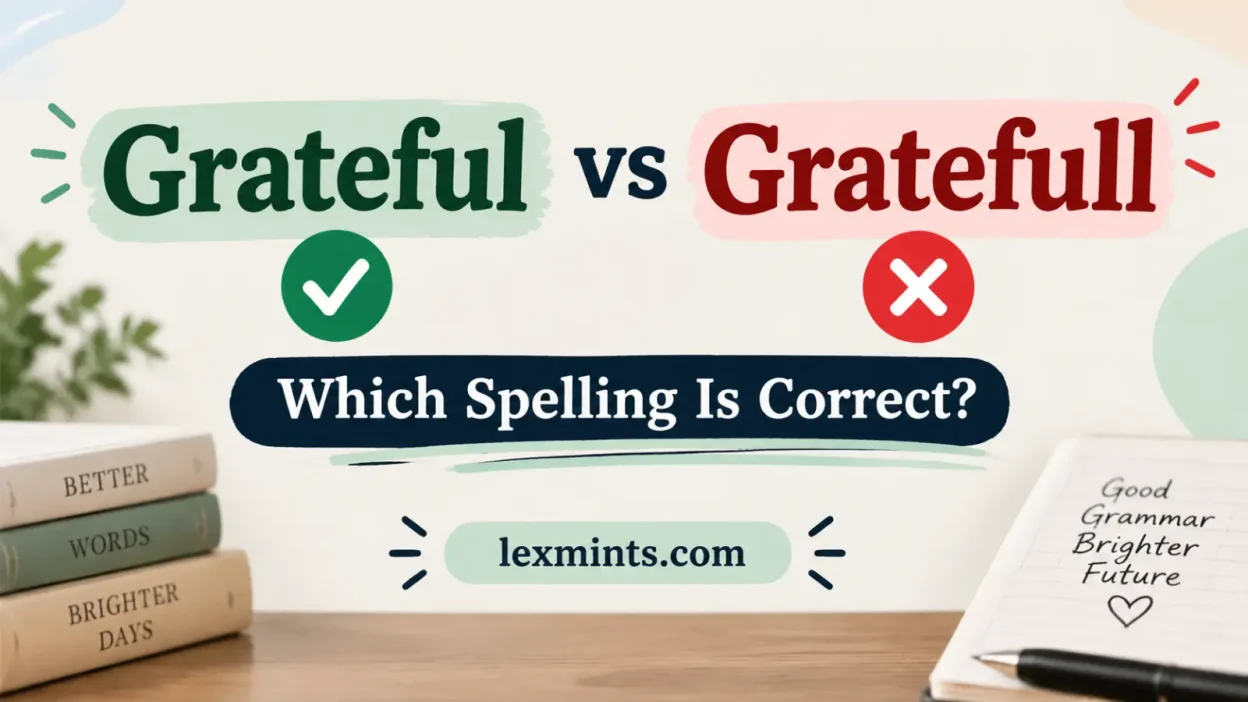
If you are unsure whether the correct spelling is grateful or gratefull, you are not alone. The two spellings look almost identical, but only one is correct in standard English.
Grateful is the correct spelling. Gratefull is a misspelling.
The word grateful is an adjective that means feeling or expressing appreciation, thankfulness, or gratitude toward someone or something. For example, you might say, “I am grateful for your help” when you want to express sincere appreciation.
The common mistake happens because many English words form their related versions with a double l, such as full → fully or words ending in -ful that can look like they should contain an extra letter. However, grateful is spelled with only one l at the end.
In this guide, we will explain the difference between grateful vs gratefull, show you the correct spelling, provide examples, explain why people make this mistake, and give you easy ways to remember the correct form.
Grateful vs Gratefull: The Quick Answer
The correct spelling is grateful.
- Grateful = correct
- Gratefull = incorrect
Grateful means thankful or appreciative.
Examples
- I am grateful for everything you have done.
- She felt grateful for the opportunity.
- We are grateful to everyone who supported us.
- He was deeply grateful for their kindness.
The spelling gratefull should not be used in standard English writing.
If you are writing an email, essay, article, professional message, application, or social media post, use grateful.
What Does Grateful Mean?
Grateful is an adjective used to describe a person who feels or expresses appreciation.
When you are grateful, you recognize that someone has helped you, given you something valuable, supported you, or contributed positively to your life.
For example:
I am grateful for your support.
This sentence means that the speaker appreciates the other person’s support.
You can be grateful to someone or grateful for something.
Grateful to Someone
Use grateful to when identifying the person toward whom you feel appreciation.
Examples:
- I am grateful to my parents.
- She is grateful to her teacher.
- We are grateful to everyone who helped us.
Grateful for Something
Use grateful for when identifying the thing, action, opportunity, or situation you appreciate.
Examples:
- I am grateful for your advice.
- He is grateful for the opportunity.
- They are grateful for their new home.
You can also use both structures in one sentence:
I am grateful to you for your kindness.
This means you appreciate the person and the specific thing they did.
Is Grateful or Gratefull Correct?
Grateful is correct.
Gratefull is a spelling error.
The correct word contains the letters:
G-R-A-T-E-F-U-L-L?
No. The correct spelling is:
G-R-A-T-E-F-U-L
So the final part is -ful, with one l.
Correct
grateful
Incorrect
gratefull
The difference is only one letter, which is why the mistake can be easy to make.
If you are checking your writing, remember that grateful ends with “ful,” not “full.”
Why Do People Spell Grateful as Gratefull?
The confusion between grateful and gratefull usually comes from the spelling of the suffix -ful.
The word is related to grate, meaning to be pleasing or appreciated in this historical word formation, plus the suffix -ful, which means “full of” or “characterized by.”
Many learners see the word full and assume that a word meaning “full of gratitude” should be spelled with full at the end.
That leads to the incorrect form:
grate + full = gratefull
However, English spelling does not work that way here.
The suffix is spelled -ful, with a single l.
This same pattern appears in many English words:
- thankful
- helpful
- careful
- useful
- peaceful
- wonderful
- beautiful
- successful
Although these words are related to the idea of being “full of” something, the suffix is normally written -ful, not -full.
That is why grateful has only one l at the end.
Grateful: Definition and Meaning
The main meaning of grateful is feeling or showing appreciation and thanks.
It can describe a temporary feeling or a general attitude.
For example:
I am grateful for the chance to work with such a talented team.
The speaker appreciates the opportunity.
Another example is:
She was grateful to her friend for helping her move.
Here, the speaker expresses appreciation toward her friend.
Grateful can describe appreciation for small things, major events, personal relationships, opportunities, kindness, assistance, or positive experiences.
More Examples
- I am grateful for your patience.
- We are grateful for the support we received.
- She was grateful to her doctor for the advice.
- He felt grateful after receiving the good news.
- They are grateful for their family and friends.
Is Gratefull a Word?
No. Gratefull is not the standard spelling of the English adjective.
If you see gratefull in a sentence, it is generally a misspelling of grateful.
For standard English writing, replace gratefull with grateful.
For example:
Incorrect:
I am gratefull for your help.
Correct:
I am grateful for your help.
The correction is simple: remove the second l.
Grateful in a Sentence
The word grateful is commonly used in several sentence patterns.
Grateful for
Use grateful for when expressing appreciation for something.
Examples:
- I am grateful for this opportunity.
- She is grateful for her family’s support.
- We are grateful for your generosity.
- He is grateful for the extra time.
Grateful to
Use grateful to when referring to a person.
Examples:
- I am grateful to you.
- She is grateful to her parents.
- We are grateful to our customers.
- He is grateful to everyone who helped.
Grateful to Someone for Something
You can combine both forms.
Examples:
- I am grateful to you for your support.
- She is grateful to her parents for their encouragement.
- We are grateful to everyone for their contributions.
This structure is especially useful in professional and formal writing.
Grateful vs Thankful
Grateful and thankful are closely related, and they are often interchangeable.
Both words can describe appreciation.
For example:
- I am grateful for your help.
- I am thankful for your help.
Both sentences are natural.
However, grateful can sometimes emphasize a deeper sense of appreciation, especially when someone has provided meaningful help or support.
For example:
I am deeply grateful for everything you have done.
This sounds particularly sincere and appreciative.
Thankful is also very common in everyday American English.
You might say:
I am thankful that everyone arrived safely.
The best word depends on the context and the exact feeling you want to communicate.
Grateful vs Gratitude
Another common point of confusion is the difference between grateful and gratitude.
They are related, but they have different grammatical roles.
Grateful is an adjective.
Gratitude is a noun.
Examples:
- I am grateful for your help.
- I feel a deep sense of gratitude.
You can use grateful to describe someone who feels appreciative.
You use gratitude to name the feeling itself.
Compare
She is grateful for the opportunity.
Here, grateful describes she.
She expressed her gratitude for the opportunity.
Here, gratitude is the noun naming her appreciation.
Common Phrases With Grateful
Learning common expressions can make it easier to remember the correct spelling of grateful.
Here are some frequently used phrases:
- grateful for your help
- grateful for your support
- grateful for the opportunity
- grateful to you
- grateful to everyone
- deeply grateful
- truly grateful
- extremely grateful
- forever grateful
- incredibly grateful
- genuinely grateful
- sincerely grateful
Example Sentences
I am truly grateful for your support.
We are deeply grateful to everyone who contributed.
She was incredibly grateful for the opportunity.
I will always be grateful for your kindness.
These expressions are common in personal, professional, academic, and public communication.
Common Mistakes With Grateful
The most common mistake is adding an extra l:
Wrong: gratefull
Correct: grateful
Another mistake is confusing grateful with greatful.
Although greatful may look logical because of the word great, it is also incorrect.
The correct spelling is:
grateful
Not:
- gratefull
- greatful
- greatfull
Correct Example
I am grateful for your kindness.
Incorrect Examples
I am gratefull for your kindness.
I am greatful for your kindness.
I am greatfull for your kindness.
Only grateful is correct in standard English.
How to Remember the Spelling of Grateful
A simple way to remember grateful is to focus on the ending.
Think:
grate + ful = grateful
The ending is -ful, not -full.
You can also connect it with familiar words such as:
- helpful
- thankful
- careful
- peaceful
- useful
They all use the single-l suffix -ful.
Another helpful memory trick is:
Grateful has one L.
If you are unsure whether to write grateful or gratefull, choose the version with one l.
Examples of Grateful in Everyday English
Here are examples showing how Americans commonly use grateful in everyday communication.
Personal Communication
I am so grateful for everything you have done for me.
Professional Communication
We are grateful for your continued support.
Academic Writing
Students may feel grateful for opportunities to learn from experienced professionals.
Social Media
Feeling grateful for all the amazing people in my life.
Thank-You Message
I am truly grateful for your kindness and generosity.
In each example, grateful is spelled with one l at the end.
Grateful in Formal Writing
Grateful is perfectly appropriate in formal English.
It can be used in:
- business emails
- thank-you letters
- academic writing
- professional statements
- speeches
- applications
- acknowledgments
- customer communication
For example:
We are grateful for your continued partnership and support.
This sentence sounds professional and respectful.
A more personal version might be:
I am incredibly grateful for your help during this difficult time.
The word works well in both formal and informal contexts.
Grateful vs Gratefull: Quick Comparison
| Spelling | Correct? | Meaning |
|---|---|---|
| grateful | Yes | Feeling or expressing appreciation |
| gratefull | No | Common misspelling of grateful |
The key difference is the final letter.
Grateful ends with -ful.
Gratefull incorrectly ends with -full.
How to Correct Gratefull in Your Writing
If you have written gratefull, simply change it to grateful.
Before
I am gratefull for your help.
After
I am grateful for your help.
The same correction applies in longer sentences:
Before
We are gratefull to everyone who supported the project.
After
We are grateful to everyone who supported the project.
When proofreading, search for gratefull and replace it with grateful.
Why the Extra L Is Incorrect
The extra l appears because writers may mentally connect grateful with the word full.
The word full has two l letters:
full
But the suffix -ful has only one:
ful
This distinction is important.
Compare:
- full
- useful
- helpful
- thankful
- grateful
- beautiful
The standalone word full has two l letters, but the suffix -ful has only one.
Therefore:
grateful ✅
gratefull ❌
Is Grateful American or British English?
Grateful is standard English in both American and British English.
There is no need to change the spelling to gratefull in either variety.
For US-English writing, use:
grateful
For UK-English writing, use:
grateful
The spelling remains the same.
FAQs
Is grateful or gratefull correct?
Grateful is correct. Gratefull is a misspelling. The standard spelling has only one l at the end.
How do you spell grateful correctly?
The correct spelling is grateful: G-R-A-T-E-F-U-L. It ends with -ful, not -full.
What does grateful mean?
Grateful means feeling or expressing appreciation or thanks. For example, “I am grateful for your help” means “I appreciate your help.”
Why do people spell grateful as gratefull?
People often make this mistake because they associate the ending with the word full, which contains two l letters. However, the suffix -ful is spelled with only one l.
Is gratefull a real word?
No. Gratefull is not the standard spelling. The correct form is grateful.
Is grateful the same as thankful?
They have very similar meanings and are often interchangeable. Both can describe appreciation, although grateful can sometimes emphasize a strong or sincere feeling of appreciation.
What is the difference between grateful and gratitude?
Grateful is an adjective that describes someone who feels appreciation. Gratitude is a noun that names the feeling of appreciation. For example, “I am grateful” and “I expressed my gratitude.”
What is the easiest way to remember grateful?
Remember that the word ends in -ful, with one l: grateful. Do not spell it gratefull.
Conclusion
When choosing between grateful vs gratefull, always use grateful.
Grateful is the correct English spelling and means feeling or expressing appreciation or thanks.
Gratefull is an incorrect spelling and should be avoided in standard English.
The easiest way to remember the difference is to focus on the ending:
grateful = -ful
not
gratefull = -full
For example:
I am grateful for your help.
She is grateful to her family.
We are deeply grateful for your support.
If you remember that grateful has only one L at the end, you can avoid this common spelling mistake every time.


