
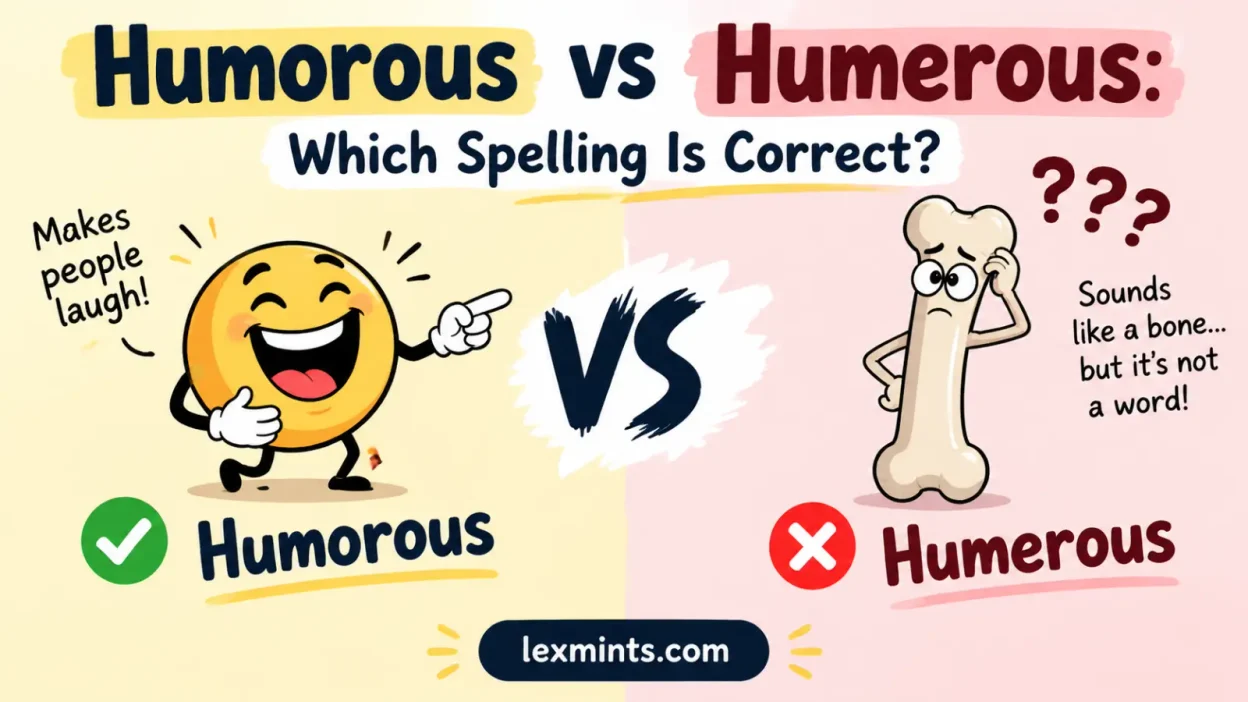
Humorous vs humerous is a common spelling confusion, especially when people hear the word rather than see it written. The two forms look almost identical, but they do not have the same status in standard American English.
The correct spelling is humorous when you mean “funny,” “amusing,” or “causing laughter.” Humerous is not the standard spelling of this adjective. It is generally considered a misspelling of humorous.
If you want to describe a person, story, comment, movie, situation, or piece of writing as funny or amusing, use humorous.
Correct: She gave a humorous response to the question.
Incorrect: She gave a humerous response to the question.
Understanding the difference is useful because humorous appears frequently in everyday writing, professional communication, articles, reviews, essays, and online content. A single misplaced vowel can turn a correctly spelled word into an error.
Humorous vs Humerous: The Quick Answer
The correct spelling is humorous.
- Humorous = correct
- Humerous = incorrect spelling in standard English
The word humorous is an adjective related to humor. It describes something that is funny, amusing, entertaining, or intended to make people laugh.
For example:
- The comedian gave a humorous performance.
- His humorous comment made everyone laugh.
- She wrote a humorous story about everyday life.
- The article uses a humorous tone.
By contrast, humerous is usually a spelling mistake caused by leaving out the second “o” in humorous.
A simple way to remember the correct spelling is to connect humorous with humor:
humor → humorous
This connection can make the spelling easier to remember.
What Does Humorous Mean?
Humorous is an adjective meaning funny, amusing, witty, or likely to make people laugh.
It can describe many different things, including people, comments, stories, books, movies, speeches, situations, and writing styles.
For example:
The teacher told a humorous story before starting the lesson.
Here, humorous means the story was funny or amusing.
Another example is:
He has a humorous personality.
This means the person often behaves or speaks in a funny and entertaining way.
The word does not necessarily mean that something is extremely funny. It can describe anything that contains humor or creates amusement.
Common meanings of humorous
Depending on the context, humorous can mean:
- funny
- amusing
- entertaining
- witty
- playful
- comical
- lighthearted
For example:
A humorous book is a book that contains funny or amusing material.
A humorous speaker is someone who uses humor while speaking.
A humorous comment is a comment intended to amuse people.
What Does Humerous Mean?
In standard modern English, humerous is not the correct spelling for the adjective meaning “funny.”
If you write:
The movie was humerous.
you should change it to:
The movie was humorous.
The mistake happens because the pronunciation of humorous can make the spelling less obvious. When people hear the word, they may naturally write humerous instead of humorous.
However, in standard written English, humorous is the form you should use.
Is Humerous Ever Correct?
For normal English writing, especially American English, humerous should not be used as a replacement for humorous.
If you are writing an essay, website article, email, report, school assignment, business document, or social media post, use humorous when you mean “funny” or “amusing.”
For example:
Correct: The author has a humorous writing style.
Incorrect: The author has a humerous writing style.
Why Do People Spell Humorous as Humerous?
The main reason for this spelling mistake is pronunciation.
The word humorous contains a sequence of vowels that can be difficult to hear clearly in ordinary speech. Depending on accent and speaking speed, the word may sound as though it contains an “e” where the written word has an “o.”
This can lead people to write:
humerous
instead of:
humorous
Another reason is that English spelling is not always perfectly predictable from pronunciation. A word can sound one way while its spelling preserves a pattern that is easier to recognize visually or historically.
The safest approach is to remember that humorous contains the complete word humor:
HUMOR + OUS = HUMOROUS
This makes the spelling easier to recall.
Humorous: Spelling Breakdown
The correct spelling is:
H-U-M-O-R-O-U-S
There are two important “o” sounds in the written form that people sometimes overlook.
Break the word into:
humor + ous
This gives:
humorous
The base word is humor, and the suffix -ous helps form the adjective.
For example:
- humor → humorous
- danger → dangerous
- fame → famous
- courage → courageous
Although English word formation has many exceptions and variations, recognizing the base word can be a useful spelling strategy.
Humorous as an Adjective
Humorous functions as an adjective.
An adjective describes or modifies a noun. In this case, humorous describes something that has humor or is amusing.
Consider these examples:
- a humorous story
- a humorous character
- a humorous speech
- a humorous comment
- a humorous video
- a humorous article
- a humorous personality
- a humorous situation
In each phrase, humorous tells us something about the noun.
Examples in sentences
- The writer created a humorous character for the novel.
- His humorous speech kept the audience engaged.
- We watched a humorous movie last night.
- She made a humorous observation about office life.
- The teacher used a humorous example to explain the concept.
- His humorous personality makes him easy to talk to.
- The article takes a humorous approach to a serious subject.
- The cartoon presents a humorous version of the situation.
Humorous vs Funny
Humorous and funny are closely related, but they are not always interchangeable in every context.
Funny is much more common in everyday conversation. It is simple, direct, and informal.
For example:
That movie was funny.
Humorous can sound slightly more descriptive or formal:
That movie was humorous.
Both sentences can communicate that the movie contains humor, but the tone is somewhat different.
When to use funny
Use funny when speaking naturally in casual situations:
- That was funny.
- He’s really funny.
- She told a funny story.
- This video is funny.
When to use humorous
Use humorous when describing a style, quality, approach, or characteristic:
- The article has a humorous tone.
- The author uses humorous language.
- The presentation included several humorous examples.
- The novel is written in a humorous style.
In professional and academic writing, humorous can sometimes sound more appropriate than funny, depending on the context.
Humorous vs Comical
Humorous and comical are also similar.
Humorous generally describes something that contains or expresses humor.
Comical often emphasizes that something is funny because it appears ridiculous, absurd, or amusing.
For example:
The writer uses a humorous tone throughout the article.
This focuses on the author’s use of humor.
His attempt to fix the problem was almost comical.
This suggests that the situation was amusing because it was somewhat ridiculous.
The two words overlap, but they can create slightly different impressions.
Humorous vs Hilarious
These words are not exact synonyms.
Humorous means funny or containing humor.
Hilarious generally means extremely funny.
For example:
The speaker gave a humorous presentation.
This means the presentation included humor.
The comedian gave a hilarious performance.
This suggests the performance was extremely funny.
Therefore, you should not automatically replace humorous with hilarious. The strength of the meaning is different.
Examples of Correct Usage
Here are several examples showing how humorous is naturally used.
Example 1: Writing
The author uses a humorous tone to discuss everyday problems.
Example 2: Conversation
She gave a humorous answer that made everyone smile.
Example 3: Entertainment
The show combines serious topics with humorous moments.
Example 4: Personality
My uncle has a very humorous personality.
Example 5: Education
The teacher used a humorous example to make the lesson memorable.
Example 6: Business
The company’s presentation included a few humorous comments.
Example 7: Literature
The novel has a humorous style that keeps the story engaging.
Example 8: Social media
He posted a humorous video about working from home.
All of these examples use humorous correctly.
Incorrect Examples With Humerous
The following sentences contain the common spelling error:
The article has a humerous tone.
Correct:
The article has a humorous tone.
She wrote a humerous story.
Correct:
She wrote a humorous story.
His speech was very humerous.
Correct:
His speech was very humorous.
The movie contains several humerous scenes.
Correct:
The movie contains several humorous scenes.
He is known for his humerous personality.
Correct:
He is known for his humorous personality.
The issue in each example is spelling, not sentence structure.
How to Remember the Correct Spelling
A simple memory trick is:
Humor → Humorous
If you remember how to spell humor, you can use it as the foundation for humorous.
Think:
HUMOR + OUS = HUMOROUS
Do not change the “o” in humor to an “e.”
Another useful technique is to visualize the word:
HUMOROUS
The first five letters are:
HUMOR
That makes the correct spelling easier to recognize.
Memory sentence
You can remember:
Humorous contains humor.
The word humorous literally keeps the spelling pattern of humor at its beginning.
Common Mistakes With Humorous
The most common mistake is:
humerous ❌
instead of:
humorous ✅
Other errors may also occur when people are unsure about the vowels.
For example, someone may accidentally type:
- humerous
- humorus
- humurous
- humerous
The standard spelling is:
humorous
When proofreading your writing, check the word carefully if you are using it in an important sentence.
Humorous in American English
For American English, humorous is the standard spelling.
The related noun is humor, spelled without the British “u” found in humour.
American English:
- humor
- humorous
British English:
- humour
- humorous
Notice an important point: even in British English, the adjective is normally spelled humorous, not humerous.
Therefore, humerous is not simply an American-versus-British spelling difference.
If you are writing for a US audience, use:
humor
and:
humorous
Humorous in Professional Writing
There is nothing inherently unprofessional about the word humorous. It can be used in business writing, journalism, marketing, education, and other formal contexts.
However, whether humor itself is appropriate depends on the audience and situation.
For example:
The report takes a humorous approach to a complicated subject.
This is perfectly acceptable.
But a serious legal document may require a neutral tone rather than humor.
Similarly, a professional presentation can include a humorous example when appropriate, but the humor should fit the audience.
The word humorous simply describes the presence or use of humor. It does not automatically make the writing informal.
Humorous in Academic Writing
Students sometimes wonder whether humorous is appropriate in academic writing.
The answer is yes, when it accurately describes something being discussed.
For example:
The author adopts a humorous tone to criticize social behavior.
This is an appropriate academic sentence because humorous describes the author’s writing style.
Another example:
The humorous examples make the complex concept easier for readers to understand.
The key is to use the word precisely and maintain an appropriate overall tone.
Humorous in Everyday Conversation
Although funny is generally more common in casual speech, humorous is still perfectly natural.
For example:
He’s a very humorous person.
That was a humorous comment.
She has a humorous way of explaining things.
The word can sound a little more descriptive than funny, but it is not incorrect or unnatural.
Word Family Related to Humor
Learning related words can help reinforce the spelling.
Some common words connected with humor include:
- humor
- humorous
- humorously
- humorist
- humorless
- humoristic
The most important connection for spelling purposes is:
humor → humorous
When you remember this relationship, you are less likely to accidentally write humerous.
Humorous or Humerous: Comparison Table
| Word | Correct? | Meaning |
|---|---|---|
| Humorous | Yes | Funny, amusing, or containing humor |
| Humerous | No | Common misspelling of “humorous” |
The difference is only one vowel, but that vowel matters in standard written English.
Quick Grammar Guide
Use humorous before or after a noun when describing something as funny or amusing.
Before a noun
It was a humorous story.
She made a humorous comment.
He wrote a humorous article.
After a linking verb
The story was humorous.
His presentation was humorous.
The situation became humorous.
Because humorous is an adjective, it can describe a person, object, action, situation, style, or piece of communication.
Frequently Confused Sentences
Here are some common sentence patterns worth remembering:
Incorrect: The comedian was humerous.
Correct: The comedian was humorous.
Incorrect: It was a humerous story.
Correct: It was a humorous story.
Incorrect: She has a humerous personality.
Correct: She has a humorous personality.
Incorrect: The writer uses a humerous tone.
Correct: The writer uses a humorous tone.
Incorrect: His response was surprisingly humerous.
Correct: His response was surprisingly humorous.
The correction is simple: replace humerous with humorous.
Why Correct Spelling Matters
Spelling mistakes can affect how readers perceive your writing.
If you use humerous in an article, essay, resume, email, or professional document, readers may recognize it as an error. Even when the intended meaning is obvious, incorrect spelling can make the writing appear less polished.
Using humorous ensures that your writing follows standard English spelling.
This is especially important for:
- school assignments
- blog posts
- business communication
- professional emails
- website content
- marketing copy
- resumes and applications
- academic papers
- published articles
Correct spelling improves clarity and credibility.
Easy Trick to Avoid the Humerous Mistake
Whenever you are unsure whether to write humorous or humerous, pause and think of the noun:
humor
Now add:
-ous
That gives:
humor + ous = humorous
This is much easier to remember than trying to memorize the entire spelling without a connection.
Remember:
Humor is humorous.
The first part of humorous is spelled like humor.
FAQs
Is it humorous or humerous?
The correct spelling is humorous. It means funny, amusing, or entertaining. Humerous is a common misspelling and should not be used in standard English.
What is the meaning of humorous?
Humorous is an adjective that describes something funny, amusing, witty, or related to humor. For example, “He gave a humorous answer.”
Why do people spell humorous as humerous?
People often spell humorous as humerous because the pronunciation can make the vowel pattern difficult to hear. Remembering the base word humor can help: humor + ous = humorous.
Is humerous a word in the English dictionary?
Humerous is generally treated as a misspelling of humorous when the intended meaning is “funny” or “amusing.” The standard spelling is humorous.
How can I remember the correct spelling of humorous?
A simple trick is to remember humor inside humorous. Think of it as HUMOR + OUS = HUMOROUS. This helps prevent the common mistake of writing humerous.
Conclusion
When choosing between humorous vs humerous, the correct spelling is clearly humorous.
Humorous is an adjective meaning funny, amusing, entertaining, or related to humor. It can describe a person, story, comment, movie, speech, article, situation, personality, or writing style.
Humerous is a common misspelling and should not be used in standard English when you mean “funny” or “amusing.”
The easiest way to remember the correct form is:
humor → humorous
So, if you want to describe something as funny, write:
The story was humorous.
Not:
The story was humerous.
For American English and standard professional writing, humorous is the spelling you should choose.


