
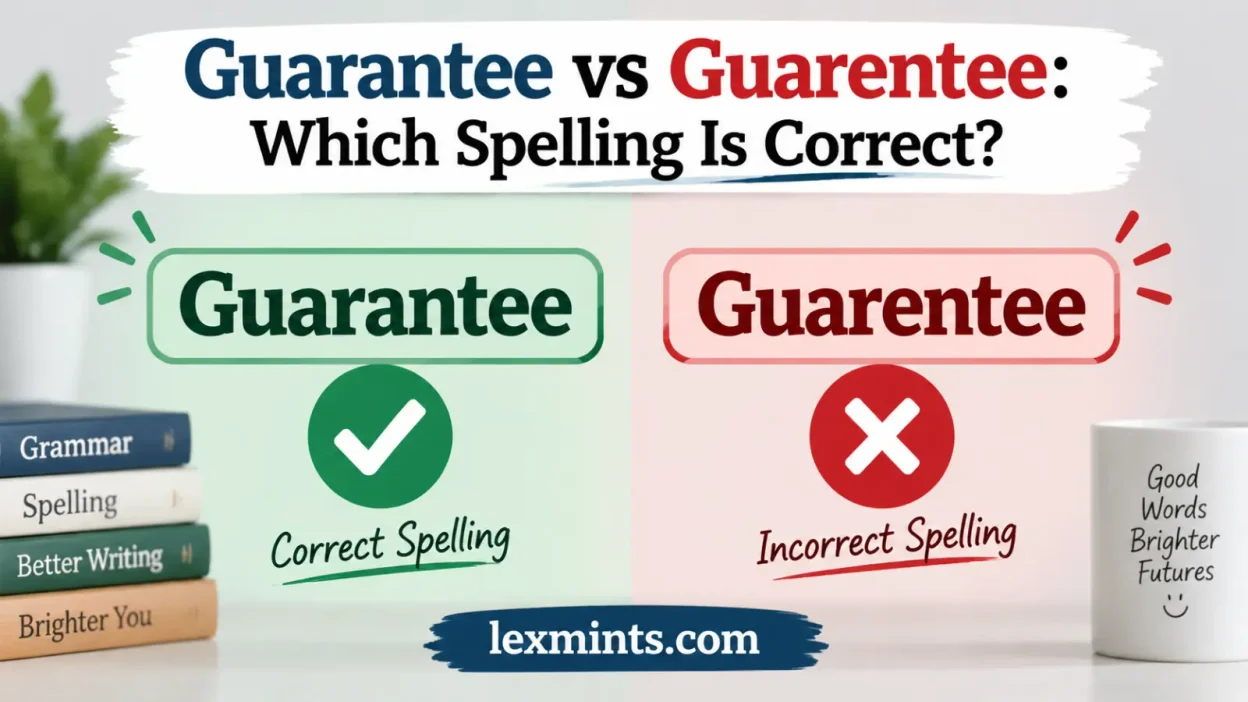
If you have ever hesitated between guarantee vs guarentee, you are not alone. These two spellings look very similar, and the pronunciation of guarantee can make its spelling surprisingly easy to forget. However, there is a clear difference between them: guarantee is the correct standard English spelling, while guarentee is a misspelling.
The correct word is guarantee.
You should use guarantee in formal writing, academic work, professional communication, business documents, websites, emails, and everyday English. Guarentee does not appear as the standard spelling of this word and should be avoided.
In this guide, we will explain the difference between guarantee and guarentee, define the correct word, show how to pronounce and use it, provide clear examples, explain why people commonly misspell it, and give you simple ways to remember the correct spelling.
Guarantee vs Guarentee: Quick Answer
The correct spelling is guarantee.
Guarentee is incorrect and should not be used in standard English.
| Spelling | Correct? | Meaning |
|---|---|---|
| Guarantee | Yes | A promise or assurance that something will happen or that a condition will be fulfilled |
| Guarentee | No | Common misspelling of guarantee |
Correct:
The company guarantees that your order will arrive on time.
Incorrect:
The company guarentees that your order will arrive on time.
The key spelling to remember is:
GUARANTEE
Not:
GUARENTEE
The correct spelling contains “antee” after the guar- beginning.
What Does Guarantee Mean?
Guarantee can function as both a noun and a verb.
As a noun, a guarantee is a promise or assurance that something will happen, work, or meet a particular condition.
For example:
The laptop comes with a two-year guarantee.
Here, guarantee refers to an assurance provided by the manufacturer.
As a verb, guarantee means to promise or assure that something will happen or be true.
For example:
We guarantee the quality of every product we sell.
In this sentence, guarantee means to make a firm promise about the quality of the products.
The word is commonly used in business, customer service, contracts, warranties, personal promises, and everyday conversations.
Is Guarantee or Guarentee Correct?
Guarantee is correct.
Guarentee is a misspelling.
If you are writing an email, article, essay, product description, contract, advertisement, or professional document, always choose guarantee.
For example:
We guarantee excellent customer service.
Not:
We guarentee excellent customer service.
The incorrect spelling often occurs because English pronunciation does not always make the written form obvious. People may hear the final part of the word and assume that it should be spelled -entee.
However, the standard spelling is:
G-U-A-R-A-N-T-E-E
Guarantee
Correct: guarantee
Guarentee
Incorrect: guarentee
If you are unsure, remember that guarantee has “ante” before the final “e.”
Why Is “Guarentee” Incorrect?
The problem with guarentee is simply that it is not the standard spelling of the English word.
The correct spelling is guarantee.
Many English words cannot be spelled reliably just by listening to their pronunciation. Guarantee is one of those words. Its pronunciation may cause writers to focus on the sound of the ending rather than the actual spelling.
The incorrect form guarentee probably seems logical because English contains many words ending in -ee, and the pronunciation of guarantee emphasizes its final syllable.
Nevertheless, spelling conventions determine the correct written form.
When you need the word meaning “a promise or assurance,” use:
guarantee
How Do You Spell Guarantee?
The correct spelling is:
G-U-A-R-A-N-T-E-E
The word has three important parts to remember:
- GUAR
- ANT
- EE
Together:
GUAR + ANT + EE = GUARANTEE
A common mistake is to replace the “an” in guarantee with “en.”
That produces:
guarentee
But the correct sequence is:
guarantee
A useful visual reminder is:
guar + an + tee
The middle “an” is important.
Guarantee Meaning in Simple English
In simple English, guarantee means a strong promise that something will happen, work, or be true.
For example:
I guarantee that you will enjoy this book.
This means:
I strongly promise that you will enjoy this book.
In a business context, a guarantee can provide assurance to customers.
For example:
The manufacturer guarantees the product for five years.
This means the manufacturer makes a promise about the product for that period, subject to the applicable terms.
The exact meaning can vary slightly depending on context, but the central idea is always related to assurance, certainty, or a promise.
Guarantee as a Noun
When guarantee is used as a noun, it refers to a promise, assurance, or form of protection.
Consider these examples:
The product comes with a money-back guarantee.
The company offers a lifetime guarantee on selected products.
There is no guarantee that the plan will succeed.
The warranty includes a limited guarantee.
The seller provided a written guarantee.
In each example, guarantee is a thing or assurance rather than an action.
More Examples
The store offers a satisfaction guarantee.
The manufacturer gave us a five-year guarantee.
There is no guarantee of success.
His promise was a guarantee that he would return.
These sentences demonstrate common noun uses of guarantee.
Guarantee as a Verb
Guarantee can also be used as a verb.
As a verb, it means to promise or assure that something will happen or be true.
Examples include:
I guarantee that this method will save you time.
The company guarantees fast delivery.
Nothing can guarantee success.
We cannot guarantee that every item will be available.
The manufacturer guarantees the quality of its products.
Here, guarantee describes an action: someone is making an assurance or promise.
Guarantee vs Warranty
Although guarantee and warranty are sometimes used similarly, they are not always interchangeable.
A guarantee is generally an assurance or promise that something will happen or that a product or service will meet certain expectations.
A warranty is commonly a specific written promise concerning a product, often covering repairs, replacement, or defects under stated conditions.
For example:
The company guarantees customer satisfaction.
This is a broad assurance.
Compare that with:
The phone comes with a one-year warranty.
This usually refers to specific coverage and conditions.
The exact legal meaning of these terms can vary depending on the jurisdiction and the document involved, so they should not automatically be treated as identical in legal or contractual contexts.
Common Examples of Guarantee
Here are several natural examples of guarantee in American English:
- We guarantee the quality of every product.
- The company offers a money-back guarantee.
- There is no guarantee that the event will sell out.
- I guarantee you will enjoy the movie.
- The service comes with a satisfaction guarantee.
- The manufacturer guarantees the product against certain defects.
- This result is not guaranteed.
- Nothing can guarantee success.
- The store guarantees next-day delivery for eligible orders.
- We cannot guarantee availability during busy periods.
Notice that the spelling remains guarantee in every case.
Common Forms of Guarantee
Because guarantee can be used as a verb and a noun, you may encounter several related forms.
Guarantee
Base form:
We guarantee our work.
Guarantees
Third-person singular present tense:
The company guarantees customer satisfaction.
Guaranteed
Past tense and past participle:
The result is guaranteed under the stated conditions.
Guaranteeing
Present participle:
The company is guaranteeing delivery by Friday.
All of these forms are based on the correct spelling guarantee.
Why Do People Spell Guarantee as Guarentee?
There are several reasons people may write guarentee instead of guarantee.
1. Pronunciation Can Be Misleading
English spelling and pronunciation do not always match perfectly. When people hear guarantee, they may focus on the sound of the final syllables and reconstruct the spelling incorrectly.
2. The Ending Looks Familiar
English has many words that contain the letter combination -ee, so writers may instinctively create guarentee.
3. The Word Is Often Heard Before It Is Seen
People may learn words through conversation before encountering their written forms. If they have mostly heard guarantee, they may not immediately know how to spell it.
4. The Middle Vowels Are Easy to Mix Up
The difference between guarantee and guarentee is small visually.
Compare them:
guarantee
guarentee
The incorrect version changes the “an” sequence to “en.”
That small difference is enough to make the spelling incorrect.
A Simple Trick to Remember Guarantee
One of the easiest ways to remember the correct spelling is to break the word into parts:
GUAR + AN + TEE
Then combine them:
GUARANTEE
Pay particular attention to the middle:
AN
Not:
EN
So remember:
GUAR + AN + TEE = GUARANTEE
You can also associate the word with guarantor and guaranteed, which share the same spelling pattern.
For example:
guarantee
guarantor
guaranteed
guaranteeing
Learning the word family can help reinforce the correct spelling.
Guarantee in American English
Guarantee is the standard spelling used in American English.
For a U.S. audience, use guarantee in:
- Business writing
- Academic writing
- Websites
- Product descriptions
- Customer service communication
- Advertising
- Emails
- Reports
- Contracts
- General writing
There is no standard American-English spelling guarentee.
If you are creating content for a U.S. audience, the correct choice is therefore straightforward:
Use guarantee.
Guarantee in British English
British English also uses guarantee.
Therefore, this is not a situation where one spelling is American and the other is British.
The standard spelling is:
guarantee
The form guarentee is still a misspelling.
This makes the choice particularly easy. Whether your audience is in the United States, the United Kingdom, Canada, Australia, or another English-speaking region, guarantee is the standard spelling.
Guarantee in Business Writing
The word guarantee is extremely common in business and marketing.
Companies may use it to communicate confidence in a product or service.
Examples include:
We guarantee your satisfaction.
Our service comes with a 30-day money-back guarantee.
We guarantee that every order is carefully inspected before shipment.
The company guarantees replacement for qualifying defective products.
When using guarantee in business writing, make sure the statement accurately reflects the company’s actual terms and conditions. A guarantee can create a strong expectation, so professional claims should be clear and accurate.
Guarantee in Everyday Conversation
Although guarantee can sound formal in some contexts, it is also common in everyday English.
For example:
I guarantee you’ll love this restaurant.
I guarantee he’s going to be late.
I can’t guarantee that the weather will cooperate.
She guaranteed that she would be there.
In these sentences, guarantee communicates strong confidence or assurance.
The word does not always refer to a formal legal or commercial promise.
Guarantee in Formal Writing
In formal writing, guarantee can be useful when you need to communicate certainty or assurance.
Examples:
The policy does not guarantee a specific outcome.
The procedure guarantees consistent results only when all conditions are met.
The organization cannot guarantee immediate processing.
However, writers should avoid making absolute claims without support. In professional and academic contexts, phrases such as does not guarantee, cannot guarantee, and not guaranteed can be useful when uncertainty needs to be communicated accurately.
Common Mistakes With Guarantee
The most common mistake is:
❌ guarentee
Correct it to:
✅ guarantee
Another mistake is assuming that the pronunciation determines the spelling.
For example, a writer may think:
“I hear an ‘ee’ sound, so I should spell it with ‘ee’ in the middle.”
But English spelling does not always work that way.
The safest approach is to remember the standard written form:
guarantee
Guarantee vs Guarentee Examples
Here are side-by-side examples to make the difference clear.
Example 1
❌ We guarentee your satisfaction.
✅ We guarantee your satisfaction.
Example 2
❌ The product comes with a money-back guarentee.
✅ The product comes with a money-back guarantee.
Example 3
❌ I guarentee that he will arrive on time.
✅ I guarantee that he will arrive on time.
Example 4
❌ The company guarentees fast delivery.
✅ The company guarantees fast delivery.
Example 5
❌ There is no guarentee of success.
✅ There is no guarantee of success.
In every example, guarantee is the correct spelling.
Guarantee vs Guarentee: Which One Should You Use?
If you are deciding between guarantee vs guarentee, always choose guarantee.
Use:
guarantee
Avoid:
guarentee
The difference is not one of meaning, dialect, or formality. Guarentee is simply a misspelling of guarantee.
How to Avoid the Mistake in the Future
If you frequently forget the spelling, try these techniques.
Memorize the Middle
Focus on:
GUAR-AN-TEE
The middle contains AN, not EN.
Learn Related Words
Practice the word family:
- guarantee
- guarantees
- guaranteed
- guaranteeing
- guarantor
Seeing the same spelling pattern repeatedly makes it easier to remember.
Use a Mental Phrase
You can remember:
A guarantee has “AN” in it.
This simple association can help prevent the common guarentee error.
Proofread Carefully
When proofreading, look specifically for:
guarentee
If you see it, replace it with:
guarantee
Is “Guarentee” Ever Correct?
No. Guarentee is not the standard spelling of the English word.
If you mean a promise, assurance, or commitment that something will happen or meet certain conditions, the correct word is:
guarantee
For example:
The company provides a satisfaction guarantee.
Not:
The company provides a satisfaction guarentee.
FAQs
Is it guarantee or guarentee?
Guarantee is the correct spelling. Guarentee is a misspelling and should not be used in standard English. For example, “We guarantee customer satisfaction” is correct.
What is the correct spelling of guarantee?
The correct spelling is guarantee: G-U-A-R-A-N-T-E-E. A helpful way to remember it is GUAR + AN + TEE.
Is “guarentee” a real word?
No. Guarentee is not the standard spelling of an English word. It is a common misspelling of guarantee, which means a promise or assurance.
What does guarantee mean?
Guarantee means to promise or assure that something will happen, work, or meet certain conditions. As a noun, it can also refer to the promise or assurance itself.
Why do people spell guarantee as guarentee?
People often write guarentee because the pronunciation of guarantee can make its spelling difficult to remember. The vowel sounds may lead writers to use -entee instead of the correct -antee spelling.
Is guarantee correct in American English?
Yes. Guarantee is the standard spelling in American English. Guarentee is incorrect and should be avoided in American English writing.
What is the difference between guarantee and guarentee?
There is no difference in meaning because guarentee is simply a misspelling. Guarantee is the correct word and can mean a promise, assurance, or commitment that something will happen or meet certain conditions.
How can I remember the spelling of guarantee?
Remember the word as GUAR-AN-TEE. The middle contains “AN,” not “EN.” This makes it easier to avoid the common mistake guarentee.
Conclusion
When comparing guarantee vs guarentee, the answer is simple:
Guarantee is the correct spelling.
Guarentee is a misspelling.
The word guarantee can be used as both a noun and a verb. As a noun, it refers to a promise or assurance. As a verb, it means to promise or assure that something will happen or be true.
The easiest way to remember the spelling is:
GUAR + AN + TEE = GUARANTEE
Do not replace AN with EN.
Whether you are writing for a U.S. audience, preparing an academic assignment, creating website content, writing a business email, or describing a product, use guarantee.
Quick Reminder
Correct: guarantee ✅
Incorrect: guarentee ❌
Meaning: a promise or assurance that something will happen, work, or meet certain conditions.
Once you remember the “GUAR-AN-TEE” pattern, the spelling becomes much easier to get right.


