Have you ever wondered whether to write their or there in a sentence? These two English words often confuse students, beginners, and even experienced writers. They sound exactly alike, but their meanings and grammatical functions are different.
Understanding the difference between their or there can help you write clearer sentences. It also helps you avoid common spelling and grammar mistakes in emails, school assignments, social media posts, and professional documents.
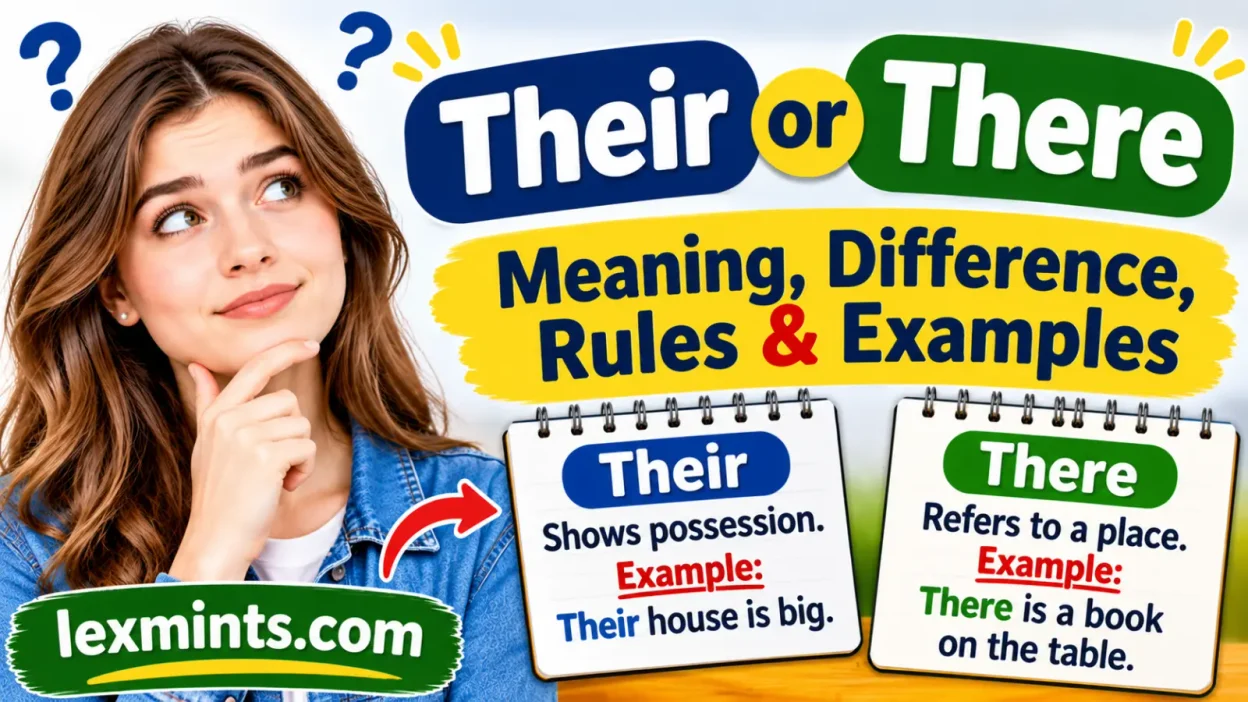
The word their shows ownership or possession. The word there usually refers to a place or introduces something that exists. A third word, they’re, also sounds the same and means they are.
In this guide, you will learn their meanings, grammatical roles, spelling rules, and practical examples. You will also discover simple tricks to remember the correct word and avoid confusing them in everyday writing.
Quick Answer: Their or There?
Both their and there are correct English words, but they have different meanings.
- Their shows that something belongs to someone. Example: Their house is beautiful.
- There refers to a place or introduces something. Example: The house is over there.
- They’re means they are. Example: They’re going home.
Choose the word that matches the meaning of your sentence.
TL;DR: Key Differences
- Their shows ownership or possession.
- There refers to a location or position.
- There introduces something that exists.
- They’re is short for they are.
- Their usually appears before a noun.
- There can introduce sentences and clauses.
What Does Their Mean?
Their is a possessive determiner that shows ownership, connection, or association. It tells readers that something belongs to or is connected with two or more people.
It is the possessive form of the pronoun they. You generally use it before a noun to identify who owns something.
For example:
- The students forgot their homework.
- My neighbors painted their house.
- The children are playing with their toys.
- The employees attended their meeting.
- The dogs wagged their tails.
In each example, their connects something with a person or group.
The homework belongs to the students. The house belongs to the neighbors, and the toys belong to the children.
Their as a Possessive Determiner
A possessive determiner appears before a noun and explains ownership or association.
For example:
- Their teacher is very friendly.
- Their business is growing quickly.
- Their favorite restaurant is downtown.
- Their parents live in California.
Here, their identifies the people connected with each noun.
Their for One Person
In modern English, their can also refer to one person whose gender is unknown, irrelevant, or expressed using singular they.
For example:
- Someone left their phone in the classroom.
- Every student should bring their notebook.
- The customer forgot their receipt.
- Everyone should check their email.
This singular use is widely accepted in contemporary American English.
It is especially helpful when you do not know someone’s gender or do not need to specify it.
What Does There Mean?
There has several uses in English. Most commonly, it refers to a place, location, or position.
It can also introduce a sentence that describes the existence of something.
For example:
- Your backpack is over there.
- We visited the museum yesterday.
- There is a new restaurant nearby.
- There are several books on the table.
- I left my keys there.
Unlike their, the word there does not show ownership.
It tells readers where something is or introduces information about something that exists.
There as an Adverb of Place
An adverb of place explains where an action happens or where something is located.
For example:
- Please sit there.
- We stayed there for two nights.
- My brother works over there.
- Put your shoes there.
- The children went outside and played there.
In these sentences, there identifies a location.
A useful memory trick is to connect there with here. Both words refer to places.
There in Existence Sentences
English also uses there to introduce the existence or presence of something.
This structure commonly appears with forms of the verb be, including:
- There is
- There are
- There was
- There were
- There will be
Examples:
- There is a problem with my computer.
- There are five people in the waiting room.
- There was a storm last night.
- There were several mistakes in the report.
- There will be a meeting tomorrow.
Notice that there introduces the subject or situation being discussed.
The verb usually agrees with the noun that follows it.
For example:
- Correct: There is a book on the desk.
- Correct: There are three books on the desk.
Use is with a singular noun and are with a plural noun in these standard constructions.
Their vs. There: Main Differences
The biggest difference is what each word communicates. Their identifies ownership, while there identifies a place or introduces existence.
Both words are pronounced the same way, but their spelling and grammatical functions are different.
| Feature | Their | There |
|---|---|---|
| Meaning | Belonging to them | In or at that place |
| Main function | Possession | Location or existence |
| Part of speech | Possessive determiner | Adverb, pronoun, and other uses |
| Common pattern | Their house | Over there |
| Example | Their car is new. | The car is there. |
Consider these examples:
- Their children are playing outside.
- There are children playing outside.
- Their office is near the airport.
- Their office is over there.
The first and third sentences show ownership or association. The other sentences describe existence or location.
When to Use Their
Use their when you want to show that something belongs to, relates to, or is associated with people.
It normally comes before a noun. Think about who owns the object or who is connected with the situation.
Use Their for Ownership
Examples:
- The students submitted their assignments.
- The workers cleaned their offices.
- My friends invited me to their wedding.
- The players celebrated their victory.
Each sentence identifies something connected with a group.
Use Their for Relationships
Ownership is not always about physically owning something. Their can also describe relationships, responsibilities, and personal connections.
Examples:
- The children visited their grandparents.
- The manager discussed their responsibilities.
- The team improved their performance.
- The students shared their opinions.
In these examples, the word expresses a connection rather than simple ownership.
Use Their With Singular They
You can use their when referring to one person with an unknown or unspecified gender.
Examples:
- Each applicant must submit their resume.
- Someone forgot their jacket.
- Every employee should bring their identification.
- The winner can collect their prize tomorrow.
This usage is natural in modern American English.
When to Use There
Use there when discussing a location, position, or the existence of something.
It can appear at the beginning, middle, or end of a sentence.
Use There for Locations
Examples:
- My parents live there.
- We will meet you there.
- The grocery store is over there.
- Please leave the package there.
- I saw your brother standing there.
In these sentences, there answers the question “Where?”
Use There to Introduce Something
Use there to introduce a person, object, event, or situation that exists.
Examples:
- There is a good movie on television tonight.
- There are many opportunities for students.
- There was a strange noise outside.
- There were two empty seats in the room.
- There will be a family gathering next weekend.
This construction is common in everyday conversations and formal writing.
Use There in Common Expressions
Some expressions use there in ways that do not describe a physical location.
Examples:
- There you go!
- There is no doubt about it.
- There, that looks much better.
- I’ve been there before.
- She was always there for her friends.
In these expressions, the word can communicate reassurance, emphasis, experience, or support.
Their or There: Real-Life Examples
The easiest way to understand these words is to see them in everyday situations.
Here are practical examples from school, work, family life, and daily conversations.
Examples in School
- The students brought their textbooks to class.
- There is a science project due tomorrow.
- Everyone should complete their assignments.
- The teachers left their materials in the classroom.
- There are twenty students in the classroom.
Examples at Work
- Employees must update their schedules.
- There is an important meeting this afternoon.
- The managers discussed their plans.
- There are several emails waiting for a response.
- The customers left their feedback online.
Examples at Home
- My parents cleaned their bedroom.
- There is a new television in the living room.
- The children put their shoes near the door.
- There are fresh vegetables in the refrigerator.
- Our neighbors parked their cars outside.
Examples in Everyday Conversations
- Are your friends bringing their children?
- Is there a coffee shop near here?
- We left our bags over there.
- Their new apartment looks beautiful.
- There is nothing to worry about.
These examples show how both words work naturally in different situations.
Their, There, and They’re: Understanding the Third Word
Although the main confusion involves their and there, another word creates similar problems.
That word is they’re.
It is a contraction formed by combining they and are. The apostrophe replaces the missing letter in the shortened form.
Examples:
- They’re waiting for the bus.
- They’re excited about their vacation.
- They’re going to visit us tomorrow.
- They’re working on a new project.
You can replace they’re with they are without changing the sentence’s basic meaning.
For example:
- They’re ready for dinner.
- They are ready for dinner.
Both sentences are correct.
However, you cannot use their or there in place of they’re when expressing they are.
Comparing All Three Words
| Word | Meaning | Example |
|---|---|---|
| Their | Belonging to them | Their house is large. |
| There | A place or existence | There is a house nearby. |
| They’re | They are | They’re inside the house. |
Remember that all three words sound alike in standard American English. Their meanings, not their pronunciation, determine the correct spelling.
Common Mistakes With Their or There
Many writers confuse these words because they have identical pronunciations.
However, a few simple corrections can help you avoid these errors.
Mistake: Using There to Show Ownership
Incorrect: The children forgot there lunchboxes.
Correct: The children forgot their lunchboxes.
Why? The lunchboxes belong to the children. Therefore, their is correct.
Mistake: Using Their for a Location
Incorrect: Please put your backpack over their.
Correct: Please put your backpack over there.
Why? The sentence identifies a location. It does not describe ownership.
Mistake: Confusing Their Are and There Are
Incorrect: Their are several people outside.
Correct: There are several people outside.
Why? The sentence introduces the existence of several people. The correct expression is there are.
Mistake: Using Their Instead of They’re
Incorrect: Their going to the movies tonight.
Correct: They’re going to the movies tonight.
Why? The intended meaning is they are going. The contraction they’re is necessary.
Mistake: Using There Instead of They’re
Incorrect: There planning a surprise party.
Correct: They’re planning a surprise party.
Why? The sentence means that the people are planning something. You can replace they’re with they are.
Mistake: Forgetting the Apostrophe
Incorrect: Their excited about the vacation.
Correct: They’re excited about the vacation.
Why? The sentence needs the contraction they’re, which contains an apostrophe.
Easy Tricks to Remember Their or There
You do not need to memorize complicated grammar rules to choose the correct word.
A few simple memory tricks can make the difference easier to remember.
Remember Their With Ownership
Think of the word their as showing something that belongs to people.
For example:
- Their house
- Their children
- Their business
- Their responsibilities
You can often replace their with our to check whether ownership is intended.
Example:
- Our house is beautiful.
- Their house is beautiful.
Both sentences show ownership.
Remember There With Here
The word there contains the word here.
Both words refer to places, which makes this a useful spelling reminder.
Examples:
- Come here.
- Go there.
- Put the box over there.
Whenever you are discussing a location, there may be the correct choice.
Remember They’re Means They Are
The apostrophe in they’re indicates that two words have been shortened.
Whenever you see they’re, try expanding it to they are.
Example:
- They’re happy.
- They are happy.
If the expanded sentence makes sense, they’re is probably correct.
Quick Comparison: Which Word Should You Choose?
The following table summarizes the correct choice for common writing situations.
| Context | Best Choice | Example |
|---|---|---|
| Showing ownership | Their | Their dog is friendly. |
| Identifying a place | There | The dog is over there. |
| Introducing existence | There | There is a dog outside. |
| Describing an action | They’re | They’re walking the dog. |
| Showing a relationship | Their | Their parents are visiting. |
| Describing a location | There | We waited there. |
Use the meaning of the sentence to make your decision.
Why Are Their and There Confused?
The words their, there, and they’re are homophones.
Homophones are words that sound alike but have different meanings or spellings.
Because these words share the same pronunciation, listeners usually cannot identify their spelling from sound alone.
For example, when someone says:
“Their friends are waiting there.”
You must understand the sentence to recognize the two different words.
The first word shows who the friends are connected with. The second identifies their location.
This confusion is especially common when writing quickly, sending text messages, or using speech-to-text applications.
The best solution is to read the entire sentence and check its intended meaning before choosing a spelling.
Is Their or There More Formal?
Both their and there are standard English words.
Neither is more formal or informal than the other. They simply serve different grammatical purposes.
You can use both in professional emails, academic assignments, business reports, and everyday conversations.
Examples of professional usage:
- Employees should review their company policies.
- There will be a training session next week.
- Customers can find their receipts online.
- There are several updates to the company website.
The important point is to use the correct word according to its meaning.
Can Their and There Be Used in the Same Sentence?
Yes. You can use both words in one sentence when you need to express ownership and location.
Examples:
- Their children are playing over there.
- Their house is located near there.
- The students left their books there.
- Their parents are waiting there.
- Their favorite restaurant is over there.
You can also use all three words in one sentence.
Example: They’re taking their bags over there.
Here:
- They’re means they are.
- Their shows ownership of the bags.
- There identifies the destination.
This example demonstrates why understanding all three words is important.
Origin and History of Their and There
The words their and there have different historical backgrounds.
Their developed from Old Norse influences and became part of English through historical language contact. It gradually replaced older English possessive forms in many contexts.
There comes from Old English and has long been used to refer to locations and positions.
Over time, both words developed their modern spelling and grammatical functions.
Although their historical origins differ, their similar pronunciation contributes to modern spelling confusion.
You do not need to memorize their history to use them correctly. Understanding their meanings and sentence functions is much more useful.
Mini Quiz: Test Your Understanding
Choose the correct word to complete each sentence.
Question 1: The children forgot _____ backpacks at school.
A. There
B. Their
C. They’re
Question 2: _____ is a new shopping center near my house.
A. Their
B. They’re
C. There
Question 3: _____ going to visit their grandparents tomorrow.
A. Their
B. There
C. They’re
Question 4: Please put the groceries over _____.
A. Their
B. There
C. They’re
Question 5: The employees submitted _____ reports yesterday.
A. They’re
B. There
C. Their
Answer Key
- Question 1: B. Their — The backpacks belong to the children.
- Question 2: C. There — The sentence introduces something that exists.
- Question 3: C. They’re — It means they are going.
- Question 4: B. There — The word identifies a location.
- Question 5: C. Their — The reports belong to the employees.
If you answered all five correctly, you understand the basic differences.
FAQs
What is the difference between their and there?
Their shows ownership or association, while there usually refers to a location or introduces existence. For example, “Their car is parked there” uses both words correctly.
When should I use their in a sentence?
Use their when something belongs to or is connected with people. For example, “The students brought their books to class.”
When should I use there in a sentence?
Use there when identifying a location or introducing something that exists. For example, “There is a grocery store nearby.”
Is their a possessive word?
Yes. Their is a possessive determiner that shows ownership or association. For example, “Their dog is sleeping outside.”
Is there a place word?
Yes. There commonly works as an adverb of place. It identifies where something happens or exists, as in “The children are playing there.”
Are their and there pronounced the same?
Yes. In standard American English, both words have the same pronunciation. They are homophones, so context determines which spelling is correct.
Can I use their for one person?
Yes. Singular their is widely accepted when referring to someone whose gender is unknown, unspecified, or expressed with singular they. For example, “Someone left their wallet here.”
Conclusion
Understanding their or there becomes easier when you remember their different meanings. Use their for ownership and there for locations or existence.
Also, remember that they’re means they are. Practice these simple rules in everyday writing to avoid common mistakes and become a more confident English writer.