Who’s or whose is a common English grammar question that confuses students, writers, and even fluent English speakers. Both words sound exactly alike, but they have different meanings and grammatical functions. Choosing the wrong one can change the meaning of a sentence or make your writing look careless.
The confusion usually comes from the apostrophe in who’s. Many people assume that an apostrophe followed by an “s” always shows ownership. However, that’s not how English contractions and possessive pronouns work. Who’s is a shortened form of two words, while whose shows possession or ownership.
Understanding this difference is useful in everyday conversations, emails, school assignments, professional writing, and social media posts. Once you learn a simple replacement trick, choosing the correct word becomes much easier.
This guide explains the meaning of who’s and whose, their grammatical roles, correct usage, common mistakes, and practical examples. You’ll also learn a quick test to remember the difference.
Quick Answer: Who’s or Whose?
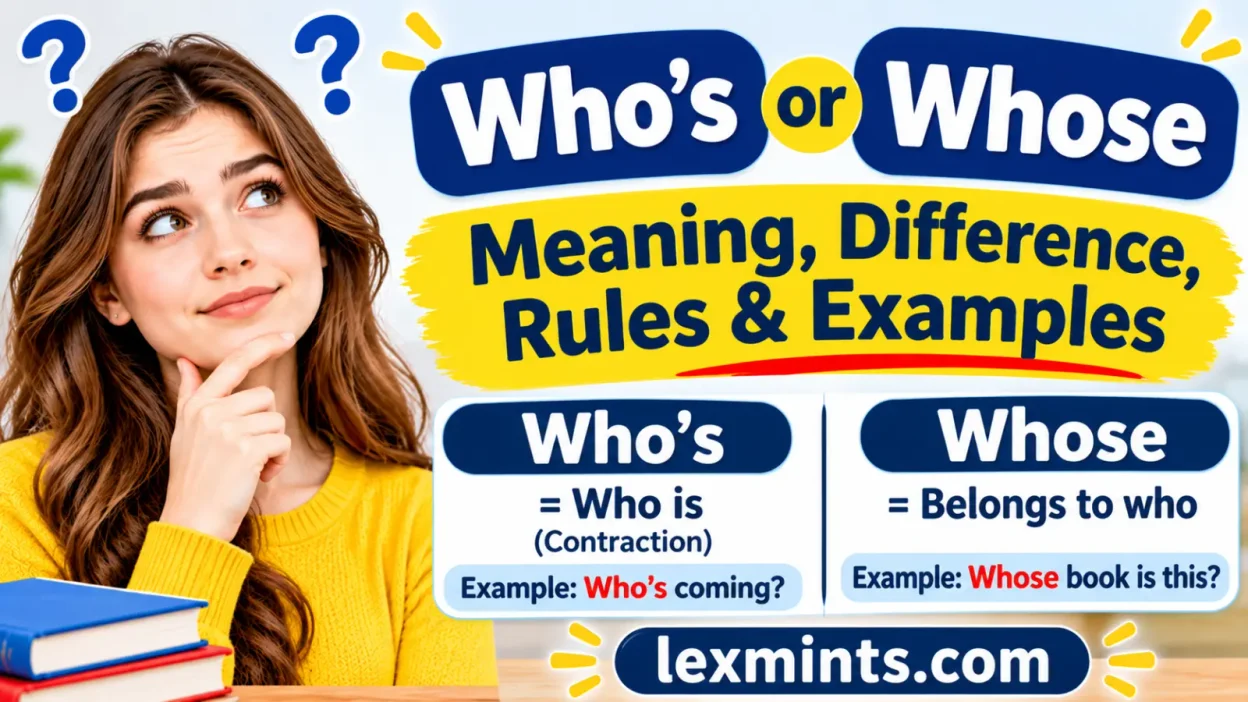
Who’s is a contraction of “who is” or “who has.” Whose is a possessive word used to ask who owns something or to show that something belongs to someone.
Examples:
- Who’s coming to the party? (Who is coming?)
- Whose phone is ringing? (Who owns the phone?)
- She’s the student whose project won first place.
- Who’s finished the assignment? (Who has finished?)
Remember this simple rule: If you can replace the word with “who is” or “who has,” use who’s. If the sentence refers to ownership or possession, use whose.
TL;DR: Important Differences
- Who’s means who is or who has.
- Whose indicates ownership or possession.
- Both words have the same pronunciation.
- Who’s is a contraction that needs an apostrophe.
- Whose is a possessive pronoun or determiner.
- Replace who’s with “who is” to check your sentence.
What Does Who’s Mean?
Who’s is a contraction that combines the pronoun “who” with either “is” or “has.” The apostrophe replaces the missing letters in the shortened expression.
It is commonly used in questions, statements, conversations, and informal writing. However, it also appears in standard written English when contractions are appropriate.
Who’s as a Contraction of Who Is
The most common meaning of who’s is “who is.” It helps create shorter, more natural sentences.
Examples:
- Who’s your favorite singer?
- Who’s waiting outside the classroom?
- Who’s responsible for this project?
- Do you know who’s calling?
- Who’s ready for the weekend?
In each example, you can replace who’s with “who is” without changing the basic meaning.
For instance:
Who’s your teacher?
Who is your teacher?
Both sentences are grammatically correct.
Who’s as a Contraction of Who Has
Who’s can also mean “who has.” This usage usually appears with a past participle or in expressions involving possession.
Examples:
- Who’s finished reading the book?
- Who’s taken my notebook?
- Who’s already submitted the application?
- Who’s been working here for five years?
- Who’s seen this movie before?
Here, who’s means “who has,” not “who is.”
For example:
Who’s completed the assignment?
Who has completed the assignment?
Both versions communicate the same question.
When to Use Who’s
Use who’s when you can expand it into “who is” or “who has.”
Common situations include:
- Asking about someone’s identity.
- Asking who is performing an action.
- Asking who has completed something.
- Describing someone’s current activity.
- Writing natural questions and statements.
Example:
Who’s joining us for dinner tonight?
This is correct because the sentence means “Who is joining us for dinner tonight?”
What Does Whose Mean?
Whose is a possessive form of the pronoun “who.” It asks who owns something or identifies the person connected to something.
Unlike who’s, whose does not contain an apostrophe. It can appear in questions and statements, including sentences that describe people, animals, and sometimes things.
Examples:
- Whose jacket is hanging by the door?
- Whose keys are these?
- I know the woman whose son attends my school.
- That’s the company whose products we use.
- Whose idea was it to organize the event?
In each example, whose expresses a relationship or connection involving ownership.
Whose in Questions
Use whose when asking who owns something or who is responsible for it.
Examples:
- Whose car is parked outside?
- Whose laptop are you using?
- Whose birthday is tomorrow?
- Whose shoes are near the entrance?
- Whose responsibility is it to clean the kitchen?
These questions ask about ownership, responsibility, or association.
Whose in Statements
Whose also introduces additional information about a person, animal, or thing.
Examples:
- She is the teacher whose lessons helped me improve.
- We met a family whose house was recently renovated.
- I know a student whose father works at the hospital.
- They purchased a house whose garden needs attention.
- He adopted a dog whose name is Max.
In these sentences, whose connects a person or thing with another noun.
When to Use Whose
Use whose when expressing possession, ownership, or a relationship.
Common situations include:
- Asking who owns an object.
- Describing someone’s belongings.
- Identifying a person’s family or relationships.
- Explaining who is responsible for something.
- Connecting a person or thing to a particular feature.
Example:
The employee whose computer stopped working contacted IT.
Whose connects the employee with the computer.
Who’s vs. Whose: Main Differences
Although who’s and whose sound alike, their meanings and grammatical functions are different.
| Feature | Who’s | Whose |
|---|---|---|
| Meaning | Who is or who has | Belonging to whom |
| Grammar | Contraction | Possessive pronoun or determiner |
| Apostrophe | Required | Not required |
| Main purpose | Shortens two words | Shows possession |
| Example | Who’s calling? | Whose phone is this? |
The most important distinction is their purpose. Who’s replaces two words, while whose indicates ownership or association.
Easy Trick to Remember Who’s or Whose
The easiest way to choose between these words is the replacement test.
Whenever you’re unsure, replace who’s with “who is.” If the sentence still makes sense, who’s is correct. If that replacement doesn’t work, try “who has.”
If neither replacement works, and the sentence expresses ownership, use whose.
The Who Is Test
Consider this example:
Who’s coming to the meeting?
Replace who’s with “who is”:
Who is coming to the meeting?
The sentence still makes sense. Therefore, who’s is correct.
Another example:
Whose bag is on the table?
Replace whose with “who is”:
Who is bag is on the table?
This sentence is incorrect. Therefore, whose is the right choice.
The Who Has Test
The same method works when who’s represents “who has.”
Example:
Who’s eaten the last slice of pizza?
Replacement:
Who has eaten the last slice of pizza?
The sentence remains correct, so who’s is appropriate.
A Simple Memory Tip
Remember these two expressions:
- Who’s = Who is or who has.
- Whose = Ownership or belonging.
You can use this trick while writing emails, answering questions, or checking assignments.
Examples of Who’s and Whose in Everyday English
Seeing both words in realistic sentences makes their meanings easier to understand.
Examples Using Who’s
- Who’s your new English teacher?
- Do you know who’s coming to the wedding?
- Who’s responsible for preparing dinner?
- Who’s been using my phone?
- Who’s going to drive us home?
- She’s the person who’s organizing the event.
- Who’s already watched the latest episode?
- I wonder who’s knocking at the door.
- Who’s working at the front desk today?
- Who’s been calling me all morning?
Each example uses who’s as a contraction of “who is” or “who has.”
Examples Using Whose
- Whose shoes are these?
- Whose birthday are we celebrating?
- I met a woman whose brother lives in Chicago.
- The student whose essay won the competition received a prize.
- Whose car is blocking the driveway?
- We visited a house whose roof needed repairs.
- She is the artist whose paintings are displayed downtown.
- Whose responsibility is it to lock the office?
- He adopted a cat whose fur is completely white.
- I spoke with a manager whose office is upstairs.
Each example expresses ownership, responsibility, or a relationship.
Common Mistakes When Using Who’s and Whose
Many writers confuse these words because they have identical sounds. However, their spelling and grammar rules are not interchangeable.
Here are some common mistakes and their corrections.
Using Who’s to Show Ownership
Incorrect: Who’s jacket is this?
Correct: Whose jacket is this?
Explanation: The question asks who owns the jacket. Therefore, whose is necessary.
Using Whose Instead of Who’s
Incorrect: Whose coming to the party?
Correct: Who’s coming to the party?
Explanation: The intended meaning is “Who is coming to the party?” Use who’s.
Adding an Apostrophe to Whose
Incorrect: Who’s book did you borrow?
Correct: Whose book did you borrow?
Explanation: Possessive whose never needs an apostrophe.
Confusing Who’s Has With Whose
Incorrect: Whose finished the assignment?
Correct: Who’s finished the assignment?
Explanation: The intended meaning is “Who has finished the assignment?” Therefore, who’s is correct.
Assuming Every Apostrophe Shows Ownership
An apostrophe does not always indicate possession. It can also show that letters have been removed from a contraction.
For example:
- Who’s = Who is or who has.
- It’s = It is or it has.
- They’re = They are.
Possessive forms such as whose, hers, yours, and theirs do not use apostrophes.
Is Whose Ever Used for Things?
Yes. Whose can refer to people, animals, and things.
Some writers mistakenly believe that whose can only describe people. However, English also uses whose to show possession or association involving objects and organizations.
Examples:
- This is a building whose windows need cleaning.
- We visited a museum whose collection includes ancient paintings.
- She purchased a laptop whose battery lasts all day.
- They work for a company whose headquarters are in Texas.
- I read a book whose ending surprised me.
These examples are grammatically acceptable.
In formal writing, some people prefer expressions such as “the windows of which.” However, whose is a natural and widely accepted choice.
Are Who’s and Whose Pronounced the Same?
Yes. Who’s and whose are homophones, meaning they have the same pronunciation but different meanings and spellings.
Both are pronounced /huːz/, which sounds like “hooz.”
Because their pronunciation is identical, listeners usually understand the intended meaning through context.
For example:
- Who’s at the door?
- Whose coat is this?
You cannot hear the apostrophe or spelling difference. You must understand the sentence to identify the correct word.
Who’s or Whose in Formal and Informal Writing
Both forms are acceptable in formal and informal English. The important point is choosing the correct word for the intended meaning.
Who’s is a contraction. Some formal writing styles prefer expanded forms such as “who is” or “who has.” However, contractions are also acceptable in many modern professional and academic contexts.
Whose is appropriate in both formal and informal writing.
Examples:
Informal:
- Who’s coming to lunch?
- Whose phone is this?
Professional:
- Please confirm who’s responsible for the final report.
- The employee whose application was approved will receive an email.
Choose the form that matches your meaning and the tone of your writing.
Related Grammar Rules to Remember
Understanding a few related grammar rules can make these words easier to use.
Who’s and Its
Who’s is a contraction, while its is a possessive form.
Examples:
- Who’s responsible for the decision?
- The dog wagged its tail.
Remember that it’s means “it is” or “it has,” while its shows possession.
Who’s and They’re
Both are contractions.
Examples:
- Who’s coming to dinner?
- They’re coming to dinner.
Who’s means “who is” or “who has.” They’re means “they are.”
Whose and Their
Both can express possession, but they serve different grammatical purposes.
Examples:
- Whose backpack is this?
- Their backpack is on the chair.
Whose asks about ownership. Their identifies something belonging to a group of people.
Mini Quiz: Test Your Understanding
Choose the correct word in each sentence.
Question 1: _____ coming to the football game tonight?
a) Whose
b) Who’s
Question 2: _____ shoes are near the front door?
a) Who’s
b) Whose
Question 3: She’s the student _____ presentation impressed everyone.
a) Who’s
b) Whose
Question 4: _____ already completed the project?
a) Whose
b) Who’s
Question 5: I met a writer _____ books are popular worldwide.
a) Who’s
b) Whose
Answer Key
- Who’s — It means “Who is coming?”
- Whose — It asks who owns the shoes.
- Whose — It connects the student with her presentation.
- Who’s — It means “Who has already completed?”
- Whose — It connects the writer with the books.
If you answered all five correctly, you’ve understood the main difference.
FAQs
Is it who’s or whose?
Both words are correct, but they have different meanings. Who’s means “who is” or “who has,” while whose shows ownership or association.
What is the difference between who’s and whose?
Who’s is a contraction of two words: who is or who has. Whose is a possessive pronoun or determiner used to ask about ownership or describe relationships.
Is whose a possessive pronoun?
Yes. Whose is the possessive form of who. It can function as a determiner before a noun or as a pronoun on its own.
Does who’s mean who has?
Yes. Who’s can represent both “who is” and “who has.” The surrounding sentence determines which meaning applies.
Why doesn’t whose have an apostrophe?
Whose is already a possessive form, so it does not need an apostrophe. Similar possessive forms include yours, hers, his, and theirs.
Can whose refer to objects?
Yes. Whose can describe possession or association involving people, animals, and things. For example, “This is the house whose roof was damaged.”
Are who’s and whose homophones?
Yes. Both words are pronounced /huːz/. They sound identical but have different meanings, spellings, and grammatical functions.
Conclusion
Understanding who’s or whose becomes simple when you remember their different purposes. Use who’s when you mean “who is” or “who has.” Use whose when asking about ownership or showing a relationship.
Always try the replacement test when you’re unsure. With regular practice, you’ll choose the correct word confidently in everyday conversations and professional writing.