
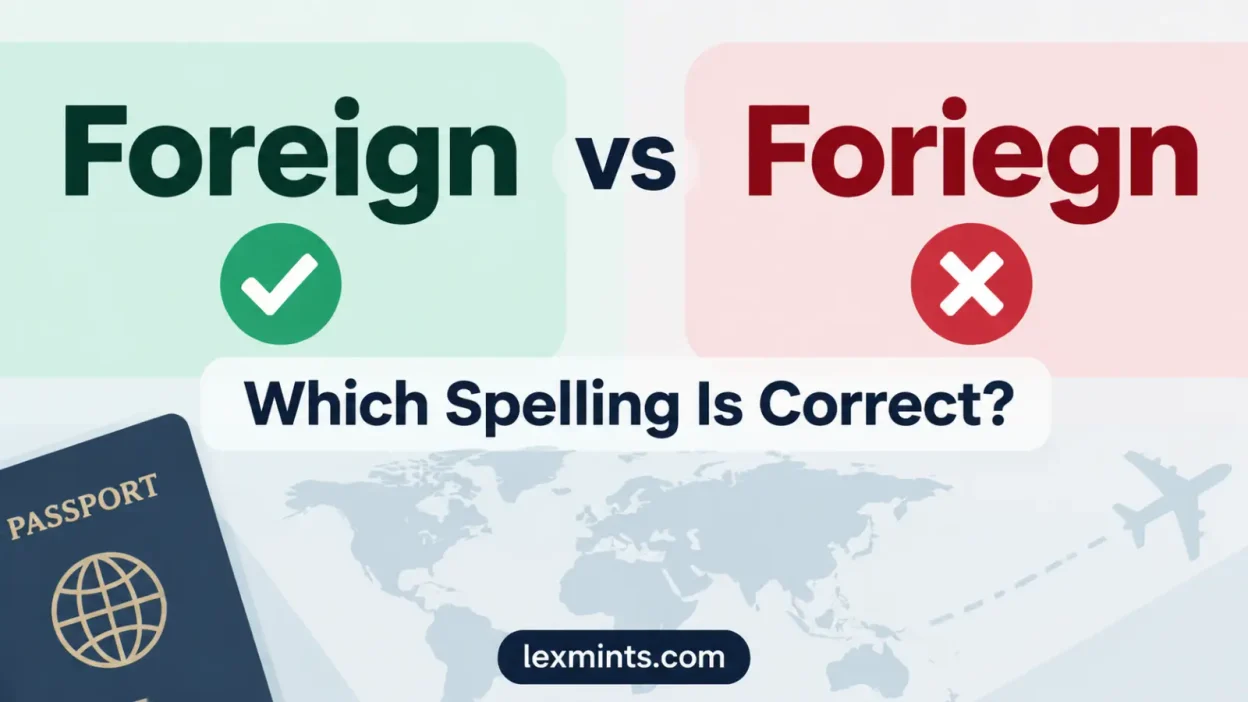
If you have ever hesitated between foreign vs foriegn, you are not alone. The two spellings look almost identical, but only one is correct in standard English.
The correct spelling is foreign.
Foriegn is a misspelling. It is not an accepted standard spelling in American English or British English. The confusion usually happens because of the unusual vowel order in foreign. Many people naturally expect the letters to appear as “ie,” which leads them to write foriegn instead.
In this guide, we will explain the difference between foreign vs foriegn, show you how to use foreign correctly, provide practical examples, and share simple ways to remember the correct spelling.
Foreign vs Foriegn: The Quick Answer
When comparing foreign vs foriegn, always use foreign.
- Foreign ✅ — correct spelling
- Foriegn ❌ — incorrect spelling
The word foreign is an adjective that generally describes something connected with another country or countries, especially when viewed from the perspective of one’s own country.
For example:
The company has several foreign investors.
Here, foreign describes investors who come from another country.
Another example is:
She enjoys learning foreign languages.
In this sentence, foreign describes languages associated with countries other than the speaker’s own.
Foriegn should not be used in formal or standard writing. If you see it in an essay, email, article, report, or other professional communication, it should be corrected to foreign.
What Does Foreign Mean?
Foreign is a standard English adjective with several closely related meanings.
Most commonly, it describes something that comes from, belongs to, or is associated with another country.
For example:
- foreign country
- foreign language
- foreign currency
- foreign company
- foreign visitor
- foreign travel
- foreign policy
- foreign goods
The word can also describe something unfamiliar, strange, or outside a particular area of experience.
For example:
The technical terminology was foreign to me.
In this sentence, foreign does not necessarily mean related to another country. Instead, it means unfamiliar or difficult to understand.
Examples of Foreign in Sentences
Here are some natural examples:
- We are planning a trip to a foreign country.
- She speaks two foreign languages.
- The store sells foreign products.
- The government announced a new foreign policy.
- He works for a foreign company.
- Foreign students can apply for the program.
- The restaurant specializes in foreign cuisine.
- Learning a foreign language can broaden your perspective.
- The museum contains many foreign artifacts.
- The company imports foreign goods.
These examples demonstrate why foreign is the spelling you should use whenever you need this word.
What Does Foriegn Mean?
Foriegn does not have a separate meaning from foreign.
Instead, foriegn is simply a misspelling of foreign.
You might see this spelling in:
- informal online writing
- social media posts
- typed messages
- student writing
- search queries
- drafts
- documents containing spelling mistakes
However, the fact that foriegn appears online does not make it a correct spelling.
For standard English writing, replace foriegn with foreign.
For example:
Incorrect:
He speaks three foriegn languages.
Correct:
He speaks three foreign languages.
Incorrect:
The company imports foriegn products.
Correct:
The company imports foreign products.
Why Do People Spell Foreign as Foriegn?
The main reason people confuse foreign vs foriegn is the unusual arrangement of the vowels.
The correct spelling is:
F-O-R-E-I-G-N
The incorrect version is:
F-O-R-I-E-G-N
The difference is the position of E and I.
In foreign, the sequence is “ei”:
fore + ign → foreign
In foriegn, the sequence is incorrectly written as “ie.”
English spelling contains many words in which vowel combinations can be difficult to predict. Because people often encounter words with ie, they may instinctively write foriegn instead of remembering the correct foreign spelling.
This is particularly common when the word is typed quickly.
Foreign Spelling: The Correct Letter Order
One of the easiest ways to understand the spelling is to break the word into its letters.
FOREIGN
- F
- O
- R
- E
- I
- G
- N
The important part to remember is:
FOREIGN = EI
Not:
FORIEGN = IE
If you frequently make this mistake, focus specifically on the middle of the word.
Think:
for-EI-gn
rather than:
for-IE-gn
The word does not contain the familiar ie sequence in the middle. It contains ei.
Is Foreign the Only Correct Spelling?
Yes.
For standard English, foreign is the accepted spelling.
The spelling foriegn is not a standard alternative. It is simply an error.
This applies across common varieties of English, including:
- American English
- British English
- Canadian English
- Australian English
Although English vocabulary and style can vary between countries, foreign is consistently spelled with ei.
So if you are writing for a US audience, use:
foreign
If you are writing for a UK audience, use:
foreign
There is no standard regional spelling foriegn.
Foreign as an Adjective
The most common grammatical role of foreign is an adjective.
An adjective modifies or describes a noun.
For example:
foreign language
Here, foreign describes the noun language.
More examples include:
- foreign student
- foreign investment
- foreign country
- foreign currency
- foreign market
- foreign policy
- foreign visitor
- foreign manufacturer
- foreign exchange
- foreign culture
Consider this sentence:
The company is expanding into foreign markets.
The adjective foreign describes the markets.
Another example:
He has experience working with foreign clients.
Here, foreign describes clients from other countries.
Foreign Can Also Mean Unfamiliar
Although foreign is strongly associated with other countries, it can also mean unfamiliar, strange, or unrelated to something.
For example:
The concept was completely foreign to her.
This means the concept was unfamiliar to her.
Another example:
Such behavior is foreign to his personality.
Here, the word means that the behavior is inconsistent with or unfamiliar to his normal character.
This broader meaning is important because foreign does not always refer literally to another country.
More Examples
- The idea was foreign to me.
- The terminology was foreign to the students.
- That kind of behavior is foreign to her nature.
- The subject initially seemed foreign to him.
In each case, foreign describes something unfamiliar or outside someone’s normal experience.
Foreign vs Foriegn in Everyday Writing
The spelling difference may seem small, but using the correct form matters.
Imagine writing:
Our business works with foriegn suppliers.
A reader will probably understand what you mean, but the spelling error can make the sentence look careless or unprofessional.
The corrected version is:
Our business works with foreign suppliers.
This is especially important in:
- business emails
- resumes
- cover letters
- academic papers
- websites
- blog posts
- reports
- presentations
- professional documents
Correct spelling helps your writing appear polished and trustworthy.
Common Phrases With Foreign
Learning common phrases can make it easier to remember the correct spelling.
Foreign Language
She is studying a foreign language.
Foreign Country
They moved to a foreign country for work.
Foreign Currency
You may need foreign currency when traveling abroad.
Foreign Exchange
The bank provides foreign exchange services.
Foreign Policy
The president discussed the country’s foreign policy.
Foreign Investment
The region has attracted significant foreign investment.
Foreign Student
The university welcomes foreign students.
Foreign Company
The product was manufactured by a foreign company.
Seeing the correct spelling repeatedly in familiar phrases can help make foreign easier to remember.
Common Mistakes With Foreign
The most common mistake is switching the e and i.
Mistake 1: Foriegn
Incorrect:
She speaks several foriegn languages.
Correct:
She speaks several foreign languages.
Mistake 2: Foriegn Country
Incorrect:
He moved to a foriegn country.
Correct:
He moved to a foreign country.
Mistake 3: Foriegn Policy
Incorrect:
The government changed its foriegn policy.
Correct:
The government changed its foreign policy.
Mistake 4: Foriegn Exchange
Incorrect:
We need to check the foriegn exchange rate.
Correct:
We need to check the foreign exchange rate.
The problem in all four examples is the same: foriegn should be replaced with foreign.
How to Remember the Spelling of Foreign
Because foreign is an irregular-looking spelling, a memory trick can be useful.
Remember “EI” in Foreign
The simplest method is to memorize the sequence:
FOREIGN = EI
When writing the word, pause briefly after for:
for + ei + gn
This helps prevent the common mistake of writing ie.
Connect Foreign With “Foreign Country”
Another useful technique is to learn the word as part of a familiar phrase:
foreign country
Instead of memorizing the spelling by itself, repeatedly practice the full phrase.
For example:
foreign country
foreign language
foreign travel
foreign currency
The more often you see the correct spelling, the more naturally it will come to mind.
Watch the Middle Letters
If you are unsure, look specifically at the middle:
foreign ✅
foriegn ❌
The correct word has EI, not IE.
Foreign vs Foriegn: Examples at a Glance
| Incorrect | Correct |
|---|---|
| foriegn language | foreign language |
| foriegn country | foreign country |
| foriegn student | foreign student |
| foriegn company | foreign company |
| foriegn currency | foreign currency |
| foriegn policy | foreign policy |
| foriegn investment | foreign investment |
| foriegn travel | foreign travel |
| foriegn products | foreign products |
| foriegn visitors | foreign visitors |
This table makes the spelling difference easy to spot.
Foreign in American English
For a US audience, foreign is the correct spelling.
American English does not use foriegn as an accepted alternative.
For example:
The United States has relationships with many foreign countries.
She is interested in foreign languages.
The company receives foreign investment.
He works with foreign clients.
If you are creating content for an American website, academic publication, business, or professional document, always choose foreign.
Is Foriegn Ever Correct?
No. Foriegn is not a standard English spelling.
If you are deciding between foreign vs foriegn, there is no meaning-based distinction and no situation in which foriegn becomes the preferred spelling.
Use:
foreign ✅
Avoid:
foriegn ❌
This is different from word pairs where both spellings may be correct in different varieties of English. In this case, there is only one standard spelling.
Foreign vs Foriegn in Search Queries
People sometimes type foriegn into search engines because they are unsure about the spelling. Search engines may still understand the intended word and return results for foreign.
However, search behavior does not determine correct spelling.
If you are writing an article, title, heading, meta description, email, or other piece of content, you should use the standard spelling:
foreign
This is especially important for professional and educational content.
Quick Grammar Check
Before publishing a sentence containing this word, ask yourself:
- Am I referring to another country or something unfamiliar?
- Am I using the word as an adjective?
- Did I spell it foreign?
- Did I accidentally write foriegn?
- Does the sentence sound natural in context?
For example:
We sell foreign products.
This sentence is grammatically correct.
But:
We sell foriegn products.
contains a spelling error.
The solution is simple: replace foriegn with foreign.
Foreign vs Foriegn: Final Verdict
The answer is straightforward:
Foreign is correct. Foriegn is incorrect.
The main reason for the confusion is the unusual vowel order in foreign. Many writers accidentally reverse ei into ie, producing the misspelling foriegn.
Remember:
FOREIGN = EI
Not:
FORIEGN = IE
Use foreign when describing something from another country or something unfamiliar or outside one’s experience.
For example:
She speaks a foreign language.
The company has foreign investors.
The subject was foreign to him.
All three sentences use foreign correctly.
If you are writing an essay, website article, business document, email, resume, or academic paper, foreign is the spelling you should choose every time.
FAQs
Is “foreign” or “foriegn” correct?
Foreign is correct. Foriegn is a misspelling and should not be used in standard English writing.
Why is “foriegn” wrong?
The spelling foriegn incorrectly places i before e. The correct spelling is foreign, which contains ei in the middle.
How do you spell foreign correctly?
The correct spelling is F-O-R-E-I-G-N: foreign.
What does foreign mean?
Foreign commonly means relating to another country or coming from another country. It can also mean unfamiliar or outside someone’s normal experience.
Is “foriegn” an American English spelling?
No. Foriegn is not a standard American English spelling. The correct spelling is foreign.
What is an easy way to remember foreign?
Remember the letters EI in the middle:
FOR + EI + GN = FOREIGN
This can help you avoid writing foriegn.
Can foreign mean unfamiliar?
Yes. Foreign can mean unfamiliar or strange in a particular context. For example, “The concept was foreign to me” means the concept was unfamiliar to the speaker.
Is foreign a noun or adjective?
Foreign is most commonly used as an adjective. It describes something associated with another country or something unfamiliar. In some specialized expressions, related forms such as foreigner are used for a person from another country.
Which is correct: “foreign language” or “foriegn language”?
The correct phrase is foreign language. Foriegn language contains a spelling error.
Which is correct: “foreign country” or “foriegn country”?
The correct phrase is foreign country. Always spell the word foreign with ei, not ie.
Conclusion
When choosing between foreign vs foriegn, there is only one correct standard spelling: foreign.
Foreign can describe something connected with another country, such as a foreign language, foreign company, or foreign currency. It can also describe something unfamiliar, as in “The idea was foreign to me.”
The misspelling foriegn is caused mainly by confusion over the order of e and i. The easiest way to remember the correct spelling is:
FOREIGN → EI
Once you remember that letter sequence, you can avoid one of the most common spelling mistakes involving this word.
So, whenever you are unsure, choose foreign—not foriegn.


