
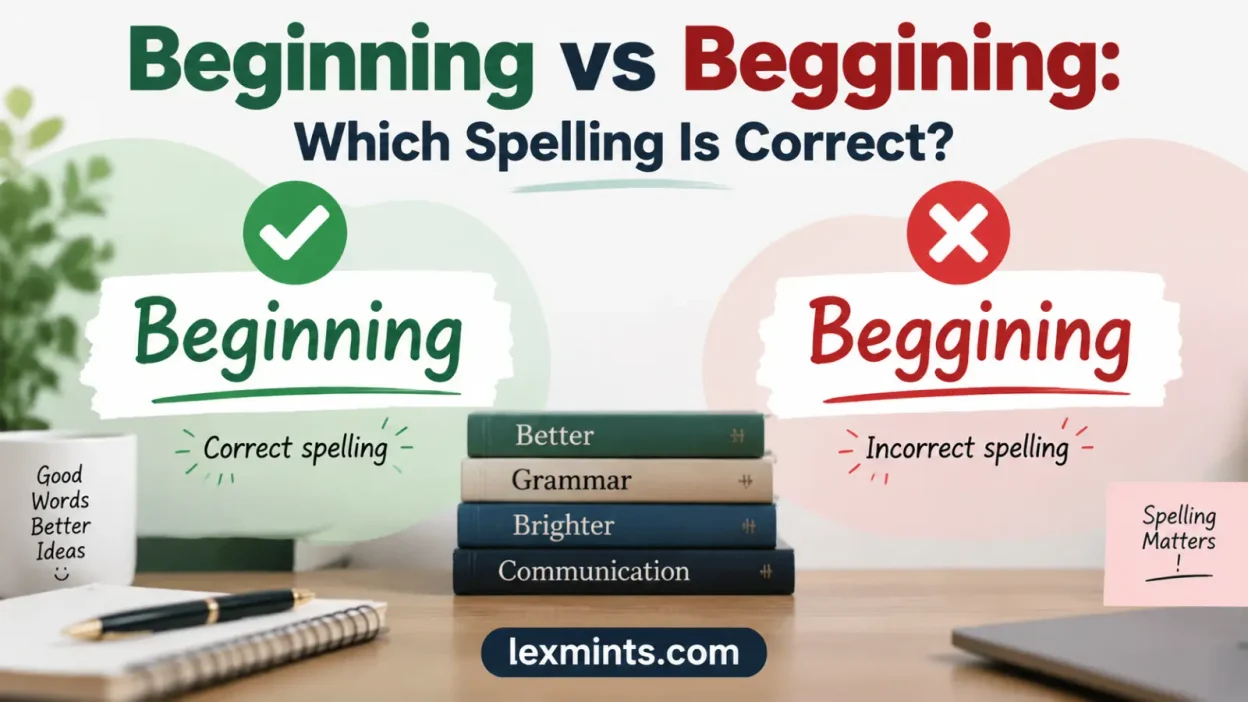
Beginning vs beggining is a common spelling question, but the answer is simple: beginning is the correct spelling, while beggining is a misspelling.
If you are wondering whether to write beginning or beggining, always choose beginning in standard American English. The word refers to the start or first part of something, and it can also be the -ing form of the verb begin.
The confusion usually happens because writers remember that the word contains a doubled consonant but place the repeated letter incorrectly. The correct spelling has a double n, not a double g:
begin → beginning
So, write:
- Correct: The beginning of the movie was exciting.
- Incorrect: The beggining of the movie was exciting.
Understanding this small spelling difference can help you avoid mistakes in school assignments, emails, professional writing, articles, and everyday communication.
Quick Answer
Beginning vs beggining has a straightforward answer: beginning is correct, and beggining is incorrect.
The standard spelling is beginning, with a double n near the middle of the word. Beggining, with a double g, is a misspelling and should not be used in standard English.
The correct spelling comes from the verb begin:
begin + ing = beginning
For example:
The beginning of the book was interesting.
Not:
The beggining of the book was interesting.
There is no US-versus-UK spelling difference here. Beginning is the standard spelling in both American and British English.
Why People Confuse Them
The spelling mistake happens because beginning has a letter pattern that is easy to misremember.
When people hear the word, they may focus on the sound rather than the exact spelling. The pronunciation does not clearly announce which consonant should be doubled. As a result, a writer may remember that there is a repeated consonant somewhere in the word but place the repetition incorrectly.
That can produce:
beggining
instead of:
beginning
Another reason is the base word begin. Some writers remember the word as if it were built around begg- and then add -ing. But the base word is begin, not beggin.
The correct spelling comes directly from begin:
begin + ing → beginning
The spelling keeps the g from begin and doubles the final n.
Compare the two forms
| Feature | Beginning | Beggining |
|---|---|---|
| Standard spelling | Yes | No |
| Standard US English | Yes | No |
| Standard UK English | Yes | No |
| Meaning | Start or first part | No standard meaning |
| Correct in formal writing | Yes | No |
| Base form | begin | Incorrectly formed |
The mistake is therefore not a matter of American versus British spelling. Both major varieties of English use beginning.
Key Differences At A Glance
There is only one correct spelling in standard English: beginning.
The supposed difference between the two forms is not a difference in meaning, pronunciation, or regional preference. Instead, one is the standard word and the other is a misspelling.
Beginning is used when referring to the start, first part, or initial stage of something. It can also be the -ing form of the verb begin.
Beggining does not have an independent standard use.
Consider these examples:
- Beginning: The beginning of the semester is always busy.
- Beggining: Incorrect spelling of beginning.
The word beginning can describe the start of many different things:
- the beginning of a story
- the beginning of a meeting
- the beginning of a relationship
- the beginning of a project
- the beginning of a school year
- the beginning of a new career
- the beginning of a conversation
In every one of these situations, the correct spelling remains beginning.
A quick visual comparison
- BEGINNING → Correct
- BEGGINING → Incorrect
- BEGINNING → Double n
- BEGGINING → Incorrectly doubles g
If you remember only one thing from this article, remember this:
The correct word is beginning, with double n—not double g.
Are They the Same Word?
Not exactly.
Beginning is the standard English word. Beggining is not a standard alternative spelling of that word.
When someone writes beggining, the intended word is almost certainly beginning. The misspelled form does not create a new definition or grammatical category.
What does “beginning” mean?
As a noun, beginning refers to the first part or start of something.
For example:
- The beginning of the movie was funny.
- We should go back to the beginning of the story.
- The beginning of the school year can be stressful.
It can also refer to the origin or starting point of something:
- The company had humble beginnings.
- The project was difficult in the beginning.
The word can also appear as the present participle of begin:
- She is beginning to understand the problem.
- They are beginning their training today.
- The weather is beginning to change.
The spelling remains the same in both uses.
Pronunciation
Beginning is pronounced approximately:
bih-GIN-ing
Its standard pronunciation does not change simply because the word is used as a noun or as the -ing form of begin.
The pronunciation can actually contribute to the spelling confusion because the spoken word does not make the written sequence nn obvious. That is why it helps to remember the written form directly:
beginning
rather than trying to spell it only from sound.
US vs UK Preference
There is no US-versus-UK spelling difference between beginning and beggining.
American English uses:
beginning
British English also uses:
beginning
The incorrect form beggining does not become correct in British English, Canadian English, Australian English, or another major variety simply because of regional spelling conventions.
This is important because English has many genuine regional spelling differences. For example, some words can appear with different endings or letters depending on the variety of English. Beginning is not one of those cases.
You should therefore not think of this comparison as:
- American: beginning
- British: beggining
That would be incorrect.
Instead, think:
- Standard English: beginning
- Common misspelling: beggining
Why the distinction matters
When writing for an American audience, use beginning in every normal context.
You should use it in:
- school papers
- business emails
- resumes
- reports
- websites
- social media posts
- personal messages
- academic writing
- professional documents
There is no need to change the spelling based on the country of your reader.
Which Spelling Should You Use?
Use beginning.
If you are deciding between beginning and beggining, choose beginning without hesitation.
The word follows the spelling pattern created by the base verb begin.
Step-by-step spelling
Start with:
begin
Add:
-ing
The final consonant is doubled:
begin + ing → beginning
This gives:
b e g i n n i n g
The important part is the sequence:
inn
not:
ggi
That makes the correct form easier to recognize.
Common correct combinations
You will often see beginning in phrases such as:
- at the beginning
- from the beginning
- in the beginning
- the beginning of the year
- the beginning of the story
- the beginning of the semester
- a new beginning
- from beginning to end
- beginning to understand
- beginning to change
Each one uses the same spelling.
For example:
We have known each other from the beginning.
The teacher explained the rules at the beginning of class.
She is beginning to feel more confident.
Every new project has a beginning.
The spelling does not change because the context changes.
When One Spelling Looks Wrong
Beggining should look suspicious whenever you see it in ordinary English writing.
The reason is straightforward: the standard word is beginning, and its spelling contains a doubled n, not a doubled g.
A useful proofreading technique is to slow down and look at the middle of the word.
Incorrect:
beggining
Correct:
beginning
You can also compare the word with its base form:
begin
The final consonant in begin is n. When the -ing ending is added, that consonant is doubled:
begin → beginning
It would not make sense to change the final consonant into gg.
Why “beggining” can look believable
English contains many words in which double consonants occur, so beggining may look reasonable at first glance.
For example:
- bigger
- beginning
- running
- sitting
- getting
Because writers encounter many doubled letters, they may remember that beginning needs a double consonant but choose the wrong one.
The solution is not to memorize a complicated rule. Instead, memorize the word as:
beginning
You can also remember:
begin + ing = beginning
That short pattern is more reliable than trying to reconstruct the spelling from memory.
Common Mistakes (and Quick Fixes)
The most common mistake is replacing the nn in beginning with gg.
Mistake 1: Writing “beggining”
Incorrect:
The beggining of the movie was slow.
Correct:
The beginning of the movie was slow.
Fix: Remember that the doubled letter is n.
Mistake 2: Writing “begining”
Another common mistake is leaving out one of the n letters.
Incorrect:
We are begining the meeting.
Correct:
We are beginning the meeting.
Fix: The word contains nn.
Mistake 3: Forgetting the relationship to “begin”
Some writers try to spell the word entirely from memory.
Instead, connect it to the base verb:
begin → beginning
This makes the correct spelling much easier to recall.
Mistake 4: Assuming there is a regional variant
Some people may wonder whether beggining is accepted in another form of English.
It is not.
The standard spelling remains beginning in both American and British English.
Mistake 5: Correcting the wrong letter
If you see:
beggining
do not simply remove one g and assume the word is finished. The correct form needs nn:
beginning
So the full correction changes the internal letter sequence.
A simple memory trick
Think:
The beginning begins with “begin.”
The word beginning contains begin at its start:
BEGIN + NING
This gives you a quick visual reminder that the correct word starts with begin, not beggin.
Everyday Examples
The word beginning is extremely common in everyday American English. It can refer to the start of an event, period, activity, relationship, process, or story.
Here are natural examples.
At the beginning
Please read the instructions at the beginning of the document.
We met at the beginning of the semester.
I missed the announcement at the beginning of the meeting.
The phrase at the beginning points to the first part of something.
In the beginning
In the beginning, the new job felt overwhelming.
In the beginning, they were not sure whether the plan would work.
This phrase can refer to an early stage of an experience or situation.
From the beginning
I knew from the beginning that the project would take time.
She was honest with me from the beginning.
This phrase emphasizes the starting point and everything that follows from it.
A new beginning
Moving to a new city gave him a chance for a new beginning.
The company sees the merger as a new beginning.
Here, beginning refers to a fresh start.
Beginning of a sentence
The word should be capitalized at the beginning of a sentence.
Here, beginning means the first part.
Beginning of a story
The beginning of the novel immediately caught my attention.
The word can describe the opening section of a written work.
Beginning of a career
She worked hard at the beginning of her career.
This refers to the early stage of professional life.
Beginning of a conversation
He mentioned the issue at the beginning of the conversation.
Again, beginning identifies the first part.
Beginning as an action
The word also appears as part of the verb form beginning:
The rain is beginning to fall.
We are beginning the final stage of the project.
She is beginning to understand the instructions.
The children are beginning their first week of school.
In these examples, beginning means starting or starting to happen.
More examples
The beginning of the book was easier to understand than the final chapter.
We should discuss the problem from the beginning.
At the beginning of the year, I set three personal goals.
The class is beginning at 9 a.m.
He is beginning to feel more comfortable in his new role.
The beginning of the concert was delayed by ten minutes.
Every successful habit has a beginning.
They have been friends since the beginning.
The teacher reviewed the material at the beginning of class.
The project looked difficult in the beginning, but it became easier.
Notice that beginning works naturally in both noun and verb contexts. The spelling stays exactly the same.
Dictionary-Style Word Details
Verb
Beginning is the present participle and -ing form of the verb begin.
The verb begin means to start happening, start doing something, or have something as its first part.
Examples:
- The class begins at nine.
- The class is beginning now.
- She began working on the project yesterday.
- They have begun a new training program.
The spelling beginning is the correct -ing form.
Beggining is not a standard verb form.
The correct progression is:
begin → beginning
The doubled consonant is n.
Noun
Beginning is also a noun.
As a noun, it means the first part, starting point, or initial stage of something.
Examples:
- The beginning of the story was surprising.
- We missed the beginning of the game.
- She remembers the beginning of her career clearly.
- Let’s start at the beginning.
The plural form is beginnings.
Examples:
- The company had modest beginnings.
- They discussed the beginnings of the organization.
Beggining is not a standard noun spelling.
Synonyms
For beginning, useful synonyms depend on context.
Common closest plain alternatives include:
- start
- opening
- launch
- origin
- outset
- commencement
These words are related, but they are not interchangeable in every sentence.
For example:
The beginning of the movie was funny.
can naturally become:
The start of the movie was funny.
But origin has a more specific sense when discussing where something came from, while launch is often used for an event, product, or business activity.
There are no separate synonyms for beggining because it is not a standard English word. When someone writes beggining, the intended standard word is normally beginning.
Example Sentences
Here are additional examples showing the correct use of beginning:
- The beginning of the school year was extremely busy.
- Please sign your name at the beginning of the form.
- We should have discussed this from the beginning.
- The movie became more interesting after the beginning.
- She is beginning to understand the new system.
- The meeting will begin at ten.
- At the beginning of the week, I made a detailed schedule.
- He remembers the beginning of the project very clearly.
- The company had a difficult beginning.
- A new job can feel stressful in the beginning.
- The teacher gave us instructions at the beginning of class.
- They are beginning a new training program.
- The beginning of the story introduces the main characters.
- We were friends from the beginning.
- The project is beginning to take shape.
- Every major change has a beginning.
- She returned to the beginning of the chapter.
- The beginning of the race was crowded.
- He was nervous at the beginning but became confident later.
- The first step marked the beginning of a new phase.
In every sentence, beginning is spelled with nn.
Word History
Beginning comes from the verb begin, which has a long history in English. The modern spelling reflects the relationship between the base verb and its -ing form.
For everyday spelling purposes, the most useful point is the direct connection:
begin → beginning
There is no need to create a separate spelling history for beggining, because it is not a standard alternative form. It is a misspelling that results from placing the doubled consonant incorrectly.
The safest historical and grammatical connection for modern writers is therefore the base form begin and its correct -ing form beginning.
Phrases Containing
Beginning appears in many common English phrases.
At the beginning
Used to refer to the first part of something.
We introduced ourselves at the beginning of class.
In the beginning
Used to describe an early stage.
In the beginning, the process seemed complicated.
From the beginning
Used to emphasize the starting point.
She understood the problem from the beginning.
From beginning to end
Used to describe something in its entirety.
He read the report from beginning to end.
A new beginning
Used for a fresh start.
The move represented a new beginning for the family.
At the beginning of
Used before a period, event, or activity.
Sales increased at the beginning of the year.
Beginning to
Used with a verb to describe something starting to happen.
The weather is beginning to improve.
Beginning with
Used to identify the first item or stage in a sequence.
Beginning with the introduction, the presentation lasted an hour.
All of these phrases use beginning, never beggining.
FAQs
Is “beginning” or “beggining” correct?
Beginning is correct. Beggining is a common misspelling and is not a standard English word. The correct spelling contains a double n: beginning.
Why do people spell beginning as “beggining”?
People often write beggining because they remember that the word contains a doubled consonant but mistakenly double the g instead of the n. Remember the base word begin: begin + ing = beginning.
Does “beggining” have a different meaning from “beginning”?
No. Beggining does not have a separate standard meaning. It is simply an incorrect spelling of beginning, which means the start or first part of something.
How do you spell beginning correctly?
The correct spelling is beginning: b-e-g-i-n-n-i-n-g. A helpful memory trick is to connect it to the verb begin: begin → beginning.
Is “beginning” spelled the same in American and British English?
Yes. Beginning is the standard spelling in both American and British English. Beggining is not an accepted regional spelling variant.
What is an example of “beginning” in a sentence?
A simple example is: “The beginning of the movie was exciting.” Here, beginning refers to the first part of the movie.
Conclusion
When choosing between beginning and beggining, the answer is clear: beginning is the correct spelling.
Beggining is a misspelling, not a different word and not a regional spelling used in another major variety of English.
The easiest way to remember the correct form is to connect it to the base verb:
begin → beginning
The final n is doubled when the -ing ending is added, giving you:
beginning
not:
beggining
The word can function as a noun referring to the start or first part of something, and it can also function as the -ing form of begin. Its pronunciation remains straightforward, but the spelling is worth memorizing because the repeated consonant can cause confusion.
So, whenever you are writing about the start of a story, meeting, project, year, career, conversation, or experience, use beginning.
Correct: The beginning of the story was exciting.
Incorrect: The beggining of the story was exciting.
A quick final reminder:
BEGIN + ING = BEGINNING
That simple pattern will help you avoid one of the most common spelling mistakes involving this word.


