
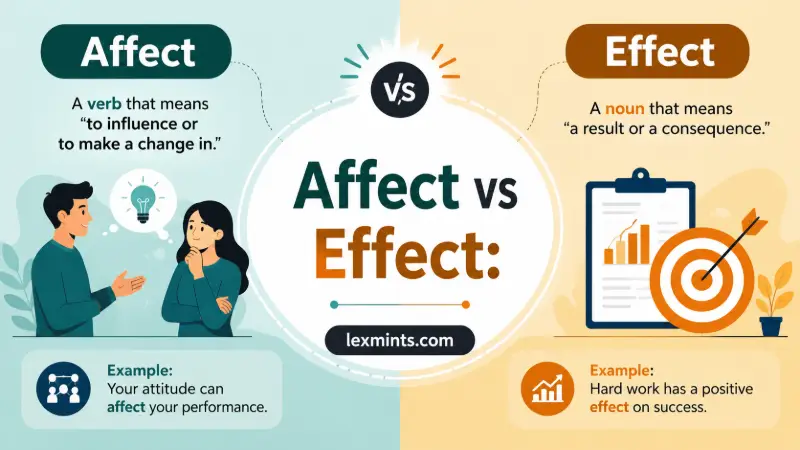
Affect vs effect is a common English confusion because the two words look similar, sound alike in many conversations, and both relate to change. However, they usually play different grammatical roles. Affect is most often a verb meaning to influence something, while effect is most often a noun meaning a result.
This basic distinction solves most everyday cases. However, English also uses effect as a verb in formal contexts and affect as a noun in psychology and clinical writing. Understanding these exceptions helps you choose the correct word confidently without treating the basic rule as absolute.
Quick Answer
Use affect when you need a verb meaning influence or change:
“The new schedule may affect attendance.”
Use effect when you need a noun meaning result or consequence:
“The new schedule had a positive effect on attendance.”
The practical rule is simple: affect is usually the action, while effect is usually the result. Two less common exceptions are the verb effect, meaning bring about, and the specialized noun affect, meaning an observable expression of emotion.
Why People Confuse Them
The words differ by only one letter, and their meanings are closely connected. When one event affects something, it produces an effect. That connection makes the wrong spelling feel reasonable even when the grammar is incorrect.
Their everyday pronunciations can also sound close. The verb affect is commonly pronounced “uh-FEKT,” while effect is commonly pronounced “ih-FEKT.” In quick speech, the first unstressed vowel may be difficult to hear.
The specialized noun affect is different. It is usually pronounced “AF-ekt,” with stress on the first syllable.
Key Differences At A Glance
| Feature | Affect | Effect |
|---|---|---|
| Most common role | Verb | Noun |
| Main meaning | To influence or change | A result or consequence |
| Common pattern | affect + object | an/the effect; effect on |
| Less common role | Noun in clinical contexts | Verb meaning bring about |
| Simple clue | An action happens | A result exists |
The common rule works in most sentences, but the less common roles matter in formal and specialized writing.
Meaning and Usage Difference
Affect usually describes what an action does to a person, object, condition, or situation. Because it is normally a transitive verb, it takes an object.
“Rising costs affect small businesses.”
Here, rising costs influence small businesses.
Effect usually names what happened because of an action, event, or condition.
“Rising costs had a serious effect on small businesses.”
Here, effect names the result or influence produced by rising costs.
The words can express the same general relationship from different grammatical angles. One sentence focuses on the action; the other focuses on its result.
The important exception is effect as a verb. It means to cause, produce, or bring something about.
“The new director hopes to effect lasting change.”
This sentence does not mean that the director merely influences change. It means the director hopes to make the change happen.
Tone, Context, and Formality
The common verb affect and noun effect are neutral. They fit conversation, schoolwork, news writing, business communication, and formal reports.
Effect as a verb sounds more formal and deliberate. It often appears with nouns such as change, reform, agreement, settlement, or improvement. In casual writing, bring about or accomplish may sound more natural.
Affect as a noun is specialized. Psychologists, clinicians, and researchers may use it for a person’s visible emotional expression. A phrase such as flat affect belongs to that context and should not replace effect when you mean a result.
Which One Should You Use?
| Context | Best Choice | Why |
| Something influences a person or situation | Affect | You need the common verb |
| You are naming a result | Effect | You need the common noun |
| Someone brings a change into existence | Effect | The formal verb means bring about |
| A clinician describes visible emotion | Affect | The specialized noun fits |
| The phrase includes “have an” | Effect | The structure normally requires a noun |
| The phrase includes “will ___ the outcome” | Affect | The blank requires a verb meaning influence |
A quick replacement check can help. When influence works as a verb, choose affect. Use effect when result fits as a noun. In less common cases, the verb effect may be correct when you mean bring about.
When One Choice Sounds Wrong
Affect sounds wrong when the sentence needs the ordinary noun for a result:
Incorrect: “The medication had an affect on my sleep.”
Correct: “The medication had an effect on my sleep.”
Effect sounds wrong when the sentence needs a verb meaning influence:
Incorrect: “The medication may effect my sleep.”
Correct: “The medication may affect my sleep.”
However, effect is correct when the subject actively brings something about:
Correct: “The agreement effected a change in the schedule.”
Likewise, noun affect is correct in a clinical sentence:
Correct: “The patient displayed a calm affect.”
Common Mistakes (and Quick Fixes)
A frequent mistake is treating the basic rule as universal. “Affect is a verb; effect is a noun” is a useful shortcut, but the two exceptions are standard English.
Another error appears with change. Compare these sentences:
“The new policy affected change.” This means the policy influenced change.
“The new policy effected change.” This means the policy caused change to happen.
Writers also confuse affected and effected. Use affected for influenced and effected for brought about:
“The outage affected several offices.”
“The negotiations effected a peaceful transfer.”
Finally, use effect in established noun phrases such as side effect, special effect, lasting effect, cause and effect, and in effect.
Everyday Examples
Affect as the common verb:
- Heavy traffic may affect the delivery time.
- Lack of sleep can affect your concentration.
- The price increase will affect every customer.
- Her feedback affected how we approached the project.
Effect as the common noun:
- The discount had little effect on total sales.
- Exercise can have a positive effect on mood.
- The storm’s effects were visible across the neighborhood.
- The rule took effect on August 1.
Less common uses:
- The committee worked to effect meaningful reform.
- The mediator effected an agreement between the two groups.
- The clinician noted that the patient’s affect remained subdued.
- He affected confidence even though he felt nervous.
The final example uses another verb meaning of affect: to pretend, assume, or put on a manner that may not be genuine.
Dictionary-Style Word Details
Verb
Affect: Most commonly means to influence or produce a change in someone or something. It can also mean to pretend or assume a manner, feeling, or style.
Effect: Means to bring about, produce, accomplish, or make something happen. This verb is correct but less common and more formal than affect.
Noun
Affect: A specialized term for an observable emotional state or expression, mainly used in psychology and clinical settings. It is not the ordinary noun for a result.
Effect: A result, consequence, impression, or change produced by a cause. In the plural, effects can also mean personal belongings.
Synonyms
Affect: Closest plain alternatives for the common verb include influence, alter, change, shape, and touch. For the verb meaning pretend, alternatives include assume, feign, and put on.
Effect: Closest plain alternatives for the common noun include result, outcome, consequence, impact, and impression. For the verb, alternatives include produce, cause, accomplish, and bring about.
Example Sentences
Affect: “The updated bus route will affect her morning commute.”
Affect: “He affected a relaxed tone during the difficult meeting.”
Effect: “The updated bus route had an immediate effect on ridership.”
Effect: “The organizers effected several changes before opening day.”
Word History
Affect and effect came into English through French and Latin sources, but they developed different standard uses.
Affect is connected with Latin forms carrying the idea of acting on or influencing. Effect is connected with forms carrying the idea of accomplishing, producing, or creating a result.
That shared background helps explain why the meanings remain related, but modern grammar determines which word fits a sentence.
Phrases Containing
Affect: adversely affect, directly affect, deeply affect, affect behavior, affect performance, affected by, and affect an accent.
Effect: in effect, take effect, side effect, special effect, cause and effect, lasting effect, effect change, personal effects, and words to that effect.
FAQs
Is it “have an affect” or “have an effect”?
Use “have an effect” in ordinary writing because effect is the noun meaning a result or influence. For example, “The schedule change had an effect on attendance.” The noun affect belongs mainly to clinical discussions of observable emotion, not this common structure.
Can effect be used as a verb?
Yes. As a verb, effect means to bring about, produce, or accomplish something. It often appears in formal phrases such as “effect change” or “effect a settlement.” Do not use it when you simply mean influence; use affect instead.
Can affect be used as a noun?
Yes, but this use is specialized. In psychology and related clinical writing, affect refers to an observable expression of emotion, as in “The patient showed a flat affect.” In this noun use, the stress usually falls on the first syllable.
Should I write affected or effected?
Choose affected when something was influenced: “The delay affected our plans.” Choose effected when someone brought something about: “The agreement effected a major change.” Because effected has a narrower, more formal meaning, affected is correct in most everyday sentences.
Is it side affect or side effect?
The standard phrase is side effect. Here, effect is a noun naming an additional result, often an unwanted one. “Side affect” is incorrect in this meaning. The same noun pattern appears in “lasting effect,” “special effect,” and “cause and effect.”
What is the easiest way to remember affect vs effect?
Remember A for action and E for end result: an action affects something, and the result is an effect. This shortcut works in most everyday sentences. Still, check the rarer verb effect and specialized noun affect when the context is formal or clinical.
Conclusion
Use affect for the common verb meaning influence, and use effect for the common noun meaning result. That rule handles most everyday writing.
Then remember the two standard exceptions. Effect can be a formal verb meaning bring about, especially in phrases such as effect change. Affect can be a specialized noun for visible emotional expression.
Check the sentence’s grammatical role and intended meaning, and the correct choice becomes much easier.


