
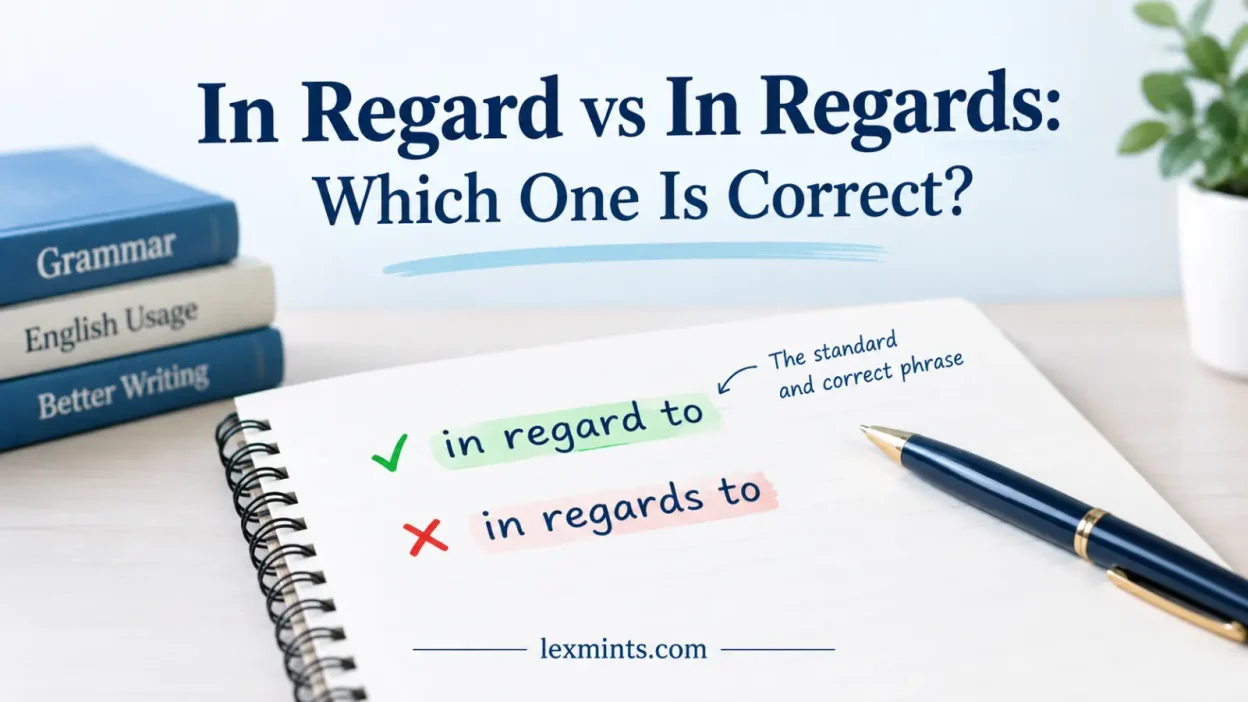
If you are unsure whether to write “in regard” or “in regards,” you are not alone. Both expressions appear in emails, business writing, conversations, and online content, but they are not used in exactly the same way.
The standard expression is “in regard to,” which means “concerning,” “about,” or “with respect to.” It is widely accepted in formal and professional English.
“In regards to” is also commonly used, especially in everyday and informal communication, but many style guides and editors consider it less standard than “in regard to.” If you want the safest choice for formal writing, use “in regard to.”
For example:
- Correct and standard: We are contacting you in regard to your application.
- Common but less formal: We are contacting you in regards to your application.
- More concise: We are contacting you about your application.
The key point is simple: “in regard to” is the preferred standard form, while “in regards to” is common but generally less formal.
In Regard vs In Regards: Quick Answer
In regard to is the preferred expression when you mean “concerning” or “about.”
In regards to is frequently heard and used, but it is generally considered less standard in formal English.
Here is a quick comparison:
| Expression | Meaning | Usage |
|---|---|---|
| in regard to | concerning; about | Standard and formal |
| in regards to | concerning; about | Common, but less formal |
| with regard to | concerning; about | Standard and formal |
| regarding | concerning; about | Standard and concise |
| about | concerning | Simple and natural |
Examples:
- I am writing in regard to your recent request.
- I am writing with regard to your recent request.
- I am writing regarding your recent request.
- I am writing about your recent request.
All of these can communicate essentially the same idea, but their tone and style can differ.
What Does “In Regard To” Mean?
The phrase “in regard to” means “concerning,” “about,” or “with respect to.”
It introduces the subject or matter being discussed.
For example:
We have a question in regard to your invoice.
This means:
We have a question concerning your invoice.
Another example:
I am contacting you in regard to the position you advertised.
This means:
I am contacting you about the position you advertised.
The phrase is especially common in professional correspondence, business documents, customer-service messages, and formal communication.
However, it can sometimes sound more formal or wordy than necessary. In many situations, “about” or “regarding” is clearer and more direct.
For example:
I am writing in regard to your order.
can become:
I am writing regarding your order.
or simply:
I am writing about your order.
What Does “In Regards To” Mean?
“In regards to” is commonly used to mean the same thing as “in regard to.” It usually introduces a topic or subject.
For example:
I have a question in regards to the new policy.
The intended meaning is:
I have a question concerning the new policy.
Although this version is widely encountered, “in regard to” is generally the safer choice in formal writing.
If you are writing an academic paper, business letter, professional email, application, report, or other formal document, choosing “in regard to” avoids unnecessary criticism.
Instead of:
I am contacting you in regards to the meeting.
Use:
I am contacting you in regard to the meeting.
Or, for a more concise style:
I am contacting you regarding the meeting.
Is “In Regards To” Grammatically Correct?
The answer depends on how strictly you are applying standard formal usage.
“In regards to” is widespread in modern English, and readers generally understand it without difficulty. However, traditional and formal usage generally prefers “in regard to.”
The difference comes from the noun regard and the way the expression developed.
In the standard phrase:
in regard to
the word regard is normally singular.
By contrast, regards is naturally used in expressions such as:
Please give my regards to your family.
Here, regards means good wishes or greetings.
That is different from the meaning of “in regard to.”
Therefore, if your goal is polished formal English, remember:
in regard to = concerning
regards = greetings or good wishes
In Regard To vs With Regard To
Another important expression is “with regard to.”
Both “in regard to” and “with regard to” can mean “concerning” or “about.”
Examples:
We have received your message in regard to the payment.
We have received your message with regard to the payment.
Both sentences are understandable and standard.
“With regard to” is especially common in formal writing.
You may also see:
- with regard to
- in regard to
- regarding
- concerning
- as regards
For example:
With regard to your request, we will respond within two business days.
In regard to your request, we will respond within two business days.
Regarding your request, we will respond within two business days.
The last version is shorter and often sounds more natural in modern business writing.
When Should You Use “In Regard To”?
Use “in regard to” when you want to introduce a specific subject or matter.
It works well in professional communication.
Business Emails
I am writing in regard to your recent inquiry.
Customer Service
We are contacting you in regard to your support request.
Job Applications
I am writing in regard to the marketing position listed on your website.
Formal Letters
We would like to provide additional information in regard to this matter.
Administrative Communication
The office has received several questions in regard to the new procedure.
In each example, “in regard to” means “concerning” or “about.”
When Is “Regarding” Better?
Although “in regard to” is correct and standard, “regarding” is often more concise.
Compare:
I am writing in regard to your application.
and:
I am writing regarding your application.
The second sentence is shorter while preserving the same basic meaning.
For modern professional writing, concise language is often easier to read.
You can usually replace “in regard to” with “regarding” when the meaning remains clear.
For example:
We have received your complaint in regard to the service.
can become:
We have received your complaint regarding the service.
This is often a cleaner choice.
Common Examples of “In Regard To”
Here are several natural examples:
- I am writing in regard to your recent application.
- We have a question in regard to the contract.
- She contacted the office in regard to her account.
- The company issued a statement in regard to the new policy.
- Please contact us in regard to any billing concerns.
- He requested additional information in regard to the project.
- We received your message in regard to the appointment.
- The manager spoke with us in regard to the schedule.
- I have some concerns in regard to the proposed changes.
- They sent an email in regard to the upcoming event.
These examples demonstrate how the expression connects the sentence to a particular subject.
Common Examples of “In Regards To”
You will also encounter “in regards to” in everyday communication.
Examples include:
- I have a question in regards to your services.
- She called in regards to her appointment.
- We received an email in regards to the order.
- He contacted the office in regards to the payment.
- They sent a notice in regards to the policy.
- I am following up in regards to our previous conversation.
- We need more information in regards to the project.
- She asked for clarification in regards to the agreement.
- The customer complained in regards to the delivery.
- I am reaching out in regards to your request.
These sentences are understandable, and this construction is commonly used. Nevertheless, in polished formal writing, many editors would change “in regards to” to “in regard to” or simply “regarding.”
Why Do People Confuse “Regard” and “Regards”?
The confusion largely comes from the fact that regard and regards are both legitimate English words.
The singular noun regard can refer to consideration, attention, respect, or a particular relationship or perspective.
For example:
She has great regard for her colleagues.
The plural regards can refer to greetings or good wishes.
For example:
Please give my regards to your family.
Because “regards” is a familiar word, people sometimes insert the plural form into expressions where the traditional construction uses the singular regard.
That leads to:
in regards to
instead of:
in regard to
The first is widespread, but the second remains the preferred formal construction.
“In Regard To” vs “In Regards To” in Professional Emails
Professional emails are one of the most common places where this issue appears.
Consider this sentence:
I am reaching out in regards to your recent application.
A more formal version would be:
I am reaching out in regard to your recent application.
An even more concise version is:
I am reaching out regarding your recent application.
All three communicate the same basic idea, but the second and third options are generally preferable for professional writing.
You could also write:
I am contacting you about your recent application.
This is straightforward and natural.
When writing an important business email, clarity usually matters more than using a complicated expression. If “about” communicates your meaning perfectly, there is no need to make the sentence longer.
In Regard To vs About
“About” is usually the simplest option.
Compare:
I am writing in regard to your request.
I am writing about your request.
The second sentence is more conversational and direct.
However, “in regard to” may fit better when the context calls for a formal tone.
For example, a legal, administrative, or corporate document may use:
With regard to the terms outlined in the agreement, both parties must provide written notice.
In casual communication, you might instead say:
About the terms in the agreement, both sides need to provide written notice.
Neither choice is automatically better in every context. The appropriate expression depends on the tone and purpose of the writing.
Common Mistakes to Avoid
Mistake 1: Using “In Regards To” in Formal Writing
While common, “in regards to” can be viewed as less standard in formal contexts.
Prefer:
in regard to
instead of:
in regards to
Mistake 2: Confusing “Regards” With “Regard”
The phrase:
Please give my regards to John.
is correct.
Here, regards means greetings or good wishes.
But:
I am writing in regard to your request.
uses singular regard.
These are different constructions with different meanings.
Mistake 3: Making the Sentence Too Wordy
Sometimes writers use “in regard to” when a shorter word would work better.
For example:
We are contacting you in regard to your complaint.
can become:
We are contacting you about your complaint.
or:
We are contacting you regarding your complaint.
Choose the version that fits your intended tone.
Mistake 4: Using “In Regards” Without “To”
If you mean “concerning,” the standard phrase is:
in regard to
Not:
in regard
when the phrase is being used to introduce a specific topic.
For example:
I have a question in regard to the policy.
The word “to” connects the expression to the subject being discussed.
Is “In Regard” Correct Without “To”?
Yes, but it depends on the sentence.
“In regard” can occur in other grammatical structures, but when you mean “concerning,” the common fixed expression is “in regard to.”
For example:
In regard to your question, we need more information.
Here, “in regard to” means “concerning.”
If you simply write:
In regard, we need more information.
the intended meaning is unclear and does not function naturally as a replacement for “in regard to.”
Therefore, when introducing a topic, remember the complete expression:
in regard to + noun/topic
“In Regard To” in Academic Writing
In academic writing, precision and clarity are important.
You can use “in regard to” when it naturally fits the sentence, but “regarding,” “concerning,” or “with respect to” may sometimes be more appropriate.
For example:
The study examines public attitudes in regard to environmental policy.
A more concise alternative is:
The study examines public attitudes regarding environmental policy.
Another option is:
The study examines public attitudes toward environmental policy.
The best wording depends on the exact relationship between the subject and the topic.
Avoid adding formal expressions simply to make academic writing sound more sophisticated. Clear language is usually more effective.
“In Regard To” in Business Writing
Business writing frequently uses expressions such as “in regard to,” “with regard to,” and “regarding.”
For example:
With regard to your proposal, we would like to schedule a follow-up meeting.
Or:
I am writing in regard to the invoice you submitted last week.
Or:
Regarding your proposal, we would like to schedule a follow-up meeting.
The third version is often the most concise.
For customer-facing communication, you may also prefer “about” because it sounds more natural:
We are contacting you about your recent order.
The choice should reflect your organization’s tone and the audience’s expectations.
Quick Memory Trick
A simple way to remember the difference is:
In regard to = concerning
If you can replace the phrase with “concerning,” use “in regard to.”
For example:
I am writing in regard to your application.
Replace the phrase:
I am writing concerning your application.
The meaning still works.
Now remember that “regards” commonly appears in expressions involving greetings:
Give my regards to your family.
So:
in regard to → concerning
my regards → my greetings/good wishes
This distinction makes the two forms much easier to remember.
In Regard vs In Regards: Side-by-Side Examples
| Less Preferred in Formal Writing | Preferred Formal Form |
|---|---|
| in regards to your application | in regard to your application |
| in regards to the contract | in regard to the contract |
| in regards to your request | in regard to your request |
| in regards to the meeting | in regard to the meeting |
| in regards to the policy | in regard to the policy |
You can also replace both with “regarding”:
- regarding your application
- regarding the contract
- regarding your request
- regarding the meeting
- regarding the policy
This often makes the writing more concise.
Which One Should You Use?
If you are deciding between “in regard” and “in regards,” the safest formal choice is:
In regard to
Use it when you mean “concerning,” “about,” or “with respect to.”
For an even more concise style, use:
Regarding
For casual communication, about is often the most natural choice.
Although “in regards to” is widely used and readily understood, it is generally better to avoid it when you want your writing to follow traditional formal usage.
FAQs
Is “in regard to” or “in regards to” correct?
“In regard to” is the preferred standard expression, especially in formal and professional English. “In regards to” is widely used and understood, but it is generally considered less formal. “Regarding” is another concise alternative.
What does “in regard to” mean?
“In regard to” means “about,” “concerning,” or “with respect to.” For example, “I am writing in regard to your application” means “I am writing concerning your application.”
Is “in regards to” grammatically correct?
“In regards to” is commonly used in modern English, but many editors and style-conscious writers prefer “in regard to” in formal writing. For professional emails, academic writing, and official documents, “in regard to” is the safer choice.
What is the difference between “in regard to” and “with regard to”?
Both “in regard to” and “with regard to” mean “concerning” or “about.” Both are standard expressions. “With regard to” is particularly common in formal and business writing.
Can I use “regarding” instead of “in regard to”?
Yes. “Regarding” can usually replace “in regard to” without changing the basic meaning. For example, “I am contacting you in regard to your order” can become “I am contacting you regarding your order.” “Regarding” is often shorter and more direct.
Conclusion
The preferred expression is “in regard to.”
“In regard to” means “concerning,” “about,” or “with respect to.” It is appropriate for formal, professional, academic, and business writing.
“In regards to” is common in everyday English, but it is generally considered less standard in formal writing.
Correct examples:
I am writing in regard to your application.
We have a question in regard to the contract.
Please contact us in regard to your account.
Also natural:
I am writing regarding your application.
We have a question about the contract.
Please contact us about your account.
Remember:
In regard to = preferred formal expression
In regards to = common, but less formal
Regarding = concise alternative
About = simple, natural alternative
If you want the most reliable choice for professional or formal English, choose “in regard to.”


