You often see the word “subjective” in school, conversations, and online debates. It usually appears when people disagree about opinions, taste, or feelings.
The term is common in discussions about art, food, reviews, and personal choices. It helps explain why people see the same thing differently.
In this article, you will learn what “subjective” means in simple English. You will also see how it is used, how it differs from “objective,” and where it appears in real sentences.
QUICK ANSWER
Subjective means based on personal feelings, opinions, or individual perception rather than facts. It describes how something is seen from a personal point of view.
TL;DR
• Based on personal opinion or feeling
• Not strictly based on facts
• Different people may disagree
• Common in art, taste, and judgments
• Opposite of objective thinking
WHAT “SUBJECTIVE” MEANS IN SIMPLE ENGLISH

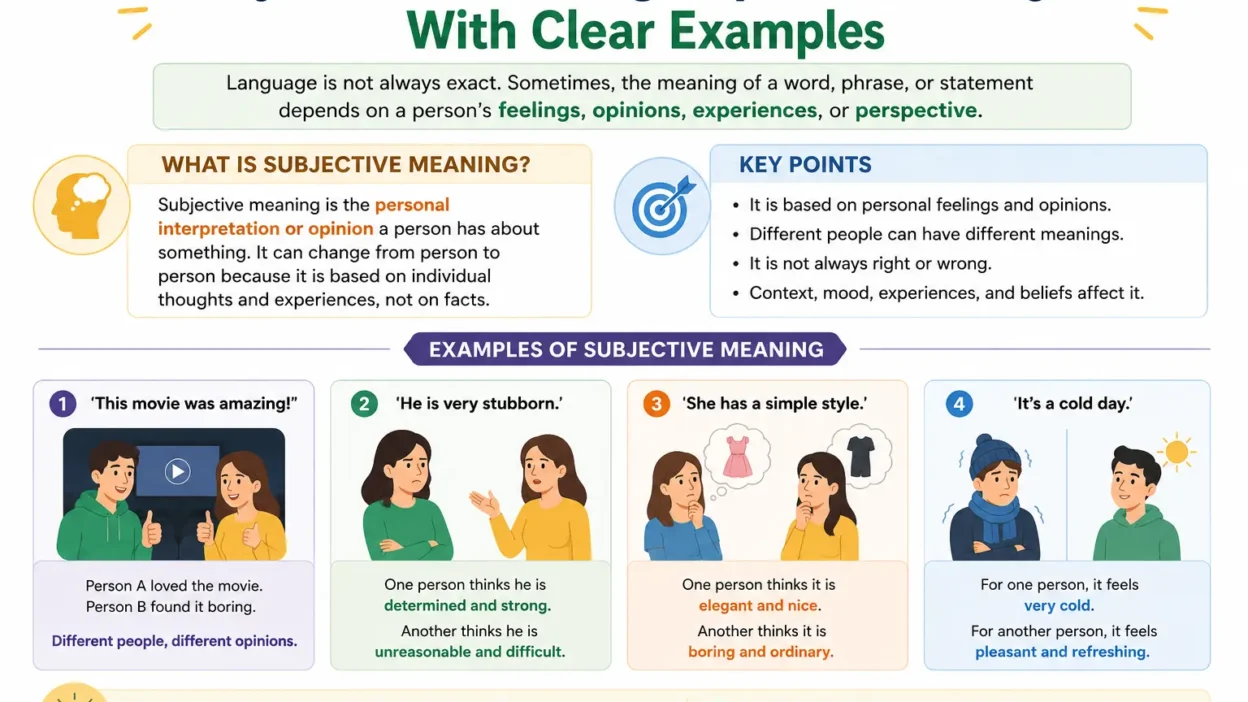
Subjective means something comes from a person’s mind or feelings. It is not fully based on facts that everyone agrees on.
For example, liking a movie is subjective. One person may love it, another may not. Both answers can be correct because it depends on personal taste.
In simple terms, subjective = “how I personally see it.”
SUBJECTIVE VS OBJECTIVE (KEY DIFFERENCE)
y=mx+by = mx + by=mx+b
mmm
bbb
-10-8-6-4-2246810-10-5510y-interceptx-intercept
| Context | Subjective | Objective |
| Movie review | “It was boring” | “It lasted 2 hours” |
| Food taste | “Too spicy for me” | “It contains chili” |
| Opinion | “I don’t like it” | “It exists” |
Subjective depends on the person. Objective does not change from person to person.
PART OF SPEECH AND GRAMMAR ROLE
“Subjective” is an adjective. It describes nouns related to opinions, feelings, or perception.
Example:
• Subjective judgment
• Subjective experience
• Subjective view
It can also relate to grammar in formal contexts, but that use is less common in daily English.
SUBJECTIVE IN EVERYDAY USE
People use “subjective” when they want to show something is based on opinion.
Common areas include:
• Movie or book reviews
• Food taste
• Fashion choices
• Art interpretation
Example:
• “Her rating is subjective, not factual.”
SUBJECTIVE OPINIONS AND JUDGMENTS

A subjective opinion is a personal belief or feeling. It is not something everyone must agree on.
Example:
• “Pizza is better than burgers.”
This is subjective because people can disagree, and both sides can be right.
SUBJECTIVE EXPERIENCE (HOW PEOPLE FEEL THINGS)
Subjective experience means how something feels inside your mind.
Example:
• Pain level
• Happiness
• Fear
• Comfort
Two people can experience the same event differently. That difference is subjective experience.
COMMON EXAMPLES IN SENTENCES
• “Beauty is subjective.”
• “That decision is subjective.”
• “His opinion is subjective.”
• “Art interpretation is subjective.”
COMMON MISTAKES LEARNERS MAKE
Mistake: Thinking subjective means “wrong”
Correction: Subjective does NOT mean wrong, just personal
Mistake: Using it for facts
Correction: Facts are not subjective
SYNONYMS AND RELATED WORDS
Close meanings:
• personal
• opinion-based
• interpretive
• individual
No perfect antonym exists, but “objective” is the standard opposite.
WHEN TO USE “SUBJECTIVE”
Use it when:
• Talking about opinions
• Describing taste or preference
• Explaining personal judgment
Do not use it when:
• Stating proven facts
• Giving measurable data
Because personal opinions can shift depending on the situation, understanding the <a href=”https://lexmints.com/context-meaning/“>meaning of context</a> can help explain why people interpret the same words, events, or experiences differently.
FAQS
What does subjective mean in simple words?
It means based on personal feelings or opinions rather than facts.
Is subjective the opposite of objective?
Yes, subjective is based on opinion, objective is based on facts.
Is taste in food subjective?
Yes, people have different preferences, so it is subjective.
Can subjective be wrong?
Not usually, because it is based on personal view, not fact.
Is “beautiful” subjective?
Yes, beauty depends on personal perception.
What is a subjective opinion?
It is a personal belief that may differ from others.
MINI QUIZ
- Is “I like this movie” subjective or objective?
- Is “Water boils at 100°C” subjective or objective?
- What does subjective depend on?
Answers:
- Subjective
- Objective
- Personal feelings or opinion
While subjective meaning depends on personal opinions, feelings, or individual interpretation, an idea can seem arbitrary in meaning when it appears based on personal choice or without a clear, fixed reason.
CONCLUSION
Subjective meaning is simple once you understand it refers to personal opinion and perception. It helps explain why people disagree on the same thing.