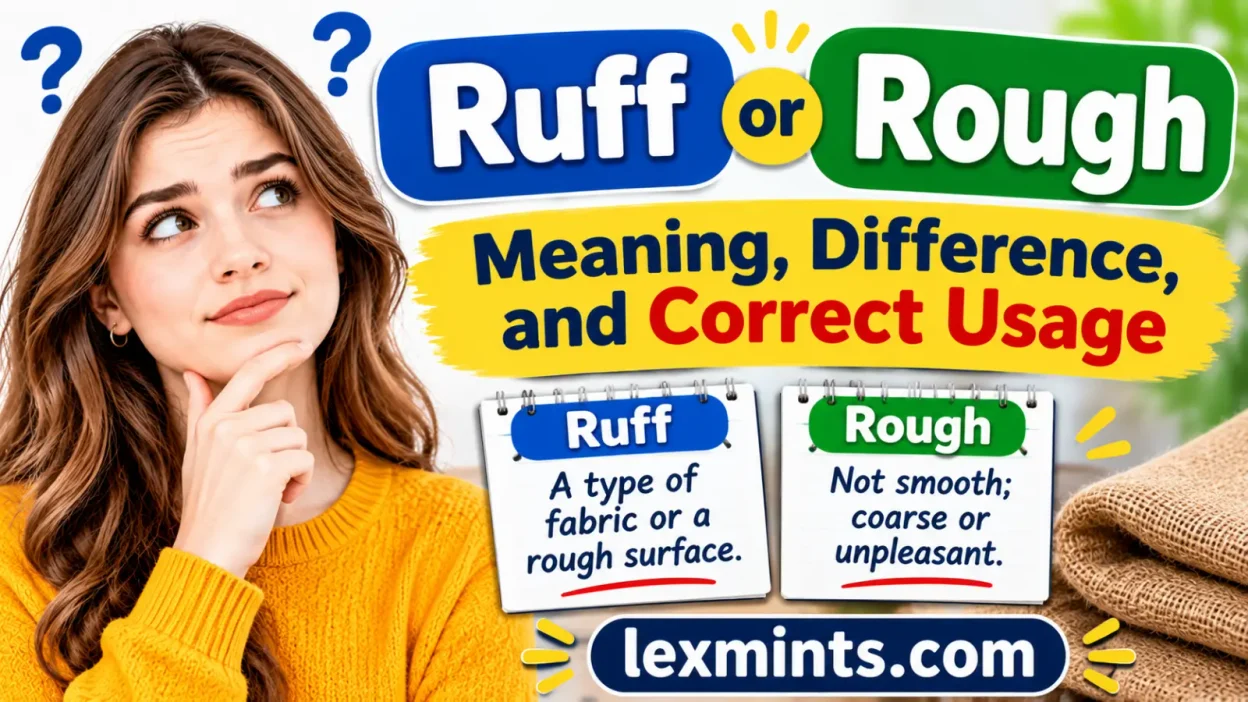
English has many words that sound alike but have different meanings and spellings. Ruff and rough are two examples that can confuse readers and writers. Both words are pronounced the same way, but they serve different purposes in English.
The word rough is common in everyday conversations, school assignments, professional writing, and online communication. It describes something uneven, difficult, harsh, or unfinished. You might use it to describe a rough road, a difficult day, or a rough draft.
The word ruff has more specialized meanings. It usually refers to a decorative collar, a ring of feathers or fur around an animal’s neck, or a particular bird.
Understanding these words helps you avoid spelling mistakes and communicate clearly. This guide explains their meanings, differences, pronunciation, grammar, and practical examples.
Quick Answer: Ruff or Rough?
Rough is the correct spelling when describing something uneven, difficult, harsh, or not completely finished.
Ruff is a real English word, but it usually refers to a decorative collar or a circle of feathers or fur around an animal’s neck.
Examples:
- The road was rough after the storm.
- The historical costume included a large white ruff.
Remember: If you mean difficult, uneven, or harsh, use rough.
Ruff vs. Rough: Meaning and Difference
Although these words sound identical, their meanings and grammatical uses are different.
What Does Rough Mean?
Rough is an adjective that describes something that is not smooth, comfortable, gentle, or completely finished.
It can also describe difficult experiences, unpleasant conditions, or approximate information.
For example:
- The wooden table has a rough surface.
- We had a rough day at work.
- She gave me a rough estimate of the total cost.
- The designer prepared a rough sketch.
In everyday American English, rough is a very common word. People use it in conversations, emails, books, and professional documents.
What Does Ruff Mean?
Ruff is primarily a noun with several specific meanings.
It commonly describes a stiff, decorative collar made from folded or pleated fabric. These collars were popular in European fashion during the 16th and 17th centuries.
It can also describe a ring of feathers or fur around an animal’s neck.
Examples:
- The historical painting showed a man wearing an elaborate ruff.
- The bird had a beautiful ruff of feathers around its neck.
- The costume included a white lace ruff.
Unlike rough, ruff is not normally used to describe difficult situations or uneven surfaces.
Ruff vs. Rough: Key Differences
The easiest way to understand these words is to examine their meanings and grammatical roles.
| Feature | Ruff | Rough |
|---|---|---|
| Part of speech | Mainly noun | Adjective, adverb, noun, and verb |
| Main meaning | Decorative collar or neck feathers | Uneven, harsh, difficult, or unfinished |
| Pronunciation | /rʌf/ | /rʌf/ |
| Everyday use | Specialized | Very common |
| Example | A historical ruff | A rough road |
Both words have the same pronunciation, but their meanings depend on spelling and context.
How to Use Rough in a Sentence
Rough has several meanings, so understanding its context is important.
Here are the most common ways to use it.
Rough Means Uneven or Not Smooth
Use rough when describing a surface that feels uneven, coarse, or irregular.
Examples:
- The old wooden floor feels rough.
- This paper has a rough texture.
- The mountain road was rough and full of rocks.
- My hands became rough during winter.
In these examples, rough describes the physical condition of something.
Rough Means Difficult or Unpleasant
Rough can also describe an unpleasant experience or challenging situation.
Examples:
- She had a rough week at school.
- Moving to another city was a rough experience.
- My brother is going through a rough time.
- The company had a rough year financially.
This meaning is especially common in casual conversations.
For example, someone might ask, “How are you doing?”
You could respond, “I’ve had a rough day, but I’m feeling better now.”
Rough Means Approximate
Use rough when information is not exact or detailed.
Examples:
- Can you give me a rough estimate?
- We have a rough idea of the project cost.
- The manager prepared a rough schedule.
- This is only a rough calculation.
In these sentences, rough means approximate rather than precise.
Rough Means Unfinished
Rough can describe something that is still being developed or needs improvement.
Examples:
- The writer shared a rough draft.
- I made a rough sketch of the new house.
- The presentation is still in its rough form.
- We discussed a rough plan for the weekend.
A rough draft is an early version of a written document. It usually needs editing before publication.
Rough Means Harsh or Violent
Rough can also describe behavior that is physically harsh or not gentle.
Examples:
- The children were playing too rough.
- The dog became nervous around rough handling.
- The players had a rough game.
- He spoke in a rough voice.
This meaning often appears in discussions about sports, physical behavior, and personal interactions.
How to Use Ruff in a Sentence
Ruff has a much narrower range of everyday uses than rough.
It is useful when discussing historical clothing, animal features, and certain specialized subjects.
Ruff as a Historical Collar
A ruff is a decorative collar made from folded, pleated, or gathered fabric.
It was especially associated with European clothing during the Renaissance and early modern periods.
Examples:
- The queen wore a beautiful lace ruff.
- His historical costume included a large white ruff.
- The museum displayed a traditional Elizabethan ruff.
- The actor wore a stiff collar-shaped ruff.
The word is useful in discussions about historical fashion, theater costumes, and clothing exhibitions.
Ruff as an Animal Feature
Ruff can also describe a circle or band of feathers or fur around an animal’s neck.
Examples:
- The bird displayed its colorful ruff.
- The animal had a thick ruff around its neck.
- The photographer captured the bird’s feathered ruff.
This meaning is useful in wildlife descriptions and nature writing.
Ruff as the Name of a Bird
A ruff is also the name of a Eurasian wading bird.
Its scientific name is Calidris pugnax. Male birds develop distinctive ornamental feathers around their necks during the breeding season.
Example:
- The wildlife photographer spotted a ruff near the wetlands.
This is a specialized meaning rather than a common everyday use.
Are Ruff and Rough Homophones?
Yes. Ruff and rough are homophones because they have the same pronunciation but different spellings and meanings.
Both words are pronounced /rʌf/.
The sound is similar to the word “tough” and rhymes with “stuff” and “cuff.”
Examples:
- The rough surface damaged the fabric.
- The bird had a beautiful ruff.
When spoken, listeners may not know which word you mean immediately. The surrounding sentence provides the necessary context.
However, written English makes the distinction clear through spelling.
Ruff or Rough: Part of Speech
Understanding the grammatical roles of these words makes them easier to use correctly.
Part of Speech of Rough
Rough can function in several grammatical roles.
Adjective: Describes something uneven, difficult, or unfinished.
Example: We traveled along a rough road.
Adverb: Used informally to describe an action performed in a rough manner.
Example: The players were playing rough.
Noun: Can refer to an early drawing or preliminary version, especially in creative work.
Example: The designer showed us several roughs.
Verb: Means to make something rough or to handle someone roughly in certain expressions.
Example: The workers roughed out the design.
Part of Speech of Ruff
Ruff is primarily used as a noun.
It identifies a physical object, animal feature, or particular bird.
Examples:
- The costume had a decorative ruff.
- The bird displayed its neck ruff.
- We spotted a ruff near the lake.
It is not the standard adjective used to describe something difficult or uneven.
Common Expressions and Phrases With Rough
Rough appears in many everyday English expressions.
Learning these phrases can improve your vocabulary and sentence construction.
Rough Day
A rough day is a day filled with problems, stress, or unpleasant experiences.
Example: I had a rough day at work yesterday.
Rough Time
A rough time refers to a difficult period in someone’s life.
Example: She is having a rough time after moving away.
Rough Estimate
A rough estimate is an approximate calculation rather than an exact figure.
Example: The contractor gave us a rough estimate for the renovation.
Rough Draft
A rough draft is an early version of a written document.
Example: Please review my rough draft before Friday.
Rough Around the Edges
This expression describes someone or something that is imperfect, unpolished, or lacking refinement.
Example: The new restaurant is a little rough around the edges, but the food is excellent.
Rough It
The expression “rough it” means living without normal comforts for a period.
Example: We decided to rough it during our camping trip.
Common Mistakes When Using Ruff and Rough
Many writers confuse these words because their pronunciation is identical.
However, replacing one with the other can change the meaning of a sentence.
Using Ruff Instead of Rough
Incorrect: We had a ruff day at school.
Correct: We had a rough day at school.
Explanation: Rough describes an unpleasant or difficult experience. Ruff does not have this meaning in standard writing.
Using Ruff for an Uneven Surface
Incorrect: The wall feels ruff.
Correct: The wall feels rough.
Explanation: Rough describes a surface that is not smooth.
Using Rough for a Decorative Collar
Incorrect: The historical costume included a large rough.
Correct: The historical costume included a large ruff.
Explanation: Ruff is the correct noun for this decorative collar.
Confusing Informal Writing With Standard English
Some people write “ruff” as a playful or informal spelling of rough.
For example, dog owners sometimes use “ruff” to imitate a dog’s bark.
However, this playful spelling should not replace rough in standard writing.
In school assignments, business communication, and professional documents, use the established spelling.
Ruff vs. Rough: Examples in Everyday English
The following examples show how each word works in different situations.
| Sentence | Correct Word | Reason |
|---|---|---|
| The road was very uneven. | Rough | Describes a surface |
| I had a difficult morning. | Rough | Describes an experience |
| The bird had neck feathers. | Ruff | Describes an animal feature |
| She prepared an early draft. | Rough | Means unfinished |
| The queen wore a decorative collar. | Ruff | Describes historical clothing |
| We need an approximate price. | Rough | Means estimated |
| The fabric feels coarse. | Rough | Describes texture |
| The wildlife guide identified the bird. | Ruff | Names a bird |
These examples demonstrate why context matters when choosing between the two spellings.
Synonyms and Related Words
Synonyms can help you understand the meanings of both words.
However, the best synonym depends on the context.
Synonyms of Rough
When rough describes an uneven surface, possible synonyms include:
- Coarse
- Uneven
- Bumpy
- Rugged
- Harsh
When rough describes a difficult experience, possible synonyms include:
- Difficult
- Challenging
- Tough
- Unpleasant
- Hard
When rough means approximate, possible synonyms include:
- Estimated
- Approximate
- Preliminary
- General
These words are not interchangeable in every sentence. Choose the synonym that matches the intended meaning.
Related Words for Ruff
Because ruff has specialized meanings, its related words depend on context.
For historical clothing:
- Collar
- Frill
- Ruffle
- Pleat
For animal features:
- Feathers
- Plumage
- Fur
- Neck feathers
These are related terms, not exact synonyms in every situation.
Easy Ways to Remember the Difference
A simple memory technique can help you remember the correct spelling.
Think about the meaning before writing the word.
Rough = Rough Surface or Rough Experience
Use rough when describing:
- An uneven road
- A difficult day
- An unfinished draft
- An approximate estimate
- Harsh treatment
Ruff = Frilled Collar or Animal Feature
Use ruff when describing:
- A historical collar
- Decorative neck feathers
- A circle of fur
- The Eurasian bird
Remembering these examples will make the distinction easier.
When Should You Use Ruff or Rough?
Choose the word based on the meaning you want to communicate.
| Context | Best Choice | Why |
|---|---|---|
| Describing an uneven road | Rough | The surface is not smooth |
| Describing a difficult day | Rough | It describes an unpleasant experience |
| Describing a historical collar | Ruff | It names a decorative garment |
| Describing approximate costs | Rough | It means an estimate |
| Describing animal neck feathers | Ruff | It names a feathered feature |
| Describing an early draft | Rough | It means unfinished |
For most everyday writing situations, rough will be the appropriate word.
Ruff is correct when you specifically mean its established noun meanings.
FAQs
Is ruff or rough the correct spelling?
Both spellings are correct English words, but they have different meanings. Rough describes something uneven, difficult, harsh, or unfinished. Ruff usually refers to a decorative collar or an animal’s neck feathers.
What does ruff mean?
Ruff is a noun that commonly describes a decorative, pleated collar worn around the neck. It can also describe a circle of feathers or fur around an animal’s neck.
What does rough mean in simple English?
Rough means not smooth, difficult, harsh, or not completely finished. For example, a rough road has an uneven surface, while a rough day is unpleasant or challenging.
Are ruff and rough pronounced the same?
Yes. Both words are pronounced /rʌf/. They rhyme with words such as tough, stuff, and cuff.
Is ruff an informal spelling of rough?
Ruff is sometimes used playfully as an informal spelling of rough, especially when imitating a dog’s bark. However, it is not an acceptable replacement in standard formal writing.
What is a rough draft?
A rough draft is an early version of a piece of writing. It contains the main ideas but may need corrections, editing, and improvements before completion.
What is a ruff collar?
A ruff collar is a decorative collar made from folded or pleated fabric. It was popular in European fashion during the 16th and 17th centuries.
Mini Quiz: Test Your Understanding
Choose the correct word to complete each sentence.
Question 1: We had a very _____ day because of the heavy rain.
- A. Ruff
- B. Rough
Question 2: The historical painting showed a man wearing a white _____.
- A. Ruff
- B. Rough
Question 3: Can you give me a _____ estimate of the repair cost?
- A. Ruff
- B. Rough
Question 4: The bird displayed its beautiful neck _____.
- A. Ruff
- B. Rough
Question 5: The wooden surface feels _____ and uneven.
- A. Ruff
- B. Rough
Answer Key
- B — Rough
- A — Ruff
- B — Rough
- A — Ruff
- B — Rough
If you answered all five correctly, you understand the main difference between these words.
Conclusion
Ruff and rough sound alike, but their meanings and uses are different. Rough describes uneven surfaces, difficult experiences, harsh conditions, and unfinished work. Ruff refers to a decorative collar, animal neck feathers, or a particular bird.
For everyday writing, remember to use rough when describing something difficult or uneven. Use ruff only when its specific meaning fits your sentence.
Understanding this small spelling difference can make your English writing clearer and more accurate.