
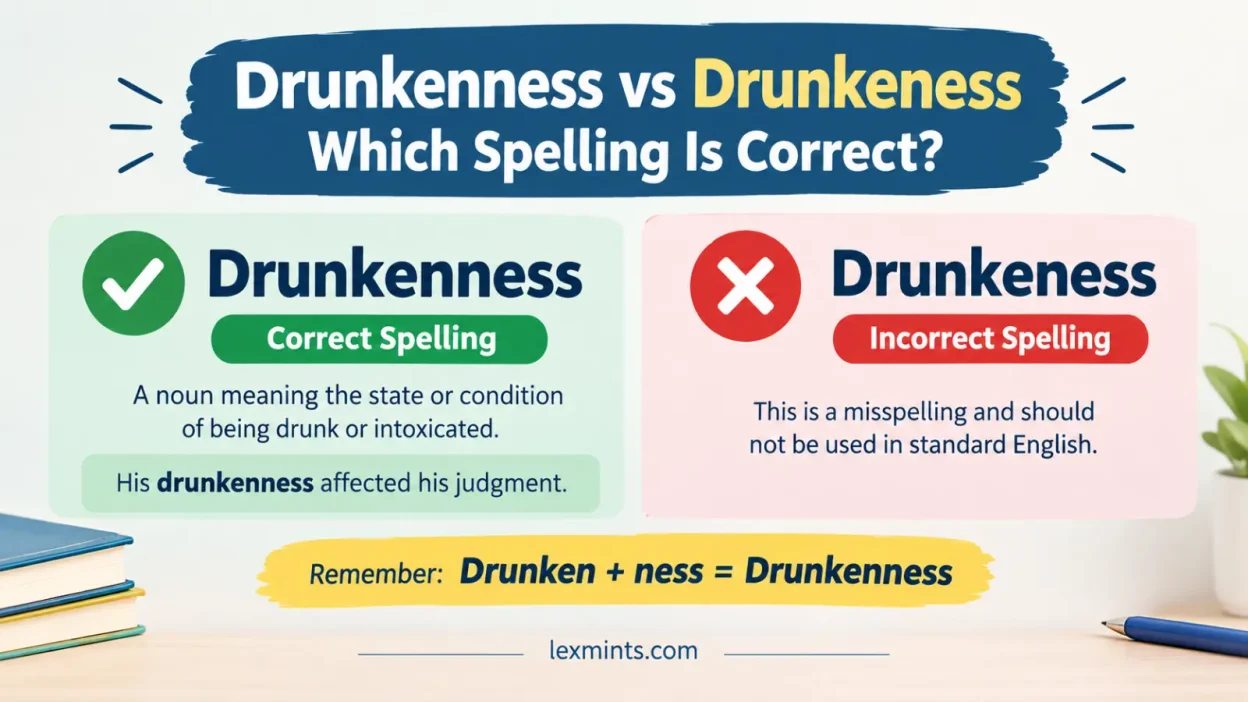
Drunkenness vs drunkeness is a common spelling confusion because both forms look nearly identical. However, only one is the standard English spelling.
The correct spelling is drunkenness with two n’s at the end: drunkenness.
Drunkeness is a misspelling and should not be used in standard English writing.
The word drunkenness refers to the state or condition of being drunk, especially when alcohol has affected a person’s behavior, judgment, coordination, or awareness. It is formed from the adjective drunken plus the suffix -ness.
Correct: drunkenness
Incorrect: drunkeness
If you are writing an article, essay, report, professional document, or any other formal content, always use drunkenness.
Drunkenness vs Drunkeness: Quick Answer
The correct spelling is drunkenness.
It contains double n before the final -ess:
D-R-U-N-K-E-N-N-E-S-S
The incorrect form drunkeness drops one of those n’s.
| Spelling | Correct? | Meaning |
|---|---|---|
| drunkenness | ✅ Yes | The state or condition of being drunk |
| drunkeness | ❌ No | Misspelling of drunkenness |
The easiest way to remember the correct spelling is to recognize that drunkenness comes from drunken + -ness. When the suffix -ness is added, the final n of drunken remains, producing drunkenness.
What Does Drunkenness Mean?
Drunkenness is a noun meaning the condition of being drunk or intoxicated.
It can describe a person’s physical or behavioral state after consuming enough alcohol to cause noticeable impairment. Depending on context, the word may refer to intoxication generally or to repeated or excessive drinking behavior.
For example:
- The man’s drunkenness made it difficult for him to communicate clearly.
- The law addresses public drunkenness in certain circumstances.
- His drunkenness affected his judgment.
- The effects of drunkenness can vary from person to person.
The word is related to drunk, drunken, and intoxication, but these words do not always function in exactly the same way.
Why Is Drunkenness Spelled With Two N’s?
The spelling becomes easier to understand when you break the word into parts:
drunken + ness = drunkenness
The adjective drunken already ends in n:
drunken
The suffix -ness begins with n:
ness
When they combine, both n’s remain:
drunken + ness → drunkenness
Therefore, the resulting word contains nn:
drunkenness
A common spelling mistake is to write:
drunken + ess → drunkeness
That form incorrectly removes one of the n’s.
This is similar to other English words in which a base word ending in n is combined with -ness. Keeping the structure of the original word in mind can help prevent the mistake.
Drunkenness: Meaning and Word Formation
Understanding how drunkenness is constructed is one of the best ways to remember its spelling.
The word can be viewed as:
drunken + -ness
Here, drunken describes a person or condition associated with being drunk, while -ness turns an adjective into a noun describing a state, quality, or condition.
Compare:
- kind → kindness
- dark → darkness
- happy → happiness
- aware → awareness
- drunken → drunkenness
The suffix -ness is extremely common in English. It usually forms nouns that refer to a quality, state, or condition.
So:
drunken → drunkenness
means approximately:
being drunken → the state of being drunken
This word formation explains why the spelling includes nn.
Is Drunkeness a Word?
No. Drunkeness is not the standard spelling of the English noun.
If you encounter drunkeness, it is generally an error for drunkenness.
For example:
❌ The effects of drunkeness can be serious.
✅ The effects of drunkenness can be serious.
The second sentence uses the standard spelling.
Because drunkeness looks so similar to the correct word, it can be easy to type accidentally. Spell-checking and proofreading can help catch this error, but remembering the word’s structure is even more useful.
Drunkenness vs Drunkeness in American English
For American English, the correct spelling is drunkenness.
There is no standard American-English spelling in which drunkeness replaces drunkenness.
This means that US writers should consistently use:
drunkenness
rather than:
drunkeness
The same standard spelling is also used in British English and other major varieties of English.
Therefore, whether you are writing for a US audience, a British audience, or a general international audience, drunkenness is the safe and correct spelling.
Examples of Drunkenness in Sentences
Seeing the correct spelling in context makes it easier to remember.
Example 1
Drunkenness can affect a person’s judgment and coordination.
Here, drunkenness is the subject of the sentence.
Example 2
The manager was concerned about the employee’s drunkenness at work.
The noun describes the employee’s condition.
Example 3
Public drunkenness may lead to legal consequences depending on the circumstances and local law.
The word is used in a formal context.
Example 4
His drunkenness became increasingly difficult for his family to manage.
Here, drunkenness refers to a continuing condition or pattern of behavior.
Example 5
The story describes the consequences of drunkenness.
The noun works naturally in formal writing.
Example 6
She recognized that drunkenness had affected his decision-making.
Again, the correct spelling contains nn.
Common Mistakes With Drunkenness
The most common mistake is leaving out one of the two n’s.
Mistake 1: Drunkeness
❌ drunkeness
This is the primary spelling error discussed in this comparison.
Correct:
✅ drunkenness
The word contains nn before ess.
Mistake 2: Drunkenness
Another possible error is:
❌ drunkenness
This spelling changes the structure of drunken.
The correct word is:
✅ drunkenness
Remember the base adjective:
drunken
not drunken with a different ending pattern.
Mistake 3: Confusing Drunkenness With Drunk
Drunkenness and drunk are related, but they are not interchangeable in every sentence.
For example:
He was drunk.
Here, drunk functions as an adjective.
His drunkenness was obvious.
Here, drunkenness is a noun.
Knowing the grammatical role of each word helps you choose the appropriate form.
Drunkenness vs Intoxication
Drunkenness and intoxication are closely related, but their tone and usage can differ.
Drunkenness specifically emphasizes the condition of being drunk, commonly because of alcohol.
Intoxication is a broader and often more formal term. It can refer to impairment caused by alcohol or other substances.
For example:
- His drunkenness was obvious.
- The report discussed alcohol intoxication.
In medical, scientific, or legal writing, intoxication may be preferred when technical precision is important.
In ordinary writing, drunkenness is a familiar noun for the state of being drunk.
Drunkenness vs Drunken Behavior
The phrase drunken behavior is another expression related to drunkenness.
However, the two expressions emphasize different things.
Drunkenness focuses on the condition or state of being drunk.
Drunken behavior focuses on actions or conduct associated with being drunk.
Compare:
His drunkenness was noticeable.
This emphasizes his condition.
His drunken behavior caused problems at the event.
This emphasizes what he did.
Both can be correct depending on what the writer wants to communicate.
Why People Spell Drunkenness Incorrectly
There are several reasons why drunkeness is such an understandable mistake.
First, English spelling does not always follow simple pronunciation patterns. When people hear or say the word, the double n may not feel especially noticeable.
Second, writers may mentally divide the word incorrectly:
drunken + ess
instead of:
drunken + ness
Third, many English nouns use -ness, so writers may focus on the ending without considering the final letter of the base word.
The solution is simple: remember the complete structure.
drunken + ness = drunkenness
A Simple Memory Trick
Use this formula:
DRUNKEN + NESS = DRUNKENNESS
Notice the two n’s where the words meet:
drunken + ness
→ drunkenness
You can also remember:
The word “drunken” keeps its final N before “-ness.”
So don’t remove that n.
❌ drunkeness
✅ drunkenness
If you visualize the word as DRUNKEN + NESS, the correct spelling becomes much easier to recall.
Is Drunkenness Formal or Informal?
Drunkenness is a standard noun and can appear in both general and formal writing.
It may be used in:
- news writing
- essays
- educational content
- legal discussions
- social commentary
- literature
- general conversation
- academic writing
However, the tone can vary depending on the surrounding language.
In technical or medical contexts, terms such as alcohol intoxication may sometimes be more precise.
In everyday English, people may simply say:
being drunk
For example:
Drunkenness can impair judgment.
More conversationally:
Being drunk can impair judgment.
Both expressions communicate a similar idea, but the first uses the formal noun drunkenness.
Drunkenness as a Noun
Grammatically, drunkenness is a noun.
This means it can serve as the subject or object of a sentence and can appear after possessive words.
Examples include:
- Drunkenness can impair judgment.
- The consequences of drunkenness can be serious.
- His drunkenness was obvious.
- They discussed the dangers of drunkenness.
- The article examines drunkenness and its effects.
The word does not normally function as an adjective.
For an adjective, English commonly uses drunken or drunk, depending on the context.
Compare:
His drunkenness was obvious.
Noun
His drunken behavior was disruptive.
Adjective
He was drunk.
Adjective
Drunken vs Drunkenness
These two words are directly related but have different grammatical functions.
Drunken
Drunken is an adjective.
It can describe a person, action, expression, or behavior associated with being drunk.
Examples:
- drunken behavior
- drunken argument
- drunken driver
- drunken laughter
- drunken celebration
Drunkenness
Drunkenness is a noun.
It names the state or condition itself.
Examples:
- public drunkenness
- signs of drunkenness
- effects of drunkenness
- repeated drunkenness
A useful comparison is:
drunken behavior = behavior associated with being drunk
drunkenness = the condition of being drunk
Drunkenness in Formal Writing
When using drunkenness in formal writing, make sure the context is clear and neutral.
For example:
The report examines the social consequences associated with alcohol-related drunkenness.
This is more formal than:
The report talks about people getting drunk.
Both can be grammatically correct, but the first is better suited to formal or analytical writing.
Avoid replacing drunkenness with the misspelled drunkeness, especially in professional content.
A spelling mistake in a heading, academic assignment, website article, or report can make the writing appear less polished.
How to Proofread Drunkenness
When proofreading this word, focus on the middle and ending:
drunkenness
Break it visually into:
DRUNKEN + NESS
Then check the joining letters:
N + N
This gives:
DRUNKENNESS
If you see:
DRUNKENESS
you know that one N is missing.
A useful proofreading question is:
Does the word contain “drunken” before “-ness”?
If yes, the spelling should be:
drunkenness
Drunkenness vs Drunkeness: Which One Should You Use?
Always use drunkenness.
If you’re choosing between these two spellings:
- drunkenness ✅
- drunkeness ❌
the answer is straightforward.
Drunkenness is the correct standard spelling, while drunkeness is a misspelling.
This applies to headings, body text, captions, essays, blog posts, reports, and other forms of standard English writing.
FAQs
Is it drunkenness or drunkeness?
The correct spelling is drunkenness. Drunkeness is a misspelling. The correct form contains two consecutive n’s: drunkenness.
What does drunkenness mean?
Drunkenness is a noun that refers to the state or condition of being drunk or intoxicated, particularly as a result of consuming alcohol.
Why does drunkenness have two n’s?
Drunkenness is formed from drunken + -ness. The word drunken ends in n, while -ness begins with n, so both letters remain: drunken + ness = drunkenness.
Is drunkeness a correct English word?
No. Drunkeness is a misspelling of drunkenness. In standard English writing, use drunkenness.
Is drunkenness a noun?
Yes. Drunkenness is a noun that describes the state or condition of being drunk. For example: “His drunkenness affected his judgment.”
What is the difference between drunkenness and intoxication?
Drunkenness specifically refers to the condition of being drunk, while intoxication is a broader and often more formal term for impairment caused by alcohol or other substances.
How can I remember the spelling of drunkenness?
Remember the word as drunken + ness. Because drunken ends in n and ness begins with n, the correct spelling is drunkenness, with two n’s.
Conclusion
Drunkenness vs drunkeness is a spelling comparison with one clear winner: drunkenness.
The correct spelling contains two consecutive n’s:
✅ Drunkenness
The incorrect spelling leaves out one n:
❌ Drunkeness
The easiest way to remember the correct spelling is to divide the word into its parts:
drunken + ness = drunkenness
The base word drunken ends in n, and the suffix -ness begins with another n. Both letters remain when the word is formed.
So, whenever you need the noun referring to the state or condition of being drunk, write drunkenness.
Correct: The article discusses the effects of drunkenness.
Incorrect: The article discusses the effects of drunkeness.
For clear, accurate, and professional English, choose drunkenness every time.


