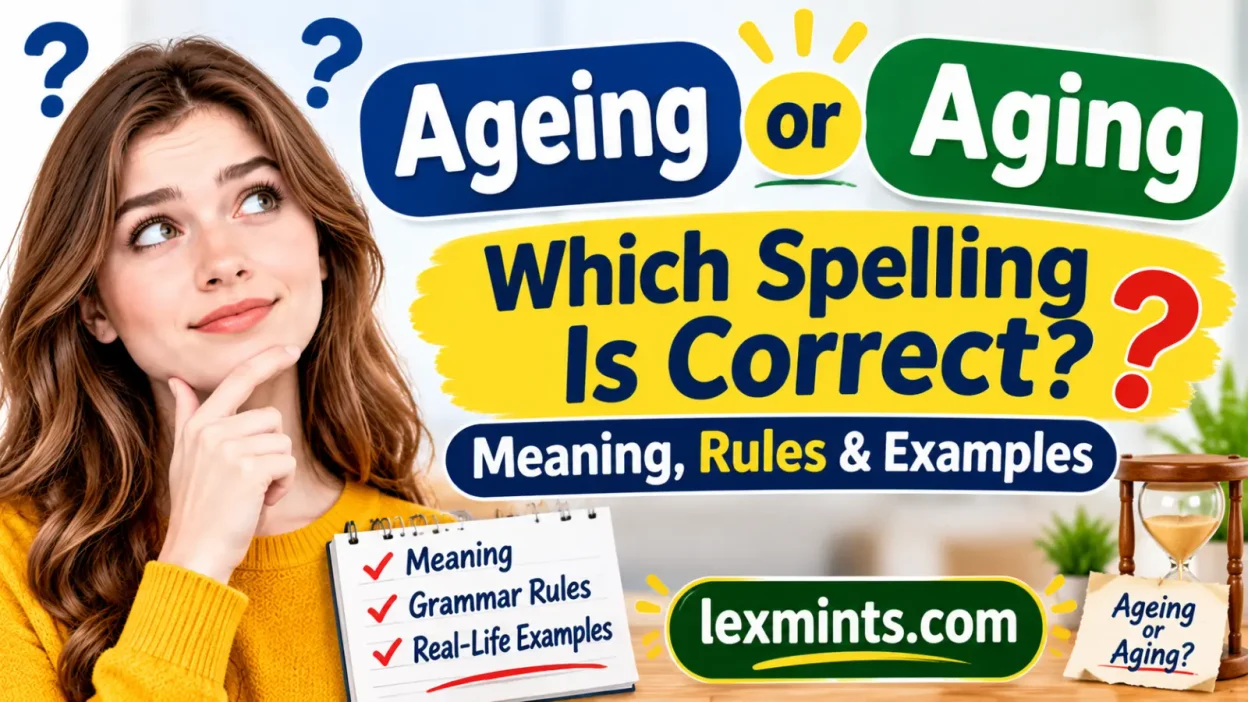
Ageing or aging is a common spelling question for English learners, students, and writers. You may encounter both forms in books, articles, advertisements, and everyday conversations.
Both spellings describe the process of becoming older. They can refer to people, animals, objects, materials, and even buildings. However, their preferred spelling depends on the type of English you are writing.
American English generally uses aging, while British English prefers ageing. Neither spelling is universally wrong.
Choosing the appropriate form helps your writing look consistent and natural. This distinction is especially useful when writing academic papers, website content, professional documents, or educational materials.
In this guide, you will learn what both spellings mean, how to use them, and which form American writers should choose. You will also find practical examples, common mistakes, and answers to frequently asked questions.
Quick Answer
Both ageing and aging are correct spellings of the same word.
- Aging: Preferred American English spelling.
- Ageing: Preferred British English spelling.
If you are writing for an American audience, use aging.
TL;DR
- Aging is the standard American English spelling.
- Ageing is the preferred British English spelling.
- Both words have the same meaning.
- Both forms describe becoming older over time.
- Their pronunciation is identical.
- Keep one spelling consistent throughout your writing.
What Do Ageing and Aging Mean?
The words ageing and aging describe the same process: becoming older as time passes.
This process can happen naturally or through gradual changes caused by environmental conditions. The word applies to living things and nonliving things.
For example:
- A person experiences aging as they grow older.
- An animal goes through aging throughout its life.
- A wooden table changes appearance as it ages.
- An old building shows signs of aging over time.
- Technology may become outdated as it ages.
The word can also describe the gradual development or improvement of something.
For instance, cheese, wine, and certain foods undergo aging during production. This process can change their flavor, texture, or quality.
The spelling changes across English varieties, but the basic meaning remains the same.
Ageing vs. Aging: The Main Difference
The main difference is regional spelling preference. American and British English follow different conventions for this word.
| Spelling | Preferred English variety | Example |
|---|---|---|
| Aging | American English | Aging parents need support. |
| Ageing | British English | Ageing parents need support. |
Both examples are grammatically correct.
However, American publications generally choose aging. British publications generally choose ageing.
Canadian English generally prefers aging, although ageing is also accepted.
The important point is to consider your readers before choosing a spelling.
Why Does American English Use Aging?
American English commonly removes the final silent e when adding certain endings to words.
The verb age becomes aging when the ending -ing is added.
This follows a familiar spelling pattern found in several English words.
Consider these examples:
- Make → Making
- Write → Writing
- Take → Taking
- Hope → Hoping
- Age → Aging
The final e is dropped before adding -ing.
This is why aging is the preferred spelling in American writing.
You will commonly see this form in American newspapers, school assignments, business documents, and scientific publications.
For example:
- The city is replacing its aging water pipes.
- Scientists are studying the effects of aging.
- She is researching healthy aging.
- His aging parents live nearby.
For American readers, aging is the natural choice.
Why Does British English Use Ageing?
British English commonly retains the final e in this particular word.
Therefore, British writers generally use ageing rather than aging.
This spelling is widely recognized in British publications, educational materials, and professional writing.
For example:
- The ageing population needs better public services.
- Scientists are researching the effects of ageing.
- She is interested in healthy ageing.
- The ageing building requires maintenance.
The additional letter does not change the word’s pronunciation or meaning.
Writers in the United Kingdom, Australia, and New Zealand commonly use ageing.
However, regional preferences are not absolute rules for every publication. Individual style guides may establish their own requirements.
Pronunciation of Ageing and Aging
Both spellings have the same pronunciation.
The word is pronounced:
AY-jing
Its phonetic pronunciation is /ˈeɪ.dʒɪŋ/.
The word contains two syllables:
- AY – The first syllable sounds like the letter A.
- jing – The second syllable sounds like the ending in changing.
Examples:
- Aging parents need additional support.
- The ageing process affects everyone differently.
- Scientists study aging in animals.
You do not need to change your pronunciation when switching between the two spellings.
The difference exists in written English, not spoken English.
Part of Speech: How the Word Works
Both spellings can perform different grammatical functions.
Understanding these functions makes it easier to use the word correctly.
Aging or Ageing as a Noun
The word can function as a noun when describing the process of becoming older.
It often appears in discussions about health, biology, society, and personal development.
Examples:
- Aging is a natural part of life.
- Scientists are studying the process of aging.
- Healthy aging requires attention to overall well-being.
- The effects of ageing can vary between individuals.
In these examples, the word identifies a process or concept.
Aging or Ageing as an Adjective
The word can also describe a person, object, or system that is becoming older.
Examples:
- His aging parents live in California.
- The city needs to repair its aging infrastructure.
- The aging computer system requires an upgrade.
- She cares for her ageing relatives.
Here, the word provides information about a noun.
Aging or Ageing as a Verb Form
The word is also the present participle and gerund form of the verb age.
It can appear in continuous verb constructions.
Examples:
- My grandfather is aging gracefully.
- The old bridge is aging quickly.
- The cheese is aging inside wooden barrels.
- The painting is aging naturally.
In these sentences, the word describes an ongoing process.
The grammatical role depends on how the word functions within the sentence.
How to Use Aging in American English
If your audience is in the United States, use aging in ordinary writing.
This applies to school assignments, websites, professional documents, and everyday communication.
Here are some common situations where the American spelling is appropriate.
Talking About People
Use aging when describing people who are becoming older.
Examples:
- Her aging parents need assistance with daily activities.
- Aging adults may experience different physical changes.
- He writes about the challenges of aging.
- My neighbor is helping his aging father.
Discussing Health and Science
The word frequently appears in medical, scientific, and educational discussions.
Examples:
- Researchers are investigating the aging process.
- Healthy aging is an important public health topic.
- Scientists examine how cells change during aging.
- The study explores different aspects of biological aging.
Describing Buildings and Equipment
The word can also describe objects that become older or less effective.
Examples:
- The school needs to replace its aging heating system.
- The aging highway requires regular repairs.
- The company upgraded its aging computers.
- Workers inspected the aging factory equipment.
Discussing Food and Materials
In cooking and manufacturing, aging can describe a controlled process.
Examples:
- The restaurant serves aged cheese.
- The company specializes in aging premium meat.
- The wine undergoes aging in oak barrels.
- Leather develops a different appearance with aging.
These examples show that the word is not limited to human life.
Common Expressions Using Aging and Ageing
Both forms appear in several everyday expressions.
Their spelling depends on the intended regional variety.
| Expression | Meaning |
|---|---|
| Aging process | The gradual process of becoming older |
| Healthy aging | Growing older while maintaining well-being |
| Signs of aging | Visible or noticeable changes associated with age |
| Aging population | A population with a growing proportion of older people |
| Premature aging | Becoming older in appearance or function earlier than expected |
| Anti-aging | Intended to reduce or slow visible signs of aging |
| Aging infrastructure | Older systems or structures that need attention |
For British writing, use the corresponding ageing forms.
For American writing, retain aging throughout.
Real-Life Examples of Aging and Ageing
The following examples demonstrate how the word works in different situations.
Everyday Conversation
- My parents are aging, so I visit them regularly.
- Everyone experiences aging differently.
- He believes aging brings valuable life experience.
- Her grandmother is aging gracefully.
Education and Academic Writing
- The professor discussed the effects of aging on memory.
- Students studied the biology of aging.
- The research examines aging in different animal species.
- The article explores healthy aging in modern society.
Business and Technology
- The company replaced its aging equipment.
- Aging infrastructure can create expensive maintenance problems.
- The organization invested in new technology.
- The aging computer system caused several delays.
Health and Lifestyle
- Regular exercise supports healthy aging.
- Researchers are investigating cellular aging.
- The doctor explained common signs of aging.
- Sleep and nutrition are important throughout the aging process.
British English Examples
- The ageing population requires additional resources.
- She studies the science of ageing.
- The ageing railway system needs repairs.
- Healthy ageing is an important public concern.
Notice that the sentences have the same meanings. Only the regional spelling changes.
Common Mistakes When Using Aging or Ageing
Although both spellings are accepted, writers sometimes make mistakes when choosing between them.
Here are some problems to avoid.
Switching Between Both Spellings
Do not randomly alternate between aging and ageing in the same article.
Incorrectly inconsistent:
- The aging population is increasing.
- Healthy ageing is important.
- Scientists are studying the aging process.
Better American English:
- The aging population is increasing.
- Healthy aging is important.
- Scientists are studying the aging process.
Choose one regional spelling and maintain it throughout your writing.
Assuming Ageing Is Always Incorrect
Some American writers believe ageing is a spelling mistake.
That is not correct.
Ageing is a recognized British English spelling. It is perfectly acceptable in British publications and other contexts that follow British conventions.
Using the Wrong Spelling for Your Audience
Using British spelling in an American document can make the writing inconsistent.
For example:
Less suitable for American English:
The ageing population is creating new challenges.
Preferred American version:
The aging population is creating new challenges.
The original sentence is understandable, but the second follows American spelling conventions.
Confusing Aging With Ageism
These words have different meanings.
- Aging: The process of becoming older.
- Ageism: Unfair treatment or discrimination based on someone’s age.
Examples:
- Aging is a natural part of life.
- Ageism can affect older employees.
Remember that ageism is spelled without the additional e in both American and British English.
When Should You Use Aging or Ageing?
Your choice should depend on your audience, publication, and writing style.
The following table provides a simple reference.
| Writing context | Recommended spelling |
|---|---|
| American school assignment | Aging |
| American website article | Aging |
| American business report | Aging |
| British newspaper article | Ageing |
| British academic paper | Ageing |
| Australian publication | Ageing |
| Canadian publication | Aging generally preferred |
If you write for an American audience, aging is the safest choice.
If you write for British readers, follow their preferred spelling.
For international publications, check the publication’s style guide.
Related Terms and Expressions
Several words are closely connected to aging.
Understanding them can help you express related ideas more clearly.
Growing older: A simple expression describing the process of becoming older.
Example: Everyone experiences changes while growing older.
Maturing: Developing physically, mentally, or emotionally over time.
Example: Children continue maturing as they grow.
Elderly: An adjective commonly used to describe older people.
Example: The organization provides services for elderly residents.
Age-related: Connected to a particular stage of life or changes associated with age.
Example: The doctor discussed several age-related changes.
Ageism: Discrimination or unfair treatment based on age.
Example: The company introduced policies to prevent ageism.
These expressions are related, but they are not interchangeable in every sentence.
For example, maturing can suggest development or improvement, while aging simply describes becoming older.
Synonyms and Antonyms of Aging
The best synonym depends on the situation.
There is no single replacement that works in every context.
Common Synonyms
- Growing older: A simple alternative for people and animals.
- Maturing: Emphasizes development over time.
- Getting older: An informal expression with a similar meaning.
- Deteriorating: Describes something becoming worse in condition.
- Wearing out: Describes gradual damage from use.
- Developing: Describes gradual change or growth.
Examples:
- My parents are growing older.
- The wood is deteriorating.
- The cheese is maturing in storage.
Antonyms
There is no exact opposite of aging in every context.
However, some words express contrasting ideas.
- Youth: The period of being young.
- Renewal: The process of restoring something.
- Rejuvenation: Making something appear or feel younger.
- Newness: The quality of being new.
These words describe different ideas rather than direct grammatical opposites.
FAQs
Is ageing or aging correct in American English?
Aging is the preferred spelling in American English. It is used in American newspapers, educational materials, and professional writing. Ageing is also understood but follows British spelling conventions.
Is ageing British or American English?
Ageing is primarily the British English spelling. It is also commonly used in Australia and New Zealand. American English generally prefers aging.
Does aging or ageing have the same meaning?
Yes, both spellings have exactly the same basic meaning. They describe the process of becoming older or changing over time. The difference is regional spelling preference.
How do you spell aging in the United States?
The standard American spelling is aging. It drops the final e from the verb age before adding -ing. For example, Americans generally write aging parents and healthy aging.
Is ageing wrong in American English?
No, ageing is not inherently wrong. It is an accepted British spelling that American readers can understand. However, American writers should generally use aging for consistency.
Are aging and ageing pronounced differently?
No, both forms have the same pronunciation: AY-jing. The pronunciation does not change based on regional spelling preferences. Only the written form differs.
What is the difference between aging and ageism?
Aging describes the process of becoming older. Ageism refers to discrimination or unfair treatment based on age. Both words are spelled without confusion about their meanings.
Mini Quiz: Test Your Knowledge
Choose the best answer for each question.
Question 1: Which spelling is preferred in American English?
- A. Ageing
- B. Aging
- C. Ageeing
Question 2: Which spelling is commonly preferred in British English?
- A. Aging
- B. Ageeing
- C. Ageing
Question 3: Do aging and ageing have different meanings?
- A. Yes
- B. No
Question 4: Which spelling should you use in an American school assignment?
- A. Aging
- B. Ageing
Question 5: What does aging generally describe?
- A. Becoming older over time
- B. Becoming younger
- C. Learning a new language
Answer Key
- B — Aging
- C — Ageing
- B — No
- A — Aging
- A — Becoming older over time
If you answered all five correctly, you understand the main spelling distinction.
Conclusion
Both ageing and aging are correct spellings with the same meaning. The difference comes from regional English conventions.
For American writing, choose aging. For British writing, choose ageing.
Remember to maintain consistent spelling throughout your articles, assignments, and professional documents. This simple habit will make your writing clearer and more natural.