
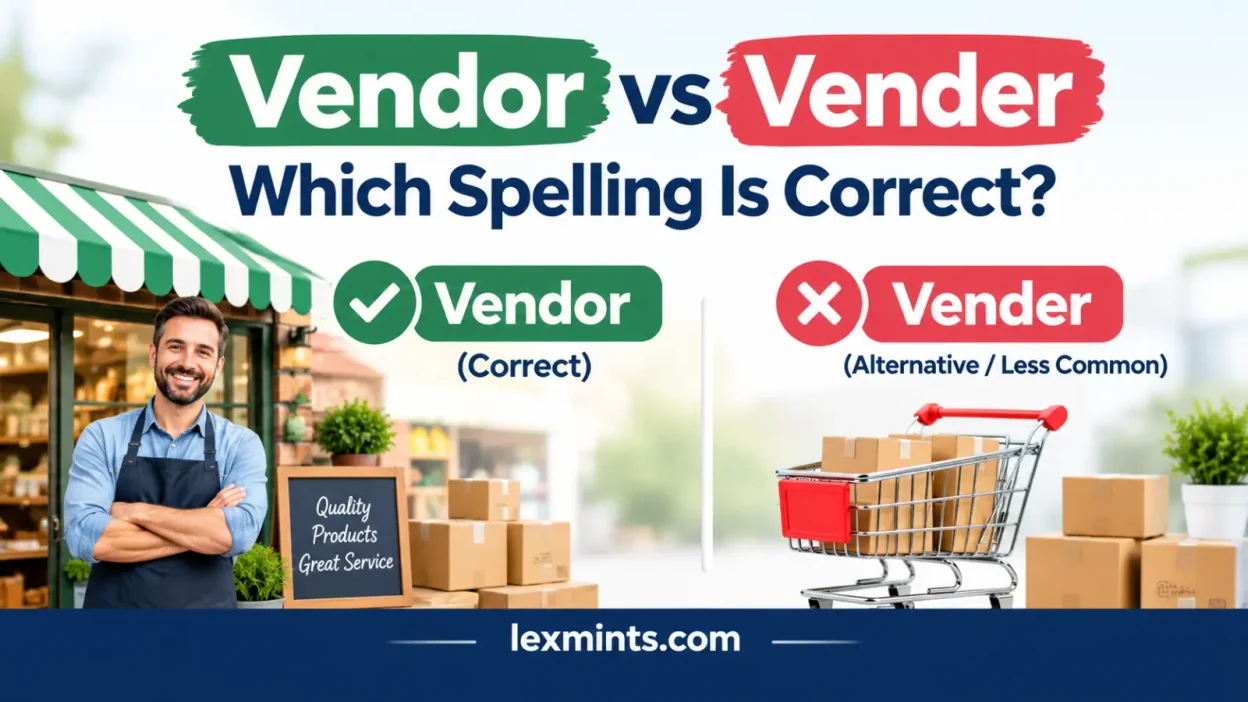
If you are confused about vendor vs vender, you are not alone. The two words look almost identical, but they do not have the same status in modern English. The spelling vendor is the standard and widely accepted form used for a person or business that sells goods or services. Vender is also a real English word, but it is much less common and is generally considered an alternative spelling of vendor.
For most writing, especially in American English, vendor is the spelling you should choose.
For example:
- Correct and standard: The software vendor released a new update.
- Also a word, but uncommon: The vender offered fresh produce at the market.
The key point is simple: vendor is the preferred spelling in modern American English, while vender is an uncommon variant.
Vendor vs Vender: Quick Answer
Vendor and vender can both refer to someone who sells goods or services, but they differ greatly in usage and frequency.
| Word | Meaning | Usage |
|---|---|---|
| Vendor | A person or company that sells goods or services | Standard and very common |
| Vender | A person who sells goods or services | Valid but uncommon |
If you are writing an email, business document, website, report, article, or academic paper, vendor is usually the better choice.
Examples
- We selected a new vendor for office supplies.
- The food vendor sells sandwiches and drinks.
- Our technology vendor provides technical support.
- Several vendors attended the trade show.
Although vender may appear in dictionaries, it is far less familiar to most modern readers.
What Does Vendor Mean?
Vendor is a noun that refers to a person, company, or organization that sells products or services.
The word is especially common in business, retail, technology, events, and commerce.
For example:
The company hired a new vendor to supply office furniture.
In this sentence, vendor refers to a business that supplies products to another company.
The word can describe many different types of sellers. A vendor might operate a small market stall, run an online store, provide software to businesses, or supply products to a large corporation.
Common uses of vendor
You may encounter vendor in phrases such as:
- food vendor
- street vendor
- software vendor
- technology vendor
- product vendor
- service vendor
- retail vendor
- online vendor
- third-party vendor
- approved vendor
- local vendor
- wholesale vendor
The meaning depends on the context, but the basic idea remains the same: a vendor is someone or something that provides goods or services for sale.
What Does Vender Mean?
Vender is a noun with essentially the same basic meaning as vendor: a person or business that sells something.
However, vender is much less common in contemporary English.
For example:
The vender displayed handmade products at the market.
The sentence is understandable, but most modern readers would expect vendor instead:
The vendor displayed handmade products at the market.
This difference in frequency is important. A word can be technically valid without being the best choice for everyday writing.
Vender is therefore not simply a spelling mistake in every context. It exists as a variant spelling. Nevertheless, vendor is the conventional spelling you will see far more often.
Is Vendor or Vender Correct?
Both vendor and vender can be considered correct words, but vendor is the standard choice for most modern English writing.
If your goal is to write naturally and avoid distracting readers, use vendor.
For example:
- The vendor confirmed the order.
- We contacted the vendor about the problem.
- The company is looking for a reliable vendor.
- Each vendor must complete the registration form.
Using vender instead would not necessarily make the sentence grammatically impossible, but it may look unusual to many readers.
This is especially true in professional and American English contexts, where vendor is overwhelmingly the familiar form.
Why Do Vendor and Vender Look So Similar?
The similarity between vendor and vender is easy to understand because both words are connected with the idea of selling.
The spelling vendor is the traditional and established form used in modern English. Vender developed as a variant spelling that follows the pronunciation and spelling patterns associated with the verb vend.
The verb vend means to sell, especially in a commercial context.
From that verb, both spellings can be connected conceptually:
- vend → vendor
- vend → vender
However, the forms do not have equal popularity in present-day usage. Vendor became the much more established noun.
This is why English learners may encounter vender occasionally but should generally choose vendor when writing.
Vendor as a Business Term
One of the most important uses of vendor is in business.
A vendor can be a company that provides products or services to another company.
For example:
The restaurant changed its food supplier after comparing several vendors.
Here, vendors refers to businesses that could supply food products.
In a business environment, you may hear phrases such as:
- vendor management
- vendor agreement
- vendor contract
- vendor relationship
- vendor selection
- vendor evaluation
- vendor payment
- vendor database
- vendor services
- vendor support
These expressions are widely used in professional communication.
Example
The purchasing department reviews every vendor before signing a contract.
In this sentence, vendor clearly refers to an outside supplier.
Vendor in Technology
The word vendor is also extremely common in the technology industry.
A technology vendor is a company that sells hardware, software, cloud services, platforms, or other technical products.
For example:
The company contacted its software vendor about the security issue.
Other examples include:
- cloud vendor
- software vendor
- hardware vendor
- security vendor
- database vendor
- technology vendor
- IT vendor
You might also see third-party vendor, which describes an outside company providing a product or service to an organization.
Example
The business uses a third-party vendor to process customer payments.
In technology and corporate writing, vendor is the overwhelmingly familiar spelling.
Vendor in Retail and Markets
A vendor can also be an individual seller.
For example:
A street vendor sold fruit near the train station.
A vendor does not have to be a large corporation. The word can describe a person selling goods from a small stand, cart, booth, or market stall.
Consider these examples:
- The market vendor sold handmade jewelry.
- A food vendor prepared fresh tacos.
- Several vendors opened booths at the festival.
- The street vendor offered newspapers to commuters.
In each case, vendor describes someone who sells something.
Vendor vs Seller
Vendor and seller are closely related, but they are not always interchangeable in tone.
A seller is simply someone who sells something.
A vendor often has a more commercial or business-oriented meaning.
Compare:
The seller shipped my package yesterday.
with:
The vendor shipped our company’s supplies yesterday.
Both sentences can refer to someone providing a product, but vendor sounds more natural in many business contexts.
Seller is broad and everyday. Vendor is especially useful when discussing commerce, suppliers, businesses, markets, or professional relationships.
Vendor vs Supplier
Vendor and supplier can also overlap.
A supplier generally emphasizes providing products, materials, or resources to another person or organization.
A vendor emphasizes the selling relationship.
For example:
The supplier delivers raw materials to the factory.
The vendor provides the company with office equipment.
Depending on the business context, the same company could potentially be described as both a supplier and a vendor.
The distinction is therefore often about context rather than a strict difference in meaning.
Is Vender a Misspelling of Vendor?
Vender is not necessarily a misspelling. It is a recognized variant spelling of vendor.
However, that does not mean you should use it routinely.
Many readers are much more familiar with vendor, and automated spelling and grammar tools may also treat vender differently depending on their dictionaries and language settings.
If you are writing for a broad audience, vendor is the safer and more conventional spelling.
Example
Less common:
The vender supplied the company with equipment.
More standard:
The vendor supplied the company with equipment.
The second version is more natural for contemporary professional writing.
Vendor vs Vender in American English
For a US audience, vendor should generally be your first choice.
American English uses vendor extensively in business, retail, technology, procurement, and everyday commercial contexts.
Examples include:
We need to find a new vendor.
The vendor sent us an updated invoice.
The software vendor provides customer support.
The event will have several food vendors.
Although vender may be found in dictionaries and some written sources, it is not the normal spelling most American readers expect.
Therefore, if your content is intended for the United States, using vendor will usually produce the most familiar and natural result.
Common Phrases With Vendor
Because vendor is so widely used, it appears in many established expressions.
1. Vendor agreement
A contract or agreement between a business and a vendor.
The company signed a vendor agreement with the supplier.
2. Vendor management
The process of managing relationships with vendors.
Effective vendor management can help a company organize its suppliers.
3. Vendor selection
The process of choosing a vendor.
The purchasing team developed a vendor selection process.
4. Vendor relationship
The professional relationship between a company and its vendor.
Maintaining a strong vendor relationship can improve communication.
5. Third-party vendor
An outside company that provides goods or services.
The bank uses a third-party vendor for certain technology services.
6. Food vendor
A person or business that sells food.
The festival attracted dozens of food vendors.
These phrases demonstrate how firmly vendor is established in modern English.
Common Mistakes With Vendor and Vender
One common mistake is assuming that vender is always wrong.
That is not quite accurate. Vender exists as a variant spelling.
The more useful rule is this:
If you want the conventional, widely recognized spelling, use vendor.
Another mistake is treating vendor as a verb. In standard modern usage, vendor is primarily a noun.
For example:
The vendor delivered the equipment.
Here, vendor is the noun.
The verb is vend, not vendor.
Correct:
The company vends products through several stores.
Incorrect:
The company vendors products through several stores.
The verb vend is itself less common in everyday conversation than sell, but it is a legitimate English verb.
How to Remember the Correct Spelling
A simple memory trick can help:
Vendor has “or” at the end: vend + or.
Think of a vendor as a person or company that performs the role of selling.
You can remember:
Vend + or = vendor
This is not a rule that determines every English word, but it can make the spelling easier to remember.
Another useful approach is to associate vendor with common business phrases:
- vendor contract
- vendor agreement
- vendor management
- software vendor
- food vendor
Seeing the word repeatedly in these familiar phrases makes the standard spelling easier to recognize.
Vendor vs Vender: Example Sentences
Here are several examples using vendor, the preferred modern spelling:
- The vendor confirmed our order by email.
- We are looking for a reliable software vendor.
- The company added a new vendor to its approved list.
- A local vendor supplied fresh vegetables to the restaurant.
- The food vendor opened a booth at the festival.
- The purchasing team compared prices from several vendors.
- The vendor provided excellent customer service.
- We contacted the vendor about the delayed shipment.
- The technology vendor released a security update.
- The company signed a contract with the vendor.
Examples using vender are grammatically understandable, but the spelling is uncommon:
- The vender displayed handmade goods at the market.
- The vender offered fresh fruit to customers.
- The market attracted several local venders.
In modern professional writing, these would normally be written with vendor/vendors.
Vendor vs Vender in Formal Writing
When writing professionally, consistency and reader familiarity matter.
Use vendor in:
- Business reports
- Emails
- Contracts
- Websites
- Blog posts
- Academic writing
- Marketing materials
- Technical documentation
- Product descriptions
- Company policies
For example:
We evaluated three vendors before selecting a service provider.
This sounds natural and professional.
Using vender may cause some readers to pause because the spelling is much less familiar.
That does not necessarily mean the word is invalid. It simply means that vendor is the conventional choice for clear modern communication.
Which One Should You Use?
For nearly all everyday and professional situations, choose vendor.
Use:
vendor
when referring to a person or company that sells goods or services.
For example:
We need to contact the vendor before placing the order.
Although vender can function as a variant spelling, it is uncommon enough that it is generally not the best choice when you want your writing to sound natural to a broad modern audience.
Quick rule
Vendor = preferred and standard modern spelling
Vender = valid but uncommon variant
If you are unsure, choose vendor.
Quick Reference
- Vendor — standard and widely used.
- Vender — recognized but uncommon variant.
- Vendor is preferred in American English.
- Vendor is common in business and technology.
- Vendor can refer to a person or company that sells goods or services.
- If you are unsure which spelling to use, choose vendor.
The easiest rule to remember is simple: When in doubt, write vendor.
FAQs
Is vendor or vender the correct spelling?
Vendor is the standard and much more common spelling in modern English, especially in American English. Vender is also a recognized variant, but it is uncommon. For business, academic, and general writing, vendor is usually the preferred choice.
What is the difference between vendor and vender?
Vendor and vender have essentially the same meaning: a person or business that sells goods or services. The main difference is usage. Vendor is widely used, while vender is a much less common variant spelling.
Is vender a misspelling of vendor?
No, vender is not necessarily a misspelling. It is a recognized variant spelling of vendor. However, because vendor is far more common and familiar to modern readers, it is generally the better spelling to use.
Should I use vendor or vender in American English?
In American English, vendor is the preferred spelling. It is commonly used in phrases such as software vendor, food vendor, vendor agreement, and vendor management. Although vender may be understood, vendor is the more natural choice.
Which spelling should I use in professional writing: vendor or vender?
Use vendor in most professional writing. It is the standard, familiar spelling used in business, technology, retail, contracts, reports, and other formal contexts. Vender is valid but uncommon and may look unusual to many readers.
Conclusion
So, vendor vs vender: which spelling is correct?
The answer depends on what you mean by “correct.” Both forms can be found in English, and vender exists as a variant spelling. However, vendor is the standard, widely used spelling in modern English, particularly in American English.
A vendor can be a person, business, supplier, or organization that sells goods or services. The word is especially common in business, retail, technology, and commerce.
Vender has the same basic meaning but is much less common. Because most readers are more familiar with vendor, it is the better choice for professional, academic, online, and general-purpose writing.
If you are writing for a US audience and want the most natural spelling, remember:
Vendor is the spelling to use.


