
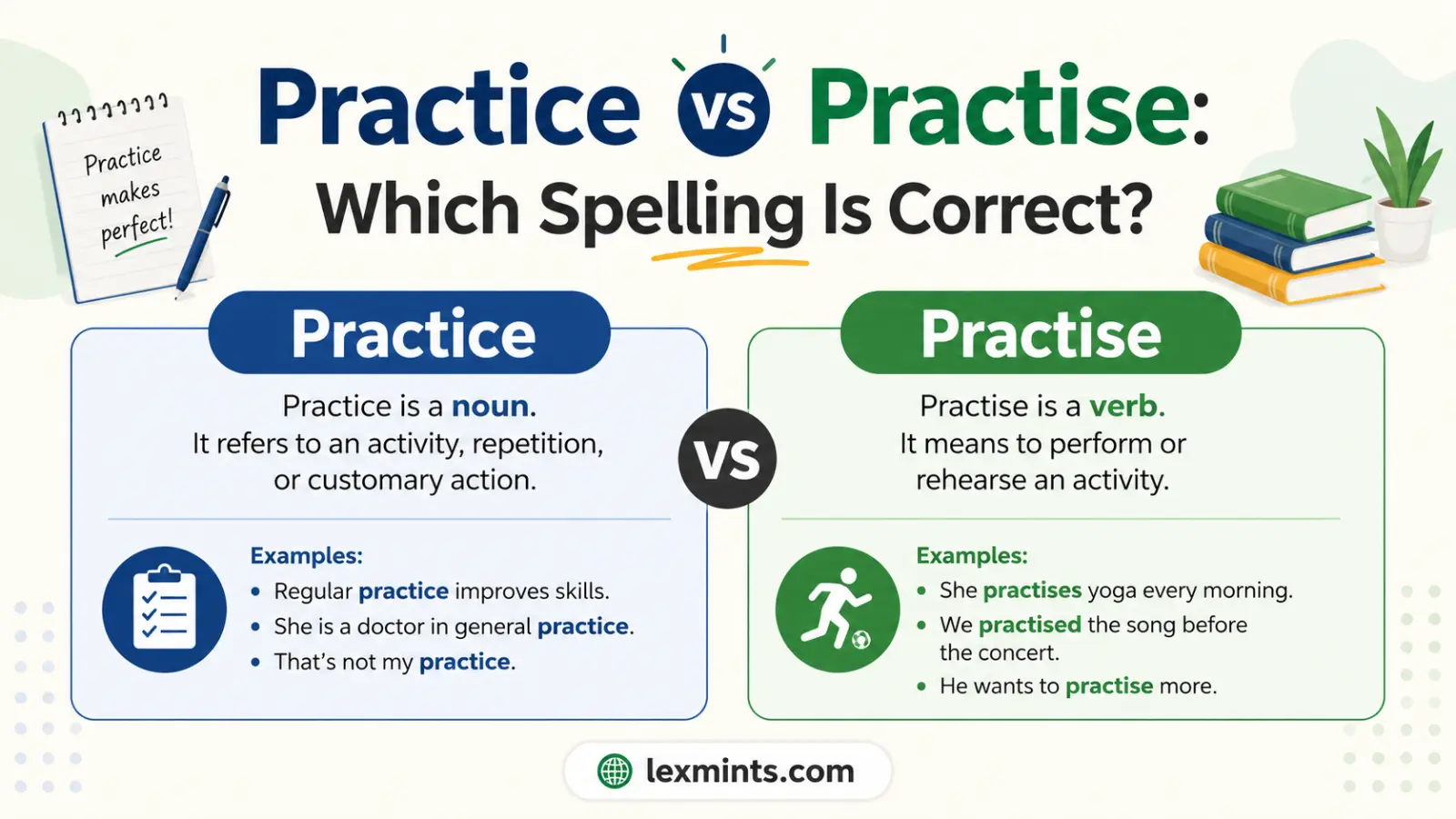
Practice vs practise is a common spelling question, especially because both words are correct in English—but they are not always used in the same way. The correct choice depends mainly on whether you are writing in American English or British English and, in British English, whether you need a noun or a verb.
If you write for a US audience, the answer is simple: practice is the correct spelling for both the noun and the verb. In British English, however, practice is usually the noun, while practise is usually the verb.
For example:
- American English: I need more practice before the test.
- American English: I practice the piano every day.
- British English: I need more practice before the test.
- British English: I practise the piano every day.
This guide explains the difference between practice vs practise, shows you how to use each spelling correctly, and gives you plenty of examples to avoid mistakes.
The Quick Answer: Practice or Practise?
Here is the easiest rule to remember:
In American English:
- Practice = noun
- Practice = verb
- Practise = generally not used
In British English:
- Practice = noun
- Practise = verb
Therefore, if your content is written for readers in the United States, practice is the correct spelling in nearly every standard situation.
Quick examples
US English:
- She goes to soccer practice after school.
- Doctors practice medicine.
- You should practice speaking English.
British English:
- She goes to soccer practice after school.
- Doctors practise medicine.
- You should practise speaking English.
The key difference is simple but important: American English uses “practice” for everything, while standard British English often separates the noun and verb forms.
What Does Practice Mean?
The word practice has several meanings. It can refer to repeated activity, a professional occupation, a regular custom, or the application of an idea.
As a noun, practice commonly means repeated training or exercise intended to improve a skill.
For example:
- Regular practice improves your writing.
- The team had football practice on Monday.
- Playing the guitar takes time and practice.
- Her pronunciation improved with daily practice.
- We need more practice before the presentation.
In all these examples, practice is a thing or activity. It is a noun.
The word can also refer to a professional business or occupation.
For example:
- She works at a dental practice.
- He joined a law practice.
- The doctor has a busy medical practice.
- Their accounting practice serves local businesses.
Here again, practice is a noun.
Another meaning involves a customary or usual way of doing something.
For example:
- It is common practice to check your work before submitting it.
- The company changed its hiring practices.
- Good safety practices can prevent accidents.
These uses also require practice or practices, regardless of whether you are writing in American or British English.
What Does Practise Mean?
Practise is primarily the British English spelling of the verb form of the word.
To practise means to perform an activity repeatedly to improve a skill. It can also mean to work in a particular profession or follow a belief, method, or activity.
Examples in British English include:
- I practise English every morning.
- She practises the violin after dinner.
- They practise for two hours every day.
- He practises medicine in London.
- The lawyer practises commercial law.
- You need to practise before the competition.
In American English, these sentences would use practice, not practise.
For example:
- I practice English every morning.
- She practices the violin after dinner.
- They practice for two hours every day.
- He practices medicine.
- The lawyer practices commercial law.
So, practise is not simply a misspelling. It is a correct spelling in British English when used as a verb.
Practice vs Practise in American English
For American English writers, practice vs practise is relatively easy.
The standard spelling is practice for both parts of speech.
Practice as a noun
- Basketball practice starts at 4 p.m.
- You need more practice.
- Daily practice builds confidence.
- The band has practice tonight.
- Good practice leads to improvement.
Practice as a verb
- I practice every day.
- She practices yoga in the morning.
- We should practice before the meeting.
- He practices the piano after school.
- They practice their presentation together.
The spelling remains practice in both cases.
This means American English does not generally follow the British noun-versus-verb distinction between practice and practise.
If you are writing an article, school assignment, business document, or website for a US audience, use practice.
Practice vs Practise in British English
British English generally makes a distinction between the two spellings.
Practice is the noun
Use practice when referring to a thing, activity, habit, business, or professional organization.
Examples:
- The players attended practice.
- Good practice requires patience.
- Her medical practice is growing.
- It is standard practice to save a backup copy.
- Regular practice helps you improve.
Practise is the verb
Use practise when describing the action of doing something repeatedly or working in a profession.
Examples:
- The players practise every afternoon.
- You should practise your pronunciation.
- She practises the piano daily.
- He practises law.
- They practise their skills before the event.
A useful question is: Is it an action or a thing?
If it is an action in British English, practise may be correct.
If it is a thing or concept, use practice.
Is Practice a Noun or a Verb?
In American English, practice can be both a noun and a verb.
Practice as a noun
A noun names a person, place, thing, idea, or activity.
In these sentences, practice is a noun:
- I need more practice.
- The team has practice today.
- Consistent practice improves performance.
- The doctor opened a private practice.
- Good study practices are important.
You can often identify the noun by looking at its role in the sentence.
For example:
We had practice after school.
Here, practice refers to an activity. It is a noun.
Practice as a verb
A verb describes an action.
In these sentences, practice is a verb:
- I practice every day.
- She practices before the concert.
- We practice speaking English.
- They practice together.
- He practices medicine.
These sentences describe what someone does. Therefore, practice functions as a verb.
For US writers, you do not need to change the spelling when the grammatical function changes.
How to Remember Practice vs Practise
There is a popular memory trick for British English.
Think about the letters C and S:
- Practice ends in C
- Practise ends in S
Some people connect the C in practice with the noun form and the S in practise with the verb form.
However, the safest method is to remember the actual grammar rule instead of relying entirely on a memory trick.
For a US audience, remember this:
American English uses “practice” as both a noun and a verb.
For British English, remember this:
Practice is usually the noun, and practise is usually the verb.
This simple distinction will solve most cases.
Practice vs Practise: Sentence Examples
Examples can make the difference much easier to understand.
American English examples
- I practice my English every day.
- She practices the guitar after work.
- We have basketball practice tonight.
- More practice will help you improve.
- The surgeon practices at a local hospital.
- The company follows good business practices.
- They practice for the competition every weekend.
- Piano practice requires concentration.
- He practices law in New York.
- Our teacher told us to practice more.
Every example above uses practice or one of its standard forms.
British English examples
- I practise my English every day.
- She practises the guitar after work.
- We have basketball practice tonight.
- More practice will help you improve.
- The surgeon practises at a local hospital.
- The company follows good business practices.
- They practise for the competition every weekend.
- Piano practice requires concentration.
- He practises law in London.
- Our teacher told us to practise more.
Notice the pattern. The noun stays practice, while the British verb becomes practise.
Practice vs Practise in Professional Writing
The correct spelling matters in professional communication because consistency helps make your writing look polished and reliable.
If your company, website, or audience uses American English, write:
- medical practice
- legal practice
- practice medicine
- practice law
- business practices
- practice regularly
If your publication follows British English, you may write:
- medical practice
- legal practice
- practise medicine
- practise law
- business practices
- practise regularly
The important point is to follow one language style consistently.
For example, an American website should not normally use practice in one sentence and practise in another unless there is a specific reason, such as quoting British text or referring to a title that uses British spelling.
Common Mistakes With Practice and Practise
One of the most common mistakes is assuming that practise is always wrong.
That is not true. Practise is a standard spelling in British English for the verb.
For example:
- Correct in British English: She practises every day.
- Correct in American English: She practices every day.
Another mistake is using practise as a noun.
For example:
- Incorrect: We need more practise.
- Correct: We need more practice.
This is because practice is the noun in both American and British English.
Another common error is mixing US and British spelling without following a consistent editorial style.
For example, a US-focused article should generally avoid switching between:
- color and colour
- organize and organise
- practice and practise
Choose the language style that matches your audience and use it consistently throughout the content.
Does Practicing Use C or S?
In American English, the present participle is:
practicing
For example:
- She is practicing for the exam.
- I am practicing my pronunciation.
- They are practicing every evening.
In British English, you will commonly see:
practising
For example:
- She is practising for the exam.
- I am practising my pronunciation.
- They are practising every evening.
This follows the same basic pattern:
- American English: practice → practicing
- British English: practise → practising
The noun remains practice.
Practice vs Practise: Other Word Forms
Understanding related forms can also help.
American English
The main forms include:
- practice
- practices
- practiced
- practicing
Examples:
- I practice every day.
- She practices daily.
- We practiced yesterday.
- They are practicing now.
British English
The verb forms generally include:
- practise
- practises
- practised
- practising
Examples:
- I practise every day.
- She practises daily.
- We practised yesterday.
- They are practising now.
The noun forms include:
- practice
- practices
For example:
- Regular practice is important.
- Good working practices matter.
This distinction is particularly useful when editing British English content.
Practice vs Practise in Education
Students frequently encounter this spelling question when writing essays, assignments, and academic content.
If your school or publication follows American English, use practice for both meanings.
For example:
- Students should practice before the exam.
- Students need more practice before the exam.
The first sentence uses the verb because students are performing an action.
The second sentence uses the noun because practice is the thing they need.
In American English, the spelling remains the same.
If you follow British English:
- Students should practise before the exam.
- Students need more practice before the exam.
This clearly demonstrates the noun-versus-verb distinction.
Practice vs Practise in Sports and Music
Sports and music provide some of the most common examples.
Sports
American English:
- The team has soccer practice tonight.
- The players practice every morning.
British English:
- The team has football practice tonight.
- The players practise every morning.
Music
American English:
- Piano practice takes discipline.
- She practices the piano for an hour.
British English:
- Piano practice takes discipline.
- She practises the piano for an hour.
The pattern remains exactly the same.
If the word names the training activity, use practice.
If British English uses the word as an action, use practise.
Practice vs Practise in Medicine and Law
The difference also appears when discussing professions.
Medicine
American English:
- She practices medicine.
- Her medical practice is successful.
British English:
- She practises medicine.
- Her medical practice is successful.
Law
American English:
- He practices law.
- He joined a law practice.
British English:
- He practises law.
- He joined a law practice.
These examples are especially useful because they show both forms close together.
In British English, the action of working professionally is practise, while the professional business or organization is a practice.
Which Spelling Should You Use?
The answer depends on your audience.
Use “practice” if:
- You are writing in American English.
- Your audience is mainly in the United States.
- Your website follows US spelling conventions.
- You need the noun form in either American or British English.
- You are referring to a business, habit, custom, or training activity.
Examples:
- I need more practice.
- We practice every day.
- She has a medical practice.
- Good safety practices are important.
Use “practise” if:
- You are writing in British English.
- You need the standard British verb form.
- You are describing the action of repeatedly doing something.
- You are describing someone working in a profession.
Examples:
- I practise every day.
- She practises the violin.
- They practise before the match.
- He practises medicine.
For most US-focused content, practice is the correct choice.
Practice vs Practise: Final Comparison
Here is the main difference in one simple comparison.
| Usage | American English | British English |
|---|---|---|
| Noun | practice | practice |
| Verb | practice | practise |
| Third-person verb | practices | practises |
| Past tense | practiced | practised |
| -ing form | practicing | practising |
This table makes the rule easy to remember.
American English keeps the spelling practice for the noun and verb.
British English generally uses practice for the noun and practise for the verb.
FAQs
1. Which is correct, practice or practise?
Both practice and practise can be correct, depending on the type of English. In American English, practice is used for both the noun and verb. In British English, practice is generally the noun, while practise is the verb.
2. Is “practise” correct in American English?
Practise is generally not the standard spelling in American English. American English uses practice for both the noun and verb. For example, “I practice English every day” is the standard US-English form.
3. What is the difference between practice and practise?
The main difference is based on English variety and grammatical use. In British English, practice is a noun, while practise is a verb. American English uses practice for both. For example, “I need more practice” and “I practice every day.”
4. How do you spell practicing in American English?
The standard American English spelling is practicing, with a c. For example: “She is practicing the piano every day.” British English commonly uses practising, with an s.
5. Should I use practice or practise for a US audience?
If you are writing for a US audience, use practice for both the noun and verb. For example, “The team has practice today” and “The players practice every afternoon.” Practise is generally associated with British English.
Conclusion
When comparing practice vs practise, neither spelling is automatically wrong. The correct spelling depends on the English variety and the grammatical role of the word.
If you are writing in American English, use practice for both the noun and the verb.
- I need more practice.
- I practice every day.
If you are writing in British English, use practice as a noun and practise as a verb.
- I need more practice.
- I practise every day.
So, for a US-focused website or American audience, practice is the spelling you will normally want.
The easiest rule to remember is this: American English uses “practice” for both the noun and verb, while British English usually uses “practice” for the noun and “practise” for the verb. Once you understand that distinction, choosing between practice vs practise becomes much easier.


