
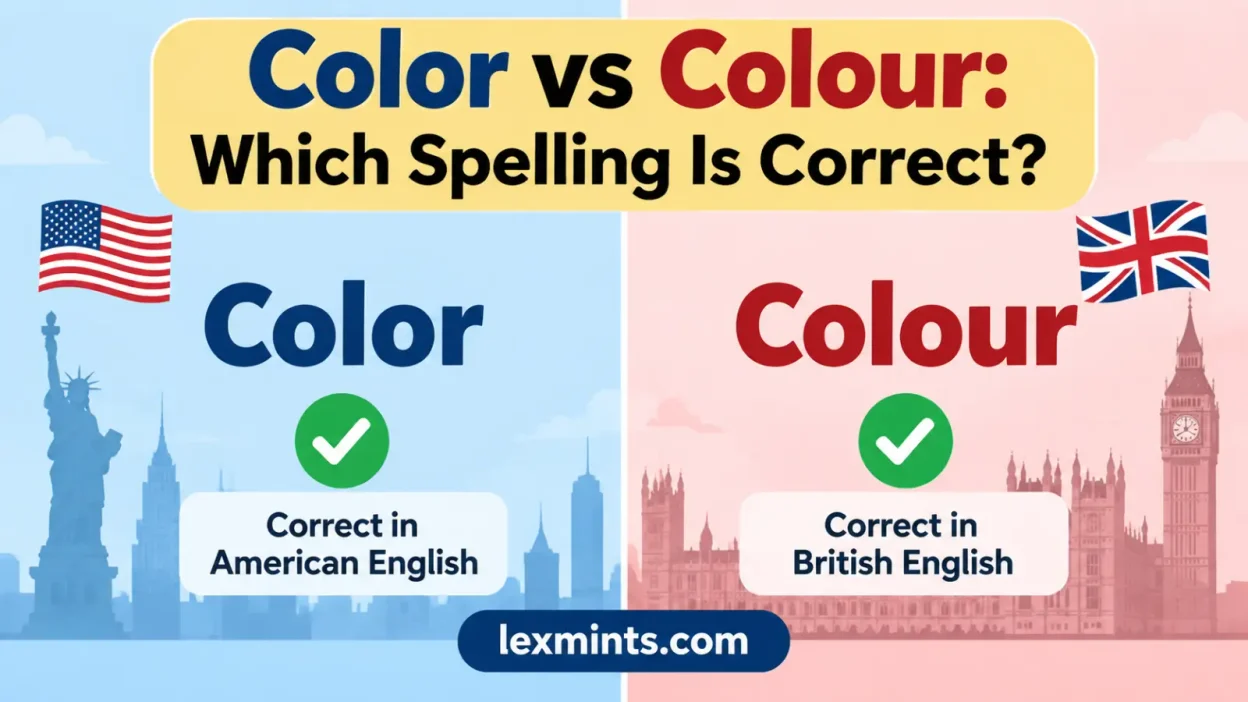
Color and colour have the same meaning and pronunciation, but they follow different English spelling conventions. The main difference is geographical: color is the standard spelling in American English, while colour is the standard spelling in British English and is also widely used in other varieties of English influenced by British spelling.
So, which one is correct?
Both “color” and “colour” are correct spellings. The right choice depends mainly on the variety of English you are writing in.
If you are writing for a US audience, use color. If you are following British English, use colour.
For example:
- American English: The color of the wall is beautiful.
- British English: The colour of the wall is beautiful.
The meaning does not change. Only the spelling differs.
Color vs Colour: Quick Answer
Color is the preferred spelling in American English.
Colour is the preferred spelling in British English.
Both words refer to the visual characteristic produced when light interacts with an object and is perceived by the eyes. They can also be used figuratively to describe personality, emotion, character, variety, or interest.
Here is the simplest rule to remember:
Color = American English
Colour = British English
If your website, school, business, or publication follows American English, choose color consistently. If it follows British English, choose colour consistently.
What Does Color Mean?
Color is the American English spelling of the word. It can refer to the appearance of an object based on the way it reflects or emits light.
For example:
- The color of the sky changed at sunset.
- My favorite color is blue.
- She bought a dress in a bright color.
- The artist used several colors in the painting.
The word can also have abstract meanings.
For example:
- The story gives color to the character.
- His experiences added color to his writing.
- The festival brought color to the city.
In American English, color is the standard spelling in everyday writing, education, business, journalism, websites, and professional communication.
What Does Colour Mean?
Colour is the British English spelling of the same word.
It has exactly the same basic meaning as color. The additional u is simply part of the British spelling convention.
Examples include:
- The colour of the sky changed at sunset.
- My favorite colour is blue.
- She bought a dress in a bright colour.
- The artist used several colours in the painting.
British English also uses colour in figurative expressions:
- The story adds colour to the character.
- His experiences brought colour to his writing.
- The festival filled the streets with colour.
There is no difference in meaning between the two spellings.
Color vs Colour: What Is the Difference?
The primary difference is English variety, not meaning.
| Word | Main English Variety | Meaning |
|---|---|---|
| Color | American English | Visual appearance or hue; also various figurative meanings |
| Colour | British English | Same meaning as color |
The spelling difference comes from different historical and linguistic conventions.
American English commonly uses shorter spellings in several words that traditionally contain -our in British English.
For example:
- color → colour
- honor → honour
- favor → favour
- behavior → behaviour
- labor → labour
American English generally uses the forms without the u, while British English generally retains it.
Is Color or Colour Correct?
Both are correct.
The important question is which English standard you are following.
If you are writing American English:
Color is correct.
If you are writing British English:
Colour is correct.
Using colour in an American-English article does not necessarily mean the word is misspelled in English generally. It simply follows a different regional spelling convention.
Likewise, color is not an incorrect form of the word in English. It is the standard American spelling.
Color in American English
American English uses color without the letter u.
This spelling is common throughout the United States.
Examples:
- What color is your car?
- The school painted the walls a different color.
- Red is a popular color for sports cars.
- The sunset had an amazing color.
- She chose her favorite colors for the design.
American dictionaries, educational materials, newspapers, websites, and businesses generally use color when following US spelling conventions.
For writers targeting American readers, color is therefore the safest and most natural choice.
Colour in British English
British English generally uses colour with the letter u.
Examples:
- What colour is your car?
- The school painted the walls a different colour.
- Red is a popular colour for sports cars.
- The sunset had an amazing colour.
- She chose her favorite colours for the design.
The British spelling is also commonly encountered in other English-speaking regions that traditionally follow British spelling conventions.
The important point is consistency. If your content follows British English, use colour rather than switching between color and colour.
Why Does American English Use Color?
The difference between color and colour is connected to the history of English spelling.
The -our spelling became established in British English in words such as colour, honour, and favour. American English later developed its own spelling preferences, and forms without the u became standard in many common words.
The American spelling is therefore not a shortened pronunciation or a different word. It is simply a different spelling convention.
This is why Americans write:
- color
- honor
- favor
- behavior
- labor
while British English commonly uses:
- colour
- honour
- favour
- behaviour
- labour
The same general spelling pattern can be seen across many related words.
Do Color and Colour Have the Same Pronunciation?
Yes. In standard usage, color and colour are pronounced the same way.
The spelling changes, but the pronunciation does not normally change because of the additional u.
For example:
color → /ˈkʌlər/
colour → /ˈkʌlə/
The exact phonetic realization can vary by accent, but the two spellings represent the same word and are generally pronounced alike.
This makes color vs colour a spelling difference rather than a pronunciation difference.
Color vs Colour in Plural Form
The plural forms follow the same spelling distinction.
American English:
color → colors
British English:
colour → colours
Examples:
- The artist used several colors.
- The artist used several colours.
Both sentences have the same meaning.
Other forms follow the same regional pattern. For example:
- colorful → colourful
- coloration → colouration
However, not every related word necessarily follows a simple one-to-one spelling change, so writers should avoid assuming that every word containing “color” automatically changes to “colour” in every context.
Colorful vs Colourful
A common related spelling difference is colorful vs colourful.
In American English, the standard spelling is:
colorful
Example:
The garden looked colorful in spring.
In British English, the standard spelling is:
colourful
Example:
The garden looked colourful in spring.
Again, the meaning and pronunciation are essentially the same. The difference is the spelling convention being followed.
For an American-English website, use colorful. For British English, use colourful.
Examples of Color in American English
Here are several natural examples using color:
Example 1
Blue is my favorite color.
Example 2
The designer selected a warm color for the room.
Example 3
What color would you like for the background?
Example 4
The leaves change color during autumn.
Example 5
The painting contains many bright colors.
Example 6
The company uses a consistent color scheme across its website.
Example 7
Her dress was a beautiful shade of green color.
The last example is less natural because English normally says a beautiful shade of green rather than “a beautiful green color.” More natural wording would be:
Her dress was a beautiful shade of green.
This illustrates an important point: choosing the correct spelling is only one part of writing naturally.
Examples of Colour in British English
Here are equivalent examples using the British spelling:
Example 1
Blue is my favorite colour.
Example 2
The designer selected a warm colour for the room.
Example 3
What colour would you like for the background?
Example 4
The leaves change colour during autumn.
Example 5
The painting contains many bright colours.
Example 6
The company uses a consistent colour scheme across its website.
These sentences communicate the same ideas as their American-English counterparts.
Color vs Colour in Formal Writing
Both spellings are acceptable in formal writing when they match the chosen variety of English.
For example, an American university paper should normally use color if the institution follows US English.
A British publication should normally use colour.
The bigger issue is consistency.
Consider this sentence:
The color of the building was different from the colour of the roof.
The sentence is not grammatically wrong, but switching between spelling systems can make the writing look inconsistent.
If you are writing American English, write:
The color of the building was different from the color of the roof.
If you are writing British English, write:
The colour of the building was different from the colour of the roof.
Consistency makes professional writing cleaner and easier to trust.
Color vs Colour for Websites and SEO
For websites, the best spelling usually depends on the audience you want to reach.
If your primary audience is in the United States, color is generally the better choice.
If your audience primarily uses British English, colour may be more appropriate.
This matters particularly when the spelling is part of a target keyword.
For example, a US-focused article might target:
color vs colour
while a British-English publication might naturally use:
colour vs color
Search engines can generally understand that the two forms are related, but writers should still create content that matches their intended audience and keyword strategy.
If your website consistently uses US English, maintaining color throughout your articles helps establish a clear editorial style.
Common Mistakes With Color and Colour
One of the most common mistakes is assuming that one spelling is universally correct.
Mistake 1: Calling Colour an American spelling
In standard American English, color is the normal spelling.
Mistake 2: Calling Color incorrect
Color is not an incorrect English word. It is the standard American spelling.
Mistake 3: Mixing spelling systems
Using color in one paragraph and colour in another can make an article look inconsistent.
Mistake 4: Changing the spelling based on pronunciation
The pronunciation is essentially the same, so pronunciation does not determine which spelling to use.
Mistake 5: Assuming the meaning is different
There is no basic meaning difference between color and colour.
Is Color American or British?
Color is primarily the American English spelling.
For example:
What color is the new car?
This spelling is standard in the United States.
Colour is primarily the British English spelling.
For example:
What colour is the new car?
Both sentences mean exactly the same thing.
Is Colour American or British?
Colour is primarily the British English spelling.
It is also used in several other English varieties that follow British spelling conventions.
For American English, use color.
For British English, use colour.
Color vs Colour in Different Countries
English spelling varies around the world.
The United States generally uses color, while the United Kingdom generally uses colour.
Other English-speaking countries may follow British, American, or their own established conventions depending on the context.
For example, you may encounter colour in British-oriented educational or governmental materials outside the United Kingdom.
This is why it is better to think of the two forms as regional spelling variants, rather than labeling one as right and the other as wrong.
How to Remember the Difference
A simple memory trick can help:
US English = COLOR
British English = COLOUR
You can also remember that British English often keeps the u in words ending in -our.
For example:
- colour
- honour
- favour
- labour
American English commonly removes that u:
- color
- honor
- favor
- labor
This pattern makes the difference easier to remember.
Color vs Colour: Which One Should You Use?
Choose the spelling that matches your audience.
Use “color” when:
- You are writing for Americans.
- Your website follows US English.
- You are targeting US readers.
- Your organization uses American spelling.
- Your style guide requires American English.
Use “colour” when:
- You are writing for a British audience.
- Your publication follows British English.
- Your organization uses British spelling.
- Your style guide requires British English.
Neither spelling is inherently better. The correct choice depends on the English variety and editorial style.
FAQs
1. Is color or colour correct?
Both color and colour are correct. Color is the standard American English spelling, while colour is the standard British English spelling.
2. Is color American or British English?
Color is the standard spelling in American English. British English generally uses colour.
3. Is colour American or British English?
Colour is primarily the British English spelling. American English normally uses color.
4. Do color and colour mean the same thing?
Yes. Color and colour have the same meaning. The difference is spelling rather than meaning.
5. Are color and colour pronounced differently?
No. They are generally pronounced the same way. The additional u in colour does not normally change the pronunciation.
6. Should I use color or colour on a US website?
If your website is written for a US audience and follows American English, color is the preferred spelling.
7. Is “colour” a misspelling of “color”?
No. Colour is the standard British English spelling. It is not a general misspelling; it belongs to a different English spelling convention.
8. Is “color” a misspelling in British English?
No. Color is the standard American form. However, British English normally prefers colour.
9. What is the plural of color?
In American English, the plural is colors.
In British English, the plural of colour is colours.
10. Which spelling should I use in an American English article?
Use color. If your article is intended for a US audience, color is the natural standard spelling.
Conclusion
So, color vs colour—which spelling is correct?
The answer is both.
Color is the standard American English spelling.
Colour is the standard British English spelling.
They have the same meaning and are generally pronounced the same way. The difference is a regional spelling convention, especially associated with American and British English.
If you are writing for a US audience, use color. If you are writing for a British audience, use colour.
The most important rule is to choose one spelling system and remain consistent throughout your content.
For US-focused writing, the final answer is simple:
Color is the correct American English spelling.
For British English:
Colour is the correct British English spelling.
Once you remember color = American English and colour = British English, the distinction becomes easy.


