
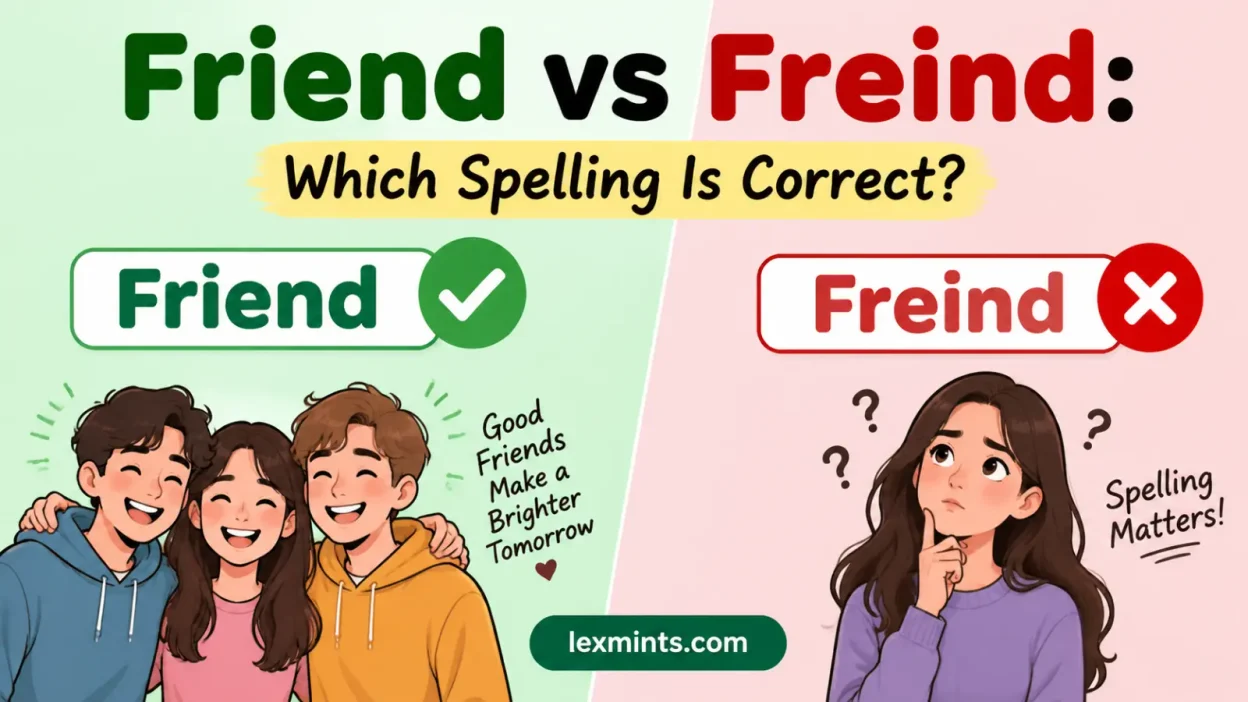
If you are confused about friend vs freind, you are not alone. These two spellings look very similar, but only one is correct in standard English. The correct spelling is friend.
Freind is a common misspelling of friend. It often happens because the letters i and e appear in an order that can be easy to reverse when writing or typing the word.
In this guide, we will explain the difference between friend vs freind, show you the correct spelling, explain the meaning of friend, provide easy examples, and share useful ways to remember the correct letter order.
Friend vs Freind: Which One Is Correct?
The correct spelling is friend.
- Friend ✅ — Correct
- Freind ❌ — Incorrect
The word friend is a standard English noun that refers to a person you know and like, usually someone with whom you have a relationship based on affection, trust, or mutual support.
Freind is not the standard spelling of the word. If you see it in an email, text message, social media post, school assignment, or other writing, it is generally a spelling mistake.
Correct:
Sarah is my best friend.
Incorrect:
Sarah is my best freind.
The only change is the position of i and e, but that small difference makes one spelling correct and the other incorrect.
What Does “Friend” Mean?
Friend is primarily used as a noun. It describes someone you know and have a relationship with based on mutual affection, trust, respect, or companionship.
For example:
- Jake is my oldest friend.
- I met a new friend at school.
- She invited all her friends to dinner.
- My best friend lives nearby.
- He has been a close friend for many years.
The word can describe different levels of relationships. Someone can be a close friend, best friend, childhood friend, family friend, school friend, or simply a friend.
The word can also be used as a verb in some contexts, particularly in informal or technological language. For example:
I friended him on social media.
However, the noun friend is by far the most familiar and common use.
Why Is “Freind” Incorrect?
Freind is incorrect because the standard spelling places the i before the e in this particular word:
f-r-i-e-n-d
A common mistake is to reverse these two vowels and write:
f-r-e-i-n-d
That creates freind, which is a misspelling.
The confusion is understandable because English contains many words where ei and ie appear in different patterns. Writers and students may remember the general “i before e” rule incorrectly or simply type the letters in the wrong order.
For friend, however, the spelling to remember is straightforward:
FRIEND
Friend vs Freind: Letter-by-Letter Difference
One of the easiest ways to understand the difference between friend vs freind is to compare their letters.
Friend
F – R – I – E – N – D
Freind
F – R – E – I – N – D
The first two letters, fr, are the same. The final three letters, end, are also the same.
The problem occurs in the middle:
- Correct: ie
- Incorrect: ei
So, if you are unsure while writing, focus on the middle of the word.
Remember:
FR + IE + ND = FRIEND
Not:
FR + EI + ND = FREIND
This simple visual pattern can help prevent the mistake.
Is “Freind” a Word?
No. Freind is not the standard English spelling of the word.
When someone writes freind, they normally intend to write friend. The incorrect spelling may appear in casual typing, social media posts, messages, comments, or other informal writing, but it should not be used in polished English.
For professional, academic, business, and formal writing, always use friend.
Example
Incorrect:
My freind helped me finish the project.
Correct:
My friend helped me finish the project.
The second sentence uses the standard spelling.
Common Reasons People Spell “Friend” as “Freind”
There are several reasons people make the friend vs freind mistake.
1. Reversing “ie”
The most common reason is simply reversing the letters i and e.
Because both letters are vowels and appear next to each other, they can be easy to mix up while typing quickly.
2. English Spelling Patterns
English has many spelling patterns, and they do not always behave consistently. Words containing ie and ei can cause confusion.
A writer may remember the wrong sequence and accidentally produce freind.
3. Fast Typing
When people type quickly, they may know the correct spelling but still make a transposition error.
For example:
freind
may simply be a typing mistake rather than a lack of knowledge.
4. Visual Similarity
The words friend and freind look almost identical. Because only two letters change places, the error can easily go unnoticed during proofreading.
5. Memory
Some people learn the pronunciation of a word before learning its written form. Since the vowel sequence is not always obvious from pronunciation, remembering the exact spelling can take practice.
How to Remember the Correct Spelling of Friend
If you frequently confuse friend vs freind, try using a simple memory technique.
Remember “FRIEND”
Break the word into parts:
FRI + END
You can think of it as:
FRIEND = FRI + END
The correct spelling begins with fri, not fre.
Another useful visual reminder is:
FRIEND has “IE” in the middle.
Write it several times:
friend
friend
friend
The more familiar the correct letter pattern becomes, the less likely you are to write freind.
A Simple Memory Trick
A useful trick is to remember:
A friend is someone who is “I” and “E” together in the right order.
The important part is:
FR-I-E-N-D
You can also focus on the first three letters:
FRI
If you remember FRI, the rest of the word becomes easier:
FRI + END = FRIEND
This is especially useful for students and anyone who frequently makes spelling mistakes when typing.
Examples of “Friend” in Sentences
Here are several examples showing how friend is correctly used.
- My best friend lives in California.
- I met an old friend at the store.
- She is a close friend of my family.
- He invited his friends to the party.
- My childhood friend moved to another city.
- We have been friends for many years.
- She became a good friend after we started working together.
- I called my friend after school.
- A true friend will support you during difficult times.
- He introduced me to one of his friends.
In every example, the correct spelling is friend.
Friend as a Singular Noun
When you are talking about one person, use the singular form friend.
Examples:
Maria is my friend.
He is a good friend.
I invited my friend to lunch.
The singular form refers to one person.
Friends as a Plural Noun
When referring to more than one person, add s to form friends.
Examples:
My friends are coming over tonight.
She has many friends at school.
We invited our friends to the wedding.
The spelling remains based on the same correct form:
friend → friends
Not:
freind → freinds
The incorrect spelling simply carries the same letter-order mistake into the plural form.
Friend as a Subject
The word friend can function as the subject of a sentence.
For example:
My friend called me yesterday.
Here, friend is the subject because the friend is performing the action of calling.
Another example:
My friend enjoys playing basketball.
Again, friend is the subject.
Friend as an Object
The word friend can also be used as an object.
For example:
I called my friend.
In this sentence, I is the subject, while my friend receives the action.
Another example:
She invited her friend to dinner.
Here, her friend is the object of the verb invited.
Common Phrases With “Friend”
The word friend appears in many common English expressions and phrases.
Some examples include:
- best friend
- close friend
- good friend
- old friend
- childhood friend
- family friend
- school friend
- true friend
- lifelong friend
- dear friend
- trusted friend
- mutual friend
- new friend
Examples:
She is my best friend.
We met through a mutual friend.
He is an old friend from college.
Their family has been a good friend to us.
In each phrase, the correct spelling is friend.
Friend vs Friends
It is also important to distinguish friend from friends.
Friend is singular:
I have one close friend.
Friends is plural:
I have several close friends.
The plural is formed by adding s.
Singular
friend
Plural
friends
Neither form should be spelled with ei in the middle.
Incorrect:
freind
freinds
Correct:
friend
friends
Friend vs Freind in Formal Writing
In formal writing, spelling accuracy matters. If you are writing an essay, report, application, email, article, or professional message, use friend.
For example:
Incorrect:
My freind recommended this book to me.
Correct:
My friend recommended this book to me.
The incorrect version can make your writing appear less polished, even though the intended meaning is obvious.
A spelling checker may catch freind, but it is still useful to recognize the mistake yourself.
Friend vs Freind in Text Messages and Social Media
People often make spelling mistakes in text messages and social media because they type quickly or rely on autocorrect.
You may occasionally see:
Thanks, freind!
The intended word is almost certainly friend.
Although casual communication often contains spelling errors, using the correct spelling is still preferable:
Thanks, friend!
For public posts, professional profiles, business communication, and other visible content, correct spelling is especially important.
Is “Freind” Ever Correct?
No. In standard modern English, freind is not the accepted spelling of the common word meaning a companion or person you know and like.
If you intend to refer to a companion, the correct word is:
friend
So when choosing between friend vs freind, there is no context in standard English where freind becomes the correct spelling of friend.
Friend vs Freind Pronunciation
Both spellings are generally intended to represent the same word when someone writes freind, but the standard pronunciation belongs to the correctly spelled word friend.
The spelling friend is pronounced approximately like “frend.”
The vowel letters ie do not produce a pronunciation that sounds exactly like each individual vowel. This is one reason spelling the word can sometimes be confusing.
However, pronunciation does not change the standard spelling.
Always write:
friend
How to Avoid the Friend vs Freind Mistake
If you regularly type freind, several simple habits can help.
Slow Down When Typing
If you know you frequently reverse i and e, take a moment to check the middle of the word.
Memorize “FRI”
Remember:
FRI + END = FRIEND
This is one of the easiest ways to retain the correct spelling.
Read Your Writing Again
Proofreading can help you catch small letter-order mistakes that you might miss while composing a sentence.
Use Spell-Check
Modern word processors and browsers can identify many common spelling errors. However, learning the correct spelling yourself is still valuable.
Practice the Word
Writing the word several times can reinforce the correct sequence:
friend
friend
friend
Quick Comparison: Friend vs Freind
| Spelling | Correct? | Meaning |
|---|---|---|
| friend | ✅ Yes | A person you know and like or trust |
| freind | ❌ No | Common misspelling of “friend” |
The difference is only the order of i and e, but friend is the correct standard spelling.
Friend vs Freind: Quick Answer
If you are searching for friend vs freind, the answer is simple:
Friend is correct. Freind is incorrect.
Use friend when referring to a person with whom you have a relationship of affection, trust, companionship, or mutual support.
Correct:
He is my best friend.
Incorrect:
He is my best freind.
Remember the spelling:
F-R-I-E-N-D
A helpful way to memorize it is:
FRI + END = FRIEND
FAQs
Is “friend” or “freind” correct?
Friend is correct. Freind is a common misspelling and should not be used in standard English.
How do you spell friend correctly?
The correct spelling is friend: F-R-I-E-N-D.
Why do people spell friend as freind?
People often reverse the i and e because the two vowels appear next to each other. Fast typing, unfamiliarity with the spelling, and confusion about English spelling patterns can also contribute to the mistake.
Is freind a real English word?
Freind is not the standard spelling of the English word friend. It is generally considered a misspelling.
What is the plural of friend?
The plural of friend is friends.
Example:
I invited my friends to dinner.
What is an easy way to remember friend?
Remember FRI + END = FRIEND. Focus on the ie sequence in the middle and remember that the word begins with fri, not fre.
Can “friend” be used as a verb?
Yes. In informal modern English, especially in social-media contexts, friend can be used as a verb. For example, someone might say, “I friended her online.” The noun friend, however, is the traditional and much more common use.
Conclusion
When comparing friend vs freind, there is only one correct spelling in standard English: friend.
Friend is the correct word for a person you know, like, trust, or have a relationship with. Freind is a common spelling mistake caused mainly by reversing the i and e.
The easiest way to remember the correct spelling is:
FRI + END = FRIEND
So, whenever you are unsure, choose friend, not freind.
Correct: Friend ✅
Incorrect: Freind ❌


