
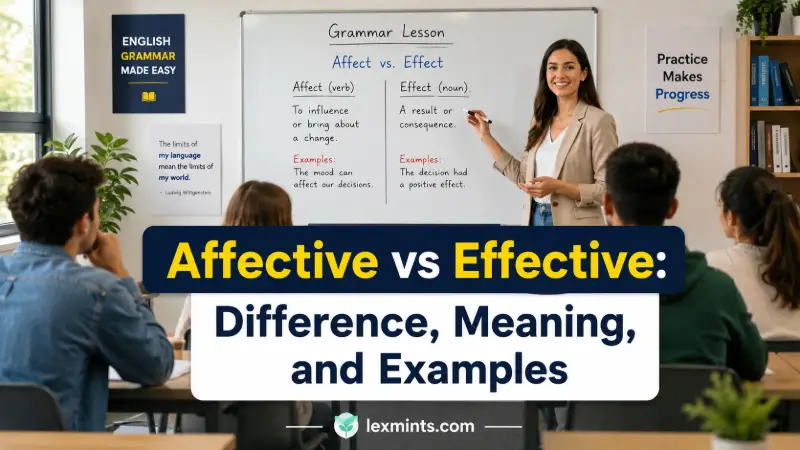
Affective and effective look similar and can sound nearly alike, but they do not mean the same thing. Both are standard English words, and both most often work as adjectives. The right choice depends on what you are describing.
Use affective for something connected with feelings, emotions, mood, or emotional expression. Use effective for something that produces a wanted result or, in some contexts, becomes officially active. Once you focus on emotion versus results, the difference becomes much easier to remember.
Quick Answer
Affective means related to feelings or emotions. Effective usually means successful in producing the intended result.
- Affective: connected with emotion — The study measured affective responses.
- Effective: producing results — The new study method was effective.
Effective can also mean “in operation,” as in The new rule is effective Monday.
Why People Confuse Them
The words differ by only one letter at the beginning, and their stressed syllable sounds the same. They are also connected in readers’ minds with the often-confused words affect and effect.
That similarity can lead people to choose by spelling rather than meaning. A better approach is to ask what the sentence describes: an emotional quality or a result.
Key Differences At A Glance
- Affective: emotion, feeling, mood, or emotional expression
- Effective: success, results, practical performance, or being in operation
- Affective: more common in psychology, education, research, and other emotion-focused contexts
- Effective: common in everyday, workplace, academic, legal, and professional writing
- Both: usually adjectives in ordinary modern use
Meaning and Usage Difference
Affective describes something related to, produced by, influencing, or expressing emotion. Phrases such as affective response, affective experience, and affective language all point toward feelings or emotional states.
Effective most often describes something that works as intended. An effective plan achieves its goal; an effective treatment produces the desired result. Effective also has an “in operation” sense: a policy can be effective on a certain date.
Pronunciation can add to the confusion. Affective is commonly heard as a-FEK-tiv, while effective is commonly ih-FEK-tiv. First-vowel pronunciations can vary, so meaning is a safer guide than sound.
Tone, Context, and Formality
Affective often sounds more technical or academic because it appears frequently in psychology, education, behavioral research, and writing about emotion. However, it is not limited to psychology. It can describe emotional qualities in language, art, relationships, or other contexts.
Effective is neutral and widely used. It fits casual, professional, academic, medical, legal, and business contexts. Its meaning changes slightly with context, but the central idea is usually successful results or active operation.
Which One Should You Use?
Use the meaning of your sentence as the test.
| Context | Best Choice | Why |
|---|---|---|
| A response involving emotion | affective | It concerns feelings or emotional expression. |
| A method that works | effective | It produces the intended result. |
| A policy starting on a date | effective | It means the policy is in operation. |
| Research on mood | affective | It concerns emotional states. |
| A successful presentation | effective | It accomplished its purpose. |
If you can naturally replace the word with emotional, affective may fit. If you can replace it with successful, working, or in effect, effective is more likely.
When One Choice Sounds Wrong
“The medication was affective” usually sounds wrong if you mean the medication worked. In that case, use effective.
“The researchers measured effective responses to sad images” also changes the intended meaning. If the researchers measured emotional responses, affective responses is the accurate phrase.
Context matters because both words are real. The error comes from choosing the wrong meaning, not from using a misspelling.
Common Mistakes (and Quick Fixes)
A common mistake is treating affective as a formal-looking version of effective. It is not. Affective specifically points toward emotion.
Another mistake is assuming affective means “having an effect.” In modern standard use, that idea is normally expressed with effective when the focus is successful performance.
A third mistake is thinking affective belongs only in medical writing. Its use is broader than that, as long as the subject involves feelings, mood, or emotional expression.
Quick fix: ask, “Am I talking about emotion or results?” Emotion points to affective; results usually point to effective.
Everyday Examples
- The counselor noted the student’s affective response to the discussion.
- The new reminder system has been surprisingly effective.
- Researchers examined the affective impact of the images.
- A short meeting can be more effective than a long one.
- The contract becomes effective on September 1.
- The course includes both cognitive and affective learning goals.
- Her effective explanation cleared up the confusion.
- The novel creates a strong affective connection with its characters.
Dictionary-Style Word Details
Verb
- Affective: Not commonly used as a verb in standard US English. Its normal role is adjective.
- Effective: Not commonly used as a verb in standard US English. Its normal role is adjective, with a rare noun use.
Noun
- Affective: Not normally used as a noun.
- Effective: A rare noun use exists for a person who is ready and able to serve, especially in military contexts. Most readers will encounter effective as an adjective.
Synonyms
- Affective: Closest plain alternatives include emotional and, in some contexts, emotive. These are not perfect replacements in every technical use.
- Effective: Depending on context, close alternatives include successful, effectual, operative, and efficacious. Ineffective is a clear antonym when effective means producing the desired result.
Example Sentences
- Affective: The researchers recorded changes in participants’ affective reactions.
- Effective: The revised schedule proved effective at reducing delays.
- Affective: The story has a strong affective dimension.
- Effective: The new policy becomes effective next month.
Word History
- Affective: English received the word through Middle French from Late Latin affectivus. Its recorded English use goes back to the 15th century.
- Effective: The word came through Middle English from Late Latin effectivus, a form associated with producing a result. Its recorded adjective use goes back to the 14th century.
Phrases Containing
- Affective: affective response, affective behavior, affective language, affective domain, affective symptoms, seasonal affective disorder
- Effective: effective immediately, effective date, effective method, effective communication, effective treatment, effective strategy
FAQs
Is affective or effective correct?
Both are correct, but they describe different things. Use affective when you mean related to feelings, moods, or emotional responses. Use effective when something works, achieves an intended result, or officially comes into operation, as in “effective immediately.”
Are affective and effective interchangeable?
No, they are not interchangeable in standard usage. Calling a treatment affective would suggest an emotional connection rather than successful performance. Calling an emotional response effective would shift the meaning toward results or practical success instead of emotion.
Is affective only used in psychology?
No. Affective appears often in psychology and related research, but it can describe emotion-related language, responses, experiences, or qualities in other fields too. The key is emotional meaning, not the profession or subject area where the word appears.
Can effective mean something is officially active?
Yes. Effective can mean “in effect” or “operative,” especially with rules, policies, contracts, and dates. For example, “The policy is effective Monday” means the policy begins operating Monday, not necessarily that it has already produced successful results.
Why do affective and effective sound so similar?
They share the stressed “FEK” sound and differ mainly in the first unstressed vowel, which can be reduced in normal speech. That makes sound alone unreliable. Meaning is the safer guide: affective connects to emotion; effective connects to results or operation.
What is the easiest way to remember affective vs effective?
Connect affective with affect as a noun related to emotion, and connect effective with effect as a result. Then check your sentence: if it concerns feelings, choose affective; if it concerns success, results, or operation, choose effective.
Conclusion
The difference between affective and effective is mainly a difference in meaning. Affective points to feelings, mood, or emotional expression. Effective usually points to successful results and can also mean officially in operation.
When you are unsure, identify the idea your sentence needs. If the focus is emotion, choose affective. If the focus is whether something works, succeeds, or takes effect, choose effective.


