
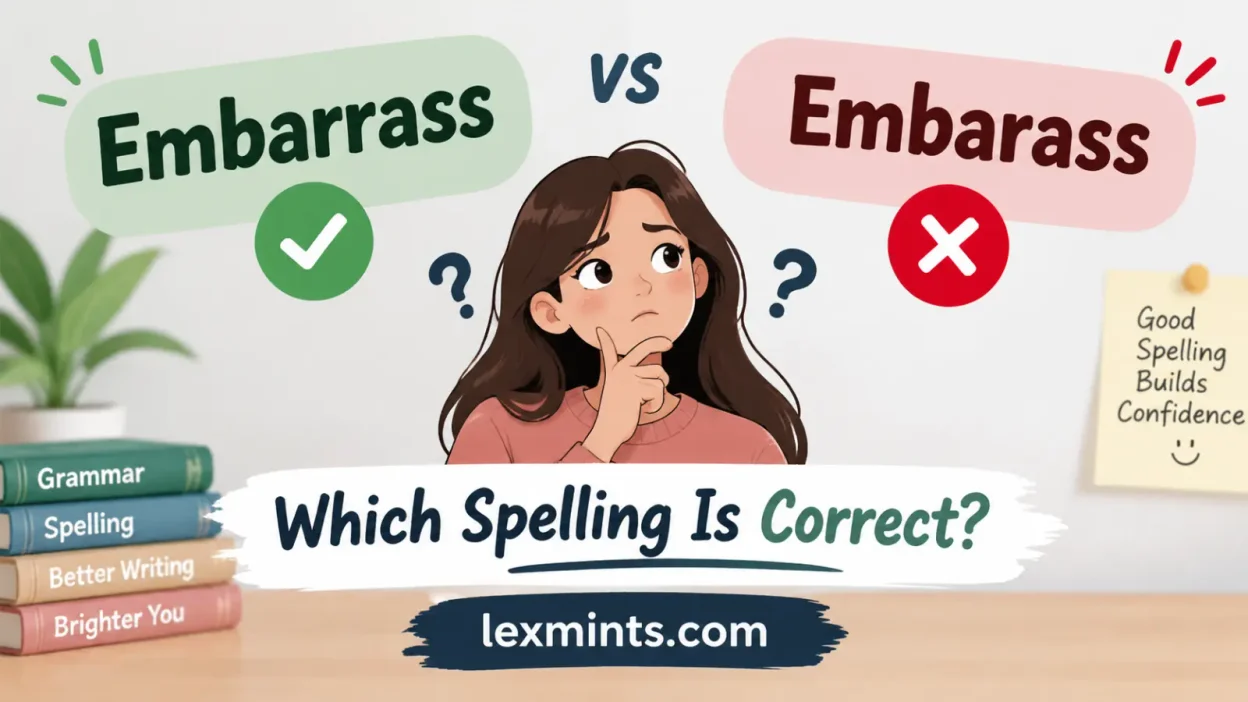
If you have ever hesitated between “embarrass” and “embarass,” you are not alone. These two spellings look almost identical, but only one is correct in standard English.
The correct spelling is embarrass, with two r’s and two s’s.
Embarass is a common misspelling and should be avoided in formal writing, school assignments, professional communication, and published content.
Understanding why this mistake happens can make the correct spelling much easier to remember. In this guide, we will explain the difference between embarrass vs embarass, define the word, show how to use it correctly, explore related forms, and provide practical examples that make the spelling easier to remember.
Embarrass vs Embarass: The Quick Answer
The correct spelling is embarrass.
The incorrect spelling is embarass.
Here is the basic comparison:
| Spelling | Correct? | Explanation |
|---|---|---|
| Embarrass | ✅ Yes | Standard English spelling |
| Embarass | ❌ No | Common misspelling |
The word embarrass means to make someone feel uncomfortable, self-conscious, awkward, or ashamed, especially because of an unexpected or socially uncomfortable situation.
For example:
- I did not mean to embarrass you.
- His mistake could embarrass the entire team.
- Try not to embarrass her in front of her friends.
The key spelling detail is easy to miss:
em + barr + ass = embarrass
There are two r’s and two s’s.
What Does “Embarrass” Mean?
Embarrass is a verb. It describes the act of causing someone to feel uncomfortable, awkward, self-conscious, or ashamed.
The word can describe something relatively minor, such as forgetting someone’s name, or something more serious that causes significant social discomfort.
For example:
- I accidentally called my teacher by the wrong name and felt embarrassed.
- She did not want to embarrass her friend.
- The unexpected question embarrassed him.
The meaning can depend on the situation. Sometimes embarrassment is temporary and harmless. In other situations, it can be more intense.
The important point is that embarrass describes an action: someone or something causes another person to experience embarrassment.
Embarrass in a Simple Sentence
Consider this example:
Don’t embarrass your brother in front of his classmates.
Here, embarrass means to make the brother feel uncomfortable or self-conscious.
Another example is:
I didn’t want to embarrass you.
In this sentence, the speaker is saying that they did not intend to make the other person feel awkward or ashamed.
Why Is “Embarass” Incorrect?
Embarass is incorrect because it leaves out one of the two r’s required in the standard spelling.
The correct form is:
embarrass
The incorrect form is:
embarass
Compare them carefully:
- embarrass
- embarass
The difference is the second r.
This is a particularly common spelling error because English pronunciation does not always make every letter obvious. When people hear or say the word, they may not naturally think about how many consonants appear in the written form.
Another reason is that English contains many words with doubled consonants, and the patterns can be difficult to memorize.
For example:
- embarrass
- embarrassed
- embarrassing
- embarrassment
Once you learn the base spelling embarrass, the related forms become much easier to recognize.
Why Do People Confuse “Embarrass” and “Embarass”?
The confusion mainly comes from the unusual combination of repeated letters.
The word contains:
- two r’s
- two s’s
That gives the middle and ending of the word a visually crowded appearance:
embarrass
When typing quickly, people often omit one of the repeated letters. This can produce:
embarass
The incorrect version may look natural because it still resembles the correct word closely.
Pronunciation also contributes to the confusion. In ordinary speech, you do not hear the individual letters. You hear the sound of the complete word. Therefore, spelling the word correctly requires remembering its written pattern rather than simply spelling it based on pronunciation.
A useful strategy is to avoid thinking of the word as one long sequence of letters. Instead, divide it into parts:
em + barr + ass
This helps you remember both sets of doubled consonants.
How to Spell “Embarrass” Correctly
A simple way to remember the spelling is:
Embarrass has two R’s and two S’s.
Think:
RR + SS
So the spelling is:
E M B A R R A S S
You can also remember the word by focusing on the ending:
-rrass
Not:
-rass
For example:
- embarrass ✅
- embarass ❌
The same pattern appears in related words:
- embarrassed
- embarrassing
- embarrassment
Learning the entire word family can reinforce the correct spelling.
A Simple Memory Trick
Try this:
“Embarrass is so awkward that it needs two R’s and two S’s.”
The phrase is intentionally memorable. Whenever you write the word, quickly check:
RR? SS?
If both pairs are present, you probably have the correct spelling.
Embarrass vs Embarrassed vs Embarrassing
One reason people may become confused about embarrass is that several related forms look similar.
Embarrass
Embarrass is the base verb.
Example:
I don’t want to embarrass him.
Embarrassed
Embarrassed is the past tense and past participle.
Example:
She was embarrassed by the mistake.
Notice that the spelling still begins with:
embarr-
Embarrassing
Embarrassing is the present participle or adjective form.
Example:
That was an embarrassing moment.
Again, the double r remains.
Embarrassment
Embarrassment is the noun.
Example:
He tried to hide his embarrassment.
It also retains the double r.
Learning these forms together is useful because the same spelling pattern appears throughout the word family.
Embarrass: Examples in Everyday English
The best way to understand the word is to see it in natural sentences.
Here are several examples:
- I didn’t mean to embarrass you.
- Please don’t embarrass me in front of everyone.
- His mistake embarrassed the whole group.
- She tried not to embarrass her younger brother.
- The teacher did not want to embarrass the student.
- That question could embarrass him.
- I hope I didn’t embarrass myself during the presentation.
- He sometimes embarrasses his friends with his jokes.
- The unexpected announcement embarrassed her.
- Parents sometimes embarrass their children without realizing it.
In every example, the correct spelling is embarrass or one of its correctly formed variations.
Embarrass in Formal and Professional Writing
The word embarrass is perfectly acceptable in formal English.
However, whether you should use it depends on the context.
For example:
The error could embarrass the company.
This is grammatically correct.
Another example:
The report revealed information that could embarrass several officials.
Again, embarrass is correctly used as a verb.
Because embarass is a misspelling, using it in professional writing can make the writer appear careless. This is especially important in:
- Business emails
- Reports
- Resumes
- Cover letters
- Academic papers
- School assignments
- Articles
- Websites
- Official documents
Whenever you need the verb, use embarrass.
Common Sentences With “Embarrass”
Here are some natural sentence patterns you can use.
“Embarrass someone”
This structure means to cause another person to feel uncomfortable or self-conscious.
I didn’t intend to embarrass my colleague.
“Embarrass yourself”
This means to cause yourself to feel awkward or ashamed.
I was worried that I would embarrass myself during the speech.
“Embarrass someone in front of…”
This identifies the social setting in which the embarrassment happens.
He did not want to embarrass her in front of her friends.
“Embarrass someone by…”
This explains what caused the embarrassment.
She embarrassed him by mentioning his mistake.
These sentence patterns are common in everyday American English.
Is “Embarass” Ever Correct?
No. Embarass is not the standard English spelling of the word.
If you mean the verb that means “to make someone feel uncomfortable or self-conscious,” the correct spelling is always:
embarrass
Therefore:
- embarrass ✅
- embarass ❌
If you see embarass in a text, it is generally a spelling error rather than an alternative spelling.
Embarrass vs Embarrassing: Don’t Drop the Second R
A frequent related mistake is dropping the second r when adding -ing.
The correct spelling is:
embarrassing
Not:
embarassing
Compare:
- embarrassing ✅
- embarassing ❌
The base word already contains two r’s:
embarrass
When you add -ing, you do not remove one of them:
embarrass + ing = embarrassing
The same principle applies to:
embarrassed
and
embarrassment
The double r remains part of the word family.
Embarrass vs Shame: Are They the Same?
Embarrass and shame can be related, but they are not always identical.
Embarrass generally refers to causing someone to feel awkward, uncomfortable, or self-conscious.
Shame can describe a deeper or more serious feeling of guilt, dishonor, or humiliation.
For example:
I embarrassed myself by forgetting his name.
This usually describes an awkward social moment.
By contrast:
He felt ashamed of his behavior.
This suggests a stronger feeling of guilt or moral discomfort.
Depending on the situation, embarrassment can be temporary and relatively mild, while shame may involve deeper emotional judgment.
How “Embarrass” Is Used in American English
In American English, embarrass is a common everyday verb.
You might hear it in conversations such as:
You’re going to embarrass me!
or:
I don’t want to embarrass her.
It also appears frequently in writing:
The mistake embarrassed the organization.
The spelling is the same in American and British English:
embarrass
There is no standard American spelling embarass.
Therefore, if you are writing for a US audience, embarrass is the form you should use.
Common Misspellings of Embarrass
Because the word contains repeated letters, several misspellings can occur.
Common errors include:
- embarass ❌
- embarress ❌
- embarras ❌
- embarres ❌
- embara ss ❌
The correct form is:
embarrass ✅
The most common mistake in the comparison discussed in this article is embarass, which contains only one r.
When proofreading, look specifically for the sequence:
rr
and the ending:
ss
Quick Comparison: Embarrass vs Embarass
Here is the difference at a glance:
| Feature | Embarrass | Embarass |
|---|---|---|
| Spelling | embarrass | embarass |
| Correct? | ✅ Yes | ❌ No |
| Part of speech | Verb | — |
| Meaning | To make someone feel awkward or self-conscious | — |
| Double R | Yes | No |
| Double S | Yes | Yes |
| Standard US English | Yes | No |
The most important fact is simple:
Embarrass is correct; embarass is incorrect.
Easy Ways to Remember the Correct Spelling
If you frequently misspell embarrass, try one of these memory techniques.
Remember “RR + SS”
The fastest method is:
Embarrass = RR + SS
There are two repeated consonants:
RR
and
SS
Break the Word Into Parts
Think:
em + barr + ass
This makes the double letters easier to remember.
Learn the Word Family
Memorize these together:
- embarrass
- embarrassed
- embarrassing
- embarrassment
They all preserve the important embarr- pattern.
Proofread Repeated Letters
When checking your writing, pay special attention to words containing repeated letters. They are easy to mistype.
If you write embarass, stop and ask:
“Where is the second R?”
That quick check can prevent the mistake.
Final Answer: Embarrass or Embarass?
The correct spelling is embarrass.
Embarass is a misspelling and should not be used in standard English.
Remember that embarrass contains two R’s and two S’s:
E-M-B-A-R-R-A-S-S
The word is a verb meaning to make someone feel awkward, uncomfortable, self-conscious, or ashamed.
For example:
I didn’t mean to embarrass you.
Related forms include embarrassed, embarrassing, and embarrassment, all of which retain the double r.
If you are unsure which spelling to use, choose embarrass every time. It is the standard spelling in American English and is appropriate for both everyday and formal writing.
FAQs
Is “embarrass” or “embarass” correct?
Embarrass is correct. Embarass is a common misspelling. The correct word contains two r’s and two s’s.
Why is “embarass” wrong?
“Embarass” is wrong because the standard spelling of the verb embarrass contains two r’s. The correct spelling is embarrass.
How do you spell embarrass correctly?
Spell it:
E-M-B-A-R-R-A-S-S
A useful memory trick is “two R’s and two S’s.”
What does embarrass mean?
Embarrass means to make someone feel awkward, uncomfortable, self-conscious, or ashamed, particularly because of a socially uncomfortable situation.
Is “embarrassing” spelled with two R’s?
Yes. The correct spelling is embarrassing, with two r’s. For example: “That was an embarrassing mistake.”
What is the past tense of embarrass?
The past tense is embarrassed.
Example:
I embarrassed myself during the presentation.
Is “embarrass” the same in American and British English?
Yes. Embarrass is the standard spelling in both American and British English. Embarass is not the standard spelling in either variety.
Conclusion
When choosing between embarrass vs embarass, there is a clear winner: embarrass.
The correct spelling has two r’s and two s’s. The form embarass is simply a misspelling.
Remember the pattern:
embarrass = RR + SS
Once you learn this spelling pattern, it becomes much easier to write embarrass, embarrassed, embarrassing, and embarrassment correctly.
So, the next time you are unsure, don’t choose embarass. Choose embarrass—the correct spelling every time.


